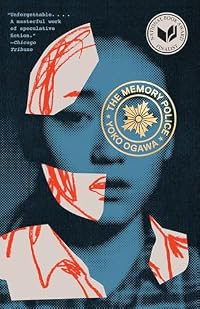
The Memory Police
by Yoko Ogawa
On This Page
Description
"On an unnamed island off an unnamed coast, things are disappearing. First, animals and flowers. Then objects--ribbons, bells, photographs. Then, body parts. Most of the island's inhabitants fail to notice these changes, while those few imbued with the power to recall the lost objects live in fear of the mysterious 'memory police,' who are committed to ensuring that the disappeared remain forgotten. When a young novelist realizes that more than her career is in danger, she hides her editor show more beneath her floorboards, and together, as fear and loss close in around them, they cling to literature as the last way of preserving the past"-- show lessTags
Recommendations




















Member Recommendations
EerierIdyllMeme Novels about writers recombining aspects of their experiences into their writing.
Member Reviews
The Short of It:
Ethereal and beautiful, tinged with sadness.
The Rest of It:
On a remote island, random objects begin to disappear. Birds, roses, ribbons, etc. The inhabitants wake to a feeling of change yet can’t put their finger on what has changed until they interact with others on the island. The strange thing is that the feeling that the disappearance causes precedes the actual disappearance which is followed through to completion by the inhabitants themselves. So when roses disappear, the inhabitants gather up all the roses to destroy them and send them down a river.
The disappearances are enforced by the Memory Police. How they know when someone is holding out is not explained but if someone tries to preserve something that has show more disappeared, they are taken away. Eventually, when all traces are removed, most of the inhabitants can no longer recall the item at all. All memory of the item has disappeared as well. But there are some who never forget. The memories of these items remain in them, and for some, they’ve even been able to preserve the actual item, such as a piece of candy. As living becomes more difficult and the situation more dire, you can’t help but compare what is going on with Orwell’s 1984.
The three main characters are for the most part, unnamed. Our protagonist, a young woman, lost both her parents and lives a solitary life. She is a writer and befriended by her editor, only known as “R” and a kind old man who knew her mother. The three navigate these disappearances as best they can but “R” happens to be one of the people who can remember and so he must go into hiding with their help. What will disappear next?
This story is beautifully written. I found myself rereading many passages as I went along. The author’s skill at evoking a particular memory is especially wonderful. I found myself mourning all the things we have lost during this pandemic. The smell of a wonderful meal, served to me in a bustling restaurant filled with laughter and happy people. Or I found myself missing movie theatres and that anticipation you feel when the previews roll or the smell of hot buttered popcorn while sitting back to enjoy a really good film. The story made me feel all kinds of things. Yes, it made me a little sad but also hopeful because I am fairly certain that the tangible things we’ve lost during this pandemic are only temporary losses, not like the ones in the story.
The author’s inspiration was Anne Frank’s The Diary of a Young Girl. This makes sense when you consider the hiding that must take place to keep these people safe. The Memory Police is a wonderful read. I have found a new favorite author in Ogawa and can’t wait to read another book by her.
For more reviews, visit my blog: Book Chatter. show less
Ethereal and beautiful, tinged with sadness.
The Rest of It:
On a remote island, random objects begin to disappear. Birds, roses, ribbons, etc. The inhabitants wake to a feeling of change yet can’t put their finger on what has changed until they interact with others on the island. The strange thing is that the feeling that the disappearance causes precedes the actual disappearance which is followed through to completion by the inhabitants themselves. So when roses disappear, the inhabitants gather up all the roses to destroy them and send them down a river.
The disappearances are enforced by the Memory Police. How they know when someone is holding out is not explained but if someone tries to preserve something that has show more disappeared, they are taken away. Eventually, when all traces are removed, most of the inhabitants can no longer recall the item at all. All memory of the item has disappeared as well. But there are some who never forget. The memories of these items remain in them, and for some, they’ve even been able to preserve the actual item, such as a piece of candy. As living becomes more difficult and the situation more dire, you can’t help but compare what is going on with Orwell’s 1984.
The three main characters are for the most part, unnamed. Our protagonist, a young woman, lost both her parents and lives a solitary life. She is a writer and befriended by her editor, only known as “R” and a kind old man who knew her mother. The three navigate these disappearances as best they can but “R” happens to be one of the people who can remember and so he must go into hiding with their help. What will disappear next?
This story is beautifully written. I found myself rereading many passages as I went along. The author’s skill at evoking a particular memory is especially wonderful. I found myself mourning all the things we have lost during this pandemic. The smell of a wonderful meal, served to me in a bustling restaurant filled with laughter and happy people. Or I found myself missing movie theatres and that anticipation you feel when the previews roll or the smell of hot buttered popcorn while sitting back to enjoy a really good film. The story made me feel all kinds of things. Yes, it made me a little sad but also hopeful because I am fairly certain that the tangible things we’ve lost during this pandemic are only temporary losses, not like the ones in the story.
The author’s inspiration was Anne Frank’s The Diary of a Young Girl. This makes sense when you consider the hiding that must take place to keep these people safe. The Memory Police is a wonderful read. I have found a new favorite author in Ogawa and can’t wait to read another book by her.
For more reviews, visit my blog: Book Chatter. show less
The Memory Police is often described—on its own back cover, no less—as “Orwellian” or comparable to Fahrenheit 451. That framing is misleading. This is not a novel about censorship imposed from above, nor about books being burned by an authoritarian state. It is quieter, more unsettling, and far more contemporary.
The novel takes place on a small Japanese island where things begin to disappear. Importantly, these things do not vanish physically at first. Instead, the inhabitants forget what an object is, what it is for, and why it mattered. Once forgotten, the objects are discarded, destroyed, or neglected until they truly are gone. The process begins with trivial items—hair ribbons, birds—but gradually extends to show more necessities.
What Ogawa seems to be examining is not coercion, but acquiescence. No one forces the islanders to forget. There is no dramatic rebellion to suppress. Instead, people adapt. Each loss feels manageable. Each adjustment feels reasonable. Over time, questioning stops—not because the characters are foolish or complicit, but because adaptation becomes the only remaining survival skill.
Read this way, the novel functions as a warning about small erosions society accepts in the name of convenience or efficiency—losses we tell ourselves are harmless because we didn’t choose them and because life continues afterward. Ogawa asks what happens when that logic is repeated too many times, and what disappears along with the objects themselves: redundancy, stability, shared reference points, and eventually selfhood.
The novel becomes increasingly surreal in its final third, but this is not a stylistic indulgence. The narrator is herself a novelist, and embedded within the book is her final work: a story about a woman who loses her voice. This internal novel mirrors and clarifies the main narrative, offering a key to understanding the ending. The metafictional structure makes clear that this is not about spectacle, but about coherence breaking down when meaning is no longer collectively sustained.
This is not a comforting book, nor a rousing dystopia. It is slow, methodical, and devastating in its logic. The Memory Police suggests that societies do not collapse because of a single tyrannical act, but because too many small losses are tolerated without resistance—until there is nothing left to resist with. show less
The novel takes place on a small Japanese island where things begin to disappear. Importantly, these things do not vanish physically at first. Instead, the inhabitants forget what an object is, what it is for, and why it mattered. Once forgotten, the objects are discarded, destroyed, or neglected until they truly are gone. The process begins with trivial items—hair ribbons, birds—but gradually extends to show more necessities.
What Ogawa seems to be examining is not coercion, but acquiescence. No one forces the islanders to forget. There is no dramatic rebellion to suppress. Instead, people adapt. Each loss feels manageable. Each adjustment feels reasonable. Over time, questioning stops—not because the characters are foolish or complicit, but because adaptation becomes the only remaining survival skill.
Read this way, the novel functions as a warning about small erosions society accepts in the name of convenience or efficiency—losses we tell ourselves are harmless because we didn’t choose them and because life continues afterward. Ogawa asks what happens when that logic is repeated too many times, and what disappears along with the objects themselves: redundancy, stability, shared reference points, and eventually selfhood.
The novel becomes increasingly surreal in its final third, but this is not a stylistic indulgence. The narrator is herself a novelist, and embedded within the book is her final work: a story about a woman who loses her voice. This internal novel mirrors and clarifies the main narrative, offering a key to understanding the ending. The metafictional structure makes clear that this is not about spectacle, but about coherence breaking down when meaning is no longer collectively sustained.
This is not a comforting book, nor a rousing dystopia. It is slow, methodical, and devastating in its logic. The Memory Police suggests that societies do not collapse because of a single tyrannical act, but because too many small losses are tolerated without resistance—until there is nothing left to resist with. show less
The Memory Police in concept is an interesting but straight forward concept: a mysterious island were objects and concepts disappear - flowers, boats, photos, calendars, days, etc - the things that disappear don't just physically disappear but are erased from peoples memories, complete with an obsessive and secretive police force that ensures that things are eternally forgotten. It's the perfect setup for the typical contrarian hero determined to fight off the tyrannical police and free the people of the island from their own oppression. Instead, it's a quiet drama of writer as she navigates an increasingly stifling world where goods are scarce and police disappear those that can't forget. The only real drama comes from her radical show more choice to hide her editor who remembers all the things that have disappeared. But really this is a vehicle explore her surreal detachment to the things that disappear. The story is paralleled by a novel within the novel she is writer was a typist slowly loses her voice. The world fades and people leave yet everything must go on as before. All there is what is left and no matter how one struggles against the loss there will always be more disappearances. She must find a new path to navigate an undefinable loss to carry on.
The Memory Police is not some epic fight against the surveillance state or self-exploration as the world around us slowly fades and what that means in some grander scheme. There's not much plot to speak of, no character development, she is just an observer of an increasingly bleak and fading world. There are no satisfying answers to the bigger questions asked in this novel; What are we without our memories? Who knows. Things just fade away and people endure. Eventually, there is nothing left to forget and the world moves on. The memory Police is an odd novel to define, it doesn't come to some satisfying conclusion, it isn't an exploration of some grand theme, it isn't a thrilling fight against an oppressor or extensional threat, it is beautifully written. I'm not entirely sure what it is, but I enjoyed it immensely. show less
The Memory Police is not some epic fight against the surveillance state or self-exploration as the world around us slowly fades and what that means in some grander scheme. There's not much plot to speak of, no character development, she is just an observer of an increasingly bleak and fading world. There are no satisfying answers to the bigger questions asked in this novel; What are we without our memories? Who knows. Things just fade away and people endure. Eventually, there is nothing left to forget and the world moves on. The memory Police is an odd novel to define, it doesn't come to some satisfying conclusion, it isn't an exploration of some grand theme, it isn't a thrilling fight against an oppressor or extensional threat, it is beautifully written. I'm not entirely sure what it is, but I enjoyed it immensely. show less
On an unnamed island things keep disappearing. But they do not just disappear - the memories for them also disappear as if the things never existed. And this had been going for a very long time. Some people are immune to the forgetting - but even they cannot change anything because they are either forced into hiding or are disappeared by the Memory Police. Some objects had been gone for so long that the narrator had just heard of them (her mother was one of the people who never forgot) - things like bells and perfume; some disappear while the story we are reading is going on - like roses and birds... and novels.
That's the main premise of Ogawa's book and it did sound fascinating enough for me to try the book. We never get the names of show more the main characters - two of them remain unnamed and one had just an initial (we do get the names of other characters here and there) and that is also part of the story's play on memories and remembrance.
The main character is a novel writer - who lives on her own after the death of her parents. And the last story (novel technically I guess) that she writes becomes part of the story -- and it is another story of loss... and memories. And it is the novel that makes the bulk of the story here - the novel itself and the story of her editor - who turns out to still have his memories and our heroine decides to hide him. And around them the world keep disappearing - the whole world seems to disappear - when the calendars disappear, the spring never comes...
By the end of the novel, the roles will get reversed - because if everything disappeared and was never there, what remains? We never learn that - the novel finishes with the end -- but also hints at a new beginning.
It is not the kind of novels I usually read - but it never bored me. Its sparse language and the gradual disappearance of the world somehow worked well enough to make me want to read more - and the more the world on the pages shrank, the more I was thinking about the things we always take for granted. And that was the whole point of the double narration after all - with the novel inside of the novel serving as another look at the same action - one of them caused, one of them appearing natural. And finding the contrasts in what is missing in the real world compared to the imaginary one made me wonder even more - the bells had already disappeared and yet they are there in the written novel...
It is a story about memories and about the creative process of writing... which may be more connected than one thinks. And it is one of the more imaginative dystopian worlds I had read about lately. show less
That's the main premise of Ogawa's book and it did sound fascinating enough for me to try the book. We never get the names of show more the main characters - two of them remain unnamed and one had just an initial (we do get the names of other characters here and there) and that is also part of the story's play on memories and remembrance.
The main character is a novel writer - who lives on her own after the death of her parents. And the last story (novel technically I guess) that she writes becomes part of the story -- and it is another story of loss... and memories. And it is the novel that makes the bulk of the story here - the novel itself and the story of her editor - who turns out to still have his memories and our heroine decides to hide him. And around them the world keep disappearing - the whole world seems to disappear - when the calendars disappear, the spring never comes...
By the end of the novel, the roles will get reversed - because if everything disappeared and was never there, what remains? We never learn that - the novel finishes with the end -- but also hints at a new beginning.
It is not the kind of novels I usually read - but it never bored me. Its sparse language and the gradual disappearance of the world somehow worked well enough to make me want to read more - and the more the world on the pages shrank, the more I was thinking about the things we always take for granted. And that was the whole point of the double narration after all - with the novel inside of the novel serving as another look at the same action - one of them caused, one of them appearing natural. And finding the contrasts in what is missing in the real world compared to the imaginary one made me wonder even more - the bells had already disappeared and yet they are there in the written novel...
It is a story about memories and about the creative process of writing... which may be more connected than one thinks. And it is one of the more imaginative dystopian worlds I had read about lately. show less
A quietly strange and tense little story about an island where things vanish from people's lives without explanation or anyone questioning the disappearance. The style of writing is smoothly descriptive and evocative yet somewhat detached at the same time. It's a perfect stylistic choice to deliver the strange story being told. We also get a meta-story via a novel our narrator is writing. Both tales deal with loss of self. Of being subsumed by others. And doing so willingly. How lack of self-esteem can lead to a kind of death. I am unlikely to re-read this but it did make me think about how it is possible for people to participate in their own victim-hood by failing to stand up and be counted. Either through fear or through apathy - or show more both. (7/10) show less
Boy this one is a doozy. It’s very out of the realm of what I usually read, but I’m staying with my sister for a bit and reading a lot of her and her boyfriends collection of books and I’m glad I read this one. It’s gonna stay in my brain for a long time. I can’t really say I enjoyed it, but also I did?? I never connected with the characters but you’re not really supposed to. You never know the narrators name, the old man is never referred to anything other than ‘the old man’ and her editor whom they hide to protect, is never known as anything other than ‘R’.
It’s an unsettling read, but all the ways it can be interpreted are interesting (and really relevant today). The way people just go along with things show more disappearing (being the ones to actually destroy things themselves!) once their memories of the thing disappears is a point that stuck with me. Def well worth a read. show less
It’s an unsettling read, but all the ways it can be interpreted are interesting (and really relevant today). The way people just go along with things show more disappearing (being the ones to actually destroy things themselves!) once their memories of the thing disappears is a point that stuck with me. Def well worth a read. show less
The Japanese seem to love metamorphosis. Their pop culture is full of people who swap genders, become robots, monsters, or even on-again-off-again pandas. It is Kafka on steroids.
Yoko Ogawa’s The Memory Police turns this fascination with fluidity and ephemerality into a dystopic tone poem. On a small island, one by one, things start to disappear and be forgotten. A special police force makes sure they stay gone and forgotten. Our narrator resists the trend by writing novels and hiding a man who can remember in a cellar room. But then—and if there were a plot, this would be a spoiler—she begins to forget parts of her body.
Every element of the story symbolizes something, be it aphasia, dementia, aging, autocracy, historical show more blindness, identity loss, or, oh well, take your pick. I have seen reviewers call it an allegory, but that suggests that the symbols all point in the same direction, and I am not sure that is the case. show less
Yoko Ogawa’s The Memory Police turns this fascination with fluidity and ephemerality into a dystopic tone poem. On a small island, one by one, things start to disappear and be forgotten. A special police force makes sure they stay gone and forgotten. Our narrator resists the trend by writing novels and hiding a man who can remember in a cellar room. But then—and if there were a plot, this would be a spoiler—she begins to forget parts of her body.
Every element of the story symbolizes something, be it aphasia, dementia, aging, autocracy, historical show more blindness, identity loss, or, oh well, take your pick. I have seen reviewers call it an allegory, but that suggests that the symbols all point in the same direction, and I am not sure that is the case. show less
Members
- Recently Added By
Lists

Best Dystopias
280 works; 276 members

Japanese Literature
230 works; 37 members

Favorite Science Fiction by Women Authors
737 works; 202 members

Top Five Books of 2020
982 works; 350 members

Recommend the 20 best books you've read in the last five years
2,168 works; 606 members

Pleasant Surprises: Books That Exceeded Our Expectations
418 works; 143 members

Top Five Books of 2019
387 works; 111 members

Best Japanese Fiction
41 works; 10 members

Books Read in 2020
4,379 works; 124 members

Books Read in 2023
5,547 works; 145 members

Dystopian and Apocalyptic Literature
350 works; 74 members

Must read
30 works; 2 members

Speculative Fiction from around the World
610 works; 17 members

Kirkus Starred Fiction Reviews of Books Published in 2019
411 works; 12 members

Books Read in 2025
4,090 works; 97 members

Favorite Books in Translation
320 works; 133 members

Widely acclaimed, one book per year
105 works; 3 members

Want to Read... Asian Authors
11 works; 1 member

Top Five Books of 2024
795 works; 264 members

Books Read in 2024
4,623 works; 126 members

Books Set on Islands
190 works; 24 members

Global Reads: Books Set in East Asia
139 works; 12 members

Magical Realism
23 works; 2 members
Author Information

59+ Works 11,396 Members
Some Editions
Awards and Honors
Awards
Distinctions
The Guardian Book of the Day (2019-08-20)
Series
Belongs to Publisher Series
Common Knowledge
- Canonical title
- The Memory Police
- Original title
- Hisoyaka na kesshō; 密やかな結晶
- Original publication date
- 1994 (original Japanese) (original Japanese); 2019 (English: Snyder) (English: Snyder)
- Important places
- Japan
- First words
- I sometimes wonder what was disappeared first—among all the things that have vanished from the island.
- Last words
- (Click to show. Warning: May contain spoilers.)Closed in the hidden room, I continued to disappear.
- Blurbers
- Mantel, Hilary; Oe, Kenzaburo
- Original language
- Japanese
- Canonical DDC/MDS
- 895.635
- Canonical LCC
- PL858.G37
Classifications
- Genres
- Fiction and Literature, Science Fiction, General Fiction
- DDC/MDS
- 895.635 — Literature & rhetoric Literatures of other languages Literatures of East and Southeast Asia Japanese Japanese fiction 1945–2000
- LCC
- PL858 .G37 — Language and Literature Languages and literatures of Eastern Asia, Africa, Oceania Languages of Eastern Asia, Africa, Oceania Japanese language and literature Japanese literature Individual authors and works
- BISAC
Statistics
- Members
- 3,678
- Popularity
- 4,383
- Reviews
- 133
- Rating
- (3.72)
- Languages
- 16 — Danish, Dutch, English, Finnish, French, German, Greek, Italian, Japanese, Korean, Polish, Portuguese, Slovenian, Spanish, Swedish, Turkish
- Media
- Paper, Audiobook, Ebook
- ISBNs
- 51
- ASINs
- 10