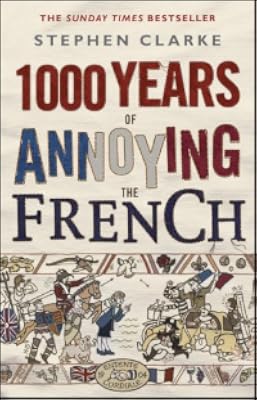
1000 Years of Annoying the French
by Stephen Clarke
On This Page
Description
Stephen Clarke's hilarious and enlightening history of the love-hate relationship between Britain and France Things have been just a little awkward between Britain and France ever since the Norman invasion in 1066. Over the subsequent thousand years of wars, treaties, and cultural rivalries, the strange relationship between these nations ranged from contentious to comic. From the Hundred Years' War and Joan of Arc, to the American Revolution and the Louisiana Purchase, to the ascendance of show more Napoleon Bonaparte and dawning of the Victorian era, Clarke examines with insight and humor the misfortunes and missteps that marked British and French-and sometimes American-relations through the centuries. Fast-paced and endlessly entertaining, 1,000 Years of Annoying the French is a riveting history of western Europe's oddest couple. show lessTags
Recommendations





















Member Recommendations


Member Reviews
This turned out far better than I expected from the (admittedly amusing) title. Indeed, this not being my period, I could only really find two errors (when talking about Mary, Queen of Scots' imprisonment at Tutbury in Staffordshire, Clarke refers to "nearby" Buxton when it's anything but; and he gets the origin of the Sudeten Germans wrong - but then again, so does nearly everyone else) and one glossing over (his account of the 1956 Suez crisis seems a bit sketchy over the American and Russian reactions, and just saying that he was concentrating on the Anglo-French story is no excuse because Clarke went off-piste for essential background earlier).
But these are minor quibbles; after all, no-one's going to use this as their primary show more source for serious historical research. Are they?
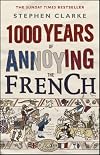
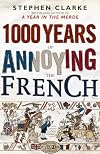
Nearly 700 pages slipped past very easily. It read like a cross between 'Game of Thrones' and 'Horrible Histories'. Ruth Murray's cover art is a delight. show less
But these are minor quibbles; after all, no-one's going to use this as their primary show more source for serious historical research. Are they?
Nearly 700 pages slipped past very easily. It read like a cross between 'Game of Thrones' and 'Horrible Histories'. Ruth Murray's cover art is a delight. show less
This is a very long book, nearly 700 pages, as might be expected from a book that covers a millenium's worth of Anglo-French relations in great detail. The author is British but has lived on both sides of the channel, and he lobs potshots in each direction. I learned a surprising number of things, such as:
1. Many things traditionally thought of as French, such as the guillotine, champagne and William of Normandy, were not French.
2. During World War II, the British hated their French allies almost as much as they hated their Soviet allies.
3. Voltaire was an enthusiastic Anglophile.
The chapters come with delightful sub-headings, such as "In India and Tahiti: France Gets Lost In Paradise: A selection of historical Frenchmen lose India, show more fail to notice Australia and give sexually transmitted diseases to Pacific islanders" and "How Britain Killed Off the Last French Royals: And the Victorians said, 'It was an accident, honest.' Three times."
If you're willing to wade through so many pages, this is a delightful read. I really enjoyed it. show less
1. Many things traditionally thought of as French, such as the guillotine, champagne and William of Normandy, were not French.
2. During World War II, the British hated their French allies almost as much as they hated their Soviet allies.
3. Voltaire was an enthusiastic Anglophile.
The chapters come with delightful sub-headings, such as "In India and Tahiti: France Gets Lost In Paradise: A selection of historical Frenchmen lose India, show more fail to notice Australia and give sexually transmitted diseases to Pacific islanders" and "How Britain Killed Off the Last French Royals: And the Victorians said, 'It was an accident, honest.' Three times."
If you're willing to wade through so many pages, this is a delightful read. I really enjoyed it. show less
When I started reading this I wasn't sure I could handle that many years, and pages, of history written with tongue planted firmly in cheek. I was wrong. Turns out it was the porridge that Goldilocks ate for telling this very long and very acrimonious relationship story.
From my travels around France and from having lived in Paris for 9 years, I've always been interested in the British vs. French rivalry, but I could never bring myself to read about it because everything seemed so boring. Until now! Even at nearly 700 pages I found this book fascinating and funny, and a great way to learn about this aspect of European history. Life's too short to read stuff you don't enjoy, so if you want a fun way to learn about the history between France and England (and impress all your friends at the next pub quiz), I highly recommend this book!
This book is a hoot. OK, so according to other reviewers, there are historical inaccuracies (my knowledge however is not as comprehensive) so to me it reads quite well.
This 'new, revised, updated and expanded edition' will need another serious revision, update and expansion now the Brexit furore has hit the history books and will certainly give even more annoyance to the French (and Germans)
Whilst reading (in batches - far too much to do all at once) the 'I didn't know THAT' syndrome crept up quite often. Many a good snippet to throw into the conversation amongst Francophones who generally speaking really are as arrogant as the French themselves.
This 'new, revised, updated and expanded edition' will need another serious revision, update and expansion now the Brexit furore has hit the history books and will certainly give even more annoyance to the French (and Germans)
Whilst reading (in batches - far too much to do all at once) the 'I didn't know THAT' syndrome crept up quite often. Many a good snippet to throw into the conversation amongst Francophones who generally speaking really are as arrogant as the French themselves.
This millennial look at the history of Britain and France is told with wry, sometimes childishly irritating, and rarely laugh-inducing humour. It’s pretty comprehensive, coming in at just under 650 pages, and it’s not all as good as the rest of it.
Beginning with William the Conqueror (not French) and ending with Nicolas Sarkozy (French), Clarke covers a fair bit of ground including food, battles, trade, battles, Canada, battles, wine, battles, Voltaire, battles, the French Revolution and battles. Oh, and there are about seven chapters dedicated to Napoleon.
You learn a lot about the impact of France on the world. In many cases, as the book has a clear anti-French bias (albeit tongue-in-cheek apparently) Clarke takes pains to point show more out where our common understanding of the influence of France on history is misplaced.
Although history is the opinion of whoever decides to interpret certain selected facts a certain way, it’s helpful to know that there are alternative ways to interpret facts so that the French don’t get the glory for many things they think they’re responsible for. As a Brit, that’s very satisfying.
Despite it being a whimsical ride for the most part, it did drag from time to time, and I was glad to get it over with. There are far too many dad jokes in here for me. He’s a writer, not a comedian.
I can see this being something of a good read on holiday or on the plane. Something to pick up and put down. It’s interesting enough. But Clarke is no Bryson, and I couldn’t help but wish our USAnian friend could have advised him. show less
Beginning with William the Conqueror (not French) and ending with Nicolas Sarkozy (French), Clarke covers a fair bit of ground including food, battles, trade, battles, Canada, battles, wine, battles, Voltaire, battles, the French Revolution and battles. Oh, and there are about seven chapters dedicated to Napoleon.
You learn a lot about the impact of France on the world. In many cases, as the book has a clear anti-French bias (albeit tongue-in-cheek apparently) Clarke takes pains to point show more out where our common understanding of the influence of France on history is misplaced.
Although history is the opinion of whoever decides to interpret certain selected facts a certain way, it’s helpful to know that there are alternative ways to interpret facts so that the French don’t get the glory for many things they think they’re responsible for. As a Brit, that’s very satisfying.
Despite it being a whimsical ride for the most part, it did drag from time to time, and I was glad to get it over with. There are far too many dad jokes in here for me. He’s a writer, not a comedian.
I can see this being something of a good read on holiday or on the plane. Something to pick up and put down. It’s interesting enough. But Clarke is no Bryson, and I couldn’t help but wish our USAnian friend could have advised him. show less
Someone wrote in his review that you don't need to be English or hate the French to enjoy this book, and he was certainly right. I enjoyed it, being Dutch, as I can always laugh with the rivalry between the French and the Brits. It is also a great history lesson which starts with a - quite necessary - explanation of what exactly happened in 1066. I had completely forgotten, as it is not my national history. Apologies. From that point on is shows histories about Canada and the to-be-USA, champagne, many a French-Anglo war, the French Revolution, Napoleon, and at last the Eurostar train between England and France. I think I learned quite a lot during this read, I found it interesting as well, as the writing style is mocking both the show more French as the Brits. show less
Members
- Recently Added By
Published Reviews
The French have always considered themselves to be nature's aristocrats, whilst their failures (such as Crecy, Agincourt, and their candidature for the 2012 Olympics) have been swept under the carpet by a race who 'still consider Napoleon's retreat from Moscow to be a strategic withdrawal, and the Nazi occupation of France as merely a waiting period until De Gaulle was ready to come back and show more seize victory.'
But in chronicling a millennium spent glowering at one another from across the Channel, Clarke also makes a spirited argument for English ownership of virtually every great French tradition.
Take Champagne, for instance. Far from being a French invention, bubbly only became possible once British bottle-making techniques provided a product that could withstand all that extra fizz without the contents exploding all over your dinner table. And with the onset of global warming, the best vintages will soon be grown on the Hackney Marshes, anyway.
Even the guillotine, ultimate symbol of liberty, equality and fraternity, can claim to be an English invention. An earlier version of this device for achieving rapid weight-loss was allegedly being used in a small market town in Yorkshire some years before the eponymous Parisian professor came up with his own design. show less
But in chronicling a millennium spent glowering at one another from across the Channel, Clarke also makes a spirited argument for English ownership of virtually every great French tradition.
Take Champagne, for instance. Far from being a French invention, bubbly only became possible once British bottle-making techniques provided a product that could withstand all that extra fizz without the contents exploding all over your dinner table. And with the onset of global warming, the best vintages will soon be grown on the Hackney Marshes, anyway.
Even the guillotine, ultimate symbol of liberty, equality and fraternity, can claim to be an English invention. An earlier version of this device for achieving rapid weight-loss was allegedly being used in a small market town in Yorkshire some years before the eponymous Parisian professor came up with his own design. show less
added by John_Vaughan
Lists

Amusing Book Titles
146 works; 39 members

Books Read in 2017
4,249 works; 130 members

Guilty Pleasures
223 works; 87 members
Author Information

17 Works 4,929 Members
Awards and Honors
Distinctions
Common Knowledge
- Canonical title
- 1000 Years of Annoying the French
- Original title
- 1000 years of annoying the French
- Original publication date
- 2010
- People/Characters
- William the Conqueror; Joan of Arc; Mary, Queen of Scots; Charles II, King of England, Scotland, and Ireland; Louis XIV, King of France (1638-1715); George Washington (show all 37); Arthur Wellesley, 1st Duke of Wellington; Horatio Nelson, 1st Viscount Nelson; Edward VII, King of the United Kingdom; Charles de Gaulle; William III, King of England; Voltaire (Francois-Marie Arouet, 1694-1778); Margaret Thatcher; Richard I, King of England; Philip VI, King of France; Philip II Augustus, King of France; Napoleon III; Napoleon Bonaparte (Emperor of the French); Catherine de Medici; Cardinal Jules Mazarin; John Churchill, 1st Duke of Marlborough; Louis Philippe I, King of France; Louis XVI, King of France; Thomas Arthur, Comte de Lally, Baron de Tollendal; René-Robert Cavelier, Sieur de La Salle; Henry V, King of England; Henry VIII, King of England; Victor Hugo; Harold II Godwinson; George III, King of the United Kingdom; Edward, the Black Prince (Prince of Wales and Aquitaine); Edward III, King of England; Anne Antoine, Comte d'Aché; Winston Churchill; Charles VII, King of France; Charles II, King of England, Scotland, and Ireland; Louis-Antoine de Bougainville (Comte de Bougainville, 1729-1811)
- Important places
- England, UK; France; Chennai, Tamil Nadu, India (as Madras); Pondicherry, Puducherry, India; Yalta, Crimea, Ukraine; Cape Trafalgar, Andalusia, Spain (show all 21); Toulon, Var, Provence-Alpes-Côte d'Azur, France; Québec, Québec, Canada; Annapolis Royal, Nova Scotia, Canada (Port Royal); Paris, Île-de-France, France; Normandy, France; New Orleans, Louisiana, USA; Hastings, East Sussex, England, UK; Fort Necessity, Farmington, Pennsylvania, USA; Fort Pitt, Point State Park, Pennsylvania, USA (Fort Duquesne); Egypt; Dunkirk, Nord, Hauts-de-France, France; Crécy-en-Ponthieu, Hauts-de-France, France; Calais, Pas-de-Calais, Hauts-de-France, France; Aboukir Bay, Alexandria, Egypt; Azincourt, Hauts-de-France, France (as Agincourt)
- Important events
- Battle of Aboukir Bay (1798); Battle of Agincourt (1415); Battle of Crécy (1346); Battle of Trafalgar (1805-10-21); Siege of Toulon (1793); Battle of Hastings (1066) (show all 7); Dunkirk Evacuation (1940-05-27 | 1940-06-04)
- Epigraph
- 'The English, by nature, always want to fight their neighbours for no reason, which is why they all die badly.' - From the Journal d'un Bourgeois de Paris, written during the Hundred Years War
'We have been, we are, a... (show all)nd I trust we always will be, detested by the French.' - The Duke of Wellington - Dedication
- To the Crimée Crew for their thousand years of patience, and especially to N., who helped me through every battle.
Merci to my editor Selina Walker for her sense of history in reminding me constantly of my deadline. ... (show all)
And to everyone at Susanna Lea's agency for their role in making this whole histoire possible. - First words
- The French are very proud of the fact that they were the last people to invade the British Isles.
- Last words
- (Click to show. Warning: May contain spoilers.)But then, after 1000 years of annoying the French, what did you expect?
- Original language*
- Anglais
*Some information comes from Common Knowledge in other languages. Click "Edit" for more information.
Classifications
- Genres
- History, General Nonfiction, Nonfiction
- DDC/MDS
- 327.41044 — Society, government, & culture Political science International Relations: Spies Europe British Isles with Europe
- LCC
- DA47.1 .C53715 — History of Europe, Asia, Africa and Oceania Great Britain History of Great Britain England History Political, military, naval, and Air Force history.
- BISAC
Statistics
- Members
- 732
- Popularity
- 38,812
- Reviews
- 20
- Rating
- (3.84)
- Languages
- English, French, German, Polish
- Media
- Paper, Ebook
- ISBNs
- 19
- ASINs
- 12