Revolutionaries: A New History of the Invention of America
by Jack Rakove
On This Page
Description
In this remarkable book, the historian Jack Rakove shows how the private lives of these men were suddenly transformed into public careers--how Washington became a strategist, Franklin a pioneering cultural diplomat, Madison a sophisticated constitutional thinker, and Hamilton a brilliant policymaker. Rakove shakes off accepted notions of these men as godlike visionaries, focusing instead on the evolution of their ideas and the crystallizing of their purpose. In Revolutionaries, we see the show more founders before they were fully formed leaders, as individuals whose lives were radically altered by the explosive events of the mid-1770s. --from publisher description show lessTags
Recommendations

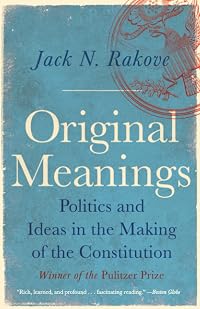


Member Recommendations
Member Reviews
I got a great deal out of "Revolutionaries," but at times, it was tough slogging. Jack Rakove is clearly a great US scholar and his passion shines through. But it is written in quite the academic manner, so the casual reader may be turned off by its dense prose. There were also several sections and chapters where Rakove takes off on tangents that took us away from the core characters of the revolution and its aftermath.
And his last three chapters focus individually on Madison, Jefferson, and Hamilton. I think this content would have been better served had it been more mixed into other chapters regarding the Constitutional Convention.
Still, I'm sure I will reference this book a good bit as I continue my study of the American Revolution show more and the creation of the Constitution. But I'll only focus on those passages I highlighted (and there were a lot of them), rather than be inclined to read it all again someday. show less
And his last three chapters focus individually on Madison, Jefferson, and Hamilton. I think this content would have been better served had it been more mixed into other chapters regarding the Constitutional Convention.
Still, I'm sure I will reference this book a good bit as I continue my study of the American Revolution show more and the creation of the Constitution. But I'll only focus on those passages I highlighted (and there were a lot of them), rather than be inclined to read it all again someday. show less
Subtitled "A New History of the Invention of America," this historical look at the American Revolution and the framing of the United States Constitution does take a different approach than the typical popular history of the era. Rakove tries to emphasize that founders of the United States were ordinary men who rose to the occasion to make the best of the opportunities that the revolution provided for nation-building. He also emphasizes that these founding fathers rarely agreed. The strength of this book is that if offers an intellectual history of the arguments that America's founders and the compromises that they needed to agree to. Rakove also deserves credit for including figures whose names rarely appear in popular history - such as show more George Mason, John Dickinson, Charles Carroll, John Jay, Henry and John Laurens, Richard Henry Lee and Robert Morris - alongside John Adams, George Washington, Thomas Jefferson, James Madison, Alexander Hamilton, and Benjamin Franklin. The book systematically discusses the origins of the revolution, the decision for independence, the course of the war campaign, diplomatic missions in Europe, United States governance under the Articles of Confederation, the framing of the Constitution, and the successful establishment of the new government. My main criticism of this book is that Rakove is often too generous in discussing the motivations of his subjects. For example, most historical works interpret George Washington wearing a military uniform to the Continental Congress as a deliberate part of a campaign to gain the command of the army, but Rakove makes it seem like happenstance. Regardless, this is a well-written and engaging history of the nation's founding and I recommend it to anyone interested in the time period.
Other little tidbits I liked:
Favorite Passages:
Other little tidbits I liked:
- John Adams liked Rembrandt's work, especially "The Prophetess Anna," the portrait of his mother with a bible that my son liked at the Rijksmuseum.
- In a letter written in 1784 to Samuel Mather, Benjamin Franklin expresses a desire to return to his childhood home of Boston and perhaps "lay my bones there."
Favorite Passages:
"We think of happiness as a personal mood or state of mind. In the eighteenth century its connotations were broader. . . Happiness was a condition that whole societies as well as individuals could enjoy. It implied a state of social contentment and not merely personal cheeriness and good humor. Happiness was one of those broad concepts that both private and public meanings, subject for philosophical inquiry rather than psychological babbling. For Jefferson the concept of happiness was something to ponder as well as pursue." - p. 300show less
"Traditionally, bills of rights were thought to operate as a restraint on government by providing people with a basis for knowing when their rulers were overstepping their power. But that function no longer fit the political life of the republic. 'Wherever the real power in a government lies, there is the danger of oppression," Madison observed. "In our Governments the real power lies in the majority of the community, and the invasion of private rights is cheifly to be apprehended, not from acts of Government contrary to the sense of its constituents, but from acts in which the Government is the mere instrument of the major number of the constituents.'" - p. 394
The book felt like a set of long footnotes to a fuller history of the United States revolution. It told ancillary tales of people or groups, each story told from a different slant, not the normal all-american celebratory narrative. In the book, Washington was a bit less leaden and God-ordained; the colonies' middle-of-the-roaders (neither wanting crown nor full separation) during 1775 were more important to the revolution; but Mr. Hamilton retained his own empire-building persona. Not a book to hunt for, but an ok addition if it falls in your hands.
This was a thorough account of how provincial colonists became revolutionaries. I highly recommend it
for all citizens of our country. My favorite part is the last chapter, which details the rise of political parties, due to the animosity between Jefferson and Hamilton. It is rich in detail and well- written.
Although written by a renowned historian, it is not just for history buffs! As a teacher of history, I plan to keep this book at hand in the classroom for easy reference.
And as good books usually do, it has inspired me to further exploration of our founding fathers' lives. I have added biographies of Jefferson, Hamilton, the Adamses to my "to read" shelf.
for all citizens of our country. My favorite part is the last chapter, which details the rise of political parties, due to the animosity between Jefferson and Hamilton. It is rich in detail and well- written.
Although written by a renowned historian, it is not just for history buffs! As a teacher of history, I plan to keep this book at hand in the classroom for easy reference.
And as good books usually do, it has inspired me to further exploration of our founding fathers' lives. I have added biographies of Jefferson, Hamilton, the Adamses to my "to read" shelf.
It's my own fault really. I should have read more reviews before buying this book in hardback. I was expecting something different. For some reason I was expecting a book that dealt of the intellectual roots of the American Revolution, I was a little disappointed. There was only a few references to Edmund Burke and even fewer to Montesquieu and only passing references to others. Instead the book gives a series of mini biographies of the Founding Fathers, organized chronologically.
In that sense it was, okay, but it did not live up to the claim of one review that it would fill the gap in the market for a one volume history of the American Revolution. The bias can be detected early on, e.g. p. 54., equal voting in the Continental Congress show more had more to do with lack of census data than any notion of equality between the states. O really? Three stars is generous. show less
In that sense it was, okay, but it did not live up to the claim of one review that it would fill the gap in the market for a one volume history of the American Revolution. The bias can be detected early on, e.g. p. 54., equal voting in the Continental Congress show more had more to do with lack of census data than any notion of equality between the states. O really? Three stars is generous. show less
Ratings
Members
- Recently Added By
Published Reviews
ThingScore 75
ARE HISTORICAL ACTORS great because they make history or are they made great by the circumstances in which they lived? Jack Rakove poses this question in his engaging account of the Founding Fathers of the United States. An eminent professor of history at Stanford University, Rakove focuses on the men who led the War of American Independence and established the nation’s political show more foundations. Not another smoothed-over version of the American national-origins story common in popular accounts, Revolutionaries: Inventing an American Nation presents a narrative that highlights the bumps along the road to the creation of the United States. show less
added by jcbrunner
Lists

Founding Father
104 works; 11 members

Best U.S. History Books (1754-1828)
363 works; 18 members
Author Information

Jack Rakove is the William Robertson Coe Professor of History and American Studies and a professor of political science at Stanford University. He is the author of, among other books, Original Meanings: Politics and Ideas in the Making of the Constitution, which won the Pulitzer Prize in 1997.
Some Editions
Awards and Honors
Awards
Common Knowledge
- Original publication date
- 2010
Classifications
Statistics
- Members
- 523
- Popularity
- 57,152
- Reviews
- 5
- Rating
- (3.80)
- Languages
- English
- Media
- Paper, Audiobook, Ebook
- ISBNs
- 12
- UPCs
- 1
- ASINs
- 5