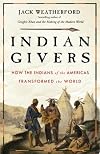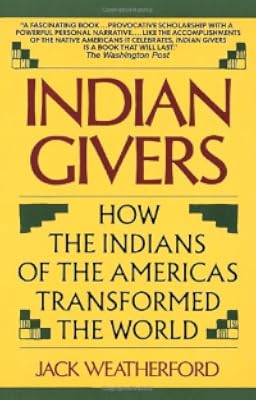
Indian Givers: How the Indians of the Americas Transformed the World
by Jack Weatherford
On This Page
Description
An utterly compelling story of how the cultural, social, and political practices of Native Americans transformed the way life is lived throughout the world, with a new introduction by the author“As entertaining as it is thoughtful . . . Few contemporary writers have Weatherford’s talent for making the deep sweep of history seem vital and immediate.”—The Washington Post
After 500 years, the world’s huge debt to the wisdom of the Native Americans has finally been explored in all show more its vivid drama by anthropologist Jack Weatherford. He traces the crucial contributions made by the Native Americans to our federal system of government, our democratic institutions, modern medicine, agriculture, architecture, and ecology, and in this astonishing, ground-breaking book takes a giant step toward recovering a true American history. show less
Tags
Recommendations






















Member Recommendations
Member Reviews
What a joy to read! I found unfamiliar stories on every page. Indian Givers, published in 1988, was written by scholar Jack Weatherford. While some of the information may be outdated and superseded by new research and discoveries, the premise of this book, that Native American people gave us an untold wealth of valuable ideas, products, food, and technologies, is still sound.
Weatherford begins the book with an Indian man living in the Bolivian Andes who spends almost every miserable day eking out a living in the nearly-spent tin mines there. From this granular image, the focus sweeps back to reveal how the European discovery of the metals available in the Americas changed the geopolitical structures of the entire globe.
The book explores show more far beyond the impact of material goods. It discusses how capitalism, corporations, the Industrial Revolution, population growth worldwide, democracy, architecture, and transportation were all directly the result of the contributions of the first Americans.
You would think the world sings their praises every day for all the gifts they’ve brought us, but no. We all know by now how these people, living successful, productive lives before the Europeans landed on their shores, were beaten, enslaved, and killed in massive numbers and apparently without a thought. So instead of receiving thanks, they had their lands confiscated, were confined to reservations, and were forced to adopt the European-American culture. And they’ve been marginalized elsewhere.
While this book is well worth a read for its stunning history, I found it most useful because it further increased my respect for these people who cultivated two continents before us. The book was so well-written that I flew through it, eager to turn each page to see what came next. I was planning to write Jack Weatherford a fan letter, but I see he has moved to Mongolia after writing a book about Genghis Khan. I hope he’s still writing. show less
Weatherford begins the book with an Indian man living in the Bolivian Andes who spends almost every miserable day eking out a living in the nearly-spent tin mines there. From this granular image, the focus sweeps back to reveal how the European discovery of the metals available in the Americas changed the geopolitical structures of the entire globe.
The book explores show more far beyond the impact of material goods. It discusses how capitalism, corporations, the Industrial Revolution, population growth worldwide, democracy, architecture, and transportation were all directly the result of the contributions of the first Americans.
You would think the world sings their praises every day for all the gifts they’ve brought us, but no. We all know by now how these people, living successful, productive lives before the Europeans landed on their shores, were beaten, enslaved, and killed in massive numbers and apparently without a thought. So instead of receiving thanks, they had their lands confiscated, were confined to reservations, and were forced to adopt the European-American culture. And they’ve been marginalized elsewhere.
While this book is well worth a read for its stunning history, I found it most useful because it further increased my respect for these people who cultivated two continents before us. The book was so well-written that I flew through it, eager to turn each page to see what came next. I was planning to write Jack Weatherford a fan letter, but I see he has moved to Mongolia after writing a book about Genghis Khan. I hope he’s still writing. show less
An amazing and powerful read. This covered this influence of Native Americans, or Indians as the author referred to them, on almost every aspect of modern life. Indians changed what the rest of the world ate and grew permanently. I knew that, of course. I had read elsewhere about how much of what modern people eat today came from the Americas. Imagine your daily diet without any tomatoes, potatoes, chocolate, chilis, corn, beans, and much, much more. Just corn and potatoes by themselves had revolutionized agriculture forever. The author cited a comparison of European agriculture based on before potatoes and after. Compared to the wheat that was the most common staple and potatoes, the wheat was inferior in the amount of work it took to show more grow it, its susceptibility to weather and predators, and most especially, to the amount of calories produced versus the amount taken to work the field. Potatoes gave over three times as much return. And then the population exploded, as Europeans finally had enough to eat and to trade.
And how about modern government. Think we got that from the Greeks and Romans? Think again. The US Constitution, which became the model for many other countries, was based not on the ancients but on the Iroquis. The whole idea of a balance of powers, of electing representatives, of governing by consensus, that all came from the Indians. The movies have this example of the Great Indian Chief, but in real life, most tribes were ruled by a council of elders, not by one guy who was in charge of everything.
So why did the Europeans manage to defeat the Native Americans? The main reason, the author felt, is not that the Indians were less advanced. It was just that they had chosen to focus on different things. Europeans used animal power, which the Indians couldn't use. The largest animal on the Americas was the llama, and it's not a beast you can plow with. The Europeans also invented machines and devices to make their work easier. But Indians had life pretty easy in some ways. Plenty of food, less trouble with fitting the environment. They had focused not on machinery or animal husbandry but on medicine, agriculture, transportation. Trouble was, none of these areas of expertise helped them stand up to an enemy that had them outmanned and outgunned.
My favorite example out of this book, the one that staggered my kids when I shared with them, is about the Incan highway system. The Incans built roads and bridges all up and down South America. In fact, some of those roads were transformed into the modern roads used there today. So when a village needed to send a message, they chose one of them who had trained for this purpose. He took the message, either in written or verbal form, and ran it up to the next stop - 250 miles away! That feat was not duplicated until the US came up with the Pony Express, but the Incans had managed to do with - without the pony. That dude from Marathon that delivered some message about a battle - what a wimp!
I really, really wish that I could read an updated edition of this one. In the last chapter, Weatherford talks about how native cultures are under attack, and with every death of an elder, society is losing that store of wisdom that may not be replaceable. Now that 25 years have passed, how much more have we lost? The secrets to curing more diseases with plants? The knowledge of food that will grow under adverse conditions - maybe even in space? The ability to calculate even more complicated mathematics, like the Aztecs had? We don't know. But I am glad that I read this book. It reminded me that the history of America did not start on Plymouth Rock or Jamestown or anywhere like that. America, under one name or another, has been here for thousands of years. 4.5 stars show less
And how about modern government. Think we got that from the Greeks and Romans? Think again. The US Constitution, which became the model for many other countries, was based not on the ancients but on the Iroquis. The whole idea of a balance of powers, of electing representatives, of governing by consensus, that all came from the Indians. The movies have this example of the Great Indian Chief, but in real life, most tribes were ruled by a council of elders, not by one guy who was in charge of everything.
So why did the Europeans manage to defeat the Native Americans? The main reason, the author felt, is not that the Indians were less advanced. It was just that they had chosen to focus on different things. Europeans used animal power, which the Indians couldn't use. The largest animal on the Americas was the llama, and it's not a beast you can plow with. The Europeans also invented machines and devices to make their work easier. But Indians had life pretty easy in some ways. Plenty of food, less trouble with fitting the environment. They had focused not on machinery or animal husbandry but on medicine, agriculture, transportation. Trouble was, none of these areas of expertise helped them stand up to an enemy that had them outmanned and outgunned.
My favorite example out of this book, the one that staggered my kids when I shared with them, is about the Incan highway system. The Incans built roads and bridges all up and down South America. In fact, some of those roads were transformed into the modern roads used there today. So when a village needed to send a message, they chose one of them who had trained for this purpose. He took the message, either in written or verbal form, and ran it up to the next stop - 250 miles away! That feat was not duplicated until the US came up with the Pony Express, but the Incans had managed to do with - without the pony. That dude from Marathon that delivered some message about a battle - what a wimp!
I really, really wish that I could read an updated edition of this one. In the last chapter, Weatherford talks about how native cultures are under attack, and with every death of an elder, society is losing that store of wisdom that may not be replaceable. Now that 25 years have passed, how much more have we lost? The secrets to curing more diseases with plants? The knowledge of food that will grow under adverse conditions - maybe even in space? The ability to calculate even more complicated mathematics, like the Aztecs had? We don't know. But I am glad that I read this book. It reminded me that the history of America did not start on Plymouth Rock or Jamestown or anywhere like that. America, under one name or another, has been here for thousands of years. 4.5 stars show less
How the gold and silver of Indians of North and South America transformed the world economy, and how their foods and medicine saved Europe from starvation, as well as their influence on fashion and religion is told in thought-provoking and accessible prose.
What would “Italian” cuisine be without the tomato? or Tex-Mex without the pepper? Where would modern transportation and machinery be without rubber for tires and hoses? These Weatherford reminds us, were agricultural and industrial technologies taken from the American Indians.
Europe had no model of a pure democracy or representative government, aside from the oligarchies of Greece or the parliaments of Europe constituted by a severely limited electorate of the elite. The notion show more that each individual was free without being subject of a lord or the slave of an owner was at first incomprehensible to the Europeans when they encountered Americans whose “chiefs” were temporary charismatic leaders without authority or power to enforce their will. The political idealism that inspired the Age of Reason was inspired by the natives of the new world. The political institutions of the Iroquois Confederacy influenced political philosophers as diverse as Benjamin Franklin and Karl Marx and political institutions as different as the United States Constitution and the twentieth-century revolutions in Mexico of Emiliano Zapata and Pancho Villa.
Where Do All Indians Live in Tipis? gives one or two page answers, Weatherford goes into chapter length detail about how undervalued the contributions that the natives of the Americas are to civilization. He details how the gold and silver of Indians of North and South America transformed the world economy, and how their foods and medicine saved Europe from starvation, as well as their influence on fashion and religion is told in thought-provoking and accessible prose. show less
What would “Italian” cuisine be without the tomato? or Tex-Mex without the pepper? Where would modern transportation and machinery be without rubber for tires and hoses? These Weatherford reminds us, were agricultural and industrial technologies taken from the American Indians.
Europe had no model of a pure democracy or representative government, aside from the oligarchies of Greece or the parliaments of Europe constituted by a severely limited electorate of the elite. The notion show more that each individual was free without being subject of a lord or the slave of an owner was at first incomprehensible to the Europeans when they encountered Americans whose “chiefs” were temporary charismatic leaders without authority or power to enforce their will. The political idealism that inspired the Age of Reason was inspired by the natives of the new world. The political institutions of the Iroquois Confederacy influenced political philosophers as diverse as Benjamin Franklin and Karl Marx and political institutions as different as the United States Constitution and the twentieth-century revolutions in Mexico of Emiliano Zapata and Pancho Villa.
Where Do All Indians Live in Tipis? gives one or two page answers, Weatherford goes into chapter length detail about how undervalued the contributions that the natives of the Americas are to civilization. He details how the gold and silver of Indians of North and South America transformed the world economy, and how their foods and medicine saved Europe from starvation, as well as their influence on fashion and religion is told in thought-provoking and accessible prose. show less
It's so easy to think of the world history through the European prism because that's what we were taught. This book explores the many ways in which the Americas ignited the industrial revolution and transformed the world. Bringing down the power of the African and Arab world and giving the means to Europe to expand and develop. Fascinating read
Indian Givers turned out to be an educational and at the same time very sobering read. Because while Jack Weatherford makes a very strong point as to why the subtitle of this book "How Native Americans Transformed The World" is totally appropriate. The sad fact is that for the most part, these contributions have gone totally unrecognized. The edition I read is a re issue of the book that originally came out in 1989. Hopefully this edition will go further in getting out the message of just how vital a role Native Americans played in transforming the world.
I am writing this review more than a decade since my initial reading of this book. I am still fascinated by the resourcefulness of the indigenous peoples, the Indians, of both North and South Americas; yet, as I have had time to digest the knowledge shared with Mr. Weatherford, my views have somewhat tempered toward the subject matter. In hindsight, this book should be viewed as incomplete. Placing the filter to Indian Givers that many use in reviewing any book about the Founding Fathers, Mr. Weatherford neglects to include negative aspects of the First American's society. In general, this book purports native nations could do nothing wrong, and that they were victims. I won't discount the scholarship Mr. Weatherford shares in this show more book, yet it merely focuses on the good. show less
Some interesting stuff here. I think Weatherford is reaching at some points and it is pretty obvious where his sentiments lie. History flipped upside down, this book is a counterweight to the western centric histories I grew up with.
Members
- Recently Added By
Lists

Books Read in 2021
5,361 works; 114 members
Author Information

Jack Weatherford holds the DeWitt Wallace Chair of Anthropology at Macalester College in Minnesota and an honorary position at Chinggis Khaan University in Mongolia. In 2007 he received the Order of the Polar Star, the highest award for service to the Mongol Nation of Genghis Khan.
Some Editions
Awards and Honors
Awards
Notable Lists
Common Knowledge
- Original publication date
- 1988
- Epigraph
- For Walker Pearce Maybank
- First words
- Each morning at five-thirty, Rodrigo Cespdes eats two rolls and drinks a cup of tea heavily laced with sugar before he slings his ratty Adidas gym bag over his shoulder and leaves for work.
- Last words
- (Click to show. Warning: May contain spoilers.)Columbus arrived in the New World in 1492, but America has yet to be discovered.
Classifications
- Genres
- Anthropology, History, Nonfiction, General Nonfiction
- DDC/MDS
- 970.00497 — History & geography History of North America History of North America North America Ethnic and National Groups Native Americans
- LCC
- E59 .I53 .W43 — History of the United States America Pre-Columbian America. The Indians
- BISAC
Statistics
- Members
- 971
- Popularity
- 27,241
- Reviews
- 10
- Rating
- (3.97)
- Languages
- English, French, German, Spanish
- Media
- Paper, Audiobook, Ebook
- ISBNs
- 12
- ASINs
- 12