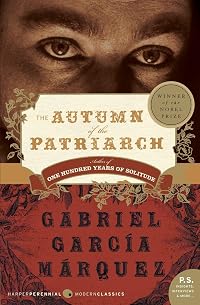
The Autumn of the Patriarch
by Gabriel García Márquez
On This Page
Description
One of Gabriel Garcia Marquez's most intricate and ambitious works, The Autumn of the Patriarch is a brilliant tale of a Caribbean tyrant and the corruption of power. Employing an innovative, dreamlike style, the novel is overflowing with symbolic descriptions as it vividly portrays the dying tyrant caught in the prison of his own dictatorship. From charity to deceit, benevolence to violence, fear of God to extreme cruelty, the dictator embodies at once the best and the worst of human nature.Tags
Recommendations







Member Recommendations
Member Reviews
En este libro García Marquez te toma de rehén. Con oraciones que pueden llegar a durar treinta páginas y son en sí mismas un compendio de anécdotas que podría contar un testigo lengualarga cualquiera consigue meter en cada una varios narradores, varios tiempos históricos, varias impresiones y producir tantas impresiones distintas en el lector con respecto al dictador que protagoniza este libro que su técnica por poco es abusiva.
No cualquiera puede construir un relato así. Y no cualquiera puede abusar de los adjetivos sin caer en la literatosis.
Un genio, y se acabó.
Libro no apto para leer en el colectivo, a menos que estés en un viaje de tres horas.
No cualquiera puede construir un relato así. Y no cualquiera puede abusar de los adjetivos sin caer en la literatosis.
Un genio, y se acabó.
Libro no apto para leer en el colectivo, a menos que estés en un viaje de tres horas.
García Márquez construyó, en El otoño del patriarca, una maquinaria narrativa perfecta que desgrana una historia universal -la agonía y muerte de un dictador- en forma cíclica, experimental y real al mismo tiempo, en seis bloques narrativos sin diálogos, sin puntos y aparte, repitiendo una anécdota siempre igual y siempre distinta, acumulando hechos y descripciones deslumbrantes.
Novela escrita en Barcelona entre 1968 y 1975, El otoño del patriarca deja asomar en su trasfondo el acontecimiento más importante de la historia española de aquellos años, la muerte del general Franco, aunque su contexto y estilo sean, como siempre con García Márquez, el de la asombrosa realidad latinoamericana, que el autor ha elevado una vez show more más a la dignidad del mito. show less
Novela escrita en Barcelona entre 1968 y 1975, El otoño del patriarca deja asomar en su trasfondo el acontecimiento más importante de la historia española de aquellos años, la muerte del general Franco, aunque su contexto y estilo sean, como siempre con García Márquez, el de la asombrosa realidad latinoamericana, que el autor ha elevado una vez show more más a la dignidad del mito. show less
This book captures the essence of what life is like in an unnamed Caribbean country living under a dictatorship. In this case it is a dictator that has been in power for over a hundred years and has died twice. It is not a book to read for plot. It is written in the author’s long paragraphs of flowing prose with many commas, few periods, and embedded conversations. It features magical realism, a stylistic choice commonly employed by García Márquez. The timeline switches regularly between the present when the dictator's body is found (which happens at the beginning), and the past when he was in power. He becomes increasingly isolated and detached from reality. It takes time to get used to the style, but after a while it becomes show more almost mesmerizing. It reads like a series of dream sequences where the reader gets to gist of the message through its rhythmic prose. Reading this book is not an easy task, but in the end, I found it worthwhile. There seems to be no end to dictators in our world, and the types of abuses of power, narcissism, and mendacity discussed in this book recur with unfortunate frequency. show less
I picked this up thanks to William Gass's otherwise terrible essay on magical realism; the essay reminded me that I'd never read any, unless you count very early Borges, or believe that everything ever written in Spanish is magical realism (a position Gass seems to flirt with). The reasons I haven't read any are fairly simple:
a) I do not care about a book's having a 'sense of place.'
b) I loathe 'lush prose.'
c) It's just so popular.
There are good reasons for me to like stereotypical magical realism, too, i.e., such books are very often concerned with political/social matters rather than domestic or 'moral' ones; thanks to that lushness, they're at least immune to american-style minimasnorringilsm. I heard a rumor somewhere that GGM's show more sentences occasionally have subclauses!
So A of the P it was, because it's shortish, and has a reputation for difficulty, so I figured there'd be less of that glorious Hispano-hablantes accessibility that I associate with endless exclamation marks and soul-bearing.
The most impressive thing about the book is, quite easily, the technique: the narrative voice is narcissistic*. In some very important sense, the story is narrated by the people who have managed to survive the horrors of the Patriarch whose story is being told. GMM pulls this off remarkably well; it makes the 'we' narrators of, say, Eugenides or Ferris look almost amateur. There's a real relationship between this narrator and the patriarch himself: they rely on each other, they love and hate each other, they suffer together.
On the downside, there's little else to the book. There are some great anecdotes, but that's the sum of the book's arrangement: each chapter has an anecdote or two told, at great length, in unnecessarily long sentences. This adds nothing to the book, and often detracts from it (granted, it might work better in Spanish. In English, it's just like reading high school papers by students who don't have time to punctuate). Finally, I do not care for lists in my fiction, and most of this book is a list.
But, as if I haven't equivocated enough, I'm also fascinated by the number of people giving this book such rave reviews on Goodreads, in languages I, ignorant as I might be, associate with actually existing tyranny. I wonder if this is a text that will continue to speak to men and women living under such conditions more than it can to someone like me? And if the texts that speak to me (to pluck a random example, Gaddis's 'JR') will seem similarly overblown, unnecessarily technical and slightly disappointing to those readers who love this book? I suspect so.
If anyone reading this has magical realism recommendations for me, please, let me know.
***
* in the technical sense of 'doesn't distinguish between objects and subjects in the world and itself.' show less
a) I do not care about a book's having a 'sense of place.'
b) I loathe 'lush prose.'
c) It's just so popular.
There are good reasons for me to like stereotypical magical realism, too, i.e., such books are very often concerned with political/social matters rather than domestic or 'moral' ones; thanks to that lushness, they're at least immune to american-style minimasnorringilsm. I heard a rumor somewhere that GGM's show more sentences occasionally have subclauses!
So A of the P it was, because it's shortish, and has a reputation for difficulty, so I figured there'd be less of that glorious Hispano-hablantes accessibility that I associate with endless exclamation marks and soul-bearing.
The most impressive thing about the book is, quite easily, the technique: the narrative voice is narcissistic*. In some very important sense, the story is narrated by the people who have managed to survive the horrors of the Patriarch whose story is being told. GMM pulls this off remarkably well; it makes the 'we' narrators of, say, Eugenides or Ferris look almost amateur. There's a real relationship between this narrator and the patriarch himself: they rely on each other, they love and hate each other, they suffer together.
On the downside, there's little else to the book. There are some great anecdotes, but that's the sum of the book's arrangement: each chapter has an anecdote or two told, at great length, in unnecessarily long sentences. This adds nothing to the book, and often detracts from it (granted, it might work better in Spanish. In English, it's just like reading high school papers by students who don't have time to punctuate). Finally, I do not care for lists in my fiction, and most of this book is a list.
But, as if I haven't equivocated enough, I'm also fascinated by the number of people giving this book such rave reviews on Goodreads, in languages I, ignorant as I might be, associate with actually existing tyranny. I wonder if this is a text that will continue to speak to men and women living under such conditions more than it can to someone like me? And if the texts that speak to me (to pluck a random example, Gaddis's 'JR') will seem similarly overblown, unnecessarily technical and slightly disappointing to those readers who love this book? I suspect so.
If anyone reading this has magical realism recommendations for me, please, let me know.
***
* in the technical sense of 'doesn't distinguish between objects and subjects in the world and itself.' show less
The repeated death, decline, and life of an unnamed Caribbean dictator, in that order, performed by a series of narrators speaking directly to the reader or quite often speaking directly to the general himself, apologizing, explaining, and occasionally cursing him just prior to their own decease. His palace is an unweeded garden gone to seed possessed by roaming cattle, hens, and vultures picking his bones in the opening scene. The surreal narrative cascades along in multiple page spanning sentences that give the impression of a spontaneous jazz improvisation. A composition in which decline and death are not the end of the piece, but only several of its reoccurring themes to be picked up and played with variations throughout the piece. show more
Other themes include his devotion to his mother Bendición Alvarado, a poor bird seller. His outrage when the church refuses to canonize her after her death results in his declaring her a saint, and then expelling the church from his realm. All priests, bishops, and members of religious orders are exiled, except one nun, Leticia Nazareno. He makes her his wife, a replacement for the stunning beauty Manuela Sánchez, who vanished during an eclipse of the sun. Needless to say, neither of them was a willing partner of the obsessive old goat. Periodically he slaughters the other generals and members of his staff, afraid that they may be plotting against him. Thus, he isolates himself from the rest of humanity and reality.
This “poem on the solitude of power,” as the author put it is, a brilliant performance. show less
Other themes include his devotion to his mother Bendición Alvarado, a poor bird seller. His outrage when the church refuses to canonize her after her death results in his declaring her a saint, and then expelling the church from his realm. All priests, bishops, and members of religious orders are exiled, except one nun, Leticia Nazareno. He makes her his wife, a replacement for the stunning beauty Manuela Sánchez, who vanished during an eclipse of the sun. Needless to say, neither of them was a willing partner of the obsessive old goat. Periodically he slaughters the other generals and members of his staff, afraid that they may be plotting against him. Thus, he isolates himself from the rest of humanity and reality.
This “poem on the solitude of power,” as the author put it is, a brilliant performance. show less
Ho dato solo 3 stelline a questo libro perché, sinceramente, l’ho trovato pesante e troppo difficile da seguire. E’ scritto quasi come un flusso di coscienza, tutto di seguito, senza respiro, con frasi lunghissime, a volte ci volevano diverse pagine per trovare un punto fermo, e in più frequentissimi cambi di io narrante, che all’inizio mi confondevano.
Eppure, capisco che la forza di questo romanzo sta anche in questo suo stile così asfissiante, infatti nonostante la fatica della lettura, ho potuto comunque vederne la bellezza e verso la fine mi sono anche un po’ lasciata conquistare dalla scrittura di Màrquez.
Il “patriarca” nel suo autunno arriva a fare quasi pena, sembra solo una marionetta sfruttata da invisibili show more burattinai, un povero vecchio malato e logorato, a cui resta solo l’ostinazione di non voler vendere il mare, e quasi si dimenticano tutte le atrocità di cui si è macchiato, forse perché neanche lui le ha mai accettate, come quando impartiva ordini atroci senza batter ciglio, per poi far giustiziare chi li aveva eseguiti, perché ci sono ordini che si possono dare ma non si possono eseguire, cazzo. Com’è scritto in quarta di copertina, Màrquez ci mostra il vero, mostruoso e umanissimo volto del potere.
Nonostante la difficoltà di lettura, questo libro è affascinante come pochi.
http://www.naufragio.it/iltempodileggere/4002 show less
Eppure, capisco che la forza di questo romanzo sta anche in questo suo stile così asfissiante, infatti nonostante la fatica della lettura, ho potuto comunque vederne la bellezza e verso la fine mi sono anche un po’ lasciata conquistare dalla scrittura di Màrquez.
Il “patriarca” nel suo autunno arriva a fare quasi pena, sembra solo una marionetta sfruttata da invisibili show more burattinai, un povero vecchio malato e logorato, a cui resta solo l’ostinazione di non voler vendere il mare, e quasi si dimenticano tutte le atrocità di cui si è macchiato, forse perché neanche lui le ha mai accettate, come quando impartiva ordini atroci senza batter ciglio, per poi far giustiziare chi li aveva eseguiti, perché ci sono ordini che si possono dare ma non si possono eseguire, cazzo. Com’è scritto in quarta di copertina, Màrquez ci mostra il vero, mostruoso e umanissimo volto del potere.
Nonostante la difficoltà di lettura, questo libro è affascinante come pochi.
http://www.naufragio.it/iltempodileggere/4002 show less
Fascinating, yet thoroughly repugnant. This is my reaction to much of Marquez’s work. THE PATRIARCH is especially distasteful due to the title character’s hideous psychology and, even more so, his heinous actions. A question that logically follows is: Do we gain insight on totalitarianism by paying aesthetic attention to such details as the serial rape of schoolgirls that occupies the Patriarch’s declining years? Is there something meaningful to learn from his extreme abuse of power? Marquez’s fans are legion, so no doubt the consensus reply would be “Yes.” For me, fascination tied with repugnance. I agree with those who find his renditions sexist, although he clearly puts denigration in the service of illuminating the show more festering sores in human institutions.
Fascinating, but not for everyone. show less
Fascinating, but not for everyone. show less
Members
- Recently Added By
Lists

1001 Books You Must Read Before You Die
1,448 works; 1,133 members

Magic Realism
371 works; 51 members

20th Century Literature
1,161 works; 55 members

1970s
657 works; 23 members

magic realism novels
44 works; 11 members

Favourite Books
1,819 works; 309 members

Unread books
1,063 works; 86 members

Favorite Caribbean Books
60 works; 28 members

1,001 BYMRBYD Concensus
723 works; 27 members
My list of 100 books to read next
100 works; 4 members

SHOULD Read Books!
354 works; 9 members

Books Read in 2013
1,630 works; 51 members

Allie's List of Books I Want To Read
93 works; 1 member

Books With Time Words in the Title
160 works; 4 members
Author Information

395+ Works 147,254 Members
Gabriel García Márquez was born in Aracataca, Colombia on March 6, 1927. After studying law and journalism at the National University of Colombia in Bogota, he became a journalist. In 1965, he left journalism, to devote himself to writing. His works included Leaf Storm, No One Writes to the Colonel, The Evil Hour, One Hundred Years of Solitude, show more Love in the Time of Cholera, The Autumn of the Patriarch, Chronicle of a Death Foretold, The General in His Labyrinth, Clandestine in Chile, and the memoir Living to Tell the Tale. He won the Nobel Prize for Literature in 1982. He died on April 17, 2014 at the age of 87. (Bowker Author Biography) show less
Some Editions
Awards and Honors
Awards
Distinctions
Notable Lists
Series
Belongs to Publisher Series
Work Relationships
Is contained in
One Hundred Years of Solitude | No One Writes to the Colonel | The Autumn of the Patriarch by Габриэль Гарсия Маркес
One Hundred Years of Solitude | Strange Pilgrims | Love in the Time of Cholera | The Autumn of the Patriarch by Gabriel Garsia Markes
Gabriel Garcia Marquez Collection: Love in the Time of Cholera, One Hundred Years of Solitude, Chronicle of a Death Foretold, of Love and Other Demons, the Story of a Shipwrecked Sai by Gabriel García Márquez
Has as a study
Common Knowledge
- Canonical title
- The Autumn of the Patriarch
- Original title
- El Otoño del Patriarca
- Alternate titles*
- Zokuchō no aki
- Original publication date
- 1975
- People/Characters
- The General; Bendicion Alvarado; Leticia Nazareno; Patricio Aragones; Manuela Sanchez; General Rodrigo de Aguilar
- Important places
- Caribbean Region
- First words
- Over the weekend the vultures got into the presidential palace by pecking through the screens on the balcony windows and the flapping of their wings stirred up the stagnant time inside, and at dawn on Monday the city awoke ou... (show all)t of its lethargy of centuries with the warm, soft breeze of a great man dead and rotting grandeur.
- Last words
- (Click to show. Warning: May contain spoilers.)... who took to the streets singing hymns of joy at the jubilant news of his death and alien forevermore to the music of liberation and the rockets of jubilation and the bells of glory that announced to the world the good news that the uncountable time of eternity had come to an end.
- Blurbers
- William Kennedy
- Original language
- Spanish
- Canonical DDC/MDS
- 868.99361
*Some information comes from Common Knowledge in other languages. Click "Edit" for more information.
Classifications
- Genres
- General Fiction, Fiction and Literature
- DDC/MDS
- 868.99361 — Literature & rhetoric Spanish Literature Spanish miscellaneous writings Spanish language literature outside of Spain Hispanic South America Colombia and Ecuador Colombia
- LCC
- PQ8180.17 .A73 .O813 — Language and Literature French, Italian, Spanish and Portuguese literatures Spanish literature Provincial, local, colonial, etc. Spanish America
- BISAC
Statistics
- Members
- 4,435
- Popularity
- 3,338
- Reviews
- 52
- Rating
- (3.77)
- Languages
- 55 — Afrikaans, Albanian, Arabic, Armenian, Basque, Belarusian, Bulgarian, Catalan, Czech, Danish, Dutch, English, Esperanto, Estonian, Finnish, French, Georgian, German, Irish, Galician, Greek, Hebrew, Hindi, Hungarian, Icelandic, Indonesian, Italian, Japanese, Korean, Latin, Latvian, Lithuanian, Macedonian, Maori, Norwegian (Bokmål), Norwegian, Farsi/Persian, Polish, Romanian, Russian, Serbian, Croatian, Slovak, Slovenian, Spanish, Swedish, Tagalog, Turkish, Urdu, Welsh, Yiddish, Portuguese (Portugal), Portuguese (Brazil), Chinese, traditional, Chinese, simplified
- Media
- Paper, Audiobook, Ebook
- ISBNs
- 137
- ASINs
- 52