
Larry Woiwode (1941–2022)
Author of Beyond the Bedroom Wall: A Family Album
About the Author
Larry Woiwode was born in Carrington, North Dakota on October 30, 1941. He went to the University of Illinois, but did not graduate. His short stories and poetry appeared in several magazines including Harper's, Partisan Review, The Atlantic, and The New Yorker. His first novel, What I'm Going to show more Do, I Think, was published in 1969. His other novels included Beyond the Bedroom Wall: A Family Album, Poppa John, Born Brothers, and Indian Affairs. His short story collections include The Neumiller Stories and Silent Passengers. He also wrote a collection of poems entitled Even Tide. He was named North Dakota Poet Laureate in 1995. (Bowker Author Biography) show less
Works by Larry Woiwode
Uz viem, co urobim 1 copy
Associated Works
A Sacrifice of Praise: An Anthology of Christian Poetry in English from Caedmon to the Mid-Twentieth Century (1999) — Foreword — 155 copies
Reality and the Vision: Eighteen Christian Authors Reveal What They Read and Why : Essays by Members of the Chrysostom Society (1990) — Contributor — 57 copies
Wonders: Writings and Drawings for the Child in Us All (1980) — Contributor, some editions — 19 copies
The armor of light: An anthology of Christian short fiction (Mandate Series) (1979) — Contributor, some editions — 6 copies
Every Place with a Name: Photographs from the Dakota Photo Documentary Project (1993) — Contributor — 1 copy
Tagged
Common Knowledge
- Legal name
- Woiwode, Larry Alfred
- Birthdate
- 1941-10-30
- Date of death
- 2022-04-28
- Gender
- male
- Education
- University of Illinois
- Occupations
- novelist
short story writer
poet
essayist
professor - Organizations
- International PEN
Chrysostym Society
State University of New York, Binghamton
Jamestown College
Image
Archipelago - Awards and honors
- Lannan Literary Fellowship (2002)
John Dos Passos Prize (1990)
American Academy of Arts and Letters Academy Award (Fiction ∙ 1980)
Poet Laureate of North Dakota (1995)
Theodore Roosevelt Rough Rider Award (1995)
Medal of Merit, American Academy of Arts & Letters (1995) - Relationships
- DeNiro, Robert (friend)
- Nationality
- USA
- Birthplace
- Carrington, North Dakota, USA
- Places of residence
- Carrington, North Dakota, USA
Chicago, Illinois, USA
New York, New York, USA - Associated Place (for map)
- USA
Members
Reviews
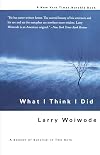
I'm pretty sure I read Woiwode's first novel, What I'm Going to Do, I Think, about 30 or 40 years ago, but I can't really remember much about it. In any case, quite frankly, I enjoyed the heck out of this particular book. Like Woiwode, I was a good Catholic boy and grew up loving books, so there was much for me to relate to here. At first I was a bit bamboozled by the roundabout style of this book, i.e. the way his story is not so neatly framed by another story about how Woiwode and his show more family fight to survive during a devastating North Dakota blizzard, a natural disaster further exacerbated by problems with a new outdoor woodburning furnace. But it soon began to make sense, to flow smoothly. As a lover of books and writing, I was especially interested in all of the writer and other celebrity friends (a 19-20 yr-old fledgling actor, "Bob" DeNiro, for example)and acquaintances he made during the early days of his career. It's not just name-dropping either. There are stories about Updike, Norman Mailer, Robert Lowell, John Berryman, Randall Jarrell and others. But the most central literary figure in Woiwode's story is William Maxwell, the consumate editor and extraordinary writer who became Larry's friend, mentor and father figure. This is also very much a coming-of-age story as the artist as a boy and then young man gropes his way toward maturity, finding, finally, lasting love with a college sweetheart. Woiwode's deep faith is also much in evidence throughout the story. I very much enjoyed this book and look forward to reading his new memoir very soon.
- Tim Bazzett, author of the memoir, BOOKLOVER show less
- Tim Bazzett, author of the memoir, BOOKLOVER show less

There is Truth, insight, even freshness, in this collection of Larry Woiwode’s essays, just as its title promises.
I’ve known of Woiwode’s writing for some time, but had not read him before getting an advance proof to review. Now, having sought out and accepted a chance to read these ten, mostly short pieces (the longest 20, 42 and 30 pages each; the others, 14 pages or less), I’m intrigued by what I find.
Less than two dozen pages into the book, I was moved. I’m predisposed to share show more values that are plainly evident here; but Woiwode’s frank discussion of his Christian faith, its centrality for him and his family’s life, and the reality that not everyone else would approve, afforded a welcome context and perspective for understanding his remaining essays, both as they each were originally written, and as reworked for the present volume.
Two quotes from Woiwode’s second essay (“Homeplace, Heaven or Hell? On the Order of Existence”) in particular still resonate:
“In the first sentence of The Closing of the American Mind, Allan Bloom states, ‘There is one thing a professor can be absolutely certain of: almost every student entering the university believes, or says he believes, that truth is relative.’ Albert Einstein said, ‘The theory of relativity refers to physics, not morals.” [p. 29? p. 25 in Advance Proof.]
“If values evolve from traditions and common sense, then when values start clashing, we need a judge or referee, as we do when we turn to a dictionary to define words. Otherwise, any individual value is as valid as another. Without an outside guide we’re in Babel, where everyone is talking nonsense, because everybody is using words that have meaning only to themselves, and, as Einstein has pointed out, ‘It is easier to denature plutonium than to denature the basic evil nature of man.’” [p. 34? p. 30 in Advance Proof.]
A second, significant aspect of the anthology that I find appealing is Woiwode’s take on aspects of contemporary American letters and society. I wasn’t expecting reflections on Wendell Berry, John Gardner, Reynolds Price, and John Updike (each admired, warts and all); but having five pieces devoted these authors, offered through the lens of Woiwode’s experience and perspective, was a delight in itself. The remaining essays concern guns as “an American Icon”; places we would identify as “home”; religion in contemporary education; news media, or – more accurately – a lack of news in the media; and the abiding nature of Shakespeare and his plays, four hundred years later. These are not necessarily topics I would have sought out (even if I do concur), but they’re nonetheless rewarding for Woiwode having shares his thoughts.
Some of the essays, particularly the shorter ones, are quick and easy to read, but Woiwode doesn’t shy away from approaching complex ideas. The longest and most demanding essay is an extended treatment of Updike’s life and work, in all its variety, inconsistencies, and ambiguity. That Woiwode would venture thoughts on spiritual, even metaphysical, aspects of Updike’s work in a (relatively) small format seems to be an impressive undertaking itself.
As with any anthology of pieces written over time, then later assembled and presented as a single volume, these essays don’t form a coherent whole, united by a common thread or thesis woven through them. As discrete works viewed together, they do give a picture of Woiwode’s particular interests and progression over thirty years, and a framework for further reading of his earlier work. That’s another way in which this little volume offers Woiwode’s “Words Made Fresh.” show less
I’ve known of Woiwode’s writing for some time, but had not read him before getting an advance proof to review. Now, having sought out and accepted a chance to read these ten, mostly short pieces (the longest 20, 42 and 30 pages each; the others, 14 pages or less), I’m intrigued by what I find.
Less than two dozen pages into the book, I was moved. I’m predisposed to share show more values that are plainly evident here; but Woiwode’s frank discussion of his Christian faith, its centrality for him and his family’s life, and the reality that not everyone else would approve, afforded a welcome context and perspective for understanding his remaining essays, both as they each were originally written, and as reworked for the present volume.
Two quotes from Woiwode’s second essay (“Homeplace, Heaven or Hell? On the Order of Existence”) in particular still resonate:
“In the first sentence of The Closing of the American Mind, Allan Bloom states, ‘There is one thing a professor can be absolutely certain of: almost every student entering the university believes, or says he believes, that truth is relative.’ Albert Einstein said, ‘The theory of relativity refers to physics, not morals.” [p. 29? p. 25 in Advance Proof.]
“If values evolve from traditions and common sense, then when values start clashing, we need a judge or referee, as we do when we turn to a dictionary to define words. Otherwise, any individual value is as valid as another. Without an outside guide we’re in Babel, where everyone is talking nonsense, because everybody is using words that have meaning only to themselves, and, as Einstein has pointed out, ‘It is easier to denature plutonium than to denature the basic evil nature of man.’” [p. 34? p. 30 in Advance Proof.]
A second, significant aspect of the anthology that I find appealing is Woiwode’s take on aspects of contemporary American letters and society. I wasn’t expecting reflections on Wendell Berry, John Gardner, Reynolds Price, and John Updike (each admired, warts and all); but having five pieces devoted these authors, offered through the lens of Woiwode’s experience and perspective, was a delight in itself. The remaining essays concern guns as “an American Icon”; places we would identify as “home”; religion in contemporary education; news media, or – more accurately – a lack of news in the media; and the abiding nature of Shakespeare and his plays, four hundred years later. These are not necessarily topics I would have sought out (even if I do concur), but they’re nonetheless rewarding for Woiwode having shares his thoughts.
Some of the essays, particularly the shorter ones, are quick and easy to read, but Woiwode doesn’t shy away from approaching complex ideas. The longest and most demanding essay is an extended treatment of Updike’s life and work, in all its variety, inconsistencies, and ambiguity. That Woiwode would venture thoughts on spiritual, even metaphysical, aspects of Updike’s work in a (relatively) small format seems to be an impressive undertaking itself.
As with any anthology of pieces written over time, then later assembled and presented as a single volume, these essays don’t form a coherent whole, united by a common thread or thesis woven through them. As discrete works viewed together, they do give a picture of Woiwode’s particular interests and progression over thirty years, and a framework for further reading of his earlier work. That’s another way in which this little volume offers Woiwode’s “Words Made Fresh.” show less
 This review was written for LibraryThing Early Reviewers.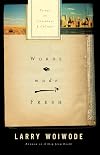
As some reviewers have noted, the title misled me into thinking this book would be about writing, the use of words, and language. I had never heard of Larry Woiwode previous to this experience. He seems to be well-read, as evidenced in his articulate, if sometimes rambling, essays on Gardner, Updike, Shakespeare, and Wendell Berry. I'm not terribly keen on his religious convictions, or his notions about morality as fundamentally linked with religion, specifically Christianity, and it's value show more in public education. Would Woiwode be willing to follow his own logic as indicated in "Deconstructing God" if it meant that local schools might adopt Muslim or Sikh moral codes? He disdains secular moralism, calling for greater liberty for schools to the teach moral codes of branded faiths. Yet, it seems very clear to me, he has only one faith in mind--his own. How is this different than what he views as a rigid wall keeping religious faith out of schools? The imposition of one's beliefs onto those who believe otherwise has always been the hallmark of Christianity--much to its detriment. People prefer secularism, not because they hold no values or spiritual convictions, but because institutional and political neutrality ensures that everyone can CHOOSE what they believe. To simply replace one tyrant with another is not liberty or academic freedom.
Overall, I did not really "get" much from this book, or that which I've read so far. I enjoyed his essay on Berry, and was morbidly astonished by "Guns & Peace," in which there seemed too much of the former and not enough of the latter. I've not read Updike and have vague memories of Gardner, although his essays on Gardner have inspired me take a new look at the author's work. Perhaps, I'm simply disappointed that this book was not what I expected. show less
Overall, I did not really "get" much from this book, or that which I've read so far. I enjoyed his essay on Berry, and was morbidly astonished by "Guns & Peace," in which there seemed too much of the former and not enough of the latter. I've not read Updike and have vague memories of Gardner, although his essays on Gardner have inspired me take a new look at the author's work. Perhaps, I'm simply disappointed that this book was not what I expected. show less
This review was written for LibraryThing Early Reviewers.Larry Woiwode presents a collection of pieces -beautifully wrought if at times weakly argued -that have been published previously through the years and are now tied together under the rubric "Words Made Fresh." Colored by the first and most harrowing reflection on his traumatic killing of a deer, the author moves us through reviews and opinion on John Gardner, John Updike, Bob Dylan and Wendell Berry as well as the Gospel translations of Reynolds Price and the faith of Shakespeare. Woiwode's show more deeply felt readings of these and other matters are informed by his obvious intelligence and concern for what Hannah Arendt calls"the Human Condition." These are the kind of essays that might fruitfully be discussed by smart high school students as well as critically minded collegians as they begin to learn how to critique an argument. And critique they should - for Woiwode invites us to the table of intellect and it is a table filled with books and ideas. For me, his strongest work is on Gardner and Updike. I have read both through many years and yet I learned a tremendous amount about HOW to approach them in a new and strong reading of their work presented here. I thought his weakest effort was the piece on Shakespeare - though it is certainly well worth reading and thinking about as are all the essays in this book. Finally, I would say that this is the kind of collection that I actually respect as well as enjoy. It seems clear to me that these are the mature and forceful writings of a mind that desires nothing more than to be engaged -argued with - perhaps even wrestled to the ground. Good work -on the whole -good work. show less
This review was written for LibraryThing Early Reviewers.Lists
Awards


You May Also Like


Associated Authors
Statistics
- Works
- 20
- Also by
- 30
- Members
- 891
- Popularity
- #28,764
- Rating
- 3.6
- Reviews
- 42
- ISBNs
- 50
- Languages
- 2
- Favorited
- 1
