
Burton L. Mack
Author of The Lost Gospel: The Book of Q & Christian Origins
About the Author
Burton L. Mack, now retired, was formerly John Wesley professor in Early Christianity at the Claremont School of Theology and Graduate University in California. He is the author of numerous publications on Hellenistic Judaism, ritual theory, classical rhetoric and Christian origins from the show more viewpoint of cultural anthropology and history of religions. show less
Works by Burton L. Mack
Rhetoric and the New Testament (GUIDES TO BIBLICAL SCHOLARSHIP NEW TESTAMENT SERIES) (1989) 51 copies
Wisdom and the Hebrew Epic: Ben Sira's Hymn in Praise of the Fathers (Chicago Studies in the History of Judaism) (1985) 17 copies
Christian Mentality: The Entanglements of Power, Violence and Fear (RELIGION IN CULTURE: STUDIES IN SOCIAL CONTEST AND CONSTRUCTION) (2011) 5 copies
The International Lost Gospel 4 copies
Associated Works
The Studia Philonica Annual XX, 2008 (Studia Philonica Annual; [Brown Judaic Studies]) (2008) — Contributor — 1 copy
The Jesus summit the historical Jesus & contemporary faith [video recording] (1994) — Panelist — 1 copy
Tagged
Common Knowledge
- Birthdate
- 1931
- Gender
- male
- Occupations
- scholar (Christian history and the New Testament)
professor emeritus (early Christianity) - Organizations
- Claremont School of Theology
- Nationality
- USA
- Associated Place (for map)
- USA
Members
Reviews
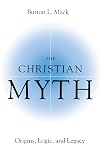
This volume summarizes the state of studies of early Christianity by Burton Mack at the outset of the 21st century. Mack's previous work had included research into the hypothetical Q sayings text of primitive Christianity as well as the mythic basis for the gospel of Mark, and in The Christian Myth he sets forth his principles of academic method for the study of Christian origins and advances a theory of social interests driving the formulation of Christian myth, while denying any show more explanatory power to the Luke-Acts narrative as such. Much of the content of this book was originally written in connection with a seminar under the auspices of the Society of Biblical Literature (SBL) and an offshoot in the North American Society for the Study of Religion (NAASR).
Although this book is fairly short, and (in my view) accessible in style, it really is addressed to fellow scholars. There is no coddling of "Christian belief," and a fairly robust argument is supplied as to why having done so has undermined the entire intellectual enterprise of New Testament studies. A lot of the book is dedicated to demonstrating the relevance of questions about the origins of Christianity to American society, but it often presumes that the reader will share Mack's views on contemporary social justice. Reading Mack more than a decade later, I fear that much of his assessment of the pluralistic state and direction of our society was a little over-optimistic--not that he didn't recognize hazards.
The key precedent studies repeatedly referenced by Mack are Jonathan Z. Smith's excellent monographs Drudgery Divine and To Take Place. Mack's method includes application of the ideas of Durkheim's sociology, and he thoroughly rejects notions of "Christianity" oriented to the interior relationship of individuals to their God. He indicts (in passing) Rodney Stark's account of Christian origins as blinkered by modern assumptions considering Christianity to be a mode of individual salvation. In general, this book makes Mack's relations to other scholars highly transparent, and there is assorted end matter where these connections are dealt with even more explicitly.
I have a terminological quibble with Mack, in that he often uses the word traditional--which implies a sort of legitimacy conferred by a tradition--in cases where the more diffident customary would suffice. I'm sure the implication to which I object is not really what he intends, though. On the whole, I enjoyed this book a great deal, and I would recommend it to scholars of religion, clergy (Christian or not), and social activists. show less
Although this book is fairly short, and (in my view) accessible in style, it really is addressed to fellow scholars. There is no coddling of "Christian belief," and a fairly robust argument is supplied as to why having done so has undermined the entire intellectual enterprise of New Testament studies. A lot of the book is dedicated to demonstrating the relevance of questions about the origins of Christianity to American society, but it often presumes that the reader will share Mack's views on contemporary social justice. Reading Mack more than a decade later, I fear that much of his assessment of the pluralistic state and direction of our society was a little over-optimistic--not that he didn't recognize hazards.
The key precedent studies repeatedly referenced by Mack are Jonathan Z. Smith's excellent monographs Drudgery Divine and To Take Place. Mack's method includes application of the ideas of Durkheim's sociology, and he thoroughly rejects notions of "Christianity" oriented to the interior relationship of individuals to their God. He indicts (in passing) Rodney Stark's account of Christian origins as blinkered by modern assumptions considering Christianity to be a mode of individual salvation. In general, this book makes Mack's relations to other scholars highly transparent, and there is assorted end matter where these connections are dealt with even more explicitly.
I have a terminological quibble with Mack, in that he often uses the word traditional--which implies a sort of legitimacy conferred by a tradition--in cases where the more diffident customary would suffice. I'm sure the implication to which I object is not really what he intends, though. On the whole, I enjoyed this book a great deal, and I would recommend it to scholars of religion, clergy (Christian or not), and social activists. show less
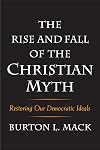
The Rise and Fall of the Christian Myth: Restoring Our Democratic Ideals by Burton L. Mack is a study of the idea of a Christian nation. Mack is Wesley Professor of Early Christianity at Claremont School of Theology. Pioneering the study of Christian origins, his nine books include The Lost Gospel. He sees the gospels more as charter documents of the early Christian movements, not as reliable accounts of the life of Jesus. In the field of religious studies more generally, Mack is known for show more popularizing the term "Social Formation," originally coming from the work of Louis Althusser, as a descriptive category for religion. This stems from his development of a theory of religion as "social interests."
The idea of a Christian Nation is thrown around quite a bit in America without really defining it. Most people have heard of the Kentucky clerk who would not give marriage certificates to gay couples because it violated her religious beliefs. That seems fine until one reads what Jesus said about adultery and divorce and what he didn’t say about homosexuality. We look at war as just, but what would Jesus say about collateral damage? The concept of a Christian Nation or what it actually means is open to interpretation much like other terms like the American Way.
Mack uses a big picture of Christianity as a social force rather than quoting Bible verses or arguing translations. Starting when Constantine adopted Christianity as the religion of Rome. This was more for stability and maintaining the state. He examines Christianity as a social force or interest in the evolution of empires to kingdoms to nations and in the US, a nation made of separate states and “empty land.” History is traced through developments especially the industrial revolution and the acceptance of capitalism -- wage labor, piece work, assembly line.
There is also an adaptation of ideas without fully understanding their meanings. Socialism and communism have very bad connotations in America. Simply because the USSR was identified as communist and the Soviets were our enemy, therefore socialism and communism were evil. It was during the Cold War that “In God, We Trust” was added to our currency and “Under God” was added to the Pledge of Allegiance. We are right so God is on our side. America also took God on its side in the previous century under Manifest Destiny.
Mack looks at historical and current issues in society such as gun control and the role of lobbyists in creating laws in their interest instead of society's interests. Society’s interest is also brought up on the subject of defense spending and war making. There is a growing difference between society’s interest and what we call national interest. It is what society comes to believe and adopt as its myth which is being discussed. The idea that America was destined by God to conquer and settle the land reaching to the Pacific seems a bit extreme today. How will the future feel about fighting to impose democracy in Iraq or for national interests like oil? Mack gives an interesting look at religion as a social force without the dogma. It is a study of society and how a nation creates a myth or hero to further its goals. Certain myths remain untouched and essentially unchallenged by society; this book is about the why. show less
The idea of a Christian Nation is thrown around quite a bit in America without really defining it. Most people have heard of the Kentucky clerk who would not give marriage certificates to gay couples because it violated her religious beliefs. That seems fine until one reads what Jesus said about adultery and divorce and what he didn’t say about homosexuality. We look at war as just, but what would Jesus say about collateral damage? The concept of a Christian Nation or what it actually means is open to interpretation much like other terms like the American Way.
Mack uses a big picture of Christianity as a social force rather than quoting Bible verses or arguing translations. Starting when Constantine adopted Christianity as the religion of Rome. This was more for stability and maintaining the state. He examines Christianity as a social force or interest in the evolution of empires to kingdoms to nations and in the US, a nation made of separate states and “empty land.” History is traced through developments especially the industrial revolution and the acceptance of capitalism -- wage labor, piece work, assembly line.
There is also an adaptation of ideas without fully understanding their meanings. Socialism and communism have very bad connotations in America. Simply because the USSR was identified as communist and the Soviets were our enemy, therefore socialism and communism were evil. It was during the Cold War that “In God, We Trust” was added to our currency and “Under God” was added to the Pledge of Allegiance. We are right so God is on our side. America also took God on its side in the previous century under Manifest Destiny.
Mack looks at historical and current issues in society such as gun control and the role of lobbyists in creating laws in their interest instead of society's interests. Society’s interest is also brought up on the subject of defense spending and war making. There is a growing difference between society’s interest and what we call national interest. It is what society comes to believe and adopt as its myth which is being discussed. The idea that America was destined by God to conquer and settle the land reaching to the Pacific seems a bit extreme today. How will the future feel about fighting to impose democracy in Iraq or for national interests like oil? Mack gives an interesting look at religion as a social force without the dogma. It is a study of society and how a nation creates a myth or hero to further its goals. Certain myths remain untouched and essentially unchallenged by society; this book is about the why. show less
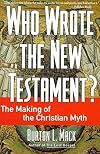
Certainly Mack's book should take its place in the front rank of the many fine introductions available to students of “New Testament” in both academic and non-academic settings. It is a comprehensive synthesis of New Testament scholarship that is nevertheless popularly accessible. That will make it a particularly useful introductory text in an area where such texts are in great demand. But it is more than an excellent introduction to “New Testament.” As the subtitle suggests, it is show more also a critical account of the making of the Christian myth—an invitation to critical reflection on the social construction of a foundational epic that has shaped (and been shaped by) the history and behavior of “the West” since Constantine. That makes it an introduction to mythmaking that is more than a colonial criticism or classification of other people's myths: it is an invitation to cultural self-criticism, an invaluable contribution to liberal education that is a potentially important corrective to triumphalist practices as tempting in our multicultural age as they were in the multicultural matrix out of which Christian scripture emerged. show less
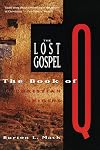
I had no idea so many decades, centuries really, of scholarship have research the "Q" root as a kernel of New Testament gospel writing with Q1-3 later revisions by others with their own intents. It urges considerations of the earliest "Jesus people" beliefs and aims.
Some modern scholars suggest Jesus shared similarities with ancient Greek Cynic philosophers due to his itinerant lifestyle, rejection of material wealth, and radical social critiques. However, this is a debated topic, as Jesus's apocalyptic, communal, and Jewish-focused message differed significantly from the individualistic, ascetic nature of Greek Cynicism. Similarities to Cynicism include:
Lifestyle: Jesus lived without456 many possessions and advocated a simple life, similar to Cynic "hardihood".
Rhetoric: Jesus’s direct, challenging teachings and parables sometimes mirrored the witty, biting, and confrontational style of Cynic philosophers.
Social Critique: Jesus critiqued the power structures of his society, promoting a "brokerless" kingdom in opposition to Roman imperialism and temple elites, note The Contemplative Life.
Distinctions from Cynicism:
Context: Jesus was deeply rooted in Jewish tradition and apocalyptic expectations, whereas Cynics belonged to the Hellenistic, Greco-Roman tradition, according to The University of Chicago Press: Journals.
Community: Cynics were often solitary, radical individualists, while Jesus gathered a community and taught about community, love, and the "Kingdom of God" rather than just individual virtue, note Reddit.
Mission: Jesus's actions were driven by a mission from his Father, rather than the rejection of conventionality for the sake of defying convention itself.
While scholars like John Dominic Crossan and Burton Mack have explored the "Jesus as Cynic" hypothesis, it is generally not accepted that Jesus was a "card-carrying" Cynic, but rather that his methods of communication and social critique in Galilee may have resembled those of popular Cynic preachers. This connection is explored here as well as the Hellenic, unique mixture of Galilee at the time. show less
As for Christian origins, it suddenly became clear that the conventional scenario was deeply indebted to the apocalyptic hypothesis. If Jesus had not been an eschatological prophet, the presence of apocalyptic language in theshow more
early traditions of the Jesus movements would have to be explained some other way. The conventional view of Christian origins assumed an apocalyptic imagination at the beginning and a gradual shift to the language of wisdom when the world did not end as expected. Now the sequence worked the other way around. The shift was not from apocalyptic announcement to instruction in wisdom, but from wisdom to apocalyptic. This switch forced a total reconsideration of Christian origins and of the way in which apocalyptic language had been understood to function. The assumption had been that preaching an apocalyptic message of judgment could attract people to a movement that promised salvation from that judgment. It now appeared that an apocalyptic imagination worked only in sup-port of social values and commitments that were generated by other attractions and persuasions already at work within the group.
.....
As interest grew in knowing more about the community of Q, however, studies began to appear that bumped up against features of the text that did not seem to fit the standard scenario etched in the Christian imagination. Not only was there no reference to the death and resurrection of Jesus, no mention of Jesus as the Christ, and no instruction to Peter and the other disciples about continuing Jesus' mission and baptizing converts into the church, the instructions in Q were couched in curious aphoristic discourse, addressed to individuals, and recommended strange public behavior. So the first attempts at describing the community of Q aimed at understanding how these odd features of the text could be made to fit the traditional picture of Christian origins.
Some modern scholars suggest Jesus shared similarities with ancient Greek Cynic philosophers due to his itinerant lifestyle, rejection of material wealth, and radical social critiques. However, this is a debated topic, as Jesus's apocalyptic, communal, and Jewish-focused message differed significantly from the individualistic, ascetic nature of Greek Cynicism. Similarities to Cynicism include:
Lifestyle: Jesus lived without456 many possessions and advocated a simple life, similar to Cynic "hardihood".
Rhetoric: Jesus’s direct, challenging teachings and parables sometimes mirrored the witty, biting, and confrontational style of Cynic philosophers.
Social Critique: Jesus critiqued the power structures of his society, promoting a "brokerless" kingdom in opposition to Roman imperialism and temple elites, note The Contemplative Life.
Distinctions from Cynicism:
Context: Jesus was deeply rooted in Jewish tradition and apocalyptic expectations, whereas Cynics belonged to the Hellenistic, Greco-Roman tradition, according to The University of Chicago Press: Journals.
Community: Cynics were often solitary, radical individualists, while Jesus gathered a community and taught about community, love, and the "Kingdom of God" rather than just individual virtue, note Reddit.
Mission: Jesus's actions were driven by a mission from his Father, rather than the rejection of conventionality for the sake of defying convention itself.
While scholars like John Dominic Crossan and Burton Mack have explored the "Jesus as Cynic" hypothesis, it is generally not accepted that Jesus was a "card-carrying" Cynic, but rather that his methods of communication and social critique in Galilee may have resembled those of popular Cynic preachers. This connection is explored here as well as the Hellenic, unique mixture of Galilee at the time. show less
Lists
You May Also Like


Associated Authors
Statistics
- Works
- 13
- Also by
- 4
- Members
- 1,343
- Popularity
- #19,158
- Rating
- 3.6
- Reviews
- 12
- ISBNs
- 40
- Languages
- 5
- Favorited
- 2