
Allan Mallinson
Author of A Close Run Thing
About the Author
Allan Mallinson is a brigadier general in the British army and is currently military attache in Rome. (Bowker Author Biography)
Series
Works by Allan Mallinson
1914: Fight The Good Fight: Britain, the Army & the Coming of the First World War (2013) 50 copies, 1 review
Tagged
Common Knowledge
- Legal name
- Mallinson, Allan Lawrence
- Birthdate
- c. 1945
- Gender
- male
- Education
- St Chad's College, Durham, UK
- Occupations
- cavalry officer
military attache - Short biography
- Allan Mallinson is a former Cavalry Officer and the author of the Matthew Hervey series. He is a British national and is also a correspondent for several British newspapers in the area of Defence.
- Nationality
- UK
- Places of residence
- Wiltshire, England, UK
- Associated Place (for map)
- England, UK
Members
Reviews

In The Making of the British Army, Allan Mallinson has provided a comprehensive and readable narrative that charts the army's development from the New Model Army of Oliver Cromwell's time to the Strategic Defence and Security Review released by David Cameron's coalition government in 2010. Mallinson's view of the army's development is one of restless evolution throughout the centuries - "An army long in the making, which yet remains very much a work in progress." (pg. 626), at times seeming show more even like "a work in regress" (pg. 633).
Mallinson's main aim appears to be to extol the virtues of the regimental system in this evolution, creating a resilience and a regenerative quality that marks the British army out as one somewhat unique. He identifies the common British ritual of waging war, wherein the hardiness and heroism of the troops and the "self-healing regimental system [avert] total catastrophe before a capable pair of hands got a grip, took the fight back to the enemy and beat him." (pg. 354). One can see this pattern in just about every war Britain has fought, from the English Civil War through the Napoleonic Wars to the Boer War and the two World Wars, and Mallinson runs with it in his narrative. Whilst this view is not new - and Mallinson is certainly a conservative historian - it has never been so ably charted and articulated as it is here.
He argues persuasively that when good generalship (and good soldiering) "is a tradition, it becomes sustaining" (pg. 14). He suggests that the British military man's awareness of his "operational heritage" (pg. 617), his history, convinces him that he is "a part of something special... [making him] fight just a little harder because he knows that others wearing the same badge have managed to fight hard in the past." (pg. 189). This isn't misty-eyed romanticism; Mallinson provides numerous examples of soldiers who testify that their fighting spirit was bolstered by the collective memory of Arnhem, say, or Waterloo, or Rorke's Drift. These soldiers, with the weight of history behind them, know that they cannot, for example, "quit a position in the face of seemingly overwhelming odds when Chard and Bromhead [the two lieutenants in charge at Rorke's Drift] had not done so - not, at least, without inviting critical comparison." (pp308-9). This theme running throughout the book makes it a very stirring read for the British patriot, yet it never threatens to lurch into jingoism - it maintains a balance by providing a hard-nosed audit of the army's numerous historical failings.
All in all, The Making of the British Army is an extremely enjoyable military history, finding that often-elusive page-turning blend between a wider narrative and a slew of refreshing historical anecdotes. I didn't learn much new in the way of factual information, beyond the origins of certain regiment names such as the Coldstream Guards, Black Watch and the Green Howards, but it didn't matter. The story has rarely been told so well. In historical appraisals, the British Army as an entity is often overlooked in favour of the glamour and importance of naval (and, more recently, air) power. Indeed, as Mallinson's analogy puts it, "as a national insurance policy the army has always been more 'third party' than 'fully comprehensive'." (pg. 618). But as he argues here, it deserves a lion's share of the glory. show less
Mallinson's main aim appears to be to extol the virtues of the regimental system in this evolution, creating a resilience and a regenerative quality that marks the British army out as one somewhat unique. He identifies the common British ritual of waging war, wherein the hardiness and heroism of the troops and the "self-healing regimental system [avert] total catastrophe before a capable pair of hands got a grip, took the fight back to the enemy and beat him." (pg. 354). One can see this pattern in just about every war Britain has fought, from the English Civil War through the Napoleonic Wars to the Boer War and the two World Wars, and Mallinson runs with it in his narrative. Whilst this view is not new - and Mallinson is certainly a conservative historian - it has never been so ably charted and articulated as it is here.
He argues persuasively that when good generalship (and good soldiering) "is a tradition, it becomes sustaining" (pg. 14). He suggests that the British military man's awareness of his "operational heritage" (pg. 617), his history, convinces him that he is "a part of something special... [making him] fight just a little harder because he knows that others wearing the same badge have managed to fight hard in the past." (pg. 189). This isn't misty-eyed romanticism; Mallinson provides numerous examples of soldiers who testify that their fighting spirit was bolstered by the collective memory of Arnhem, say, or Waterloo, or Rorke's Drift. These soldiers, with the weight of history behind them, know that they cannot, for example, "quit a position in the face of seemingly overwhelming odds when Chard and Bromhead [the two lieutenants in charge at Rorke's Drift] had not done so - not, at least, without inviting critical comparison." (pp308-9). This theme running throughout the book makes it a very stirring read for the British patriot, yet it never threatens to lurch into jingoism - it maintains a balance by providing a hard-nosed audit of the army's numerous historical failings.
All in all, The Making of the British Army is an extremely enjoyable military history, finding that often-elusive page-turning blend between a wider narrative and a slew of refreshing historical anecdotes. I didn't learn much new in the way of factual information, beyond the origins of certain regiment names such as the Coldstream Guards, Black Watch and the Green Howards, but it didn't matter. The story has rarely been told so well. In historical appraisals, the British Army as an entity is often overlooked in favour of the glamour and importance of naval (and, more recently, air) power. Indeed, as Mallinson's analogy puts it, "as a national insurance policy the army has always been more 'third party' than 'fully comprehensive'." (pg. 618). But as he argues here, it deserves a lion's share of the glory. show less
If you get emotional reading about the British Empire (as I do), this can be a very hard read. But if you're going to be able to convincingly blame the English for most of the world's current problems (as I do when under the influence of ignorance or tequila) you ought to read it and be armed with facts.

https://nwhyte.livejournal.com/3296662.html
One of the 28th is a standalone novel, whereas A Close Run Thing, published in in 1999, is the first in a series of thirteen (so far) chronicling the adventures of Matthew Hervey, the latest of which came out last year. I would be astonished if Mallinson had not read Henty before starting to write. There are some clear similarities between the books - both the protagonists are from middle-class family backgrounds (Hervey's father is a vicar, so is show more Ralph's prospective father-in-law), struggling to rise in the officer caste of the army; both protagonists fall in love and get married at the end of the book (sorry for spoilers); both novels feature questions of inheritance; and in both, the protagonist and his comrades are sent to Ireland - indeed, both to Cork - to keep order during the interval between Napoleon's exile to Elba and the Hundred Days.
But the take of the two books on Ireland is very different. By superior intellect and judgement, Ralph Conway of the 28th manages to capture a Galway ruffian and liberate the locals from the tyranny of untaxed liquor distillation, er, well. Hervey on the other hand gets into trouble for defending the local peasants against eviction, having got himself sensitised to the Irish situation by reading Maria Edgeworth. I don't find either scenario particularly believable, but I do find it interesting that both authors felt they needed to invoke Ireland in some detail to set the scene for the later phases.
A Close Run Thing is more consciously a Bildungsroman (in fairness, Henty's characters are so two-dimensional that it is unfair to expect character development from them). Hervey is constantly getting into trouble, mainly for doing the right thing and therefore annoying the wrong superior officers, and a lot of the book involves those disentanglements as well as developing his relationship with his girlfriend. (There's also a surprising amount of theology.) Mallinson here is following in the footsteps of Cornwell/Sharpe and O'Brien/Maturin.
When it comes to the actual Battle of Waterloo, both have pretty detailed accounts of the fighting, drawn from the usual sources. Mallinson goes into it in more depth, but wears it a bit better because he has been giving us military detail all through the book (especially about horses). He also puts Hervey, who conveniently speaks German, into a crucial role in liaison between the Prussians and Wellington. Henty's detailed account of the battle is a jarring deviation from the tight-third of most of the book, especially since Ralph himself is more at the worm's eye than bird's eye point of view, rather like Stendhal's protagonist in The Charterhouse of Parma.
Hervey gets through unscathed, though dearly beloved comrades are killed in front of him. show less
One of the 28th is a standalone novel, whereas A Close Run Thing, published in in 1999, is the first in a series of thirteen (so far) chronicling the adventures of Matthew Hervey, the latest of which came out last year. I would be astonished if Mallinson had not read Henty before starting to write. There are some clear similarities between the books - both the protagonists are from middle-class family backgrounds (Hervey's father is a vicar, so is show more Ralph's prospective father-in-law), struggling to rise in the officer caste of the army; both protagonists fall in love and get married at the end of the book (sorry for spoilers); both novels feature questions of inheritance; and in both, the protagonist and his comrades are sent to Ireland - indeed, both to Cork - to keep order during the interval between Napoleon's exile to Elba and the Hundred Days.
But the take of the two books on Ireland is very different. By superior intellect and judgement, Ralph Conway of the 28th manages to capture a Galway ruffian and liberate the locals from the tyranny of untaxed liquor distillation, er, well. Hervey on the other hand gets into trouble for defending the local peasants against eviction, having got himself sensitised to the Irish situation by reading Maria Edgeworth. I don't find either scenario particularly believable, but I do find it interesting that both authors felt they needed to invoke Ireland in some detail to set the scene for the later phases.
A Close Run Thing is more consciously a Bildungsroman (in fairness, Henty's characters are so two-dimensional that it is unfair to expect character development from them). Hervey is constantly getting into trouble, mainly for doing the right thing and therefore annoying the wrong superior officers, and a lot of the book involves those disentanglements as well as developing his relationship with his girlfriend. (There's also a surprising amount of theology.) Mallinson here is following in the footsteps of Cornwell/Sharpe and O'Brien/Maturin.
When it comes to the actual Battle of Waterloo, both have pretty detailed accounts of the fighting, drawn from the usual sources. Mallinson goes into it in more depth, but wears it a bit better because he has been giving us military detail all through the book (especially about horses). He also puts Hervey, who conveniently speaks German, into a crucial role in liaison between the Prussians and Wellington. Henty's detailed account of the battle is a jarring deviation from the tight-third of most of the book, especially since Ralph himself is more at the worm's eye than bird's eye point of view, rather like Stendhal's protagonist in The Charterhouse of Parma.
Hervey gets through unscathed, though dearly beloved comrades are killed in front of him. show less
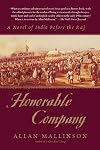
Intrigues in a minor state to prepare for Wellington's return to India or to erase compromising proofs of his prior sojourn? This Matthew Hervey serie finds a well told narrative in "Honorable Company" a book in which few are honorable or even good to keep company with. His wedding preparations thoroughly cut short by Hervey's departure for India will not prevent his brief romance with the Rajah's daughter before an all out charge of the thin red line against thousands of armed opponents. show more
What is fantastic with Mallinson is that even if you have never set foot in India, you know after a few pages, the best places to go hunting hogs on horseback with a lance. Strangely you feel acquainted with this risky exercise, almost as well as a local. show less
What is fantastic with Mallinson is that even if you have never set foot in India, you know after a few pages, the best places to go hunting hogs on horseback with a lance. Strangely you feel acquainted with this risky exercise, almost as well as a local. show less
Lists
Awards

You May Also Like


Statistics
- Works
- 23
- Members
- 1,853
- Popularity
- #13,887
- Rating
- 3.5
- Reviews
- 20
- ISBNs
- 172
- Languages
- 1
- Favorited
- 4