

Patricia J. Williams
Author of The Alchemy of Race and Rights
About the Author
Image credit: Credit: David Shankbone, Sept. 2007
Works by Patricia J. Williams
Associated Works
Critical Race Theory: The Key Writings That Formed the Movement (1995) — Contributor — 473 copies, 1 review
Race-ing Justice, En-Gendering Power: Essays on Anita Hill, Clarence Thomas, and the Construction of Social Reality (1992) — Contributor — 355 copies, 1 review
What Orwell Didn't Know: Propaganda and the New Face of American Politics (2007) — Contributor — 133 copies, 1 review
Birth of a Nation'hood: Gaze, Script, and Spectacle in the O. J. Simpson Case (1997) — Contributor — 79 copies
When Race Becomes Real: Black and White Writers Confront Their Personal Histories (2002) — Contributor — 49 copies
I Still Believe Anita Hill: Three Generations Discuss the Legacies of Speaking Truth to Power (2012) — Contributor — 23 copies, 1 review
Tagged
Common Knowledge
- Birthdate
- 1951-08-28
- Gender
- female
- Education
- Wellesley College (AB|1972)
Harvard Law School (JD|1975) - Occupations
- law school professor
public intellectual - Organizations
- Columbia Law School
The Nation - Awards and honors
- BBC Reith Lecturer (1997)
MacArthur Fellowship (2000) - Nationality
- USA
- Birthplace
- Boston, Massachusetts, USA
- Associated Place (for map)
- Massachusetts, USA
Members
Reviews
Engaging reflection on the effects of racism told in the style of a memoir by a brilliant legal mind.
Race is it indicative of class? Does color define power? It seems race has transformed the barriers and erected fundamental rifts in humanity… in the era of the Greeks and Romans there yet were slaves some received grace to be free and some stayed imprisoned same transferrances can be summed up in modern America … red lining reality… racial surcharge what could be gathered in a culture that is not new of human incongruence? Many may not know the spectacle of black or Afro-Latino or show more biopic predestination… is whiteness the unfatigable perjoritive norm for racism meaning has black culture been given the culture transmography from poor criminal to elected passable white after middle class status ? It’s interesting how blacks are seen as white until alienation or catastrophe but I understand class and race in the context of economy and the status of education which especially during slavery were limited resources … the knowledge of history and race brings people towards spacial liberation the freedom to be who they wish and live where they find most equity… in this way I assume the idea of racial divide an economy of access to wealth or rather education… white or black rich or poor communities move toward places of rich knowledge rich locations for the advancement of their unique family … when the market value of housing drops due to invasive technology human incongruity which is in many ways machine or given over to the mechanics of finding a more sustainable form of illumination… meaning… the stock of man is dependent on how someone can raise or lower the efficacy of power in societal relationships… if racial divide creates a lack of wealth for a community if the standard of beauty lies solely on one category of humanity then this makes sense to make the person's status subject to extraneous factors besides cars houses education and be socially accepted to make its association to a level of connection with higher classed people or those with more economic resources to help create a fertile environment for placing their seed into roost… in a more basic way humans classify race disparity with the way or manner in which association with one group or another gives us ease of access to resources to find a mate build a nest rear children and live a longer healthier and more comfortable life… in a sense my prognosis for alleviating the divide put in mechanically from systematic segregation and slavery would be for an equanimous balance of power WHICH inveriably we actually do see in society although it is understood less and less and even overlooked such conflict in body structure of the poorer class the bourgeois and the untouchable class can be seen in my controversial perspective as being more resilient and stronger not necessarily black or white but based on the economic imbalance of work roles … yes it is said more educated more spiritual and healthier living proves longevity but if the master, so to speak, lives close at hand to the slave, so to speak, does not both parties benefit? Not to say that the slave always wishes to be the master one day… in effect it may be controversial to speak in these terms about class disruption or imbalance but that was why my thesis on education is the overbearing reality of emancipation and will always be the sole source of freedom … from education in the arts or music or sports to science and philosophy or politics show less
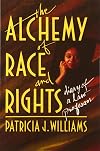
Patricia Williams is a lawyer and a professor of commercial law, the great-great-granddaughter of a slave and a white southern lawyer. The Alchemy of Race and Rights is an eloquent autobiographical essay in which the author reflects on the intersection of race, gender, and class. Using the tools of critical literary and legal theory, she sets out her views of contemporary popular culture and current events, from Howard Beach to homelessness, from Tawana Brawley to the law-school classrom, show more from civil rights to Oprah Winfrey, from Bernhard Goetz to Marth Beth Whitehead. She also traces the workings of "ordinary racism"--everyday occurences, casual, unintended, banal perhaps, but mortifying. Taking up the metaphor of alchemy, Williams casts the law as a mythological text in which the powers of commerce and the Constitution, wealth and poverty, sanity and insanity, wage war across complex and overlapping boundaries of discourse. In deliberately transgressing such boundaries, she persues a path toward racial justice that is, ultimately, transformative.
Williams gets to the roots of racism not by fingerpointing but by much gentler methods. Her book is full of anecdote and witness, vivid characters known and observed, trenchant analysis of the law's shortcomings. Only by such an inquiry and such patient phenomenology can we understand racism. The book is deeply moving and not so, finally, just because racism is wrong--we all know that. What we don't know is how to unthink the process that allows racism to persist. THis Williams enables us to see. The result is a testament of considerable beauty, a triumph of moral tactfullness, The result, as the title suggests, is magic. show less
Williams gets to the roots of racism not by fingerpointing but by much gentler methods. Her book is full of anecdote and witness, vivid characters known and observed, trenchant analysis of the law's shortcomings. Only by such an inquiry and such patient phenomenology can we understand racism. The book is deeply moving and not so, finally, just because racism is wrong--we all know that. What we don't know is how to unthink the process that allows racism to persist. THis Williams enables us to see. The result is a testament of considerable beauty, a triumph of moral tactfullness, The result, as the title suggests, is magic. show less
Awards

You May Also Like


Associated Authors
Statistics
- Works
- 9
- Also by
- 9
- Members
- 685
- Popularity
- #36,933
- Rating
- 4.1
- Reviews
- 3
- ISBNs
- 20
- Languages
- 1
- Favorited
- 2