
Marie Darrieussecq
Author of Pig Tales: A Novel of Lust and Transformation
About the Author
Works by Marie Darrieussecq
Associated Works
Tagged
Common Knowledge
- Canonical name
- Darrieussecq, Marie
- Legal name
- Darrieussecq, Marie
- Birthdate
- 1969-01-03
- Gender
- female
- Education
- Lycée Cassin, Bayonne, France (Baccalauréat lettres ∙ 1986)
Ecole Normale Supérieure, Paris
Sorbonne Nouvelle, Paris
Lycée Michel-Montaigne, Bordeaux, France (hypokhâgne, khâgne)
Lycée Louis le Grand, Paris, France (khâgne) - Occupations
- novelist
- Organizations
- L'Obs, Magazine (Chroniqueuse, 20 17 | )
Charlie Hebdo (Chroniqueuse, 20 15 | 20 18)
Libération, Journal (Chroniqueuse, 20 13 | 20 15) - Relationships
- Marmande, Francis (Directeur de thèse)
- Nationality
- France (birth)
- Birthplace
- Bayonne, Pyrénées-Atlantiques, France
- Places of residence
- Paris, France
Lille, France - Map Location
- France
Members
Reviews
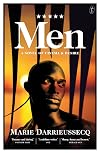
Imagine reading a mainstream, highly praised novel set in the present were white people own black people. The characters repeatedly use a litany of racist black inferiority stereotypes page after page.
And that’s the whole book.
There’s no reckoning. No conflict. No emancipation. Life goes on as if this is just the normal state of things. It’s as if somebody created a racist Lake Wobegon and nobody bothered to challenge it.
The book would quickly and rightly be completely shamed.
And yet show more somehow in 2013 the misogynistic equivalent of this was printed. Published. Sold on Amazon and others.
This fundamentally flawed, backwards attitudes and thoughts regurgitation of one of the most crippling clichés in heterosexual romantic relationships was presented as reputable literature.
Do you, as a woman, because let’s face it no man is going to voluntarily read this, need another author normalizing this dysfunctional masochistic relationship pattern that’s already hailed as the way things should be in eons of other popular culture songs, videos and books:
Woman falls for “free spirit” (euphemism alert: should say “emotionally unavailable/commitment phobic”) exotic bad boy. Tries to tame him using unconditional (and unrequited love). After completely giving up every vestige of her own life to immerse herself completely in his, both literally and metaphorically, he discards her (in this case, again, literally)–usually in an underhanded passive aggressive way–until way way way later making some pronouncement of the incredible impact she had on his life. To no avail, of course. He’s married with kids anyway. So it’s way too late.
Except its not too late for her. Because now she can get a self-esteem boost and maybe even closure knowing she served the ultimate goal of womanhood: to be useful to a man no matter how fleeting or what the cost to her. Like an accelerant for fire: momentarily crucial then completely consumed in the process.
If it sat on the Harlequin Romance shelf sandwiched between “Beloved Rogue” and “The Vixen’s Revenge” (yup, real books both) I wouldn’t be so critical. No one goes to Comic Con thinking a few yards of red satin affixed to their costume will let them jump safely off the roof.
But no.
This was categorized as literature with critics from Kirkus, Paris Match and others actually praising it. Happily I could find no mention of it from The New York Times, London Review of Books, Bookforum or other sources I profoundly respect.
Finally, winning a tie with the preceding two items for the most offensive part of this novel: The author cloaks this tired romantic trope in a cloak of the timely serious issues of racism and nationalism seemingly to add gravitas or legitimacy to what is otherwise going straight to the $1 cart at The Strand.
Five thumbs down. show less
And that’s the whole book.
There’s no reckoning. No conflict. No emancipation. Life goes on as if this is just the normal state of things. It’s as if somebody created a racist Lake Wobegon and nobody bothered to challenge it.
The book would quickly and rightly be completely shamed.
And yet show more somehow in 2013 the misogynistic equivalent of this was printed. Published. Sold on Amazon and others.
This fundamentally flawed, backwards attitudes and thoughts regurgitation of one of the most crippling clichés in heterosexual romantic relationships was presented as reputable literature.
Do you, as a woman, because let’s face it no man is going to voluntarily read this, need another author normalizing this dysfunctional masochistic relationship pattern that’s already hailed as the way things should be in eons of other popular culture songs, videos and books:
Woman falls for “free spirit” (euphemism alert: should say “emotionally unavailable/commitment phobic”) exotic bad boy. Tries to tame him using unconditional (and unrequited love). After completely giving up every vestige of her own life to immerse herself completely in his, both literally and metaphorically, he discards her (in this case, again, literally)–usually in an underhanded passive aggressive way–until way way way later making some pronouncement of the incredible impact she had on his life. To no avail, of course. He’s married with kids anyway. So it’s way too late.
Except its not too late for her. Because now she can get a self-esteem boost and maybe even closure knowing she served the ultimate goal of womanhood: to be useful to a man no matter how fleeting or what the cost to her. Like an accelerant for fire: momentarily crucial then completely consumed in the process.
If it sat on the Harlequin Romance shelf sandwiched between “Beloved Rogue” and “The Vixen’s Revenge” (yup, real books both) I wouldn’t be so critical. No one goes to Comic Con thinking a few yards of red satin affixed to their costume will let them jump safely off the roof.
But no.
This was categorized as literature with critics from Kirkus, Paris Match and others actually praising it. Happily I could find no mention of it from The New York Times, London Review of Books, Bookforum or other sources I profoundly respect.
Finally, winning a tie with the preceding two items for the most offensive part of this novel: The author cloaks this tired romantic trope in a cloak of the timely serious issues of racism and nationalism seemingly to add gravitas or legitimacy to what is otherwise going straight to the $1 cart at The Strand.
Five thumbs down. show less
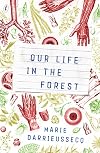
I’ve read a couple of Marie Darrieussecq’s other novels, [b:Pig Tales: A Novel of Lust and Transformation|767124|Pig Tales A Novel of Lust and Transformation |Marie Darrieussecq|https://images.gr-assets.com/books/1328752441s/767124.jpg|1005698] and [b:White|119780|White|Marie Darrieussecq|https://images.gr-assets.com/books/1329920985s/119780.jpg|2142085], neither of which I was particularly keen on. I much prefer ‘Our Life in the Forest’, which like the other two follows a woman show more going through some visceral bodily weirdness. The first person narrator, also called Marie, is trying to explain what’s happening before her organs shut down. Her voice is distinctive and compelling, her situation deeply unsettling. In this near future world, rich people have clones that they keep for spare parts, known as halves. Marie, who works as a therapist, is one of those who form emotional attachments to their comatose ‘halves’. Eventually, she flees into the forest with her half, to join a secret community there. Although the blurb implies that halves behaviour animates the plot, in fact the narrative is one of slow progress towards grim realisation.
Darriessecq colours the narrative with many memorable details that merit the term dystopian. I particularly liked the job of the clicker: training deep learning networks to make associations between things.
I’ve recently been lecturing on neural networks and AI, so this rang chillingly true to me, as did the perpetual automated surveillance that could be baffled by using metaphors. Climate change, pollution, ecological collapse, and extreme wealth inequality all form part of the background detail. Prior to her life in the forest, Marie inhabited a tiny apartment and worked long hours, with visiting her half seemingly her only leisure activity. Despite thisand the revelation that she too is a clone used for spare parts by the 1% , she is never self-pitying and recounts her story with a certain ironic detachment. With elan, even. She apologises for being sentimental and exhibits a rather grim pragmatism:
Although the story is quite simple, Marie's digressive style allows many intriguing questions to be raised. Is ignorance better or worse than unconsciousness of suffering? Should immortality be for sale? When wealth inequality shapes the entire world, does it vanish into the background? What separates human beings from robots? How does life change when all tasks are automated, all life electronically monitored, all persons connected to networks? Yet all these abstractions are grounded in the narrative focus on Marie’s body, scarred by surgery and lacking organs. Seeing the dysfunctional future world from her limited yet incisive perspective, as she attempts to sort through her life before her body shuts down, is quite an experience. I found the halves, ostensibly the focus of the book, perhaps the least interesting part of the book.They’re a red herring in some ways. The comment about researchers being delighted with all the comparisons between the comatose and conscious clones was suitably unsettling, though. It builds to a moving conclusion, as Marie seeks to imagine her legacy.
Effective dystopian writing reflects on current anxieties by strategically exaggerating and warping them. Darrieussecq manages this elegantly, addressing a range of preoccupations about bodies, machines, and the search for a meaningful life. ‘Our Life in the Forest’ has a lot to say in just 150 pages. show less
Darriessecq colours the narrative with many memorable details that merit the term dystopian. I particularly liked the job of the clicker: training deep learning networks to make associations between things.
The clicker came to speak to me about the infinite tedium of his duties. It is envisaged that the project will be completed in about fifty years. But, until then, the job consists of staying seated in front of your device, and clicking every match between words and images, or words and sounds, or sounds and images, or colours and emotions, that sort of thing. You can even do it in your head if you agree to have your device implanted. You can do it while walking or under the shower, except it requires - as the clicker explained - complete focus. It seems like a mechanical process, but it demands concentration and speed. You’re endlessly performing a task the mind can do but which discombobulates a robot. And which is nevertheless difficult to conceptualise. The only solution is to multiply the links, click, click, click, until the robot has been supplied with everything we could possibly have thought up until now, everything we could have felt, everything humanity could have experienced.
I’ve recently been lecturing on neural networks and AI, so this rang chillingly true to me, as did the perpetual automated surveillance that could be baffled by using metaphors. Climate change, pollution, ecological collapse, and extreme wealth inequality all form part of the background detail. Prior to her life in the forest, Marie inhabited a tiny apartment and worked long hours, with visiting her half seemingly her only leisure activity. Despite this
I had the operation. I have no memory of it, which is normal, what with all the anesthetics. And they say it’s better not to remember. I can’t say they’re wrong. After treating lots and lots of traumatised cases, with only moderate success in the medium term, I’m convinced in the end that it’s better not to remember. Bad memories are like toxic organ grafts, difficult to uproot; at best they can be fenced off so you can’t go and graze on them. Bad memories = weeds. Best not to have them at all, or to invent good memories for yourself instead, so you can reprogram your brain. So you can plant a new garden.
Although the story is quite simple, Marie's digressive style allows many intriguing questions to be raised. Is ignorance better or worse than unconsciousness of suffering? Should immortality be for sale? When wealth inequality shapes the entire world, does it vanish into the background? What separates human beings from robots? How does life change when all tasks are automated, all life electronically monitored, all persons connected to networks? Yet all these abstractions are grounded in the narrative focus on Marie’s body, scarred by surgery and lacking organs. Seeing the dysfunctional future world from her limited yet incisive perspective, as she attempts to sort through her life before her body shuts down, is quite an experience. I found the halves, ostensibly the focus of the book, perhaps the least interesting part of the book.
Effective dystopian writing reflects on current anxieties by strategically exaggerating and warping them. Darrieussecq manages this elegantly, addressing a range of preoccupations about bodies, machines, and the search for a meaningful life. ‘Our Life in the Forest’ has a lot to say in just 150 pages. show less
Pig Tales: A Novel of Lust and Transformation (New Press International Fiction) by Marie Darrieussecq
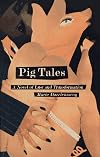
Pig Tales is a wonderful piece of translation literature that reads like a fable. It reveals the animal nature of man and the moral proof that beauty is only skin deep. Political corruption is examined within this context: how we corrupt or are corrupted.
Darrieussecq's imaginative narrative, broadly, examines self-identity via transformation. She looks at how we are continuously changing and evolving, refining our individual selves, but not always for the good. Her method is both humorous show more and brutal. The pig, as an edible woman, is a warning of what we can become, especially through ignorance and folly. Likewise, the male conversion as wolf, symbolizes the violent nature of man.
This is an amazing novella seamlessly written from beginning to end. Needless to say, it makes an impression. It is abstractly narrated as if a Cubist painting - there is much to observe, and from all different angles. Darrieussecq has created a unique and unforgettable work of literature.
Additional notes and quotes at: https://bibliophilebethlc.blogspot.com show less
Darrieussecq's imaginative narrative, broadly, examines self-identity via transformation. She looks at how we are continuously changing and evolving, refining our individual selves, but not always for the good. Her method is both humorous show more and brutal. The pig, as an edible woman, is a warning of what we can become, especially through ignorance and folly. Likewise, the male conversion as wolf, symbolizes the violent nature of man.
This is an amazing novella seamlessly written from beginning to end. Needless to say, it makes an impression. It is abstractly narrated as if a Cubist painting - there is much to observe, and from all different angles. Darrieussecq has created a unique and unforgettable work of literature.
Additional notes and quotes at: https://bibliophilebethlc.blogspot.com show less
Pig Tales: A Novel of Lust and Transformation (New Press International Fiction) by Marie Darrieussecq
A woman transforms in and out of pighood? Seriously? Believe it or not this works! This is a fast-paced visionary and satiric look at politics, gender, and the role of sex in both. I laughed, I cringed, and I couldn't put it down. The author points her sharply attuned literary finger at both genders, all forms of government and spares no one. Perhaps the point is that we as humans are all capable of both good and bad. The form of our lives becomes a question of which side prevails, and how show more much it is within the control of the individual versus within the domain of ethnicity and/or social class. Ms. Darrieussecq packed quite a bit into a short novel. Well done! show less
Lists
Awards


You May Also Like


Associated Authors
Statistics
- Works
- 38
- Also by
- 7
- Members
- 1,657
- Popularity
- #15,508
- Rating
- 3.4
- Reviews
- 36
- ISBNs
- 182
- Languages
- 19
- Favorited
- 1


