
Jean-Philippe Toussaint
Author of The Bathroom
About the Author
Series
Works by Jean-Philippe Toussaint
Associated Works
Tagged
Common Knowledge
- Birthdate
- 1957-11-29
- Gender
- male
- Education
- Institute of Political Studies (Paris, France)
- Occupations
- novelist
filmmaker - Nationality
- Belgium
- Birthplace
- Brussels, Belgium
- Places of residence
- Brussels, Belgium
Paris, France
Médéa, Algeria
Madrid, Spain
Berlin, Germany
Members
Reviews
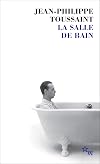
There is a 27-year-old man who loves to stay in the bathtub and ponder over life for the whole afternoon every day. He does not have a mental problem, yet, he is a mere reflection of our anxiety in this 21st-century modern bustling world. He represents the helpless and desperate attitude towards life yet no one can resist such desperation.
He is not a loser, instead, he is somehow a thinker or a philosopher. One day, he took a book someone left in the cafe in Venice. The book was the English show more version of "Pensées" written by Blaise Pascal. He was fascinated by the quotation about death and desperation. From my point of view, all of his mentality and actions throughout the whole novel actually represent us, as modern citizens in this modern world, as well as our deepest fear: what are we exactly doing in our lives while we are all going to die one day? What to do with our short and desperate lives that are doomed? We cannot change anything because we are so small.
This little book may be plotless, yet it contains a lot of meanings and philosophy. There are few times that the narrator comes really close to offering the reader a reason for his bathroom behaviour. However, he can never be able to complete the sentence. This is because he does not, and will not, and cannot know the answer. He is hopeless. I think Toussaint is trying to reveal our fear of death and uncertainty by using a very relaxing, slow and peaceful tone. He talks about life and death without fear. Also, he mentions a little about love as well by including Edmondsson in the story. I strongly recommend you this beautiful little book. show less
He is not a loser, instead, he is somehow a thinker or a philosopher. One day, he took a book someone left in the cafe in Venice. The book was the English show more version of "Pensées" written by Blaise Pascal. He was fascinated by the quotation about death and desperation. From my point of view, all of his mentality and actions throughout the whole novel actually represent us, as modern citizens in this modern world, as well as our deepest fear: what are we exactly doing in our lives while we are all going to die one day? What to do with our short and desperate lives that are doomed? We cannot change anything because we are so small.
This little book may be plotless, yet it contains a lot of meanings and philosophy. There are few times that the narrator comes really close to offering the reader a reason for his bathroom behaviour. However, he can never be able to complete the sentence. This is because he does not, and will not, and cannot know the answer. He is hopeless. I think Toussaint is trying to reveal our fear of death and uncertainty by using a very relaxing, slow and peaceful tone. He talks about life and death without fear. Also, he mentions a little about love as well by including Edmondsson in the story. I strongly recommend you this beautiful little book. show less
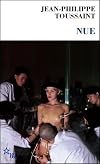
This is the fourth and last book in the series about an artist in the world of haute couture: Marie Madeleine Marguerite de Montalte. I have not read the previous three, but had no trouble with picking up the story in Nue. Thankfully the heroine is referred to as plain Marie in this book and her story is pieced together by the narrator the unnamed admirer and lover of Marie. The story is told in several set piece situations. The first is an outrageous fashion show in Japan where Marie has show more designed a dress that clings to the body of her model like a second skin and is the colour of honey. She arranges to have a swarm of bees follow the model down the catwalk. We then find the narrator alone in his Paris apartment after enjoying a holiday with Marie in Elba. He spends two months looking out of the window waiting for Marie to phone him. The narrator remembers an art exhibition celebrating Marie in Japan, to which he had not been invited and how he climbed onto the roof and peered down at the gathering through a porthole like window. Then he finally receives a phone call and meets Marie in a run down Paris cafe on a wet winters night in the city and then agrees that night to go back to Elba with her for a funeral.
These incidents are described in some detail with the author intent on providing an atmosphere which connects them to each other. I enjoyed the writing which has a dream-like quality to it. It has the feel of being written by a person in love who understands that he must play his part in the game of love, without fully understanding the rules. It is a waiting game and like the diaphanous honey coloured dress, nothing must be done to spoil the overall effect. I was carried away by the writing in this short novel which has a timely resolution. I need not read the preceding three to understand the story, but I would like to for the quality of the writing. 4 stars. show less
These incidents are described in some detail with the author intent on providing an atmosphere which connects them to each other. I enjoyed the writing which has a dream-like quality to it. It has the feel of being written by a person in love who understands that he must play his part in the game of love, without fully understanding the rules. It is a waiting game and like the diaphanous honey coloured dress, nothing must be done to spoil the overall effect. I was carried away by the writing in this short novel which has a timely resolution. I need not read the preceding three to understand the story, but I would like to for the quality of the writing. 4 stars. show less
It’s particularly amusing to read ‘Camera’ after [b:The House of Writers|30458562|The House of Writers|M.J. Nicholls|https://i.gr-assets.com/images/S/compressed.photo.goodreads.com/books/1465630098l/30458562._SX50_.jpg|50977283], as this is exactly the sort of literary work that the latter mocks. In a very similar manner to [b:Event Factory|9257320|Event Factory|Renee Gladman|https://i.gr-assets.com/images/S/compressed.photo.goodreads.com/books/1283884881l/9257320._SX50_.jpg|14137990] show more earlier this week, I found the novella itself did not make a huge impact on me. However I was very entertained by the interview with Jean-Philippe Toussaint included at the end. The novella itself seeks profundity via triviality. The narrator is always travelling about, for vague or unspecified reasons. He wanders cities, smokes, and contemplates existence in classic flâneur style, except without any great interest in society. He looks inside rather than outside himself, or just stares into space. The narrative begins with an air of gently playful absurdity, then concludes on a darker note. Prosaically, this darker note is because the protagonist has missed the last train. (I’ve been there, it's a real bummer.) I think the writing style probably works better in the original French, as it tends towards the trite in English. Nonetheless, there is some elegance in the close observation of petty incidents and uneventful journeys.
The author interview, however, is a joy for its sheer unselfconscious pretentiousness. Surely a British author would be embarrassed to baldly state: “‘The Bathroom’ can be described as the description of a crisis, whereas ‘Camera’ is more the description of a condition, the condition of someone’s place in the world. The book progressively shifts from the ‘struggle of living’ to the ‘despair of being’”. I mean, does it really? I can be a terribly literal reader, thus sometimes fail to notice the full profundity of despair occasioned by missing a train. Nonetheless, I find it fascinating to learn what authors of deliberately plotless fiction think they are up to. As Toussaint puts it:
It is of course ambitious and brave to write of such dull things, as without plot to intrigue the reader the pressure is on the author to write exquisitely beautiful prose and/or to extract deeper meaning from minutiae. Naturally, Toussaint references Kafka to this end - something Nicholls spends a whole chapter mocking in [b:The House of Writers|30458562|The House of Writers|M.J. Nicholls|https://i.gr-assets.com/images/S/compressed.photo.goodreads.com/books/1465630098l/30458562._SX50_.jpg|50977283]. At the end of the interview, Toussaint discusses possible names for this turn in literature: ‘the minimalist novel’, ‘the postmodern novel’, and ‘the impassive novel’ are mentioned. He favours ‘the infinitesimal novel’, as this ‘evokes the infinitely large as much as the infinitely small: it contains the two extremes that should always be found in my books’. There might be something in that, or on the other hand it might be total waffle.
Personally, I find ‘the impassive novel’ most apposite. Camus is mentioned on the back cover and Toussaint’s narrator has a similar disconnection from his surroundings and the consequences of his actions. When reading [b:L'étranger|26872153|L'étranger|Albert Camus|https://i.gr-assets.com/images/S/compressed.photo.goodreads.com/books/1444086884l/26872153._SX50_.jpg|56650583], Sartre’s [b:Nausea|298275|Nausea|Jean-Paul Sartre|https://i.gr-assets.com/images/S/compressed.photo.goodreads.com/books/1377674928l/298275._SY75_.jpg|1319935], and latterly ‘Camera’, I was struck by how not giving a shit is a peculiarly masculine luxury. At the end of ‘Camera’, the protagonist calls his girlfriend from a phonebox, waking her up, because he’s missed the last train. Her annoyance and worry at her boyfriend’s fecklessness go unmentioned. Only his existential musings matter. I haven’t come across any impassive novels by women and do not think that’s a coincidence. (I also find it fascinating that the canon of French literature includes such extremes of emotional affect and lack thereof as Victor Hugo and Albert Camus, but that requires further thought.)
Surely someone has written a novel taking the form of an interview with a novelist? The nearest thing that I’m aware of is [b:Lint|407035|Lint|Steve Aylett|https://i.gr-assets.com/images/S/compressed.photo.goodreads.com/books/1398308745l/407035._SY75_.jpg|1603052] by Steve Aylett, which in my opinion is the most hilarious book ever written. I certainly prefer the latter of these quotes (from the interview) to the former (from the novella):
Is it even more pretentious of me to get greater enjoyment from the interview? Am I enjoying it ironically? Who knows. I just think it would be fun if authors of postmodern literary fiction were more frequently asked to explain themselves. show less
The author interview, however, is a joy for its sheer unselfconscious pretentiousness. Surely a British author would be embarrassed to baldly state: “‘The Bathroom’ can be described as the description of a crisis, whereas ‘Camera’ is more the description of a condition, the condition of someone’s place in the world. The book progressively shifts from the ‘struggle of living’ to the ‘despair of being’”. I mean, does it really? I can be a terribly literal reader, thus sometimes fail to notice the full profundity of despair occasioned by missing a train. Nonetheless, I find it fascinating to learn what authors of deliberately plotless fiction think they are up to. As Toussaint puts it:
Underlying my novel is, although it isn’t expressed theoretically, an idea of literature focused on the insignificant, on the banal, on the mundane, the ‘not interesting’, the ‘not edifying’, on lulls in time, on marginal events, which are usually excluded from literature and are not dealt with in books.
It is of course ambitious and brave to write of such dull things, as without plot to intrigue the reader the pressure is on the author to write exquisitely beautiful prose and/or to extract deeper meaning from minutiae. Naturally, Toussaint references Kafka to this end - something Nicholls spends a whole chapter mocking in [b:The House of Writers|30458562|The House of Writers|M.J. Nicholls|https://i.gr-assets.com/images/S/compressed.photo.goodreads.com/books/1465630098l/30458562._SX50_.jpg|50977283]. At the end of the interview, Toussaint discusses possible names for this turn in literature: ‘the minimalist novel’, ‘the postmodern novel’, and ‘the impassive novel’ are mentioned. He favours ‘the infinitesimal novel’, as this ‘evokes the infinitely large as much as the infinitely small: it contains the two extremes that should always be found in my books’. There might be something in that, or on the other hand it might be total waffle.
Personally, I find ‘the impassive novel’ most apposite. Camus is mentioned on the back cover and Toussaint’s narrator has a similar disconnection from his surroundings and the consequences of his actions. When reading [b:L'étranger|26872153|L'étranger|Albert Camus|https://i.gr-assets.com/images/S/compressed.photo.goodreads.com/books/1444086884l/26872153._SX50_.jpg|56650583], Sartre’s [b:Nausea|298275|Nausea|Jean-Paul Sartre|https://i.gr-assets.com/images/S/compressed.photo.goodreads.com/books/1377674928l/298275._SY75_.jpg|1319935], and latterly ‘Camera’, I was struck by how not giving a shit is a peculiarly masculine luxury. At the end of ‘Camera’, the protagonist calls his girlfriend from a phonebox, waking her up, because he’s missed the last train. Her annoyance and worry at her boyfriend’s fecklessness go unmentioned. Only his existential musings matter. I haven’t come across any impassive novels by women and do not think that’s a coincidence. (I also find it fascinating that the canon of French literature includes such extremes of emotional affect and lack thereof as Victor Hugo and Albert Camus, but that requires further thought.)
Surely someone has written a novel taking the form of an interview with a novelist? The nearest thing that I’m aware of is [b:Lint|407035|Lint|Steve Aylett|https://i.gr-assets.com/images/S/compressed.photo.goodreads.com/books/1398308745l/407035._SY75_.jpg|1603052] by Steve Aylett, which in my opinion is the most hilarious book ever written. I certainly prefer the latter of these quotes (from the interview) to the former (from the novella):
[Protagonist is sitting in a phone booth] Hours passed in an unvarying sweetness and my thoughts continued to maintain amongst themselves a network of sensual and fluid relationships, as if they were continuously adhering to a play of mysterious and complex forces that would come at times and stabilise them into an almost palpable point of my mind and at other times would have them fight a moment against the current to return immediately to their infinite course in the peaceful, silent state of my mind.
[...]
[Interviewer:] Could we say that ‘Camera’ is the outcome of ‘The Bathroom’?
JPT: You could, but ‘Camera’ is also a dead end. It can be seen as the outcome of ‘The Bathroom’, but the outcome may be less interesting than the initial moment, the first attempt, the moment when a style, a manner of things, something new, appears, without our know quite where it comes from or how it was done. At any rate, I didn’t pursue this further. Something ends with ‘Camera’. I opened a path and then I stopped, went on to something else, I made movies, experienced other things in my books, I thought I wouldn’t write a novel like ‘Camera’ every two or three years, but maybe others will. As far as I’m concerned, I intend to go further, I want to discover something else, find the initial impetus which had motivated me to write in the first place, a sharpness, something Kafkaesque or Dostoyevskian.
Is it even more pretentious of me to get greater enjoyment from the interview? Am I enjoying it ironically? Who knows. I just think it would be fun if authors of postmodern literary fiction were more frequently asked to explain themselves. show less
A three part review of Toussaint's 'Marie' novels, excluding the first one, 'Making Love,' which is out of print and would have cost me over eighty dollars second hand--here's hoping the current copyright owners will let Dalkey bring it out and keep it in print.
Running Away was a very pleasant surprise; a bit like a Javier Marias novel with most of the thinking taken out. It's all spectacular scenes in wonderfully interesting writing, and ever so slightly silly--the narrator is always out show more of his depth, and there's nothing he can do about that fact. The book is also perfectly structured; if nothing else, Toussaint's work here will do prospective writers as much or more good than a semester at an MFA. My only complaint--and this will echo through the other volumes--is that when Marie is present, the book becomes less interesting. It's hard to avoid in this one: we start with a near-love scene on a train, move onto the best chase scene I've ever read, and then... well, then Marie is just kind of there, being supposedly irresistable, but actually falling prey to the all-too-common 'Anna Karenina' syndrome, in which the supporting female character is far more interesting and alluring than the 'sexy,' 'mysterious' lead.
The Truth About Marie has scenes as wonderful as RA's, but with the special bonus of actually including Marie and making her ever-so-slightly interesting, provided you can nget interested in a woman who is really sad because her horse has died. I'm sure it's very sad when your horse dies; but really, if you own a horse, and hang out with people who own racehorses, my sympathy levels start pretty low. But the Marias comparison holds here, too: great, silly, but affecting and funny and spectacular scenes, but done much more efficiently (for better and worse).
Naked was, after all that, a bit of a let-down. There are no wonderful scenes here, really; the opening gambits are far too silly and, unfortunately, actually feature Marie, who is... just not interesting. Anna Karenina rules this book, and without the spectacle or intelligence of the second and third books in the series, I can't help thinking that Toussaint just wanted to wrap it up and move on. Alternatively, he wanted to write something beautiful and romantic, but there's more love and tension in any given page of RA's train romance than in this entire book. show less
Running Away was a very pleasant surprise; a bit like a Javier Marias novel with most of the thinking taken out. It's all spectacular scenes in wonderfully interesting writing, and ever so slightly silly--the narrator is always out show more of his depth, and there's nothing he can do about that fact. The book is also perfectly structured; if nothing else, Toussaint's work here will do prospective writers as much or more good than a semester at an MFA. My only complaint--and this will echo through the other volumes--is that when Marie is present, the book becomes less interesting. It's hard to avoid in this one: we start with a near-love scene on a train, move onto the best chase scene I've ever read, and then... well, then Marie is just kind of there, being supposedly irresistable, but actually falling prey to the all-too-common 'Anna Karenina' syndrome, in which the supporting female character is far more interesting and alluring than the 'sexy,' 'mysterious' lead.
The Truth About Marie has scenes as wonderful as RA's, but with the special bonus of actually including Marie and making her ever-so-slightly interesting, provided you can nget interested in a woman who is really sad because her horse has died. I'm sure it's very sad when your horse dies; but really, if you own a horse, and hang out with people who own racehorses, my sympathy levels start pretty low. But the Marias comparison holds here, too: great, silly, but affecting and funny and spectacular scenes, but done much more efficiently (for better and worse).
Naked was, after all that, a bit of a let-down. There are no wonderful scenes here, really; the opening gambits are far too silly and, unfortunately, actually feature Marie, who is... just not interesting. Anna Karenina rules this book, and without the spectacle or intelligence of the second and third books in the series, I can't help thinking that Toussaint just wanted to wrap it up and move on. Alternatively, he wanted to write something beautiful and romantic, but there's more love and tension in any given page of RA's train romance than in this entire book. show less
Lists
Awards


You May Also Like


Associated Authors
Statistics
- Works
- 41
- Also by
- 2
- Members
- 1,992
- Popularity
- #12,914
- Rating
- 3.5
- Reviews
- 60
- ISBNs
- 170
- Languages
- 21
- Favorited
- 6