
Paul Veyne (1930–2022)
Author of A History of Private Life, Volume 1: From Pagan Rome to Byzantium
About the Author
Paul Veyne is a Professor at the College de France.
Series
Works by Paul Veyne
A History of Private Life, Volume 1: From Pagan Rome to Byzantium (1985) — Editor — 1,768 copies, 13 reviews
Did the Greeks Believe in Their Myths?: An Essay on the Constitutive Imagination (1983) 342 copies, 3 reviews
Comment On Écrit L'histoire ? - (Suivi De) Foucault Révolutionne L'histoire (1971) 47 copies, 1 review
L'inventaire des differences: Lecon inaugurale au College de France (French Edition) (1976) 3 copies
Quando l'Europa ©· diventata cristiana (312-394): Costantino, la conversione, l'impero (2010) 1 copy
A elegia erótica romana 1 copy
Fuko 1 copy
Associated Works
Tagged
Common Knowledge
- Canonical name
- Veyne, Paul
- Legal name
- Veyne, Paul-Marie
- Birthdate
- 1930-06-13
- Date of death
- 2022-09-22
- Gender
- male
- Education
- École Normale Supérieure, Paris (1951-55)
École française de Rome - Occupations
- archaeologist
historian - Organizations
- University of Provence
Collège de France - Awards and honors
- Chevalier de la Légion d'honneur (1990)
Officier de la Légion d'honneur (2016-03-25)
Commandeur de l'ordre des Arts et des Lettres (2016)
Grand prix Gobert (Pour l'ensemble de son oeuvre, 2007) - Relationships
- Ville, Georges (Condisciple)
Aron, Raymond (Tuteur)
Foucault, Michel (Ami)
Seston, Willam (Directeur de thèse) - Nationality
- France
- Birthplace
- Aix-en-Provence, Provence, France
- Places of residence
- Bédoin, Vaucluse, France
Lille, France
Paris, France - Place of death
- Bédoin, Vaucluse, Provence-Alpes-Côte d'Azur, France
- Map Location
- France
- Associated Place (for map)
- France
Members
Reviews
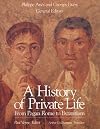
I found the chapters on Rome enlightening and fascinating. This book brings home the brutality of daily Roman life, especially with its descriptions of abandoned infants left to die by the side of the road. It is important when looking at the merits of the Greek and Roman cultures whose heritage we have inherited to take off our rose-colored glasses and see the flip-side as well. This book reveals a lot of history overlooked elsewhere.
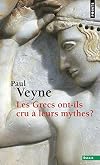
Not an easy book, not at all. Of course, that is a consequence of the subject, or rather the question posed: did the Greeks believe their own myths, did they think they were truly true? Anyone expecting a straightforward answer to this question will be disappointed. The French historian of antiquity, Paul Veyne (1930-2022), rightly points out that concepts like "belief in/of" or "truth" are problematic in themselves, because what exactly do we mean by them? This is therefore, to a certain show more extent, more of a philosophical book that probes the relationship between representation and reality, and thus inevitably falls within the postmodernist sphere.
Veyne primarily examines the work of the historians of antiquity, with Herodotus, Polybius, and Pausanias prominently featured. Through various winding paths, he arrives at the proposition that the Greeks knew that the mythical stories weren't exactly true, as we now understand "true," but they did believe in them, in the sense that they saw them as a coherent whole that made it possible to interpret reality in a way they found transparent and plausible (Veyne uses the term "allegorical"). From this perspective, "believing in/in" comes to mean something quite different than we generally understand in our culture, marked by Jewish exclusivism and Christian dogmatism.
I don't know if "allegorical" is entirely accurate. Because that's where I find a weakness in this book: Veyne refers primarily to texts and narratives when referring to myths, thereby ignoring the broader field of rituals and cults. Perhaps he would have found a shorter path to his conclusion if he had included that in his research. Because in my view rituals and cults – more than stories or texts – are ways to make sense of the surrounding, chaotic reality. They offer greater proximity and consequently more security (in the sense of peace of mind, or knowing where one belongs to) than the more cerebral aspect of narratives. And precisely that security, literally the feeling of being situated in reality, is one of the most important existential needs. Ultimately, what Veyne writes about the difference between believing in/about and being true is correct, but at the same time, he ignores a significant part of human culture. show less
Veyne primarily examines the work of the historians of antiquity, with Herodotus, Polybius, and Pausanias prominently featured. Through various winding paths, he arrives at the proposition that the Greeks knew that the mythical stories weren't exactly true, as we now understand "true," but they did believe in them, in the sense that they saw them as a coherent whole that made it possible to interpret reality in a way they found transparent and plausible (Veyne uses the term "allegorical"). From this perspective, "believing in/in" comes to mean something quite different than we generally understand in our culture, marked by Jewish exclusivism and Christian dogmatism.
I don't know if "allegorical" is entirely accurate. Because that's where I find a weakness in this book: Veyne refers primarily to texts and narratives when referring to myths, thereby ignoring the broader field of rituals and cults. Perhaps he would have found a shorter path to his conclusion if he had included that in his research. Because in my view rituals and cults – more than stories or texts – are ways to make sense of the surrounding, chaotic reality. They offer greater proximity and consequently more security (in the sense of peace of mind, or knowing where one belongs to) than the more cerebral aspect of narratives. And precisely that security, literally the feeling of being situated in reality, is one of the most important existential needs. Ultimately, what Veyne writes about the difference between believing in/about and being true is correct, but at the same time, he ignores a significant part of human culture. show less

There are many important ideas in this book about the nature of historiography, but I felt that it often was too much of a polemic to develop them carefully and clearly for the reader. The book therefore reads as if every single sentences is written in capital letters, followed by multiple exclamation marks.
There are hardly any glimpses of the overall argument during the book, so that one is sucked into dense discussions with sources that one may or may not know, as Veyne presupposes a vast show more amount of knowledge about 20th century sociology and history. It is up to the reader to occasionally rise to the surface to gasp for air and to see where she is in the larger picture that Writing History attempts to sketch.
If one is willing to enter this philosophical roller coaster, one is likely to feel dazzled and surprised, like I do now, but once the dizziness yields, I think that there is a powerful core to be found in Veyne, that ties nominalism to narrative theory, that explains well why history is concerned with the specific and why it will never become a science.
EDIT: a week later, I have started to appreciate the book more. Rereading helps. show less
There are hardly any glimpses of the overall argument during the book, so that one is sucked into dense discussions with sources that one may or may not know, as Veyne presupposes a vast show more amount of knowledge about 20th century sociology and history. It is up to the reader to occasionally rise to the surface to gasp for air and to see where she is in the larger picture that Writing History attempts to sketch.
If one is willing to enter this philosophical roller coaster, one is likely to feel dazzled and surprised, like I do now, but once the dizziness yields, I think that there is a powerful core to be found in Veyne, that ties nominalism to narrative theory, that explains well why history is concerned with the specific and why it will never become a science.
EDIT: a week later, I have started to appreciate the book more. Rereading helps. show less
Veyne is an historian, and his style is largely rhetorical. The book illustrates its points, and argues them through, with examples which only much erudition could provide.
Veyne's book is persuasive by virtue of its warmth, charm, and the infectious self-confidence with which the assertions are made. His examples are illuminating rather than merely informative. Moreover, while the book is not written in the exacting style of an analytical philosopher, it displays much understanding of the show more issues of analytical epistemology, and expresses what seems initially to be an analytically clear position.
Veyne's book is a very fine and fruitful document. It is a major contribution to the literature. show less
Veyne's book is persuasive by virtue of its warmth, charm, and the infectious self-confidence with which the assertions are made. His examples are illuminating rather than merely informative. Moreover, while the book is not written in the exacting style of an analytical philosopher, it displays much understanding of the show more issues of analytical epistemology, and expresses what seems initially to be an analytically clear position.
Veyne's book is a very fine and fruitful document. It is a major contribution to the literature. show less
Lists
Awards


You May Also Like


Associated Authors
Statistics
- Works
- 53
- Also by
- 3
- Members
- 3,276
- Popularity
- #7,813
- Rating
- 3.8
- Reviews
- 31
- ISBNs
- 197
- Languages
- 17
- Favorited
- 2

