
Erik Orsenna
Author of Grammar Is a Sweet, Gentle Song
About the Author
Erik Orsenna is currently director of the International Center of the Sea.
Series
Works by Erik Orsenna
Climat : une planète et des hommes : quelle influence sur le réchauffement climatique (2010) 7 copies
Voyage au pays des bibliothèques : lire aujourd'hui, lire demain : rapport no 2017-35 (2019) — Author — 5 copies
La Mormaire 1 copy
Du mariage aux noces: Souvenirs de Comtesses e lyse ennes: souvenirs de Comtesses e lyse ennes 1 copy
Vive l'océan ! : Deux étés ; L'entreprise des Indes ; Salut au Grand Sud ; Passer par le Nord - La nouvelle route maritime (2017) 1 copy
Dokuz Gitarda Dünya Tarihi 1 copy
Associated Works
Twitterature: The World's Greatest Books Retold Through Twitter (2009) — Preface, some editions — 332 copies, 17 reviews
L'épopée sibérienne : La Russie à la conquête de la Sibérie et du Grand Nord (2018) — Foreword, some editions — 8 copies
La bibliothèque des écrivains: Le livre qui a changé leur vie (2021) — Contributor — 4 copies, 1 review
Tagged
Common Knowledge
- Canonical name
- Orsenna, Érik
- Legal name
- Arnoult, Erik
- Other names
- Arnoult, Eric
- Birthdate
- 1947-03-22
- Gender
- male
- Education
- Institut d'études politique, Paris (Diplôme, 19 68)
Lycée La Bruyère, Versailles - Occupations
- Haut fonctionnaire
Romancier - Organizations
- Académie française (1998)
- Awards and honors
- Prix Goncourt (1988)
- Short biography
- Né en 1947, Érik Orsenna est romancier et membre de l'Académie française. Après des études de philosophie, de sciences politiques et d'économie, il devient enseignant-chercheur, puis docteur d'état en finance internationale et en économie du développement à l'Université de Paris I et à l'École normale supérieure. En 1981, il travaille au ministère de la Coopération, aux côtés de Jean-Pierre Cot. Conseiller culturel à l'Élysée de 1983 à 1984, il seconde Roland Dumas sur les questions africaines au ministère des affaires étrangères, au début des années 1990. Parallèlement maître des requêtes au Conseil d'État en décembre 1985, il est nommé conseiller d'État en 2000. Érik Orsenna fait partie du Haut Conseil de la Francophonie.
Érik Orsenna est l'auteur de nombreux ouvrages, parmi lesquels La Vie comme à Lausanne (Seuil, 1977), prix Roger-Nimier 1978 et L'Exposition coloniale (Seuil, 1988), prix Goncourt 1988. Érik Orsenna a notamment publié Histoire du monde en neuf guitares, avec Thierry Arnoult (Fayard, 1996), Deux étés (Fayard, 1997), Longtemps (Fayard, 1998), Portrait d'un homme heureux : André Le Nôtre (Fayard, 2000), La Grammaire est une chanson douce (Stock, 2001), Madame Bâ (Stock, 2003), Portrait du Gulf Stream : Éloge des courants : promenade (Seuil, 2005), Voyage aux pays du coton : Petit précis de mondialisation (Fayard, 2006) prix du livre d'économie 2007, Salut au Grand Sud, avec Isabelle Autissier (Stock, 2006) et La Révolte des accents (Stock, 2007). - Nationality
- France
- Birthplace
- Paris, France
- Map Location
- France
- Associated Place (for map)
- Paris, France
Members
Reviews
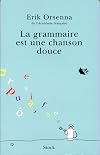
This is an utterly charming little book about the joys of language. Jeanne and her brother, Thomas, are on a sea cruise during their Easter holidays when their ship is wrecked and they wash up on an island. They are so shocked by the disaster they underwent that they have "lost their words" -- fortunately, this island is filled with words that will help them recover. I enjoyed this book immensely. If you enjoy fables or Le petit prince, or if you love to play with language, then you will show more probably like this book.
Many thanks to IrishHolger for pointing out that an English version exists (I did not realize there was one): Grammar is a Sweet Gentle Song: http://www.amazon.ca/Grammar-Is-Sweet-Gentle-Song/dp/0807615315 show less
Many thanks to IrishHolger for pointing out that an English version exists (I did not realize there was one): Grammar is a Sweet Gentle Song: http://www.amazon.ca/Grammar-Is-Sweet-Gentle-Song/dp/0807615315 show less

Orsenna's novel L'exposition coloniale won both the main Prix Goncourt and the Goncourt des Lycéens in 1988. It's a book full of half-buried jokes and false trails, from the title down - although the great Paris Colonial Exhibition of 1931 does (eventually) play a small part in the book, it's the book itself that is an "exhibition" of the history of the foolishly optimistic dreams that were behind the notion of French colonialism from its early days in the 1880s to its collapse at Dien Bien show more Phu in 1954.
That history is mirrored by the life of the main character and sometimes narrator, Gabriel Orsenna, whose father, the dreamy bookseller Louis, spent his early life preparing for a career in the colonies but resigned on the eve of being sent overseas, driven into a panic by everything he had read about tropical diseases.
Gabriel is a little man with a bouncy personality who finds himself attracted from an early age by one of the key colonial commodity products, rubber, and makes his career with a large Clermont-Ferrand-based tyre company, "La Manufacture", which gives Orsenna plenty of opportunities to show us French colonial failures in action. (Obviously, Orsenna doesn't want to infringe the trademarks of any real companies that might be manufacturing tyres in that part of France, but he does drop a few hints that we might find a resemblance between Gabriel and a certain official mascot...) In 1913, he's in Brazil, trying to bring rubber-growing back to life there after it has been all-but wiped out by competition from British plantations in Asia; in the early 50s, he's in the collapsing colony of Indochina, and in between he's with the company's motor-sport department, trying to prove French superiority over the Germans and Italians on the Grand Prix circuit.
However big and all-embracing this book appears to be, it is primarily a book about how the metropolitan French thought of their colonies, not about how colonialism was experienced by the people whose countries they were colonising. Which means that some of the most obvious things you would expect to be said in a book about colonialism simply don't arise: it is normally only with hindsight that large-scale abuses of human rights become part of the general perceptions of people in the countries in whose names they are perpetrated. Although there are good plot reasons for such things not being there, it does occasionally give you an uncomfortable feeling.
This is a lively, chatty sort of book, and it certainly doesn't have the kind of gravitas you might expect from a major doorstep novel by a heavy-duty French intellectual. Everywhere you look, there are querulous footnotes, as Gabriel's wife and sister-in-law read through the manuscript and cast doubt on his assertions; when that joke is wearing a bit thin and we have got used to the false trails that might make this a history of the Orsenna family, had an Orsenna family ever really existed, the author simply throws in some joke character-names. On arrival in England during WWII, for instance, Gabriel is interviewed by an MI5 officer called Cornwell - we're led on along a bogus trail of associations for several pages before he gives the officer the first name "George" and we remember that the real David Cornwell would still have been at school in 1943...
Fun, but perhaps hasn't aged quite as well as it might have. show less
That history is mirrored by the life of the main character and sometimes narrator, Gabriel Orsenna, whose father, the dreamy bookseller Louis, spent his early life preparing for a career in the colonies but resigned on the eve of being sent overseas, driven into a panic by everything he had read about tropical diseases.
Gabriel is a little man with a bouncy personality who finds himself attracted from an early age by one of the key colonial commodity products, rubber, and makes his career with a large Clermont-Ferrand-based tyre company, "La Manufacture", which gives Orsenna plenty of opportunities to show us French colonial failures in action. (Obviously, Orsenna doesn't want to infringe the trademarks of any real companies that might be manufacturing tyres in that part of France, but he does drop a few hints that we might find a resemblance between Gabriel and a certain official mascot...) In 1913, he's in Brazil, trying to bring rubber-growing back to life there after it has been all-but wiped out by competition from British plantations in Asia; in the early 50s, he's in the collapsing colony of Indochina, and in between he's with the company's motor-sport department, trying to prove French superiority over the Germans and Italians on the Grand Prix circuit.
However big and all-embracing this book appears to be, it is primarily a book about how the metropolitan French thought of their colonies, not about how colonialism was experienced by the people whose countries they were colonising. Which means that some of the most obvious things you would expect to be said in a book about colonialism simply don't arise: it is normally only with hindsight that large-scale abuses of human rights become part of the general perceptions of people in the countries in whose names they are perpetrated. Although there are good plot reasons for such things not being there, it does occasionally give you an uncomfortable feeling.
This is a lively, chatty sort of book, and it certainly doesn't have the kind of gravitas you might expect from a major doorstep novel by a heavy-duty French intellectual. Everywhere you look, there are querulous footnotes, as Gabriel's wife and sister-in-law read through the manuscript and cast doubt on his assertions; when that joke is wearing a bit thin and we have got used to the false trails that might make this a history of the Orsenna family, had an Orsenna family ever really existed, the author simply throws in some joke character-names. On arrival in England during WWII, for instance, Gabriel is interviewed by an MI5 officer called Cornwell - we're led on along a bogus trail of associations for several pages before he gives the officer the first name "George" and we remember that the real David Cornwell would still have been at school in 1943...
Fun, but perhaps hasn't aged quite as well as it might have. show less

Wieder einmal Orsenna über ein essentielles, gefährdetes Ding. Diesmal über einen Kontinent, den er, obwohl die Schifsreise und somit ein Großteil des Buches ja nur einen kleinen Zipfel den äußersten Randes abdeckt, vortrefflich beschreibt und nebenbei eine so authentische Mitfahratmosphäre aufkommen lässt, dass man denkt, es sei doch noch eine weitere Kajüte an Bord. Ein typischer Orsenna, vor allem - und Gott sei Dank - im Stil. Hinreißend, sogar auf Deutsch!

L'entreprise des Indes is an historical novel in which we hear about the background to the European "discovery" of the Americas from the point of view of Christopher Columbus's younger brother Bartolomé. In retirement in Santo Domingo in 1511, he is being interviewed by a young Dominican, Bartolomé de las Casas, who is trying to investigate the origins of Spanish cruelty against the Indians. Although Columbus is sickened himself by the atrocities that he has witnessed and failed to show more prevent, he blames the Dominicans for instigating the persecution of the Jews in Spain and Portugal, and isn't much inclined to cooperate with his namesake. Instead he talks about his experiences as a mapmaker in Lisbon, his relationship with his brother, and the various drives that came together to bring about their great "enterprise". He speculates about the nature of exploration and discovery, suggesting that the real motivation for seeking a westward route to China had less to do with commercial exploitation and acquisition of territory (although these were needed as bait to secure royal investment) than with a simple boyish urge to push back boundaries and achieve recognition.
With all this macho conquistadoring going on, there isn't much room for female characters, but during his time in Lisbon, Bartolomé is very preoccupied with the fate of the many sailor's wives in the city (at one point he diversifies from map-making into selling them evidence of their husbands' deaths overseas so that they can remarry) - unmarried himself, in Orsenna's version he seems to become a kind of proxy for his brother's wife, taking over after her death as a mother-figure for his nephew and a "feminine" influence on Christopher, who of course left him behind on his first two voyages.
Entertaining, and nicely done, but I don't think it tells us anything very new about colonialism. show less
With all this macho conquistadoring going on, there isn't much room for female characters, but during his time in Lisbon, Bartolomé is very preoccupied with the fate of the many sailor's wives in the city (at one point he diversifies from map-making into selling them evidence of their husbands' deaths overseas so that they can remarry) - unmarried himself, in Orsenna's version he seems to become a kind of proxy for his brother's wife, taking over after her death as a mother-figure for his nephew and a "feminine" influence on Christopher, who of course left him behind on his first two voyages.
Entertaining, and nicely done, but I don't think it tells us anything very new about colonialism. show less
Lists
Awards


You May Also Like


Associated Authors
Statistics
- Works
- 67
- Also by
- 8
- Members
- 2,209
- Popularity
- #11,610
- Rating
- 3.5
- Reviews
- 54
- ISBNs
- 259
- Languages
- 9
- Favorited
- 3
