
Dionne Brand
Author of What We All Long For
About the Author
Dionne Brand was born in 1953 in Guayguayare, Trinidad and was educated at the University of Toronto and the Ontario Institute for Studies in Education. Brand was the founder and editor of Our Lives, Canada's first newspaper for black women. She has also worked on Fuse Magazine, The Harriet Tubman show more Review, Canadian Women Studies, and Research for Feminist Research. She also belongs to several community organizations including the Immigrant Women's Center and the Caribbean Peoples' Development Agency. Brand's involvement in politics is prevalent in her books, Chronicles of the Hostile Sun, Rivers Have Sources, Trees Have Roots: Speaking of Racism and Primitive Offensive, and Land to Light On, for which she received a Governor General's Award. Brand has also directed Sister's in Struggle, Long Time Comin' and Older, Stronger, Wiser for the National Film Board of Canada. (Bowker Author Biography) show less
Image credit: toronto.ca
Works by Dionne Brand
L'amour, à peu près 1 copy
Associated Works
Daughters of Africa: An International Anthology of Words and Writings by Women of African Descent from the Ancient Egyptian to the Present (1992) — Contributor — 188 copies
Poems Between Women: Four Centuries of Love, Romantic Friendship, and Desire (1997) — Contributor — 97 copies, 1 review
Our Caribbean: A Gathering of Lesbian and Gay Writing from the Antilles (2008) — Contributor — 57 copies, 1 review
Her True-True Name : an anthology of women's writing from the Caribbean (1989) — Contributor — 48 copies
Stories from Blue Latitudes: Caribbean Women Writers at Home and Abroad (2006) — Contributor — 32 copies
So Much Things to Say: 100 Poets from the First Ten Years of the Calabash International Literary Festival (2010) — Contributor — 26 copies, 1 review
Another English: Anglophone Poems from Around the World (Poets in the World) (2014) — Contributor — 11 copies
Tagged
Common Knowledge
- Birthdate
- 1953-01-07
- Gender
- female
- Education
- University of Toronto (BA|English & Philosophy)
University of Toronto (MA|Philosophy of Education) - Occupations
- instructor
poet
writer
director
editor - Organizations
- University of Guelph
Alchemy imprint, Knopf Canada - Awards and honors
- Royal Society of Canada (Fellow, 2006)
Poet Laureate of Toronto (2009, 3-year term)
Order of Canada (2017) - Nationality
- Trinidad and Tobago (birth)
Canada - Birthplace
- Guayaguayare, Trinidad and Tobago
- Places of residence
- Guayaguayare, Trinidad and Tobago
Toronto, Ontario, Canada - Associated Place (for map)
- Toronto, Ontario, Canada
Members
Reviews
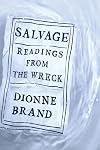
Thoughtful, thought provoking and eye-opening, this book looks at literature that is purportedly "universal" from the perspective of a black woman from a colonized country. Brand reveals the violence inherent in these works to "a reader like her." Made me see the books she talks about in a new light, complicating all that I have been taught about them. This is an important book.
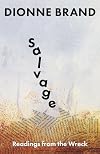
Salvaged from Slavery
A review of the Knopf Canada hardcover edition (August 27, 2024) released simultaneously with the eBook/audiobook.
The central premise here has Trinidadian-Canadian novelist & poet [author:Dionne Brand|88541] (1953-) looking back on her early life and later education and reading. Much of that reading was in the classics, but her focus here is especially the mostly untold background of colonialism and slavery in the time of the growing British Empire and the concurrent show more novels of English literature. The "Wreck" of the title is a metaphor for the colonial past, the "Salvage" is what we can learn from it.
Several novels which were discussed at length here were completely new to me. One of these was Aphra Behn's [book:Oroonoko: or, The History of the Royal Slave|13439163] (1688). [author:Aphra Behn|28778] (1640-1689) is considered the first professional female author and the book as one of the first ever English language novels. Although it has been considered as an anti-slavery novel, the fate of the title character is traumatic and grotesque.
Better known is Daniel Dafoe's [book:Robinson Crusoe|2932] (1719). But if you are reading that book as a castaway adventure story, did you ever pause to think about the fact that Crusoe embarked on his journey because he was on a slavery expedition, and that he had a plantation in Brazil which was worked by slaves? When he finally is rescued from the island after 28 years, he has the accumulated fortune from the plantation's earnings to live on.
Following on from Dafoe, another book that was new to me was J.M. Coetzee's [book:Foe|525544] (1986), which is an alternate version of the Crusoe story introducing a woman castaway to the mix. The resultant assault and rape doesn't make it sound any more appealing.
Other extended sections of the book focused on Jane Austen's [book:Mansfield Park|45032] (1814), Charlotte Brontë's [book:Jane Eyre|10210] (1847) and William Makepeace Thackeray's [book:Vanity Fair|5797] (1847).
There were tangents in the telling here as Brand is also memorializing her early life and absent mother and aunt who left Trinidad to work as nurses in England. So this is a blend of memoir and creative non-fiction. I found it all quite revelatory and I think it will cause many to think back on their lifetime of reading and what were the untold stories behind the texts in the classics.
Trivia and Links
Aphra Behn's Oroonoko is in the Public Domain and can be read online at various sources such as Project Gutenberg or as an audiobook at LibriVox. The antiquated style may not be easy reading, so if you just want a summary you can read it at Wikipedia. show less
A review of the Knopf Canada hardcover edition (August 27, 2024) released simultaneously with the eBook/audiobook.
The central premise here has Trinidadian-Canadian novelist & poet [author:Dionne Brand|88541] (1953-) looking back on her early life and later education and reading. Much of that reading was in the classics, but her focus here is especially the mostly untold background of colonialism and slavery in the time of the growing British Empire and the concurrent show more novels of English literature. The "Wreck" of the title is a metaphor for the colonial past, the "Salvage" is what we can learn from it.
Several novels which were discussed at length here were completely new to me. One of these was Aphra Behn's [book:Oroonoko: or, The History of the Royal Slave|13439163] (1688). [author:Aphra Behn|28778] (1640-1689) is considered the first professional female author and the book as one of the first ever English language novels. Although it has been considered as an anti-slavery novel, the fate of the title character is traumatic and grotesque.
Better known is Daniel Dafoe's [book:Robinson Crusoe|2932] (1719). But if you are reading that book as a castaway adventure story, did you ever pause to think about the fact that Crusoe embarked on his journey because he was on a slavery expedition, and that he had a plantation in Brazil which was worked by slaves? When he finally is rescued from the island after 28 years, he has the accumulated fortune from the plantation's earnings to live on.
Following on from Dafoe, another book that was new to me was J.M. Coetzee's [book:Foe|525544] (1986), which is an alternate version of the Crusoe story introducing a woman castaway to the mix. The resultant assault and rape doesn't make it sound any more appealing.
Other extended sections of the book focused on Jane Austen's [book:Mansfield Park|45032] (1814), Charlotte Brontë's [book:Jane Eyre|10210] (1847) and William Makepeace Thackeray's [book:Vanity Fair|5797] (1847).
There were tangents in the telling here as Brand is also memorializing her early life and absent mother and aunt who left Trinidad to work as nurses in England. So this is a blend of memoir and creative non-fiction. I found it all quite revelatory and I think it will cause many to think back on their lifetime of reading and what were the untold stories behind the texts in the classics.
Trivia and Links
Aphra Behn's Oroonoko is in the Public Domain and can be read online at various sources such as Project Gutenberg or as an audiobook at LibriVox. The antiquated style may not be easy reading, so if you just want a summary you can read it at Wikipedia. show less
"Yes, June collects sadness. What would happen if no one remembered sadness? We’d walk around mutilated and mutilating and not know how we got there or have any remorse."
Perhaps this is as true of the author, Dionne Brand, as it is of June in Love Enough, for characters in In Another Place, Not Here and What We All Long For seem to embody this quality as well.
Love Enough seems to simultaneously rail against this tendency and honour it. It is a mass of contradictions (as is love, itself): show more beautifully and hauntingly expressed.
Throughout the narrative, many characters come up against uncomfortable truths. They have believed something or someone to be true; instead, they have misunderstood.
"If you were to notice every small physical gesture of an individual person and if you observed those small gestures over the course of a year and a half, say, and if you were to lose that person you should be able to find that person. Like tracking the genome sequence, but the genome sequence of gestures. You should be able to find that person. You should."
You should. You should be able to.
But the implication is that you cannot.
But, why not?
Perhaps we are tracking the wrong trail.
"As we all do, June had expected her own reflection in the lover’s face. Her reflection being a benign understanding. But the lover’s face, in the end, was fierce and foreign. It wasn’t the same person. Not someone June knew at all."
A novel about the nature of love might be sprawling to afford the opportunity to contain all those unanswerable questions, but Dionne Brand is a poet. One expects precision of language and Love Enough exhibits this. A single sentence, for all its simplicity, may have been laboured on for hours. (Another contradiction.)
"The woman loves being loved, more than she loves. That the man loves her is more compelling than whether she loves him. But sometimes, as now, she is overwhelmed by this love and breaks off to the lake or to the red underwings of a black bird."
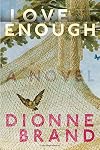
Some of the statements seem also mythic in their universality. And the philosophical link between love and freedom (strikingly illustrated on the cover), connection and disconnection, is explored in layers. "To be lost or to be free."
"They weren’t old men really, his father and his uncle, but they seemed old because of how their life was. It was all in the past tense. And when they told him what he should do, he felt as it they were welcoming him to some petrified life. So he had separated himself from them, separated himself from the grim warmth around the counter at Bilan. He felt left."
With such exacting prose, it's ironic that chaos lurks beneath. Disorder. Happiness?
"And people with ordered lives always think that people whose lives are in disorder are looking for their kind of order. They think their kind of order is happiness, when their kind of order is gluttony and selfishness. And with all this order, June thinks, we are creating wreckage and disorder, piling it up like a midden."
There lies a midden of emotions.
"Then is when she decided that you had to keep the noise of other people out of you. This is when she knew the only recourse was to watch and wait. Wait, because you can’t change people, you can only change yourself."
With those you love, you must disconnect. And yet there is cost not only with the unfiltered noise of love, but also with the protective layer of silence.
"He’s disappeared into the elements of mayhem and randomness. They are indeed elements, June thinks, like iron or mercury. Of course June knows she’s being a little precious. She laughs at herself out loud. Right now she is probably an odd-looking woman in the coffee shop. She looks around and laughs again. Everybody in the coffee shop is odd-looking except those who have someone sitting across from them talking. Companionship makes you look sane."
Is it even about love? Perhaps, something else? Perhaps survival.
"You have to survive people. You meet people and sometimes you have no control of that, and then it’s a simple matter of waiting them out."
Sometimes the shortest sentences contain the greatest amount of confusion: "(No one thinks they’ve been loved enough.)"
What one character muses is true, too, of a novel like Love Enough. "It is hard if you really want to do it right."
It's very difficult to produce a tightly honed novel on a subject which suggests that any book considering the matter should be the length of Anna Karenina or Kristin Lavransdatter.
Dionne Brand makes it look easy.
This review originally appeared on BuriedInPrint. show less
Perhaps this is as true of the author, Dionne Brand, as it is of June in Love Enough, for characters in In Another Place, Not Here and What We All Long For seem to embody this quality as well.
Love Enough seems to simultaneously rail against this tendency and honour it. It is a mass of contradictions (as is love, itself): show more beautifully and hauntingly expressed.
Throughout the narrative, many characters come up against uncomfortable truths. They have believed something or someone to be true; instead, they have misunderstood.
"If you were to notice every small physical gesture of an individual person and if you observed those small gestures over the course of a year and a half, say, and if you were to lose that person you should be able to find that person. Like tracking the genome sequence, but the genome sequence of gestures. You should be able to find that person. You should."
You should. You should be able to.
But the implication is that you cannot.
But, why not?
Perhaps we are tracking the wrong trail.
"As we all do, June had expected her own reflection in the lover’s face. Her reflection being a benign understanding. But the lover’s face, in the end, was fierce and foreign. It wasn’t the same person. Not someone June knew at all."
A novel about the nature of love might be sprawling to afford the opportunity to contain all those unanswerable questions, but Dionne Brand is a poet. One expects precision of language and Love Enough exhibits this. A single sentence, for all its simplicity, may have been laboured on for hours. (Another contradiction.)
"The woman loves being loved, more than she loves. That the man loves her is more compelling than whether she loves him. But sometimes, as now, she is overwhelmed by this love and breaks off to the lake or to the red underwings of a black bird."
Some of the statements seem also mythic in their universality. And the philosophical link between love and freedom (strikingly illustrated on the cover), connection and disconnection, is explored in layers. "To be lost or to be free."
"They weren’t old men really, his father and his uncle, but they seemed old because of how their life was. It was all in the past tense. And when they told him what he should do, he felt as it they were welcoming him to some petrified life. So he had separated himself from them, separated himself from the grim warmth around the counter at Bilan. He felt left."
With such exacting prose, it's ironic that chaos lurks beneath. Disorder. Happiness?
"And people with ordered lives always think that people whose lives are in disorder are looking for their kind of order. They think their kind of order is happiness, when their kind of order is gluttony and selfishness. And with all this order, June thinks, we are creating wreckage and disorder, piling it up like a midden."
There lies a midden of emotions.
"Then is when she decided that you had to keep the noise of other people out of you. This is when she knew the only recourse was to watch and wait. Wait, because you can’t change people, you can only change yourself."
With those you love, you must disconnect. And yet there is cost not only with the unfiltered noise of love, but also with the protective layer of silence.
"He’s disappeared into the elements of mayhem and randomness. They are indeed elements, June thinks, like iron or mercury. Of course June knows she’s being a little precious. She laughs at herself out loud. Right now she is probably an odd-looking woman in the coffee shop. She looks around and laughs again. Everybody in the coffee shop is odd-looking except those who have someone sitting across from them talking. Companionship makes you look sane."
Is it even about love? Perhaps, something else? Perhaps survival.
"You have to survive people. You meet people and sometimes you have no control of that, and then it’s a simple matter of waiting them out."
Sometimes the shortest sentences contain the greatest amount of confusion: "(No one thinks they’ve been loved enough.)"
What one character muses is true, too, of a novel like Love Enough. "It is hard if you really want to do it right."
It's very difficult to produce a tightly honed novel on a subject which suggests that any book considering the matter should be the length of Anna Karenina or Kristin Lavransdatter.
Dionne Brand makes it look easy.
This review originally appeared on BuriedInPrint. show less
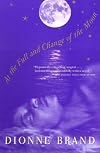
I SOBBED. I love Dionne Brand's writing even when I didn't love what she was writing about! Are we all just a speck in Marie Ursule's dream, reflected in the ocean of her daughter's eye?
Lists
Awards


You May Also Like


Associated Authors
Statistics
- Works
- 35
- Also by
- 20
- Members
- 1,606
- Popularity
- #16,050
- Rating
- 3.7
- Reviews
- 34
- ISBNs
- 103
- Languages
- 3
- Favorited
- 4
