
Guillem d' Ockham (1287–1347)
Author of Ockham - Philosophical Writings: A Selection
About the Author
William of Ockham was a Franciscan at Oxford. He came just short of receiving his theology degree; he was never able to undertake the necessary year of teaching because of the long list of those waiting and the opposition of his enemy, John Lutterel. From 1320 to 1324, he taught and wrote at the show more London Studium, the private school of his order. He was summoned to Avignon in 1324 on charges of heresy and became involved there in the dispute over Franciscan poverty. In 1328 Ockham fled with Michael of Cesena, general of his order, was excommunicated, and took refuge in Munich with Duke Ludwig of Bavaria, who had also been excommunicated. From there he engaged in an extensive polemic against Pope John XXII and his successors, writing numerous political works. Ockham's metaphysics and his logic are closely connected because of his deployment of "Ockham's razor," the notion that we should not suppose that more things exist than are needed to explain the meaning of true sentences. Very often his arguments hang on the logical analysis of a sentence, revealing its logical structure and making it clear that some questionable entity, something other than a word or an individual thing, is not referred to in it. His philosophy is marked by nominalism. He rejected the notion that we somehow or other get the forms of things themselves into our intellect, attacking especially Scotist attempts to hold on to this view using the "formal distinction." Instead, he held that our concepts were like mental words, with a natural capacity to signify their objects but in no way to be identified with their objects. This led to a strong skeptical current among his followers. (Bowker Author Biography) show less
Works by Guillem d' Ockham
Texte zur Theorie der Erkenntnis und der Wissenschaft: Lateinisch/Deutsch (Universal-Bibliothek) (1984) 17 copies
Breviloqui sobre el principat tirànic damunt les coses divines i humanes- i en especial damunt els súbdits de l'imperi- usurpat pels anomenats suprems… (1981) 10 copies, 1 review
Summa logicae 8 copies
Ockham on Aristotle's Physics : a translation of Ockham's Brevis summa libri physicorum (1989) 8 copies
Guillelmi de Ockham : Scriptum in Librum Primum Sententiarum, Ordinatio, Opera Theologica, Prologues et Distinctio Prima (1967) 7 copies
Evidente kennis en theologische waarheden (proloog van de commentaar op de Sententiën, quaestio I) (1984) 7 copies
Kurze Zusammenfassung zu Aristoteles' Büchern über Naturphilosophie = (Summulae in libros physicorum) (1987) 7 copies
A Compendium of Ockham's Teachings: A Translation of the Tractatus de Principiis Theologiae (1998) 6 copies
Filosofia teologia politica 1 copy
Guillelmi de Ockham: Expositio in Libros Physicorum, Bks. IV-VIII (Guillelmi de Ockham) (1985) 1 copy
Somme de logique 1 copy
Ockham 1 copy
Guillemi De Ockham, Scriptum in Librum Primum Sententiarum Ordination (Dist. XIX=XLVIII) (Latin Edition) (1979) 1 copy
Lógica dos termos 1 copy
Principios de Teología 1 copy
Opera Philosophica Vol IV: Expositio in Libros Physicorum Aristotelis: Prologus & Libri I-III 1 copy
Somme de logique 1 copy
Sobre la suposición 1 copy
Despre universalii 1 copy
Guillelmi de Ockham: Quaestiones Variar, Questions I-8 (Guillelmi de Ockham) (Latin Edition) (1983) 1 copy
Seleção de textos 1 copy
Francis of Assisi's Cat 1 copy
Associated Works
Philosophy in the Middle Ages: The Christian, Islamic, and Jewish Traditions (1983) — Contributor — 493 copies, 2 reviews
The Sheed and Ward Anthology of Catholic Philosophy (A Sheed & Ward Classic) (2005) — Contributor — 34 copies
Tagged
Common Knowledge
- Canonical name
- William of Ockham
- Other names
- William of Occam
Gulielmus Occamus
Guillermo de Ockham
Guillermo de Occam - Birthdate
- 1287
- Date of death
- 1347-04-09
- Gender
- male
- Education
- University of Oxford
- Occupations
- Franciscan Friar
scholastic philosopher
theologian
mathematician - Organizations
- Order of Friars Minor
- Nationality
- England
- Birthplace
- Ockham, Surrey, Inglaterra.
- Place of death
- Múnich, Baviera, Alemania.
- Associated Place (for map)
- England
Members
Reviews
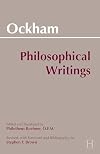
Philosophies centered on epistemology and exercises in logic are not always the most enthralling, but Ockham is good reading in order to keep one's deductive reasoning sharp. Aquinas is very similar, as are most of the medieval philosophers. They usually tackle the same questions without necessarily coming to the same conclusions. The Aristotelian language does wear on the patience from time to time. I'm more of a Platonist, but I am willing to grant Aristotle some amount of respect.

SOBRE EL GOBIERNO TIRÁNICO DEL PAPA
Estamos asistiendo al descubrimiento del Guillermo de
Ockham político. Su obra política es hoy objeto de
investigación y crítica con la misma intensidad que otras
épocas estudiaron su obra teológica. Ockham se ha
convertido en autor imprescindible para interpretar la
ciencia, la teología, la filosofía y la moral modernas. A lo
largo del siglo XX va surgiendo su perfil de político original
y valioso.
El punto de partida de Ockham son los hechos show more concretos,
personas con nombre propio, situaciones y con
ductas particulares de la sociedad medieval del siglo XIV
A ellos aplica una reflexión realizada desde la razón y la
fe. Su show less
Estamos asistiendo al descubrimiento del Guillermo de
Ockham político. Su obra política es hoy objeto de
investigación y crítica con la misma intensidad que otras
épocas estudiaron su obra teológica. Ockham se ha
convertido en autor imprescindible para interpretar la
ciencia, la teología, la filosofía y la moral modernas. A lo
largo del siglo XX va surgiendo su perfil de político original
y valioso.
El punto de partida de Ockham son los hechos show more concretos,
personas con nombre propio, situaciones y con
ductas particulares de la sociedad medieval del siglo XIV
A ellos aplica una reflexión realizada desde la razón y la
fe. Su show less
Apr 23, 2024Spanish


You May Also Like


Associated Authors
Statistics
- Works
- 90
- Also by
- 4
- Members
- 890
- Popularity
- #28,790
- Rating
- 3.7
- Reviews
- 4
- ISBNs
- 86
- Languages
- 10
- Favorited
- 4
