
Leonora Carrington (1917–2011)
Author of The Hearing Trumpet
About the Author
Disambiguation Notice:
Do not confuse with painter Dora de Houghton Carrington (1893-1932).
Works by Leonora Carrington
My Flannel Knickers 3 copies
White Rabbits 3 copies
Historias de ensueño 1 copy
The Debutante 1 copy
Shantih : Vol. I, No. 3 1 copy
Penelope 1 copy
Associated Works
Wayward Girls and Wicked Women: An Anthology of Subversive Stories (1986) — Contributor — 576 copies, 9 reviews
Sisters of the Revolution: A Feminist Speculative Fiction Anthology (2015) — Contributor — 343 copies, 8 reviews
The Penguin Book of Modern Fantasy by Women (1995) — Cover artist, Contributor — 172 copies, 3 reviews
Queens of the Abyss: Lost Stories from the Women of the Weird (2020) — Contributor — 155 copies, 4 reviews
What Did Miss Darrington See? An Anthology of Feminist Supernatural Fiction (1989) — Contributor — 126 copies
From Flaubert to the Present: French Stories — Contributor — 3 copies
SFファンタジイ大全集 (別冊奇想天外 10) — Contributor — 1 copy
Tagged
Common Knowledge
- Canonical name
- Carrington, Leonora
- Legal name
- Carrington, Mary Leonora
- Other names
- Prim (childhood nickname)
- Birthdate
- 1917-04-06
- Date of death
- 2011-05-26
- Gender
- female
- Education
- Chelsea School of Art
Ozenfant Academy of Fine Arts
Mrs. Penrose's Academy of Art, Florence - Occupations
- painter
novelist
short story writer
sculptor
memoirist - Awards and honors
- Order of the British Empire (Officer, 2000)
National Arts Prize of the National Institute of Fine Arts (2005) - Relationships
- Ernst, Max (lover)
Weisz, Emerico (spouse)
Leduc, Renato (spouse)
Moorhead, Joanna (second cousin)
Ozenfant, Amédée (teacher)
Edgeworth, Maria (ancestor) (show all 8)
Weisz Carrington, Gabriel (son)
Weisz Carrington, Pablo (son) - Short biography
- Leonora Carrington was born to an Anglo-Irish family in Clayton Green, Lancashire, England. Her parents were Marie (Moorhead) and Harold Wylde Carrington, a wealthy textile manufacturer, and she had three brothers. She was educated by governesses and attended two convent boarding schools, but was expelled for rebellious behavior. In 1935, her mother sent her to Chelsea School of Art in London for a year; she transferred to the Ozenfant Academy of Fine Arts established by French modernist Amédée Ozenfant. She then went to Florence, Italy, where she attended Mrs. Penrose's Academy of Art. Her father opposed her desire to pursue a career as an artist and writer, but her mother encouraged her and gave her a copy of Herbert Read's book Surrealism. In 1937, 19-year-old Carrington met German Surrealist artist Max Ernst, 26 years her senior, at a party in London, after which Ernst separated from his wife and ran off with Carrington. The couple went to live in a small farmhouse in Saint-Martin-d'Ardèche in the Rhône Valley of France, where they began to collaborate and support each other's artistic development. They painted and sculptured guardian animals to decorate their home, and made portraits of each other. At this time, Carrington completed her first major painting Self-Portrait (Inn of the Dawn Horse), now at the Metropolitan Museum of Art in New York City. After Nazi Germany invaded France in World War II, Ernst was arrested by the Gestapo, but managed to escape and flee to the USA with the help of Peggy Guggenheim. Carrington was devastated. She was persuaded to go to Spain, where she had a mental breakdown and was institutionalized. She was given electro-convulsive therapy and treated with the drugs Cardiazol and Luminal. This experience would influence her artistic and written works, for example, her 1944 memoir Down Below and her paintings Portrait of Dr. Morales (1940), Green Tea (1942), and Map of Down Below (1943). Carrington was released from the asylum into the care of a keeper sent by her family, whom she eluded in Lisbon. She made a marriage of convenience with Mexican poet Renato Leduc and in 1942, arrived in Mexico City, which already had a large community of European refugees from the Nazis. She remarried to Hungarian photographer Emerico "Chiki" Weisz, with whom she had two sons. After seven years, she held the first solo exhibition of her art at the Galeria Clardecor, and became famous almost overnight. She is considered to have feminised Surrealism by bringing a woman's perspective to what was otherwise a male-dominated artistic movement. She was also a founding member of the women's liberation movement in Mexico during the 1970s. Her best-known novel The Hearing Trumpet (1974) was reissued in 2021. At her death, she left behind an immense body of work: novels, prints, plays, costumes, and hundreds of sculptures and paintings.
- Cause of death
- pneumonia
- Nationality
- UK (birth)
Mexico (naturalized 1942) - Birthplace
- Clayton-le-Woods, Leyland, Lancashire, England, UK
- Places of residence
- Florence, Italy
London, England, UK
Paris, France
Mexico City, Mexico
New York, New York, USA
Spain (show all 9)
Westwood House, Clayton-le-Woods, Leyland, Lancashire England, UK
Hazelwood Hall, Morecambe, Lancashire, England, UK
Saint-Martin-d'Ardèche, France - Place of death
- Mexico City, Mexico
- Burial location
- Panteón Inglés, Mexico City, Mexico
- Map Location
- Mexico
- Disambiguation notice
- Do not confuse with painter Dora de Houghton Carrington (1893-1932).
Members
Reviews
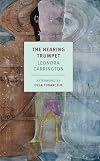
Wonderfully weird tale of a very old woman consigned to a fantastical facility, the people she encounters there, and the adventures they have. It's full of strong-willed characters navigating old age and a very strange universe. Carrington's writing here has exactly the right surrealism-to-logic proportions to keep the book from spiraling out into whimsy—it's funny and dark, but never silly. It made for a great book club discussion, especially for all of us ladies of a certain age. show more Definitely recommended if you're one of those. show less

This is a wild and wonderful fable about some amazing old ladies! It begins when Marian Leatherby’s friend Carmella gives her a hearing trumpet, so that she is now able to hear that her family is sending her to an old folks home. But what an old folks home it is! The residents are housed in a strange array of concrete outbuildings that I visualized as a giant miniature golf course. And that’s before things get weird.
“All this is a digression and I do not wish anyone to think my mind show more wanders far, it wanders but never further than I want.”
Toss in the venal New Age-y owners of the nursing home who encourage residents to do the Work of Self Remembering, a cast of whacky old women, a winking Abbess, the Knights Templar, the Holy Grail, and even more progressively surreal events, and it’s like Foucault’s Pendulum in Wonderland, only hilarious.
“One would not have expected these kinds of problems in a home for senile old ladies.” Indeed. show less
“All this is a digression and I do not wish anyone to think my mind show more wanders far, it wanders but never further than I want.”
Toss in the venal New Age-y owners of the nursing home who encourage residents to do the Work of Self Remembering, a cast of whacky old women, a winking Abbess, the Knights Templar, the Holy Grail, and even more progressively surreal events, and it’s like Foucault’s Pendulum in Wonderland, only hilarious.
“One would not have expected these kinds of problems in a home for senile old ladies.” Indeed. show less
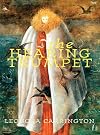
The original Latin root for 'obedience' is obaudire. It can be translated as ‘standing by, ready to listen’. Don’t let it fool you, The Hearing Trumpet is drenched in anarchism.
Its timeless rebelliousness appears as matter of fact and is of the healthiest kind: the stabbing social commentary sustains a very low level of venom and the narrator’s tone remains stately even when things get violent (it’s Mrs Carrington's signature trait, I am told). The novel follows the surrealist show more tradition with grace and without the usual self-indulgence that plagues the art of this variety. It’s all genuine, free-spirited and plain awesome sabbath of the weird; the bizarre imagery bleeds into the book’s reality gradually, in increasingly incisive bursts, but never diminishes the idea behind it. Even the now-familiar White Goddess tropes are delivered with flair and same thing can be said about the amazing finale in which, not to reveal too much, the order of things becomes somewhat re-oriented.
The book is full of brilliantly subtle comic characterizations but one truly unforgettable character is Remedios Varo-inspired Carmella: an avid loud-thinker and a red-wig wearing proto-riot girl in her 80’s. She steals the show every single time she appears.
Wild at heart and weird on top, this endlessly inventive book about elderly ladies has aged much better (if at all) than you’d think surrealist writing could. It may be not exactly my cup of tea but I can recognize a genius when I see one.
Read it and live free or die hard. show less
Its timeless rebelliousness appears as matter of fact and is of the healthiest kind: the stabbing social commentary sustains a very low level of venom and the narrator’s tone remains stately even when things get violent (it’s Mrs Carrington's signature trait, I am told). The novel follows the surrealist show more tradition with grace and without the usual self-indulgence that plagues the art of this variety. It’s all genuine, free-spirited and plain awesome sabbath of the weird; the bizarre imagery bleeds into the book’s reality gradually, in increasingly incisive bursts, but never diminishes the idea behind it. Even the now-familiar White Goddess tropes are delivered with flair and same thing can be said about the amazing finale in which, not to reveal too much, the order of things becomes somewhat re-oriented.
The book is full of brilliantly subtle comic characterizations but one truly unforgettable character is Remedios Varo-inspired Carmella: an avid loud-thinker and a red-wig wearing proto-riot girl in her 80’s. She steals the show every single time she appears.
Wild at heart and weird on top, this endlessly inventive book about elderly ladies has aged much better (if at all) than you’d think surrealist writing could. It may be not exactly my cup of tea but I can recognize a genius when I see one.
Read it and live free or die hard. show less

“Do you believe that the past dies?”
“Yes, if the present cuts its throat.”
The form is fables, folk and fairy tales; the feel is fantastical, dream-like, surreal (in the original sense, per André Breton, as behind or beneath sensory consciousness, where lies the ominous and the absurd). These stories are weird and wild like Carrington’s paintings—there are equine homunculi with vulgar passions, spooky soothsaying birds, a fountain full of stupefied bees and allusions to Alfred show more Jarry (‘Mr. MacFrolick offered me a china dish on which rested his own moustache’). A family of hunters, cursed ever after a grandfather broke wind during his first communion ceremony, displays its trophies in a long lamp-lit gallery ‘consisting only of sausages: sausages in aquariums, sausages in cages, sausages hanging on the walls, sausages in sumptuous glass boxes.’ Carrington was a connoisseur of eccentric collections and the frisson of contraries—verdant decay, exhausted innocence, the mundane miraculous.
About a hundred yards from the Church of Saint Alexander there was what he called “my garden of the little Flowers of Mortification.” This consisted of a number of lugubrious instruments half buried in the earth: chairs made of wire (“I sit in them when they’re white-hot and stay there until they cool off”); enormous, smiling mouths with pointed, poisonous teeth; underwear of reinforced concrete full of scorpions and adders; cushions made of millions of black mice biting one another—when the blessed buttocks were elsewhere.
Most of the stories were written in the late 1930s & early 1940s but seem to come from a timeless wellspring. The handful of stories composed from the 1950s onward more often refer (if only obliquely) to the contemporaneous world and are less cryptic and more satirical.
The Head of the Psychoanalytical Association, Dr. Siegried Laftnalger, received the gift of the Rats in the shadow of the monument to Semi-Applied and Metaphorical Science. This monument, recognized around the world as unique, consists of three heroes and a horse triumphantly penetrating a streptococcus culture. show less
“Yes, if the present cuts its throat.”
The form is fables, folk and fairy tales; the feel is fantastical, dream-like, surreal (in the original sense, per André Breton, as behind or beneath sensory consciousness, where lies the ominous and the absurd). These stories are weird and wild like Carrington’s paintings—there are equine homunculi with vulgar passions, spooky soothsaying birds, a fountain full of stupefied bees and allusions to Alfred show more Jarry (‘Mr. MacFrolick offered me a china dish on which rested his own moustache’). A family of hunters, cursed ever after a grandfather broke wind during his first communion ceremony, displays its trophies in a long lamp-lit gallery ‘consisting only of sausages: sausages in aquariums, sausages in cages, sausages hanging on the walls, sausages in sumptuous glass boxes.’ Carrington was a connoisseur of eccentric collections and the frisson of contraries—verdant decay, exhausted innocence, the mundane miraculous.
About a hundred yards from the Church of Saint Alexander there was what he called “my garden of the little Flowers of Mortification.” This consisted of a number of lugubrious instruments half buried in the earth: chairs made of wire (“I sit in them when they’re white-hot and stay there until they cool off”); enormous, smiling mouths with pointed, poisonous teeth; underwear of reinforced concrete full of scorpions and adders; cushions made of millions of black mice biting one another—when the blessed buttocks were elsewhere.
Most of the stories were written in the late 1930s & early 1940s but seem to come from a timeless wellspring. The handful of stories composed from the 1950s onward more often refer (if only obliquely) to the contemporaneous world and are less cryptic and more satirical.
The Head of the Psychoanalytical Association, Dr. Siegried Laftnalger, received the gift of the Rats in the shadow of the monument to Semi-Applied and Metaphorical Science. This monument, recognized around the world as unique, consists of three heroes and a horse triumphantly penetrating a streptococcus culture. show less
Lists
Awards


You May Also Like


Associated Authors
Statistics
- Works
- 50
- Also by
- 21
- Members
- 3,527
- Popularity
- #7,200
- Rating
- 3.9
- Reviews
- 93
- ISBNs
- 116
- Languages
- 11
- Favorited
- 20