
Hugo von Hofmannsthal (1874–1929)
Author of The Lord Chandos Letter and Other Writings
About the Author
Hofmannsthal's plays are all written in verse, and most are modernized adaptations from other dramatists. His masterpiece, Electra (1903), was set to music by Richard Strauss. Dramas such as Jedermann (1911) and The Tower (1925, o.p.) showed him to be a serious and responsible social critic: their show more "deep symbolism is pervaded by an uncanny insight into the demonic forces and potentialities of our century" (LJ). With Max Reinhardt, Hofmannsthal helped to found the Salzburg Festival of music and theater, which is still an annual event. He also collaborated successfully with Strauss, despite their divergent personalities and mutually preferred habit of working at a distance, through the mails. Hofmannsthal wrote the libretti for Strauss's Der Rosenkavalier, Ariadne auf NaxosDer Rosenkavalier, Ariadne auf Naxos, and Die Frau ohne Schatten. In his poetry, almost all written in his early twenties, Hofmannsthal proved himself to be the most socially sensitive of the Viennese poets of the 1890s. A traditionalist writing in an era of experimentation, he wrote meditations on the theme of transience, noted for their elevated diction and technical perfection. (Bowker Author Biography) show less
Image credit: Photo © ÖNB/Wien
Series
Works by Hugo von Hofmannsthal
The Metropolitan Opera classics library : Strauss : Der Rosenkavalier (1971) — Librettist — 43 copies, 1 review
A working friendship; the correspondence between Richard Strauss and Hugo von Hofmannsthal (1970) 33 copies
Deutsche Erzähler. Erster Band. ( Bd 1. ). Ausgewählt und eingeleitet von Hugo von Hofmannsthal. (1994) 30 copies
Gesammelte Werke in zehn Einzelbänden. Bd. 7. Erzählungen. Erfundene Gespräche und Briefe. Reisen (1979) 16 copies
Gesammelte Werke in zehn Einzelbänden. Bd. 10. Reden und Aufsätze III (1925–1929). Aufzeichnungen (1980) 6 copies
Electre - Le Chevalier à la rose - Ariane à Naxos (édition bilingue français-allemand) (2002) 6 copies
La donna senz'ombra e altri racconti 4 copies
Gesammelte Werke in zehn Einzelbänden. Band 6: Dramen, 6.: Ballette, Pantomimen, Bearbeitungen, Ubersetzungen (1979) 3 copies
Liriche e drammi 3 copies
Gesammelte Werke in Einzelausgaben 3 copies
Opern der Welt : Textbuch : Einführung und Kommentar : Strauss : Der Rosenkavalier (1985) — Librettist — 3 copies
Lustspiele 3 copies
Briefwechsel mit Max Rychner, mit Samuel und Hedwig Fischer, Oscar Bie und Moritz Heimann (1973) 3 copies
Früheste Prosastücke 3 copies
Viaggi e saggi 2 copies
Corona |1. Jg./1930, Heft 2 2 copies
Die Frau ohne Schatten : Erzählungen — Author — 2 copies
Prosa III 2 copies
Beethoven 2 copies
Deutsche Erzähler Erster Band. / Ausgewählt und eingeleitet von Hugo von Hofmannsthal (2022) 2 copies
Seçme Yazılar 2 copies
Die Berührung der Sphären 2 copies
1890-1901 2 copies
Sämtliche Werke (Kritische Ausgabe). 2 copies
Elektra [libretto : IPA master] — Librettist — 2 copies
Loris 2 copies
Nachlese der Gedichte 2 copies
Opern der Welt : Textbuch : Einführung und Kommentar : Strauss : Elektra (1995) — Librettist — 1 copy
The Tower 1 copy
La torre. 1 copy
Essays und Reden 1 copy
Die Erzh̃lungen 1 copy
Il libro degli amici 1 copy
Die Frau im Fenster. Die Hochzeit der Sobeide. Der Abenteurer und die Sängerin. Theater in Versen 1 copy
Deutsche Erzähler 1 copy
Hugo Von Hofmannsthal 1 copy
Briefwechsel 1898-1929 1 copy
Die Frau ohnr Schatten 1 copy
Poezii 1 copy
Gesammelte Werke Prosa IV 1 copy
Gesammelte Werke Prosa III 1 copy
Gesammelte Werke Prosa I 1 copy
ÇDOKUSHI 1 copy
Vijf vroege verzen 1 copy
Briefe 1900 - 1909 1 copy
Cartas Para Este Tempo 1 copy
1900-1909 1 copy
Briefe 1 copy
Piccoli drammi 1 copy
Strauss : Elektra + Salome [libretto] — Librettist — 1 copy
Deutsche Epigramme 1 copy
Er liess schlagen eine Brucken : Prinz Eugen, Feldherr, Staatsmann und der Künste Freund (1963) 1 copy
Ausgewählte Werke — Author — 1 copy
Florindo 1 copy
Konjička priča i druga proza 1 copy
SECME YAZILAR 1 copy
Associated Works
Spells of Enchantment: The Wondrous Fairy Tales of Western Culture (1991) — Contributor — 603 copies, 5 reviews
World Poetry: An Anthology of Verse from Antiquity to Our Time (1998) — Contributor — 496 copies, 2 reviews
Die Erzählungen aus den Tausendundein Nächten, 6 Bde. in 12 Tl.-Bdn. (1953) — Introduction — 74 copies, 1 review
The Dedalus/Ariadne Book of Austrian Fantasy: The Meyrink Years 1890-1930 (1992) — Contributor — 28 copies
Die Erzählungen aus den Tausendundein Nächten (Band 1) — Introduction — 9 copies
Schillers Selbstcharakteristik : aus seinen Schriften nach einem älteren Vorbild neu herausgegeben (2004) — Editor — 5 copies
Bij de uitverkorenen vertalingen uit het oeuvre van geliefde dichters — Contributor — 2 copies
Elektra [vocal score] — Libretto — 2 copies
Strauss : Der Rosenkavalier {video recording} {2015 film} {Glyndebourne} (2015) — Librettist — 1 copy
Der Rosenkavalier {opera companion} — Original story — 1 copy
Elektra [score] — Libretto — 1 copy
Lebensgut — Ein deutsches Lesebuch für Mädchen — 5. Teil (9. Schuljahr) — Contributor — 1 copy
50 seltsame Geschichten — Contributor — 1 copy
L'Oeuvre de Balzac, Tome 07 : La comédie Humaine, Etudes de Mœurs au XIXe siècle (1962) — Introduction, some editions — 1 copy
Tagged
Common Knowledge
- Canonical name
- von Hofmannsthal, Hugo
- Legal name
- von Hofmannsthal, Hugo Laurenz August Hofmann, Edler
- Other names
- Loris (pseudonym)
Melikow, Loris (pseudonym)
Morren, Theophil (pseudonym) - Birthdate
- 1874-02-01
- Date of death
- 1929-07-15
- Gender
- male
- Education
- Akademisches Gymnasium, Vienna, Austro-Hungarian Empire
University of Vienna (laws, French philology) (Dr. phil. 1898) - Occupations
- poet
dramatist
essayist
librettist
novelist - Relationships
- Andrian, Leopold von (friend)
Rilke, Rainer Maria (friend)
Strauss, Richard (friend) - Nationality
- Austria
- Birthplace
- Landstraße, Vienna, Austria, Austro-Hungarian Empire
- Places of residence
- Vienna, Austro-Hungarian Empire
Rodaun, Austria - Place of death
- Rodaun, Austria
- Burial location
- Kalksburg cemetery, Vienna, Austria (group 1, number 49)
- Associated Place (for map)
- Austria
Members
Reviews
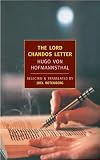
Hofmannsthal is probably best known as the librettist for Richard Strauss. His single most famous prose work is likely the Lord Chandos Letter which is collected here with a number of his stories. The Lord Chandos Letter purports to be a letter from Chandos to Francis Bacon explaining why he has given up writing. Briefly put, he has concluded that language is unable to adequately express the human experience. Written in 1902, I can see why it is very important in intellectual history, but show more although a fascinating piece of writing, I didn’t particularly “enjoy” it. The stories collected with it in my book ranged from the downright weird to the excellent. Most are haunting in some way, all are quite impressionistic. Regardless of story, the protagonists generally live in some sort of dream world always accompanied by an undefinable sense of foreboding and dread. show less
Le parole non sono di questo mondo. Lettere al guardiamarina E. K., 1892-1895 by Hugo von Hofmannsthal
Scrivere di Hofmannsthal non è difficile, perchè non si può che dire bene di un autore cosi' giovane, così limpido, così accurato. Ma non è neppure facile, poichè le corde dell'anima che tocca - con affondi inaspettati - risultano frastornate dalle riflessioni del poeta. Il testo è costituito da una raccolta di lettere che l'autore (diciottenne) e il guardiamarina Edgar Karg (ventenne) si sono scambiati nel corso di tre anni, dal 1892 al 1895. Passate le prime schermaglie di show more reciproca conoscenza, le lettere (comprese le risposte di Karg) si susseguono in un crescendo di confidenze, di riflessioni, di dubbi che scorrono dal più anziano al più giovane, che nel cercare risposte all'amico dà immagini mirabili del suo stesso sentire - nonchè un quadro, tra le righe, della cultura della Vienna di fine secolo. Libro che va lasciato riposare, e ripreso a momenti distanti. Mi ha ricordato - seppure lo scheletro e l'intenzione di quest'ultimo fossero differenti - il Diario di Jules Renard. Ma a differenza di Renard, che ho acquistato, il testo di Hofmannsthal mi è stato donato; e quando i doni superano le aspettative, sono ancora più belli. show less
Hugo von Hofmannsthal is one of a litany of writers whose fantastic reputations have dwindled since their own day. Considered a literary phenom in fin-de-siecle Vienna, and highly regarded as Richard Strauss' librettist for some of his finest operas...moreHugo von Hofmannsthal is one of a litany of writers whose fantastic reputations have dwindled since their own day. Considered a literary phenom in fin-de-siecle Vienna, and highly regarded as Richard Strauss' librettist for some of his show more finest operas, including Elektra (1909), Ariande auf Naxos (1912), and Der Rosenkavalier (1911), he hadn't even hit the age of age of twenty before his writing began to draw serious attention. Today, he is mostly known for the eponymous story originally published as "Ein Brief," known much better today as "The Lord Chandos Letter."
Hofmannsthal's writing, at least all of the short stories drawn together in this short volume, have a patina of existential crisis and concern which he manages to manifest in the most interesting of ways. Old literary preoccupations like character development and conventional plot have largely been sacrificed to communicate the message that something is deeply and terribly wrong. His characters all have trouble resolving where, quite literally, they began and the world beyond them stops. Hofmannsthal makes a conscious effort to functionally blunt the senses of the reader in much the same way his characters' senses have been blunted, by the use of other-worldly, mystical, automatic associations. Descriptors that readily come to mind when I think of the best of these stories are oneiric and magical (sur)realist.
In some stories, Hofmannsthal is able to take a common message - in this case, the imminence and ubiquity of mortality - and reworks it into something wholly innovative and compelling. In "Tale of the Veiled Woman," a miner's wife eagerly awaits the return of her husband from work. We see her wring her hands, running through her mind on a loop the dozens of things that could have gone wrong at the mine that day. At the mine, the husband encounters the woman in the veil, whose presence preternaturally attunes him to the concerns of another world. When he arrives home, he notices that his body no longer casts a shadow against his house and this, quite rightly, worries him. Over the dinner table, he tries to avoid the light of the kerosene lamp; he has noticed that the face of his wife, beautiful, young, and milky that morning, is now a skull stretched over with a piece of tallow-colored skin, a walking corpse. Unable to cope with this horrible vision (is it just a vision?), he readies a chariot and escapes from his family.
In "Tale of the 672nd Night," a man lives a solitary life, accompanied only by his faithful servants who, in carefully sustained paranoid delusion, he thinks are always watching him. Seeking a debouche from his house, he sets out to escape them, only to find himself chased by a series of characters that he slowly discovers are actually avatars of his servants Caught in a dead end, trying to find still another escape, he is kicked by a horse. Efforts by local townspeople to help him are futile, and he dies in a small, dark room, totally antithetical the gigantic, empty manse he is used to. But at least he is free of the help.
The title story takes the form of a long letter to renowned scientist Francis Bacon, written from one among his circle of literary friends who wants apologize for the recent lack of literary output. In his letter, Lord Chandos details a most peculiar symptom: he is unable to formulate the most simple of thoughts. (Yes, he is writing this in a lengthy, eloquent reader, so you need a healthy suspension of disbelief.) Here, too, Chandos claims moments of heightened sensation or afflatus, but they are of no use in helping him overcome his newfound crisis: "As soon, however, as this strange enchantment falls from me, I find myself confused; wherein this harmony transcending me and the entire world consisted, and how it made itself known to me, I could present in sensible words as little as I could say anything precise about the inner movements of my intestines or a congestion of my blood." For anyone deeply invested in the task of writing, this story haunts the imagination like a specter; for all the spookiness of some of the other stories, this one looms largest. Some have suggested that this letter has autobiographical elements, as it conspicuously marks Hofmannsthal's transition from the composition of lyric poetry to drama and libretti. Perhaps it is an ode to the impuissance of literature as Hofmannsthal knew it, a cue for the ushering in of a brave, new modernism. show less
Hofmannsthal's writing, at least all of the short stories drawn together in this short volume, have a patina of existential crisis and concern which he manages to manifest in the most interesting of ways. Old literary preoccupations like character development and conventional plot have largely been sacrificed to communicate the message that something is deeply and terribly wrong. His characters all have trouble resolving where, quite literally, they began and the world beyond them stops. Hofmannsthal makes a conscious effort to functionally blunt the senses of the reader in much the same way his characters' senses have been blunted, by the use of other-worldly, mystical, automatic associations. Descriptors that readily come to mind when I think of the best of these stories are oneiric and magical (sur)realist.
In some stories, Hofmannsthal is able to take a common message - in this case, the imminence and ubiquity of mortality - and reworks it into something wholly innovative and compelling. In "Tale of the Veiled Woman," a miner's wife eagerly awaits the return of her husband from work. We see her wring her hands, running through her mind on a loop the dozens of things that could have gone wrong at the mine that day. At the mine, the husband encounters the woman in the veil, whose presence preternaturally attunes him to the concerns of another world. When he arrives home, he notices that his body no longer casts a shadow against his house and this, quite rightly, worries him. Over the dinner table, he tries to avoid the light of the kerosene lamp; he has noticed that the face of his wife, beautiful, young, and milky that morning, is now a skull stretched over with a piece of tallow-colored skin, a walking corpse. Unable to cope with this horrible vision (is it just a vision?), he readies a chariot and escapes from his family.
In "Tale of the 672nd Night," a man lives a solitary life, accompanied only by his faithful servants who, in carefully sustained paranoid delusion, he thinks are always watching him. Seeking a debouche from his house, he sets out to escape them, only to find himself chased by a series of characters that he slowly discovers are actually avatars of his servants Caught in a dead end, trying to find still another escape, he is kicked by a horse. Efforts by local townspeople to help him are futile, and he dies in a small, dark room, totally antithetical the gigantic, empty manse he is used to. But at least he is free of the help.
The title story takes the form of a long letter to renowned scientist Francis Bacon, written from one among his circle of literary friends who wants apologize for the recent lack of literary output. In his letter, Lord Chandos details a most peculiar symptom: he is unable to formulate the most simple of thoughts. (Yes, he is writing this in a lengthy, eloquent reader, so you need a healthy suspension of disbelief.) Here, too, Chandos claims moments of heightened sensation or afflatus, but they are of no use in helping him overcome his newfound crisis: "As soon, however, as this strange enchantment falls from me, I find myself confused; wherein this harmony transcending me and the entire world consisted, and how it made itself known to me, I could present in sensible words as little as I could say anything precise about the inner movements of my intestines or a congestion of my blood." For anyone deeply invested in the task of writing, this story haunts the imagination like a specter; for all the spookiness of some of the other stories, this one looms largest. Some have suggested that this letter has autobiographical elements, as it conspicuously marks Hofmannsthal's transition from the composition of lyric poetry to drama and libretti. Perhaps it is an ode to the impuissance of literature as Hofmannsthal knew it, a cue for the ushering in of a brave, new modernism. show less
I can only rate three stars because nothing other than Lord Chandos Letter itself, actually only 10% of the book, spoke to me. It is a letter to a friend explaining why words no longer can express anything he sees or feels, so he decides to abandon words altogether. There is a certain irony to the "story" itself in that he expresses beautifully in the letter itself what he means and why he will abandon language completely and withdraw from society.
Two of the other stories, particularly the show more profound "An Incident in the Life of Marshall de Bassompierre." and "Cavalry Story." really spoke to me. The form of most of the stories is a sort of stream of consciousness surrealism; interesting but somewhat dull unless you're into that sort of thing.
It's a slim nyrb volume but I would recommend taking it in small bites to let it sink in. I tended to read each story in one sit down each.
Whenever I go back and re-read my reviews they look like they were written by someone who doesn’t really understand the English language. Brain to hand seems to be short circuited. show less
Two of the other stories, particularly the show more profound "An Incident in the Life of Marshall de Bassompierre." and "Cavalry Story." really spoke to me. The form of most of the stories is a sort of stream of consciousness surrealism; interesting but somewhat dull unless you're into that sort of thing.
It's a slim nyrb volume but I would recommend taking it in small bites to let it sink in. I tended to read each story in one sit down each.
Whenever I go back and re-read my reviews they look like they were written by someone who doesn’t really understand the English language. Brain to hand seems to be short circuited. show less
Lists
Awards


You May Also Like


Associated Authors
Statistics
- Works
- 281
- Also by
- 40
- Members
- 2,492
- Popularity
- #10,291
- Rating
- 3.7
- Reviews
- 20
- ISBNs
- 400
- Languages
- 16
- Favorited
- 8
