
Chaim Herzog (1918–1997)
Author of Battles of the Bible
About the Author
Image credit: www.president.gov.il
Works by Chaim Herzog
Associated Works
Tagged
Common Knowledge
- Birthdate
- 1918-09-17
- Date of death
- 1997-04-17
- Gender
- male
- Education
- Wesley College
University College London
Lincoln's Inn, London, England, UK - Occupations
- soldier
lawyer
diplomat
politician
Member of the Israeli Knesset
President of Israel (1983-1993) - Organizations
- Haganah
Israeli Defense Forces
Intelligence Corps
United Nations (Israeli ambassador)
Israel (President) - Relationships
- Herzog, Yaacov (brother)
- Nationality
- UK (birth)
Israel (naturalized) - Birthplace
- Belfast, Northern Ireland, UK
- Places of residence
- Ireland
UK
Israel - Place of death
- Tel Aviv, Israel
- Burial location
- Mount Herzl, Israel
- Map Location
- Israel
Members
Reviews

This book purports to be a work of military history. The authors attempt to reconstruct the historic battles fought by the Israelites, in a time frame that ranges from the invasion of Canaan, through the conquests by David and Solomon, split of the kingdom into Israel and Judah, to the Maccabee rebellion. Its authors are Chaim Herzog (formerly the Director of Israeli Military Intelligence and subsequently, President of Israel) and Mordecham Gichon (a military expert, writer, and holder of show more academic positions).
The main question is whether a book of this nature is at all trustworthy. The chief problem is that available information is so limited; as a result the authors rely on biblical writings. Such writings clearly are biased, unreliable, and in addition, often invoke supernatural events.
The authors, to their credit, do not invoke such supernatural events; there is nothing in their account about Joshua making the sun stand still or causing the walls of Jericho to fall by marching around them, or about their god intervening to ensure military victories by the Israelites.
Nevertheless, the authors assume that the ancient Hebrew writings are truthful accounts, From them, they reconstruct major battles, including the geographical arrangement of opposing forces, the relative strengths and weaponry of the combatants, and the military maneuvers involved.
Here is an example of a kind that would refute the contents of this book. Modern scholarship has challenged the idea that a group of Israelite sheepherders, having wandered through the desert for decades, attacked and conquered the highly organized society of Canaan, killing all the males and enslaving the women. Evidence indicates that ancestors of the Israelites were themselves Canaanites -- indigenous people who only later constructed one of those foundational creation myths that cultures construct, to justify their existence and solidify their society. Similarly, "David" and "Solomon" were no more than local tribal chieftains; their supposed great kingdoms were the equivalent of local towns, and their supposed military successes are again entirely mythological.
In sum, while the authors reject supernatural explanations, their attempts to reconstruct ancient history is a house of cards. Being based on dubious assumptions about the truth of their religion- based accounts, it entirely collapses if even minimal standards of historical scholarship are applied. show less
The main question is whether a book of this nature is at all trustworthy. The chief problem is that available information is so limited; as a result the authors rely on biblical writings. Such writings clearly are biased, unreliable, and in addition, often invoke supernatural events.
The authors, to their credit, do not invoke such supernatural events; there is nothing in their account about Joshua making the sun stand still or causing the walls of Jericho to fall by marching around them, or about their god intervening to ensure military victories by the Israelites.
Nevertheless, the authors assume that the ancient Hebrew writings are truthful accounts, From them, they reconstruct major battles, including the geographical arrangement of opposing forces, the relative strengths and weaponry of the combatants, and the military maneuvers involved.
Here is an example of a kind that would refute the contents of this book. Modern scholarship has challenged the idea that a group of Israelite sheepherders, having wandered through the desert for decades, attacked and conquered the highly organized society of Canaan, killing all the males and enslaving the women. Evidence indicates that ancestors of the Israelites were themselves Canaanites -- indigenous people who only later constructed one of those foundational creation myths that cultures construct, to justify their existence and solidify their society. Similarly, "David" and "Solomon" were no more than local tribal chieftains; their supposed great kingdoms were the equivalent of local towns, and their supposed military successes are again entirely mythological.
In sum, while the authors reject supernatural explanations, their attempts to reconstruct ancient history is a house of cards. Being based on dubious assumptions about the truth of their religion- based accounts, it entirely collapses if even minimal standards of historical scholarship are applied. show less
The War of Atonement: The Inside Story of the Yom Kippur War (Greenhill Military Paperback) by Chaim Herzog
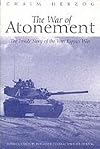
The War of Atonement is an uneven account of the Yom Kippur War. Herzog was a retired IDF general and Israeli politician. Around the time the book was first published in 1975 he was Israeli ambassador to the UN, and he would later serve as the (largely ceremonial) President of Israel. This book is at its worst, and paradoxically at its most interesting, when it argues for Israeli military reforms, and is otherwise a workman-like account of a war that had barely faded from the headlines.
The show more strategic situation heading into 1973 was one of instability. The Arab powers, particularly Egypt and Syria, were itching for a chance to reverse their catastrophic defeat in 1967. Israel knew that a second war was coming, but conventional wisdom was that it would be in 1975, when Egypt had rebuilt its medium bomber fleet. Israeli defense policy was based around taking the initial attack with outposts and what little strategic depth was available, and then counter-attacking with an armored force composed from reserves, which required between 46 and 72 hours to be organized. And this time, diplomatic realities preventing the kind of brilliant preemptive strike which began the Six Day War. The Arabs would launch the first strike.
The long War of Attrition in the lead-up to October 1973 served Egypt and Syria better than Israel. Israeli defenses were small and undermanned, its command structure weakened by rotation of senior officer, and its defense plans ambiguous. Meanwhile, Egypt and Syria trained for years on the initial attacks, every part of the plan rehearsed, while concentrating artillery and new anti-air missiles. While Israeli military intelligence did get wind of the attack with perhaps a days notice, they specified H-hour as 6:00 PM local time, 4 hours later than the actual H-hour of 2:00 PM. The initial Arab attacks met with great success, but Israeli defenders managed to inflict outsized losses in the fine defensive terrain of the Golan heights, and desperately mobilized forces finally turned back the Syrians. Meanwhile, in the south, Egypt crossed that Suez canal across its entire 110 mile length, but failed to move deeper into Sinai. A daring counter-crossing by the Israeli military drove deep into Egyptian territory, severing the Egyptian supply lines.
This book was published before the Camp David accords were finalized, so the diplomatic resolution is out of scope of the book. And while Israeli won, its military resolve was shaken. Herzog goes after Moshe Dayan for irresponsibility as defense minister in the lead up to the war, and defeatism in command during the war. Ariel Sharon is criticized for being unable to work as part of a unified command team, a charismatic asshole after glory. And the Israeli military as a whole assumed the ongoing supremacy of its armor and airpower, neglecting its infantry and artillery and the counters of new Soviet guided missiles in Arab hands, which caused excessive causalities. show less
The show more strategic situation heading into 1973 was one of instability. The Arab powers, particularly Egypt and Syria, were itching for a chance to reverse their catastrophic defeat in 1967. Israel knew that a second war was coming, but conventional wisdom was that it would be in 1975, when Egypt had rebuilt its medium bomber fleet. Israeli defense policy was based around taking the initial attack with outposts and what little strategic depth was available, and then counter-attacking with an armored force composed from reserves, which required between 46 and 72 hours to be organized. And this time, diplomatic realities preventing the kind of brilliant preemptive strike which began the Six Day War. The Arabs would launch the first strike.
The long War of Attrition in the lead-up to October 1973 served Egypt and Syria better than Israel. Israeli defenses were small and undermanned, its command structure weakened by rotation of senior officer, and its defense plans ambiguous. Meanwhile, Egypt and Syria trained for years on the initial attacks, every part of the plan rehearsed, while concentrating artillery and new anti-air missiles. While Israeli military intelligence did get wind of the attack with perhaps a days notice, they specified H-hour as 6:00 PM local time, 4 hours later than the actual H-hour of 2:00 PM. The initial Arab attacks met with great success, but Israeli defenders managed to inflict outsized losses in the fine defensive terrain of the Golan heights, and desperately mobilized forces finally turned back the Syrians. Meanwhile, in the south, Egypt crossed that Suez canal across its entire 110 mile length, but failed to move deeper into Sinai. A daring counter-crossing by the Israeli military drove deep into Egyptian territory, severing the Egyptian supply lines.
This book was published before the Camp David accords were finalized, so the diplomatic resolution is out of scope of the book. And while Israeli won, its military resolve was shaken. Herzog goes after Moshe Dayan for irresponsibility as defense minister in the lead up to the war, and defeatism in command during the war. Ariel Sharon is criticized for being unable to work as part of a unified command team, a charismatic asshole after glory. And the Israeli military as a whole assumed the ongoing supremacy of its armor and airpower, neglecting its infantry and artillery and the counters of new Soviet guided missiles in Arab hands, which caused excessive causalities. show less

NO OF PAGES: 295 SUB CAT I: Israel SUB CAT II: History SUB CAT III: DESCRIPTION: Chaim Herzog, President of the State of Israel, celebrates Jewish heroes, ancient and modern, in this inspirational testament to the strength and valor of the Jewish people. As President Herzog writes in his introduction, those profiled have "played a vital role in ensuring the survival and security of the Jewish people" during many centuries of struggle against oppressors. These are the men and women who have show more kept Judaism alive. Herzog draws upon his own experience in the battlefield to breathe new life into the familiar heroes like Deborah, who led an army long before other women were even permitted to join in battle, centuries before the birth of Joan of Arc; and Samson, whose passionate nature made him a prisoner, yet whose bravery in captivity helped destroy the Philistine enemies of the Jews. These and other ancient figures serve as examples to modern Jews fighting for similar freedoms. By placing each within the context of his or her times, Herzog also offers a broad view of Jewish history as a whole. Then, with the insight of one who has known many of his subjects personally, Herzog introduces more recent examples of Jewish bravery, as displayed by national leaders as well as groups of undecorated soldiers and ordinary citizens. He tells the poignant story of Hannah Szenes, who realized her dream of living on an Israeli kibbut, only to be drawn back to the danger of her native Hungary when World War II broke out, giving her own life to save the lives of many of her countrymen. Here too are the stories of David Ben-Gurion, and the Palmach, Israel's Youth Movement Army, which freed hundreds of thousands of World War II refugees from British internment camps and snuck them to safety and liberty in Palestine. The final dramatic chapter concerns the 1976 Israeli Defense Force's raid on Entebbe airport in Uganda that saved the lives of more than a hundred hijacking hostages. Heroes of Israel is an uplifting tribute not just to those whose stories are told but to a courageous people. These tales of heroism are a reminder of the universal strength of the human spirit when bolstered by passionate conviction.NOTES: Purchased at Half Price Books. SUBTITLE: Profiles of Jewish Courage show less
The Arab-Israeli Wars: War and Peace in the Middle East from the War of Independence through Lebanon by Chaim Herzog

NO OF PAGES: 403 SUB CAT I: Arab-Israeli Conflict SUB CAT II: Jewish Wars SUB CAT III: DESCRIPTION: Chaim Herzog, now President of Israel, has been involved in every war in Palestine and later Israel since he joined the Haganah as a teenager. He was a major general in the Israeli army and served as his country's Ambassador to the United Nations. In this invaluable book he tells the story of Israel's fight since 1947 to preserve her existence against the repeated attacks of neighboring Arab show more nations. He vividly describes each campaign of the four major wars and analyzes the "war of attrition" between 1967 and 1970 in which Israelis and Egyptians tested American and Soviet weapons against each other and tells the story of the heroic raid on Entebbe. His authoritative account of Israel's 1982 advance into Lebanon has been updated for this edition. "The Arab-Israeli Wars" not only tells the story of Israel's struggle to survive but gives a vivid picture of the people and politics that continue to shape the destiny of the Middle East.NOTES: Purchased at Good Will Industries SUBTITLE: War and Peace in the Middle East from the War of Independence through Lebanon show less
Lists
You May Also Like


Associated Authors
Statistics
- Works
- 11
- Also by
- 1
- Members
- 1,353
- Popularity
- #19,001
- Rating
- 3.7
- Reviews
- 5
- ISBNs
- 60
- Languages
- 8