
David Bentley Hart
Author of Atheist Delusions: The Christian Revolution and Its Fashionable Enemies
About the Author
David Bentley Hart is an Eastern Orthodox scholar of religion and a philosopher, writer, and cultural commentator. His books include The Experience of God and The New Testament: A Translation.
Image credit: Reform Magazine
Works by David Bentley Hart
Atheist Delusions: The Christian Revolution and Its Fashionable Enemies (2009) 610 copies, 7 reviews
A Roland Colonnade 3 copies
Associated Works
The Justification of the Good: An Essay on Moral Philosophy (1976) — Foreword, some editions — 58 copies
The Analogy of Being: Invention of the Antichrist or Wisdom of God? (2010) — Contributor — 51 copies
Tagged
Common Knowledge
- Canonical name
- Hart, David Bentley
- Other names
- 大衛. 班特利. 哈特
- Birthdate
- 1965
- Gender
- male
- Education
- University of Virginia (Ph.D)
University of Cambridge (M.Phil)
University of Maryland (BA) - Occupations
- philosopher
theologian - Awards and honors
- Michael Ramsey Prize (2011)
Publishers Weekly Religion Book of the Year (2020)
Times Literary Supplement Book of the Year (2021) - Relationships
- Hart, Addison H. (brother)
Hart, Robert (brother) - Nationality
- USA
- Birthplace
- Howard County, Maryland, USA
- Associated Place (for map)
- Maryland, USA
Members
Reviews
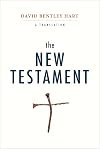
Though I am not a practising Christian, I remain fascinated by religions and how they came to be. In particular, I'm very interested in the history of that diverse collection of documents we call the Bible: how those documents were selected, who wrote them, when they were written, how it was decided to include or exclude them, and what those varied authors had to say.
This new translation of the New Testament by David Bentley Hart is truly interesting, because he has attempted what he calls a show more 'pitilessly literal' translation from the original Greek (you know that all of the New Testament was originally written in Greek, don't you?). In doing this, he says that he has attempted to provide as thin a layer of translation as possible between the modern reader and the original authors of these documents. He carefully documents his treatment of certain words and phrases and explains why he has chosen to translate them in a particular way.
Lest I give you the wrong impression, Hart is a committed Christian, who believes the writings of the Bible were divinely inspired, but that this "must involve an acknowledgement that God speaks through human beings, in all their historical, cultural and personal contingency."
In many cases, though, Hart's literal translation, insisting on focusing on what the actual words of the original Greek say, rather than on what the layers of theological teachings over the centuries demand that it *should* say, demonstrates that much of the latter interpretation is misplaced. For example, there is nothing in the original Greek which supports the concept of original sin, or that of eternal torment in Hell for sinners. Nor was the Apostle Paul the stiff mysogynist some have made him out to be (indeed my respect for Paul has been increased greatly by reading Hart's translation of Paul's letters—you actually begin to get a sense of him as an actual person). There's one passage in one of Paul's letters, a couple of paragraphs condemning women, which Hart demonstrates convincingly is a later, clumsy insertion into Paul's writing, interrupting a logical argument he is setting out about an entirely different issue.
Certainly those Christians who insist that every word of the New Testament is the literal voice of God, but then want to lean on unlikely readings of the text to make it agree with a particular theological stance they hold, will not like Hart's translation. I, though, found it extremely interesting and refreshing.
Hart's foreword, his footnotes about his translation decisions, and his long 'Concluding Scientific Postcript' are worth the price of the book alone. show less
This new translation of the New Testament by David Bentley Hart is truly interesting, because he has attempted what he calls a show more 'pitilessly literal' translation from the original Greek (you know that all of the New Testament was originally written in Greek, don't you?). In doing this, he says that he has attempted to provide as thin a layer of translation as possible between the modern reader and the original authors of these documents. He carefully documents his treatment of certain words and phrases and explains why he has chosen to translate them in a particular way.
Lest I give you the wrong impression, Hart is a committed Christian, who believes the writings of the Bible were divinely inspired, but that this "must involve an acknowledgement that God speaks through human beings, in all their historical, cultural and personal contingency."
In many cases, though, Hart's literal translation, insisting on focusing on what the actual words of the original Greek say, rather than on what the layers of theological teachings over the centuries demand that it *should* say, demonstrates that much of the latter interpretation is misplaced. For example, there is nothing in the original Greek which supports the concept of original sin, or that of eternal torment in Hell for sinners. Nor was the Apostle Paul the stiff mysogynist some have made him out to be (indeed my respect for Paul has been increased greatly by reading Hart's translation of Paul's letters—you actually begin to get a sense of him as an actual person). There's one passage in one of Paul's letters, a couple of paragraphs condemning women, which Hart demonstrates convincingly is a later, clumsy insertion into Paul's writing, interrupting a logical argument he is setting out about an entirely different issue.
Certainly those Christians who insist that every word of the New Testament is the literal voice of God, but then want to lean on unlikely readings of the text to make it agree with a particular theological stance they hold, will not like Hart's translation. I, though, found it extremely interesting and refreshing.
Hart's foreword, his footnotes about his translation decisions, and his long 'Concluding Scientific Postcript' are worth the price of the book alone. show less
The second edition of David Bentley Hart’s critically acclaimed New Testament translation. David Bentley Hart’s translation of the New Testament, first published in 2017, was hailed as a “remarkable feat” and as a “strange, disconcerting, radical version of a strange, disconcerting manifesto of profoundly radical values.” In this second edition, which includes a powerful new preface and more than a thousand changes to the text, Hart’s purpose remains the same: to render the show more original Greek texts faithfully, free of doctrine and theology, awakening readers to the uncanniness that often lies hidden beneath doctrinal layers.
Through his startling translation, with its raw, unfinished quality, Hart reveals a world conceptually quite unlike our own. “It was a world,” he writes, “in which the heavens above were occupied by celestial spiritual potentates of questionable character, in which angels ruled the nations of the earth as local gods, in which demons prowled the empty places, . . . and in which the entire cosmos was for many an eternal divine order and for many others a darkened prison house.” He challenges readers to imagine it anew: a God who reigned on high, appearing in the form of a slave and dying as a criminal, only then to be raised up and revealed as the Lord of all things."
“In [David Bentley Hart’s] hands, the words of Jesus and his followers produce not shivers of mere approximation, but rather shivers of awe at the clarity, poignancy, and simplicity of this complex treatise. . . . We are delivered a text pulsing with contemporary urgency.Jen" (nifer Kurdyla, America) show less
Through his startling translation, with its raw, unfinished quality, Hart reveals a world conceptually quite unlike our own. “It was a world,” he writes, “in which the heavens above were occupied by celestial spiritual potentates of questionable character, in which angels ruled the nations of the earth as local gods, in which demons prowled the empty places, . . . and in which the entire cosmos was for many an eternal divine order and for many others a darkened prison house.” He challenges readers to imagine it anew: a God who reigned on high, appearing in the form of a slave and dying as a criminal, only then to be raised up and revealed as the Lord of all things."
“In [David Bentley Hart’s] hands, the words of Jesus and his followers produce not shivers of mere approximation, but rather shivers of awe at the clarity, poignancy, and simplicity of this complex treatise. . . . We are delivered a text pulsing with contemporary urgency.Jen" (nifer Kurdyla, America) show less
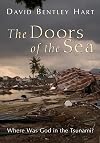
Here is a book I will need to reread a few times to take in what I've missed or misunderstood the first time around. At barely 100 pages, I looked up more words than I have with any other book. The lexicon at work here is so perfectly specific, but it bogs down what is already a difficult topic - not just in logic but in fundamental beliefs.
I found many profound and succinct ways of articulating what I believe in this book, while also stumbling through some hand-wavery to explain the crux of show more the issue - why on God's green earth is evil present.
I submit wholeheartedly to the idea that God is all loving and good and evil cannot come from him or be part of his "plan". To believe in a god like that would be shrugging off accountability, essentially leaving one complicit in the evil. A very Nuremberg defense of bad theology.
I just find myself wanting more explanation of why creation fell in the first place, allowing the mysterious hand of evil to bind us to death. Free and rational beings apparently call for it, but I lost the plot with that explanation. We might be free of a controlling will, but we are certainly not individually free of creation's falling.
I think this is leading me to a more communal understanding of the Church and the body of faith, and away from the personal/individual religion I grew up with. The deconstruction continues. show less
I found many profound and succinct ways of articulating what I believe in this book, while also stumbling through some hand-wavery to explain the crux of show more the issue - why on God's green earth is evil present.
I submit wholeheartedly to the idea that God is all loving and good and evil cannot come from him or be part of his "plan". To believe in a god like that would be shrugging off accountability, essentially leaving one complicit in the evil. A very Nuremberg defense of bad theology.
I just find myself wanting more explanation of why creation fell in the first place, allowing the mysterious hand of evil to bind us to death. Free and rational beings apparently call for it, but I lost the plot with that explanation. We might be free of a controlling will, but we are certainly not individually free of creation's falling.
I think this is leading me to a more communal understanding of the Church and the body of faith, and away from the personal/individual religion I grew up with. The deconstruction continues. show less
Restorationists are often accused, and often rightly so, of not knowing a whole lot about the Christian tradition in general. Yet such is true of most Christians, and really, society at large.
There are lot of expansive histories of Christianity which are good and profitable yet would probably be too long and arcane for the purposes of a general audience.
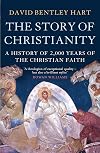
In The Story of Christianity: A History of 2,000 Years of the Christian Faith, David Bentley Hart (DBH), a notable theologian, has done well show more at describing the story of Christendom over the past 2,000 years with clear prose and short chapters.
Yes, I said “Christendom,” not “Christianity.” While certain doctrinal arguments are described, much of the book is about the behaviors of European kings and societies which were nominally “Christian.” DBH has done well to broaden the scope to include the churches of the East, India, and Africa, but by necessity much of the work is about the events and developments of Europe in the medieval and modern eras. DBH is Eastern Orthodox and so the “institutional” and Christendom emphases are not terribly surprising; if you’re expecting a lot of detail about the rise and nature of Evangelicalism, you’ll be disappointed, but a lot more will be brought out regarding the Catholic and Orthodox heritage.
As an overall introduction this works well to explain the influence of Christendom over the past two thousand years. In the end, it is the story of “big men” and the “big ideas,” and not about daily life and practice throughout time. I suppose the latter is yet to be written or might be found elsewhere. show less
There are lot of expansive histories of Christianity which are good and profitable yet would probably be too long and arcane for the purposes of a general audience.
In The Story of Christianity: A History of 2,000 Years of the Christian Faith, David Bentley Hart (DBH), a notable theologian, has done well show more at describing the story of Christendom over the past 2,000 years with clear prose and short chapters.
Yes, I said “Christendom,” not “Christianity.” While certain doctrinal arguments are described, much of the book is about the behaviors of European kings and societies which were nominally “Christian.” DBH has done well to broaden the scope to include the churches of the East, India, and Africa, but by necessity much of the work is about the events and developments of Europe in the medieval and modern eras. DBH is Eastern Orthodox and so the “institutional” and Christendom emphases are not terribly surprising; if you’re expecting a lot of detail about the rise and nature of Evangelicalism, you’ll be disappointed, but a lot more will be brought out regarding the Catholic and Orthodox heritage.
As an overall introduction this works well to explain the influence of Christendom over the past two thousand years. In the end, it is the story of “big men” and the “big ideas,” and not about daily life and practice throughout time. I suppose the latter is yet to be written or might be found elsewhere. show less
Lists
Awards


You May Also Like


Associated Authors
Statistics
- Works
- 34
- Also by
- 7
- Members
- 3,804
- Popularity
- #6,666
- Rating
- 4.2
- Reviews
- 35
- ISBNs
- 89
- Languages
- 5
- Favorited
- 10