
Kin Platt (1911–2003)
Author of Big Max
About the Author
Image credit: media.comicvine.com
Series
Works by Kin Platt
The Three Investigators 3-in-1: The Mystery of the Flaming Footprints / The Mystery of the Coughing Dragon / The Mystery of the Singing Serpent (1981) 8 copies
The Three Investigators 3-in-1: The Mystery of the Coughing Dragon / The Mystery of Death Trap Mine / The Mystery of the Magic Circle (1987) 2 copies
De wildjager 1 copy
Coo Coo Comics No. 35 1 copy
Associated Works
Tagged
Common Knowledge
- Canonical name
- Platt, Kin
- Legal name
- Platt, Kin
- Other names
- West, Alan
West, Guy
West, Nick
York, Guy
York, Wesley Simon
Tall, Nick (show all 8)
Zark, Noah
Carr, Kirby - Birthdate
- 1911-12-08
- Date of death
- 2003-11-30
- Gender
- male
- Occupations
- cartoonist
author - Organizations
- Writers Guild of America
Mystery Writers of America
National Cartoonist Society - Agent
- Marilyn E. Marlowe (died in 2003) of Curtis Brown Inc., New York, NY.
- Relationships
- Platt, Christopher (son)
- Nationality
- USA
- Birthplace
- New York, New York, USA
- Places of residence
- Los Angeles, California, USA
New York, New York, USA - Place of death
- New York, New York, USA
- Associated Place (for map)
- New York, USA
Members
Reviews

For some stupid reason, probably because it's a rainy Sunday and I'm feeling a bit out of sorts, I started thinking about this book, which was a sequel to the not-quite-as-vile Chloris and the Creeps (Kin Platt has such a knack for catchy titles, no?). I read this one a good 30-some years ago when I was perhaps 11 or thereabouts. Even at the time, I realized it was a piece of shit. My hand to god.
Here's what I remember: Jenny, the narrator, has an older sister, Chloris, who is, not to put show more too fine a point on it, a real bitch. At some point, I think during the first book, Jenny and Chloris's father takes his own life with a shotgun. By the second book, Jenny, who's around 11 or 12 at the time, has dealt with it, but Chloris, who was a daddy's girl, totally loses it and becomes sort of a Poison-Ivy-crossed-with-Regan-from-The-Exorcist psycho hose beast. Her head doesn't start turning 360 degrees around, but damn near. All that's really missing is Max von Sydow and Jason Miller throwing holy water and yelling, "The power of Christ compels you!"
So, by the second book, the mother has remarried a nice Mexican artist named Fidel Mancha (please don't ask me why the hell I remember that name), who's very sweet. Jenny loves him, Chloris hates him. Bet you couldn't see that one coming.
Meanwhile, Jenny, who heretofore has shown absolutely zero interest in astrology, has become sort of a junior Jeanne Dixon and is obsessed with it. (When I first read the book, I figured that either Kin Platt had just caught onto the astrology craze of the 70s and determined that it would help his sales figures if he worked it into the book come hell or high water, or that he had become an aficionado himself while trolling the singles bars after his divorce, probably the latter. It certainly was nice to see that he had his finger on the pulse of the decade, not that it made his work any better.) Therefore, about half this book is taken up with Jenny's telling us what was in her horoscope that morning, as well as that of her mother, her stepfather, and Chloris. As a result, the book is generally a strenuous bore.
ANYway, Chloris somehow purports to talk to the spirit of her dead father, who urges her to break up the marriage between her mother and Fidel. (I swear to Christ I am not making this up.) Now, you can see where this is going, right? Of course, it will transpire that Chloris is a very, very troubled girl who was deeply shaken by her father's death, as any teen would be, and is working out her sublimated issues by fantasizing that her dead father has come to fix her problems, right? And by the end, she gets some help, probably through therapy, right?
No, wrong. That would be the way an author without a thought disorder would deal with it. Here, because Kin Platt evidently did have a thought disorder, and was probably also just sort of a garden variety idiot, Chloris is really talking to the spirit of her dead father! That's right, folks: she's not a troubled teen who's so devastated by her father's death that she deals with it in the best way she knows how. No, she is actually communing with spirits. The only thing I can figure out is that Kin Platt took some adolescent psychology course at some point, read a case study where a girl fantasized about talking to the ghost of her dead father, and missed the class where the professor carefully explained that the fantasy wasn't actually real. (I guess we should thank god he never got around to reading Freud's case study of "The Wolf Man" -- I hate to think of the book the kids would have been subjected to if he had.) If I've ever seen a book with a less grasp of metaphor, I can't remember it.
So at the end, the father's ghost, or Chloris, who the fuck can even figure it out at this point, breaks up the mother and stepfather's marriage by making, I think, the mother have an affair. (Hey, you go try to figure it out if you're really interested.)
I suppose we should count ourselves lucky that this book appears to be out of print.
In all fairness to Kin Platt, he's not always this bad. Sometimes he's even worse, as he demonstrated when he wrote the execrable Hey, Dummy. I would say that Hey, Dummy was one of the worst YA books of the 70s, but that would be doing it a disservice, as surely it's one of the YA worst books ever written. (See also The Boy Who Could Make Himself Disappear). show less
Here's what I remember: Jenny, the narrator, has an older sister, Chloris, who is, not to put show more too fine a point on it, a real bitch. At some point, I think during the first book, Jenny and Chloris's father takes his own life with a shotgun. By the second book, Jenny, who's around 11 or 12 at the time, has dealt with it, but Chloris, who was a daddy's girl, totally loses it and becomes sort of a Poison-Ivy-crossed-with-Regan-from-The-Exorcist psycho hose beast. Her head doesn't start turning 360 degrees around, but damn near. All that's really missing is Max von Sydow and Jason Miller throwing holy water and yelling, "The power of Christ compels you!"
So, by the second book, the mother has remarried a nice Mexican artist named Fidel Mancha (please don't ask me why the hell I remember that name), who's very sweet. Jenny loves him, Chloris hates him. Bet you couldn't see that one coming.
Meanwhile, Jenny, who heretofore has shown absolutely zero interest in astrology, has become sort of a junior Jeanne Dixon and is obsessed with it. (When I first read the book, I figured that either Kin Platt had just caught onto the astrology craze of the 70s and determined that it would help his sales figures if he worked it into the book come hell or high water, or that he had become an aficionado himself while trolling the singles bars after his divorce, probably the latter. It certainly was nice to see that he had his finger on the pulse of the decade, not that it made his work any better.) Therefore, about half this book is taken up with Jenny's telling us what was in her horoscope that morning, as well as that of her mother, her stepfather, and Chloris. As a result, the book is generally a strenuous bore.
ANYway, Chloris somehow purports to talk to the spirit of her dead father, who urges her to break up the marriage between her mother and Fidel. (I swear to Christ I am not making this up.) Now, you can see where this is going, right? Of course, it will transpire that Chloris is a very, very troubled girl who was deeply shaken by her father's death, as any teen would be, and is working out her sublimated issues by fantasizing that her dead father has come to fix her problems, right? And by the end, she gets some help, probably through therapy, right?
No, wrong. That would be the way an author without a thought disorder would deal with it. Here, because Kin Platt evidently did have a thought disorder, and was probably also just sort of a garden variety idiot, Chloris is really talking to the spirit of her dead father! That's right, folks: she's not a troubled teen who's so devastated by her father's death that she deals with it in the best way she knows how. No, she is actually communing with spirits. The only thing I can figure out is that Kin Platt took some adolescent psychology course at some point, read a case study where a girl fantasized about talking to the ghost of her dead father, and missed the class where the professor carefully explained that the fantasy wasn't actually real. (I guess we should thank god he never got around to reading Freud's case study of "The Wolf Man" -- I hate to think of the book the kids would have been subjected to if he had.) If I've ever seen a book with a less grasp of metaphor, I can't remember it.
So at the end, the father's ghost, or Chloris, who the fuck can even figure it out at this point, breaks up the mother and stepfather's marriage by making, I think, the mother have an affair. (Hey, you go try to figure it out if you're really interested.)
I suppose we should count ourselves lucky that this book appears to be out of print.
In all fairness to Kin Platt, he's not always this bad. Sometimes he's even worse, as he demonstrated when he wrote the execrable Hey, Dummy. I would say that Hey, Dummy was one of the worst YA books of the 70s, but that would be doing it a disservice, as surely it's one of the YA worst books ever written. (See also The Boy Who Could Make Himself Disappear). show less
Something's weird about the publication dates, but I'm not going to fret about it, only say that this feels very old-fashioned. I'd like to read the first, but since other reviewers say the plot of the two is the same, I won't bother ordering it. This is a charming Leveled Reader, and refreshingly different from most of them, because most are friendship stories. The word choice, sentence length, etc. are formulated for beginning readers, but still engaging, not lame. And the fantasy world is show more imaginative and funny. I do recommend them if your 5-6 yo is having trouble moving on to regular books. show less
This is why weeding is important. You find the stuff you bought years ago without really looking at it and think...
What. The. Heck.
The Big Max titles, of which there were thankfully only two, were written back in the 1970s. However, like most of the I Can Read! imprint they are still available in paperback or prebind.
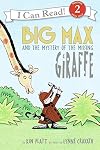
Big Max, a Sherlock-type investigator, gets a call on his Victorian-style phone. There is a mystery! King Punchapillow in Ah-Ah Achoo has a problem. He has lost his pet giraffe. show more Big Max says he will be there right away and gets directions to Ah-Ah Achoo which is "between Sneeze and Gesundheit, just past Runnynose." Big Max flies in on his umbrella, with several adventures along the way, and fortunately lands on a bouncy rubber tree. He investigates the king's pets, which consist of two of everything, except Jake the giraffe. Eventually, Big Max follows the right clues and they discover Jake, who, lonely for his friends, escaped and went to join a soccer game. The king apologizes to Jake for keeping him locked up with nothing to kick but rocks and offers Big Max a million Achoo rupees but Big Max prefers to finish watching the soccer game.
The first Big Max book was illustrated by Robert Lopshire, and Lynne Cravath has a very similar art style. This is a level 2, "reading with help" and so has more complex sentences and denser text. I'm always looking for funny books featuring diverse characters, but this is...not really funny. The author apparently had Africa and India confused and the tired old stereotype of people of color with funny names is not really funny. It was reviewed as silly and funny back when it was written, but even then I can't imagine that somebody didn't say "hey, maybe it's not funny to have an "african" king with a nonsensical name? Call me deficient in humor if you will, but there are plenty of humorous, nonsensical easy readers out there that don't use tired old stereotypes. It's time this character was retired from the I Can Read imprint, in my opinion.
Verdict: Thankfully, I originally pulled this because it had an old call number and was a paperback (I'm planning to slowly replace all the paperback easy readers) and then discovered that it was falling apart. Weeded.
ISBN: 9780060099206; Published 2005 by HarperCollins; Weeded for condition and general awfulness show less
What. The. Heck.
The Big Max titles, of which there were thankfully only two, were written back in the 1970s. However, like most of the I Can Read! imprint they are still available in paperback or prebind.
Big Max, a Sherlock-type investigator, gets a call on his Victorian-style phone. There is a mystery! King Punchapillow in Ah-Ah Achoo has a problem. He has lost his pet giraffe. show more Big Max says he will be there right away and gets directions to Ah-Ah Achoo which is "between Sneeze and Gesundheit, just past Runnynose." Big Max flies in on his umbrella, with several adventures along the way, and fortunately lands on a bouncy rubber tree. He investigates the king's pets, which consist of two of everything, except Jake the giraffe. Eventually, Big Max follows the right clues and they discover Jake, who, lonely for his friends, escaped and went to join a soccer game. The king apologizes to Jake for keeping him locked up with nothing to kick but rocks and offers Big Max a million Achoo rupees but Big Max prefers to finish watching the soccer game.
The first Big Max book was illustrated by Robert Lopshire, and Lynne Cravath has a very similar art style. This is a level 2, "reading with help" and so has more complex sentences and denser text. I'm always looking for funny books featuring diverse characters, but this is...not really funny. The author apparently had Africa and India confused and the tired old stereotype of people of color with funny names is not really funny. It was reviewed as silly and funny back when it was written, but even then I can't imagine that somebody didn't say "hey, maybe it's not funny to have an "african" king with a nonsensical name? Call me deficient in humor if you will, but there are plenty of humorous, nonsensical easy readers out there that don't use tired old stereotypes. It's time this character was retired from the I Can Read imprint, in my opinion.
Verdict: Thankfully, I originally pulled this because it had an old call number and was a paperback (I'm planning to slowly replace all the paperback easy readers) and then discovered that it was falling apart. Weeded.
ISBN: 9780060099206; Published 2005 by HarperCollins; Weeded for condition and general awfulness show less

I found this book first in grade school, then read it again (and again) as I got older. Although something of a 70s period piece, this story of a child abuse and survival haunts me still. I don't have the copy to hand and I haven't read through it in a few years, so I can't recall if it is told in first person or just a narrow focus third person, but it seems to me that the story was in Roger's voice (Roger being the young protagonist), a voice with a defect, a lisp, that has deeper roots show more and far reaching affects on his life. The brutal realities of his life -- the neglect and casual cruelty of his parents, both busy trying to figure themselves out and only barely aware they even are parents; the relationships he forges with strangers; the awkward horror of school; the mystery of being an invisible young boy in New York City. These features of the story have lasted in my mind for nearly 30 years, and those features have no age. show less
Lists
Awards


You May Also Like


Associated Authors
Statistics
- Works
- 47
- Also by
- 2
- Members
- 2,631
- Popularity
- #9,757
- Rating
- 3.6
- Reviews
- 51
- ISBNs
- 178
- Languages
- 10