
Heimito von Doderer (1896–1966)
Author of The Strudlhof Steps
About the Author
Image credit: Fritz Kern / © ÖNB/Wien
Works by Heimito von Doderer
The Secret of the Empire: A Novel of the Russian Civil War (Studies in Austrian Literature, Culture and Thought : Transl (1998) 9 copies
Person Made of Porcelain And Other Stories (Studies in Austrian Literature, Culture, and Thought) (2005) 8 copies
Frühe Prosa: Die Sibirische Klarheit. Die Bresche / Jutta Bamberger. Das Geheimnis des Reichs (2008) 7 copies
Seraphica (Franziscus von Assisi). Montefal (Eine avanture). Zwei Erzählungen aus dem Nachlaß (2009) 3 copies
Ein Weg im Dunklen 3 copies
El tormento de los saquitos de cuero 2 copies
Die erleuchteten Fenster oder die Menschwerdung des Amtsrates Julius Zihal. Ein Umweg (2016) 2 copies
Meine neunzehn Lebensläufe und neun andere Geschichten ; [zum siebzigsten Geburtstag des Autors] 2 copies
Poslednja pustolovina 1 copy
Die erleuchteten Fenster oder die Menschwerdung des Amtsrates Julius Zihal. Ein Umweg : zwei Romane (1989) 1 copy
Wege und Umwege 1 copy
Jerihonske trube 1 copy
Osvetljeni prozori 1 copy
I Demoni 1 copy
La Scalinata 1 copy
Die erleuchteten Fenster oder Die Menschwerdung des Amtsrates Julius Zihal / Ein Umweg. Zwei Romane 1 copy
1985 1 copy
1976 1 copy
Drum cotit 1 copy
Associated Works
Deutsche Kurzgeschichten : eine Auswahl für mittlere Klassen (1972) — Author, some editions — 5 copies, 1 review
Moderne Erzähler 13 — Author — 2 copies
Tagged
Common Knowledge
- Canonical name
- Doderer, Heimito von
- Legal name
- von Doderer, Heimito
- Birthdate
- 1896-09-06
- Date of death
- 1966-12-23
- Gender
- male
- Education
- University of Vienna
- Occupations
- soldier
lumberjack
novelist - Organizations
- Deutsche Akademie für Sprache und Dichtung
- Awards and honors
- Wilhelm-Raabe-Preis (1966)
Großer Literaturpreis der Bayerischen Akademie der Schönen Künste (1964)
Literaturpreis der Stadt Wien (1961)
Großer Österreichischer Staatspreis (1958)
Literaturpreis für Epik vom Bundesverband der deutschen Industrie (1954) - Nationality
- Austria
- Birthplace
- Weidlingau, Austria, Austro-Hungarian Empire (now Hadersdorf-Weidlingau in Vienna, Austria)
- Places of residence
- Weidlingau, Austria (birth)
Vienna, Austria (death) - Place of death
- Vienna, Austria
- Burial location
- Grinzinger Friedhof, Wien, Österreich
- Associated Place (for map)
- Austria
Members
Reviews

Published in 1956, "The Demons" (original German title: "Die Dämonen") is a notable work by Austrian author Heimito von Doderer. This novel is often regarded as one of the most important Austrian novels of its era, providing a panoramic portrayal of Viennese society during the late 1920s.
The novel follows a plethora of characters whose lives intersect in Vienna, capturing the social and political turmoil of the period. It explores themes of the decline of European civilization, with a show more backdrop of the fall of the Austrian monarchy and its subsequent effects. The narrative structure is symphonic, drawing comparisons to the works of Dostoyevsky, Proust, and Musil, with a detailed reconstruction of Vienna through architectural drawings and historical documents.
Narrated by Georg von Geyrenhoff, a retired civil servant, "The Demons" uses a chronicle-like format to depict events from different social strata of Vienna. The novel's structure includes a nod to Dostoyevsky's "Demons" through its subtitle, focusing on the chronicle of the Section Council Geyrenhoff. Doderer's language is noted for its humor, irony, and satirical elements, creating a rich tapestry of human interactions and societal critique.
The novel reflects on the interwar period in Austria, culminating in the historical event of the burning of the Palace of Justice in 1927. It examines the ideological fractures and the superficial peace of post-World War I Europe, hinting at the despair and decline that would lead to World War II.
I enjoyed its epic scope and detailed character development, reminding me of Dante, Tolstoy, and Balzac. It was a candidate for the Nobel Prize in Literature, showcasing Doderer's status as a significant author in the post-war Austrian literary scene.
Availability: For those interested in reading "The Demons," it has been translated into English by Richard and Clara Winston. It's available in various editions, including a notable two-volume set by Wiseblood Books, which includes additional scholarly material like introductions and lectures by Doderer himself.
This novel not only provides a deep dive into the cultural and social life of Vienna in the 1920s but also stands as a testament to Doderer's literary prowess in capturing the complexity of human experience within the context of historical and ideological shifts. show less
The novel follows a plethora of characters whose lives intersect in Vienna, capturing the social and political turmoil of the period. It explores themes of the decline of European civilization, with a show more backdrop of the fall of the Austrian monarchy and its subsequent effects. The narrative structure is symphonic, drawing comparisons to the works of Dostoyevsky, Proust, and Musil, with a detailed reconstruction of Vienna through architectural drawings and historical documents.
Narrated by Georg von Geyrenhoff, a retired civil servant, "The Demons" uses a chronicle-like format to depict events from different social strata of Vienna. The novel's structure includes a nod to Dostoyevsky's "Demons" through its subtitle, focusing on the chronicle of the Section Council Geyrenhoff. Doderer's language is noted for its humor, irony, and satirical elements, creating a rich tapestry of human interactions and societal critique.
The novel reflects on the interwar period in Austria, culminating in the historical event of the burning of the Palace of Justice in 1927. It examines the ideological fractures and the superficial peace of post-World War I Europe, hinting at the despair and decline that would lead to World War II.
I enjoyed its epic scope and detailed character development, reminding me of Dante, Tolstoy, and Balzac. It was a candidate for the Nobel Prize in Literature, showcasing Doderer's status as a significant author in the post-war Austrian literary scene.
Availability: For those interested in reading "The Demons," it has been translated into English by Richard and Clara Winston. It's available in various editions, including a notable two-volume set by Wiseblood Books, which includes additional scholarly material like introductions and lectures by Doderer himself.
This novel not only provides a deep dive into the cultural and social life of Vienna in the 1920s but also stands as a testament to Doderer's literary prowess in capturing the complexity of human experience within the context of historical and ideological shifts. show less

Il fatto è che non si può far violenza a opere scritte per essere lette su una sedia a dondolo in stanze dove una pendola tranquillamente oscilla e il pulviscolo fluttua nella luce calda del sole e leggerle a bordo di un autobus... (questa la prima riflessione dopo le prime trenta deliziosamente irresolute pagine).
Conseguentemente, ho cercato di rallentare i ritmi di lettura, di aprire il libro solo quando ero sufficientemente riposato per rendere la lettura la più godibile possibile. E show more lo è stata, godibile, a tratti anche godibilissima. Ma facile no. E' una lettura impegnativa ma gratificante, non delude. Il tour de force è del lettore, l'autore ha piena padronanza e fila liscio che è un piacere, senza fatica, con ammirevole facilità di scrittura.
Nell'introduzione si rimanda al film di Max Ophuels La ronde. Ecco, io il film non l'ho ancora visto e mi riprometto di farlo, ma di sicuro posso dire che in effetti la narrazione ha il ritmo di un ballo. Un giro di walzer nella Vienna degli inizi del '900... show less
Conseguentemente, ho cercato di rallentare i ritmi di lettura, di aprire il libro solo quando ero sufficientemente riposato per rendere la lettura la più godibile possibile. E show more lo è stata, godibile, a tratti anche godibilissima. Ma facile no. E' una lettura impegnativa ma gratificante, non delude. Il tour de force è del lettore, l'autore ha piena padronanza e fila liscio che è un piacere, senza fatica, con ammirevole facilità di scrittura.
Nell'introduzione si rimanda al film di Max Ophuels La ronde. Ecco, io il film non l'ho ancora visto e mi riprometto di farlo, ma di sicuro posso dire che in effetti la narrazione ha il ritmo di un ballo. Un giro di walzer nella Vienna degli inizi del '900... show less

Every Man a Murderer, published in 1938 even while the author was working on his larger work-The Demons, is a story of personal and political crisis. The political crisis is exemplified by the rise of National Socialism while the personal crisis has its roots in Doderer's relationships, especially his marriage and divorce.
The novel is set in Germany and is monographic in that it is focused on a single figure and his fate, character, love, and death. The narrative is leisurely and thoughtful show more concerning one Conrad Castiletz, a young man, who becomes fascinated with the story of his sister-in-law who was murdered on a train eight years before he met and married his wife; also how he discovers his own personal connections with this event. It is almost Sophoclean in its exploration of the protagonist's own guilt. The first third, which deals with the hero’s childhood, schooling, sexual initiation, and so on, is fascinating though seemingly not necessary for the rest of the story. It is only upon the accidental death of Conrad and the way it links to the recovery of his youthful world that the themes of accident, fate , and character link together to make the connection. For the author the task of humanization begins with overcoming character. This may be seen in the opening lines of the novel. "Everyone's childhood is plumped down over his head like a bucket. The contents of this bucket are at first unknown. But throughout life, the stuff drips down on him slowly--and there's no sense changing clothes or costume, for the dripping will continue." (p 3)
Only when Conrad begins to respect this is he able to become a person by overcoming his fate. The oppressive atmosphere of the Gestapo-like society provides a surreal and sinister background for Conrad's story.
The novel is one of ideas, spiritual linkages, and metaphysical drama, reminiscent of Hesse and Conrad or perhaps of Thomas Mann which for some readers is enough to recommend it.
"The man who lay beside the pile of lumber was no longer sick. He was, in a manner of speaking, far healthier than anyone else, for he was dead.” Or: “If anyone says, ‘Nonsense!’ in regard to something, it generally shows that he has not dealt inwardly with the matter."
This is a novel for those interested in ideas and man's spiritual dilemma. show less
The novel is set in Germany and is monographic in that it is focused on a single figure and his fate, character, love, and death. The narrative is leisurely and thoughtful show more concerning one Conrad Castiletz, a young man, who becomes fascinated with the story of his sister-in-law who was murdered on a train eight years before he met and married his wife; also how he discovers his own personal connections with this event. It is almost Sophoclean in its exploration of the protagonist's own guilt. The first third, which deals with the hero’s childhood, schooling, sexual initiation, and so on, is fascinating though seemingly not necessary for the rest of the story. It is only upon the accidental death of Conrad and the way it links to the recovery of his youthful world that the themes of accident, fate , and character link together to make the connection. For the author the task of humanization begins with overcoming character. This may be seen in the opening lines of the novel. "Everyone's childhood is plumped down over his head like a bucket. The contents of this bucket are at first unknown. But throughout life, the stuff drips down on him slowly--and there's no sense changing clothes or costume, for the dripping will continue." (p 3)
Only when Conrad begins to respect this is he able to become a person by overcoming his fate. The oppressive atmosphere of the Gestapo-like society provides a surreal and sinister background for Conrad's story.
The novel is one of ideas, spiritual linkages, and metaphysical drama, reminiscent of Hesse and Conrad or perhaps of Thomas Mann which for some readers is enough to recommend it.
"The man who lay beside the pile of lumber was no longer sick. He was, in a manner of speaking, far healthier than anyone else, for he was dead.” Or: “If anyone says, ‘Nonsense!’ in regard to something, it generally shows that he has not dealt inwardly with the matter."
This is a novel for those interested in ideas and man's spiritual dilemma. show less
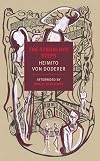
As "The Strudlhof Steps" consists of no less than 800 pages, one would expect my review to be considerably lengthy in order to do the book justice. Alas, I cannot meet that expectation. Although I do have lengthy observations, I shall try to be concise.
First, the positives (what I liked). The author, Heimito Von Doderer, was without a doubt, an incredibly intelligent, talented, witty, and sophisticated writer. His prose consistently challenges and yet entertains the reader. There is no show more shortage of wisdom shared; yet shared in an often slyly humorous fashion. Through this, one comes to know not only the characters but, also, to a not insignificant degree, the author as well.
The challenges become all too familiar. The author's prose is not easy to read. His sentences are lengthy often containing dependent clauses, parenthetical remarks, literary alusions, and quotations from classic authors. Not surprisingly, his paragraphs can spill over several pages.
"The Strudlhof Steps" is often considered "a", if not "the" quintessential portrait of early twentieth-century Vienna. Although that seems to be an accurate observation, I felt that going into the novel the reader would be well served by gaining some fundamental knowledge of the city and its environs. It felt that it was extremely easy to "get lost".
The book has been described by some reviewers as series of soap opera scenes. It certainly is more than that but it does lack an overarching plot beyond the often conflicted interactions of the multifarious characters. And, the book is not lacking in characters. At least 10-15 characters shuffle in and out of the spotlight. As many of those characters are alternately referred to by nicknames, titles, first and/or last names, I quickly became overwhelmed.
Having said all that, I would still say the book is enormously enjoyable. I think it's appeal for me rested in the author's sophisticated and intelligent prose. Despite the text's challenges (as mentioned above), reading the work was consistently a pleasure. show less
First, the positives (what I liked). The author, Heimito Von Doderer, was without a doubt, an incredibly intelligent, talented, witty, and sophisticated writer. His prose consistently challenges and yet entertains the reader. There is no show more shortage of wisdom shared; yet shared in an often slyly humorous fashion. Through this, one comes to know not only the characters but, also, to a not insignificant degree, the author as well.
The challenges become all too familiar. The author's prose is not easy to read. His sentences are lengthy often containing dependent clauses, parenthetical remarks, literary alusions, and quotations from classic authors. Not surprisingly, his paragraphs can spill over several pages.
"The Strudlhof Steps" is often considered "a", if not "the" quintessential portrait of early twentieth-century Vienna. Although that seems to be an accurate observation, I felt that going into the novel the reader would be well served by gaining some fundamental knowledge of the city and its environs. It felt that it was extremely easy to "get lost".
The book has been described by some reviewers as series of soap opera scenes. It certainly is more than that but it does lack an overarching plot beyond the often conflicted interactions of the multifarious characters. And, the book is not lacking in characters. At least 10-15 characters shuffle in and out of the spotlight. As many of those characters are alternately referred to by nicknames, titles, first and/or last names, I quickly became overwhelmed.
Having said all that, I would still say the book is enormously enjoyable. I think it's appeal for me rested in the author's sophisticated and intelligent prose. Despite the text's challenges (as mentioned above), reading the work was consistently a pleasure. show less
Lists
Awards


You May Also Like


Associated Authors
Statistics
- Works
- 70
- Also by
- 6
- Members
- 1,347
- Popularity
- #19,100
- Rating
- 4.1
- Reviews
- 14
- ISBNs
- 127
- Languages
- 12
- Favorited
- 12