
Rana Foroohar
Author of Makers and Takers: The Rise of Finance and the Fall of American Business
About the Author
Rana Foroohar is a global business columnist and associate editor for the Financial Times, and a global economic analyst for CNN. Previously, she was the assistant managing editor and economic columnist at Time. She has received a 2018 Best in Business Award from the Society for Advancing Business show more Editing and Writing (SABEW), and awards and fellowships from the Johns Hopkins School of Advanced International Studies and the East-West Center, and her previous book, Makers and Takers, was shortlisted for the Financial Times/McKinsey Business Book of the Year Award. She is a life member of the Council on Foreign Relations. show less
Works by Rana Foroohar
Makers and Takers: The Rise of Finance and the Fall of American Business (2016) 213 copies, 5 reviews
Don't Be Evil: How Big Tech Betrayed Its Founding Principles and All of Us (2019) 159 copies, 6 reviews
Associated Works
Tagged
Common Knowledge
- Gender
- female
Members
Reviews

Don't Be Evil: How Big Tech Betrayed Its Founding Principles - And All of Us by Rana Foroohar is a well researched assessment of the many ways big tech has helped to dismantle the very fabric of society at large and the US democracy in particular. Their ideals went out the window just as soon as they realized the amount of money and power they could wield, and they make no excuses for it, they are still, as of March 2020, doing all they can to spread disinformation while profiting off of all show more of the data they collect. So, too late, they are evil.
If anyone claims this book is over the top or hyperbolic, ignore them. My statements above are far more extreme and hyperbolic, though definitely accurate, than anything in Foroohar's book. She presents the evidence in a clear and thoughtful manner, supported by 25 pages of end notes and a substantial bibliography, as well as her years of experience.
The basic premise of the book, that these companies have, and continue to, disrupt and destroy community and democracy, are pretty widely acknowledged, even though some people are fine with it and prove that by pretending that it isn't happening. Oh well, hope that Kool-Aid tasted good. What Foroohar shows is the scope of the unethical practices and the depth of the lack of concern or compassion for the majority of humankind that these little techies have. They believe themselves to actually be deserving of lording over us, and when we do put an end to their reign, it will be a long and, I hope, painful fall. Ideally with adjoining jail cells with the Trumpenfuehrer clan.
While this book is data and research driven I also read a memoir along with it. Uncanny Valley by Anna Wiener is a firsthand memoir about her time in the hellhole that is Silicon Valley, with the bro culture and the self-righteous trampling of individuals and democracy. These two books together offer a nice well-rounded view of the inbred culture of big tech.
Reviewed from a copy made available through Goodreads First Reads. show less
If anyone claims this book is over the top or hyperbolic, ignore them. My statements above are far more extreme and hyperbolic, though definitely accurate, than anything in Foroohar's book. She presents the evidence in a clear and thoughtful manner, supported by 25 pages of end notes and a substantial bibliography, as well as her years of experience.
The basic premise of the book, that these companies have, and continue to, disrupt and destroy community and democracy, are pretty widely acknowledged, even though some people are fine with it and prove that by pretending that it isn't happening. Oh well, hope that Kool-Aid tasted good. What Foroohar shows is the scope of the unethical practices and the depth of the lack of concern or compassion for the majority of humankind that these little techies have. They believe themselves to actually be deserving of lording over us, and when we do put an end to their reign, it will be a long and, I hope, painful fall. Ideally with adjoining jail cells with the Trumpenfuehrer clan.
While this book is data and research driven I also read a memoir along with it. Uncanny Valley by Anna Wiener is a firsthand memoir about her time in the hellhole that is Silicon Valley, with the bro culture and the self-righteous trampling of individuals and democracy. These two books together offer a nice well-rounded view of the inbred culture of big tech.
Reviewed from a copy made available through Goodreads First Reads. show less

Don't Be Evil: How Big Tech Betrayed Its Founding Principles - And All of Us by Rana Foroohar is a well researched assessment of the many ways big tech has helped to dismantle the very fabric of society at large and the US democracy in particular. Their ideals went out the window just as soon as they realized the amount of money and power they could wield, and they make no excuses for it, they are still, as of March 2020, doing all they can to spread disinformation while profiting off of all show more of the data they collect. So, too late, they are evil.
If anyone claims this book is over the top or hyperbolic, ignore them. My statements above are far more extreme and hyperbolic, though definitely accurate, than anything in Foroohar's book. She presents the evidence in a clear and thoughtful manner, supported by 25 pages of end notes and a substantial bibliography, as well as her years of experience.
The basic premise of the book, that these companies have, and continue to, disrupt and destroy community and democracy, are pretty widely acknowledged, even though some people are fine with it and prove that by pretending that it isn't happening. Oh well, hope that Kool-Aid tasted good. What Foroohar shows is the scope of the unethical practices and the depth of the lack of concern or compassion for the majority of humankind that these little techies have. They believe themselves to actually be deserving of lording over us, and when we do put an end to their reign, it will be a long and, I hope, painful fall. Ideally with adjoining jail cells with the Trumpenfuehrer clan.
While this book is data and research driven I also read a memoir along with it. Uncanny Valley by Anna Wiener is a firsthand memoir about her time in the hellhole that is Silicon Valley, with the bro culture and the self-righteous trampling of individuals and democracy. These two books together offer a nice well-rounded view of the inbred culture of big tech.
Reviewed from a copy made available through Goodreads First Reads. show less
If anyone claims this book is over the top or hyperbolic, ignore them. My statements above are far more extreme and hyperbolic, though definitely accurate, than anything in Foroohar's book. She presents the evidence in a clear and thoughtful manner, supported by 25 pages of end notes and a substantial bibliography, as well as her years of experience.
The basic premise of the book, that these companies have, and continue to, disrupt and destroy community and democracy, are pretty widely acknowledged, even though some people are fine with it and prove that by pretending that it isn't happening. Oh well, hope that Kool-Aid tasted good. What Foroohar shows is the scope of the unethical practices and the depth of the lack of concern or compassion for the majority of humankind that these little techies have. They believe themselves to actually be deserving of lording over us, and when we do put an end to their reign, it will be a long and, I hope, painful fall. Ideally with adjoining jail cells with the Trumpenfuehrer clan.
While this book is data and research driven I also read a memoir along with it. Uncanny Valley by Anna Wiener is a firsthand memoir about her time in the hellhole that is Silicon Valley, with the bro culture and the self-righteous trampling of individuals and democracy. These two books together offer a nice well-rounded view of the inbred culture of big tech.
Reviewed from a copy made available through Goodreads First Reads. show less

A brilliant book, diving into the shift from our focus on business (before WWII) to finance (post WWII), the difference between the two, and our need to reorient back to a focus on business (not what happens at Wall Street, but what happens on Main Street). Foroohar takes the common disparagement 'Makers and Takers' (a conservative epithet in common parlance: the first is usually framed as individuals who work, while the second are the 'welfare queens') and turns it on its head: in her show more opinion, makers are the persons (on 'Main Street') who are actually, tangibly producing goods and services. Takers are those who do not produce anything tangible or functionally useable - the mavens of Wall Street and the finance industry who only trade. Foroohar shows historically how this shift happened, with a transformation of (mainly American, but eventually global) university business schools/departments and a shift of focus away from production to financial trading. She also helpfully illustrates how certain common procedures are harmful to the global economy; a primary example is the practice of shareholder buy-backs, wherein shares of a company are repurchased by a company in order to goose share price, artificially driving the value of a company higher. A very good read: well documented and clear. I highly recommend it. show less
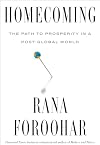
As the subtitle tells you, this book is about post-globalism. With the COVID pandemic marking an inflection point, it seems as though we've turned a corner from globalism to regional federation, and Foroohar charts that shift in this book.
In the late aughts, I deferred my college entrance and instead spent a year at a farming and homesteading program. The following year, I helped start a network focused on local food system infrastructure investment (think commercial kitchens, slaughter show more houses, mills, shipping, etc.). While reading this book, I felt as though Foroohar was trying to summarize a shift that I've been living for my entire adult life.
There's part of me that feels some lack of recognition for the movements and communities whom, from my perspective, have precipitate many of the shifts she describes. She fails to mention Slow Money, The Capital Institute (and their 2012 book, "The Next (Regenerative) Industrial Age: The Story of the National Manufacturing Renaissance Campaign"), Tellus Institute, r3.0, Fibershed, Carol Sanford Institute, The Schumacher Center for New Economics, Buckminster Fuller Institute Post Growth Institute, or Local Future, to name a few. Much of the book is dedicated to building resilience in regional food and fiber systems (domains I have extensive experience with), so I was surprised that we have almost zero overlap in our respective stories of who it is that has brought about some of the shifts that have been happening in these spheres.
If I can let go of the pride I feel for my colleagues for a moment, I can get to a place of being in agreement about the broad strokes of Foroohar's arguments, and actually feeling a little surprise about just how mainstream many of these things have become. Foroohar—an associate editor of the Financial Times—is saying we're in a post-neoliberal world. I hadn't realized we'd arrived so quickly!
Foroohar does get into the ethics of decentralization, and points to the blockchain space as a promising frontier (unlike many journalists of her ilk, who dismiss the ethics of decentralization as naïvely inefficient).
The antagonist of the narrative, as you might have guessed, is the Chinese Communist Party (CCP)—although Foroohar could do better in precision around her language (often slipping into naming "China" as a whole as the US adversary, which threatens to cross over into the realm of racist nationalism). She also names computer chips as one of the main battle grounds. Having just read Chris Miller's "Chip War," it seems as though Foroohar is overstating the United States ability to re-shore the chip business (Miller concludes that the chip supply chain is fundamentally global, and any decoupling will be extremely fraught and potentially impossible). Realism aside, Foroohar isn't wrong that it isn't worth trying (maybe we could have two independent global chip supply chains instead of one—one US-centric and the other China-centric, but both multi-national).
I actually bought a pair of US-designed, -grown, -spun, -knit, -dyed, -sewn, sweatpants from American Giant as a result of this book, as I was looking for a good pair and was sold on Foroohar's pitch on the company and their practices.
I'm also reading Christopher Alexander's "The Nature of Order" and Andreas Weber's "Enlivenment" at this time, which remind me that Foroohar's rhetoric excludes the aesthetic, animist, and spiritual reasons for following a path of more relationship in our supply webs.
All-in-all, I'm grateful to Foroohar bringing an ethic of regionalism, federation, and decentralization to an audience of the worlds of finance, business, and politics. show less
In the late aughts, I deferred my college entrance and instead spent a year at a farming and homesteading program. The following year, I helped start a network focused on local food system infrastructure investment (think commercial kitchens, slaughter show more houses, mills, shipping, etc.). While reading this book, I felt as though Foroohar was trying to summarize a shift that I've been living for my entire adult life.
There's part of me that feels some lack of recognition for the movements and communities whom, from my perspective, have precipitate many of the shifts she describes. She fails to mention Slow Money, The Capital Institute (and their 2012 book, "The Next (Regenerative) Industrial Age: The Story of the National Manufacturing Renaissance Campaign"), Tellus Institute, r3.0, Fibershed, Carol Sanford Institute, The Schumacher Center for New Economics, Buckminster Fuller Institute Post Growth Institute, or Local Future, to name a few. Much of the book is dedicated to building resilience in regional food and fiber systems (domains I have extensive experience with), so I was surprised that we have almost zero overlap in our respective stories of who it is that has brought about some of the shifts that have been happening in these spheres.
If I can let go of the pride I feel for my colleagues for a moment, I can get to a place of being in agreement about the broad strokes of Foroohar's arguments, and actually feeling a little surprise about just how mainstream many of these things have become. Foroohar—an associate editor of the Financial Times—is saying we're in a post-neoliberal world. I hadn't realized we'd arrived so quickly!
Foroohar does get into the ethics of decentralization, and points to the blockchain space as a promising frontier (unlike many journalists of her ilk, who dismiss the ethics of decentralization as naïvely inefficient).
The antagonist of the narrative, as you might have guessed, is the Chinese Communist Party (CCP)—although Foroohar could do better in precision around her language (often slipping into naming "China" as a whole as the US adversary, which threatens to cross over into the realm of racist nationalism). She also names computer chips as one of the main battle grounds. Having just read Chris Miller's "Chip War," it seems as though Foroohar is overstating the United States ability to re-shore the chip business (Miller concludes that the chip supply chain is fundamentally global, and any decoupling will be extremely fraught and potentially impossible). Realism aside, Foroohar isn't wrong that it isn't worth trying (maybe we could have two independent global chip supply chains instead of one—one US-centric and the other China-centric, but both multi-national).
I actually bought a pair of US-designed, -grown, -spun, -knit, -dyed, -sewn, sweatpants from American Giant as a result of this book, as I was looking for a good pair and was sold on Foroohar's pitch on the company and their practices.
I'm also reading Christopher Alexander's "The Nature of Order" and Andreas Weber's "Enlivenment" at this time, which remind me that Foroohar's rhetoric excludes the aesthetic, animist, and spiritual reasons for following a path of more relationship in our supply webs.
All-in-all, I'm grateful to Foroohar bringing an ethic of regionalism, federation, and decentralization to an audience of the worlds of finance, business, and politics. show less
Awards


You May Also Like


Associated Authors
Statistics
- Works
- 4
- Also by
- 1
- Members
- 414
- Popularity
- #58,865
- Rating
- 4.1
- Reviews
- 12
- ISBNs
- 23
- Languages
- 1