
Pascal Quignard
Author of All the World's Mornings
About the Author
Series
Works by Pascal Quignard
Georges De LA Tour & Pascal Quignard (Secret Museums. 17th Century, Vol. 1) (1991) — Author — 19 copies
Portraits de la Pensée (cat. exp., Lille, Palais des Beaux-arts, 11 mars – 13 juin 2011) (2011) 4 copies
Happy the Hours 2 copies
Les Lieux de Pascal Quignard: Actes du colloque de l'université du Havre (29 et 30 avril 2013) (2014) 1 copy
Amerikan Isgali 1 copy
Tajný život 1 copy
Crítica del juicio. 1 copy
Terasa v Římě 1 copy
Petits traités, vol. 6 1 copy
Sur le défaut de terre 1 copy
الجنس والفزع 1 copy
Associated Works
Tagged
Common Knowledge
- Canonical name
- Quignard, Pascal
- Legal name
- Quignard, Pascal
- Birthdate
- 1948-04-23
- Gender
- male
- Education
- Université de Nanterre, (Licence, Philosophie)
- Occupations
- novelist
translator - Organizations
- Mercure de France (Traducteur, 1969 et lecteur, 1976)
- Relationships
- Bruneau, Charles (Grand-père)
- Nationality
- France
- Birthplace
- Verneuil-sur-Avre, Eure, Normandie, France
- Places of residence
- Verneuil-sur-Avre, Eure, Normandie, France
- Map Location
- France
Members
Reviews
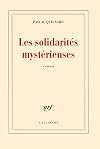
Les solidarités mystérieuses looks from a distance rather like a simple romantic tale about a woman who returns to live near the village where she grew up and hooks up with her childhood sweetheart, whose wife is not amused. Add Claire's brother Paul, who's in love with the local curé, stir in a lot of Breton weather and a few standing stones, a fire and an accident at sea, make a point of not talking about how the parents and younger sister died, and you have a plot that Name that book show more would be proud of.
But of course that's not what this book is about, any more than its cross-channel counterpart is about Meryl Streep walking up and down the Cobb at Lyme Regis. The corny plot elements are subtly but very firmly undermined by awkward little continuity "errors". The wrong amount of time passes between two overdetermined fixed points - or it passes the wrong way; different POV characters see different versions of the story that can't quite be resolved; key events are left unexplained; the real landscape around Dinard and Saint-Énogat is described in such detail that you feel you could easily follow it on a map, but then he inserts a village that doesn't and couldn't fit in anywhere near where he puts it. And so on.
What we do get are a series of short, lyrical, very sensual scenes, long on sight and sound and smell and texture, but mostly short on well-defined narrative content. When you add them up, they start to form a complex, not quite consistent view of the characters of Claire and Paul and the world they live in, in the same sort of way that the poems in a collection start to build up a picture in your mind of the poet, but there's nothing like narrative closure going on, and you could probably read the book in a dozen different ways quite legitimately.
It should be frustrating, and I've very little idea what - if anything - it's "really about" (other than promoting the Breton tourist industry...), but I enjoyed Quignard's unusual but rather poetic style very much. Interesting. And another holiday destination to add to my list. show less
But of course that's not what this book is about, any more than its cross-channel counterpart is about Meryl Streep walking up and down the Cobb at Lyme Regis. The corny plot elements are subtly but very firmly undermined by awkward little continuity "errors". The wrong amount of time passes between two overdetermined fixed points - or it passes the wrong way; different POV characters see different versions of the story that can't quite be resolved; key events are left unexplained; the real landscape around Dinard and Saint-Énogat is described in such detail that you feel you could easily follow it on a map, but then he inserts a village that doesn't and couldn't fit in anywhere near where he puts it. And so on.
What we do get are a series of short, lyrical, very sensual scenes, long on sight and sound and smell and texture, but mostly short on well-defined narrative content. When you add them up, they start to form a complex, not quite consistent view of the characters of Claire and Paul and the world they live in, in the same sort of way that the poems in a collection start to build up a picture in your mind of the poet, but there's nothing like narrative closure going on, and you could probably read the book in a dozen different ways quite legitimately.
It should be frustrating, and I've very little idea what - if anything - it's "really about" (other than promoting the Breton tourist industry...), but I enjoyed Quignard's unusual but rather poetic style very much. Interesting. And another holiday destination to add to my list. show less
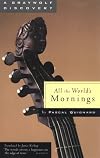
The writing is very lush, very sensuous, and with an erotic charge to it. I love reading such beautiful narratives about music, creativity, passion. Quignard is a fine writer. The ending though, is such a tired trope -- the spurned woman who wastes away from a broken heart, her purity gone. It's an older book, so to be forgiven. It was going somewhere so beautiful and rich, and just really hobbled itself.
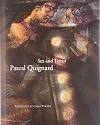
A wonderfully dense little book of cultural interpretation on the Greco-Roman world and their sensibilities in relation to sex and death. It is not dense in a ponderous academic sense, but dense in its richness of thoughts and references. It is probably not the best book to read if you are unfamiliar with the pre-Christian Greco-Roman world because you will miss the point of much of what he is saying or the subtle nuances, but if you are, it is a delightful book that gave me a better show more understanding of the values and concerns of the Ancients who were obsessed with death and sex. And is it any wonder? More than half of all children would die before the age of ten and never reproduce. Priapus, the god of the fructifying seed implanter, was the most worshipped god in the ancient world. Erect penises were everywhere but so was death.
The ritual specific to Rome is the ludibrium, a Priapic rite of ritualized indecency. This sarcastic game, the obscene dancing, joking, the sarcastic display of erect penises, the killing with ridicule, was Rome’s contribution to the ancient world.
To quote from the book: “The Christian history has a ludibrium as its founding moment. The primal scene of Christianity – the servile torture of crucifixion reserved for the man claiming to be God, the flagellatio, the inscription ‘Iesus Nazarenus Rex Iudaeorum’, the purple robe (veste purpurea), the royal crown made of thorns (coronam spineam), the reed as scepter and the shaming nudity – is a ludibrium designed to elicit laughter. The seventeenth-century Chinese to whom the Jesuit fathers were attempting to teach Christianity understood it as such from the outset and could not comprehend how a comic scene could be made into a an article of faith.”
OMG – This is so right on - it truly is the religion of slaves as Lucian sarcastically pointed out.
The author discusses the slow transformation that occurred under the Romans from the joyful sexual exuberance of the Greeks to the melancholic Romans who laid the groundwork for the final renunciation by the Christians. To quote the author: “The Christians no more invented Christian morality than they invented the Latin language.” This truth has always been apparent to me. The New Testament reflects Roman values…it does not represent Jewish values or anything of the sort...those who have only read Christian literature…especially of the conservative variety don’t get this…can’t get this because they have never read or studied the Ancients themselves. As Joachim Jeremias, Professor of New Testament and Near Eastern Studies, once wrote, there is not one original thought in the New Testament. Well of course…it is only with a profound historical forgetfulness that Moderns don't know this.
IMO, the one thing that is quintessentially Jewish however, is how the death of Jesus is turned into a triumph. This characterizes all of Jewish history down to the present. The fact that the Jewish people survive repeated crushing defeats is turned ( subverted ) into a triumph. And thus it is with Jesus. The bastard son of a low woman from a conquered crushed people is turned into a King( When Pompey conquered Israel in 63BCE, he put 12,000 Jews to death. When he entered the Temple and saw the tablets, he said 'Smash it all'. ) .
The book is not about Christianity, these were merely remarks - which characterizes the book as a whole - it is full of insightful remarks - the book is about how Romans viewed the world as illustrated in their literature and visual arts. The author includes many color plates of ancient art along with his unique interpretation.
A nice complement to this book is From Shame to Sin: The Christian Transformation of Sexual Morality in Late Antiquity( http://www.librarything.com/work/14100723 ).
The book includes many color plates of Roman art and his interesting interpretation.
Tolle lege! I am rereading it again. show less
The ritual specific to Rome is the ludibrium, a Priapic rite of ritualized indecency. This sarcastic game, the obscene dancing, joking, the sarcastic display of erect penises, the killing with ridicule, was Rome’s contribution to the ancient world.
To quote from the book: “The Christian history has a ludibrium as its founding moment. The primal scene of Christianity – the servile torture of crucifixion reserved for the man claiming to be God, the flagellatio, the inscription ‘Iesus Nazarenus Rex Iudaeorum’, the purple robe (veste purpurea), the royal crown made of thorns (coronam spineam), the reed as scepter and the shaming nudity – is a ludibrium designed to elicit laughter. The seventeenth-century Chinese to whom the Jesuit fathers were attempting to teach Christianity understood it as such from the outset and could not comprehend how a comic scene could be made into a an article of faith.”
OMG – This is so right on - it truly is the religion of slaves as Lucian sarcastically pointed out.
The author discusses the slow transformation that occurred under the Romans from the joyful sexual exuberance of the Greeks to the melancholic Romans who laid the groundwork for the final renunciation by the Christians. To quote the author: “The Christians no more invented Christian morality than they invented the Latin language.” This truth has always been apparent to me. The New Testament reflects Roman values…it does not represent Jewish values or anything of the sort...those who have only read Christian literature…especially of the conservative variety don’t get this…can’t get this because they have never read or studied the Ancients themselves. As Joachim Jeremias, Professor of New Testament and Near Eastern Studies, once wrote, there is not one original thought in the New Testament. Well of course…it is only with a profound historical forgetfulness that Moderns don't know this.
IMO, the one thing that is quintessentially Jewish however, is how the death of Jesus is turned into a triumph. This characterizes all of Jewish history down to the present. The fact that the Jewish people survive repeated crushing defeats is turned ( subverted ) into a triumph. And thus it is with Jesus. The bastard son of a low woman from a conquered crushed people is turned into a King( When Pompey conquered Israel in 63BCE, he put 12,000 Jews to death. When he entered the Temple and saw the tablets, he said 'Smash it all'. ) .
The book is not about Christianity, these were merely remarks - which characterizes the book as a whole - it is full of insightful remarks - the book is about how Romans viewed the world as illustrated in their literature and visual arts. The author includes many color plates of ancient art along with his unique interpretation.
A nice complement to this book is From Shame to Sin: The Christian Transformation of Sexual Morality in Late Antiquity( http://www.librarything.com/work/14100723 ).
The book includes many color plates of Roman art and his interesting interpretation.
Tolle lege! I am rereading it again. show less
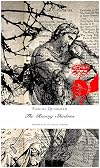
Purloined shadows
Written in aphoristic chapters, Quignard's The Roving Shadows is delicately philosophical, capriciously poetic, splashed with tidbits of historical anecdote and folkloric fragments.
Concerning itself with shadows (with the shadows of shadows), the author's sometimes hazy, sometimes lucid reflections on the human psyche reach from now into the distant past (and visa versa).
Clearly enigmatic: the writing entices, enchants, puzzles; its meaning teasingly sublime, artfully vague, show more potentially insightful, deft.
If, on a sunny day, your shadow gained a life of its own and you watched it move away, I'm guessing you would follow it... (intrigued, amazed): that's what this wondrous book is like - it stirs a perplexed curiosity. show less
Written in aphoristic chapters, Quignard's The Roving Shadows is delicately philosophical, capriciously poetic, splashed with tidbits of historical anecdote and folkloric fragments.
Concerning itself with shadows (with the shadows of shadows), the author's sometimes hazy, sometimes lucid reflections on the human psyche reach from now into the distant past (and visa versa).
Clearly enigmatic: the writing entices, enchants, puzzles; its meaning teasingly sublime, artfully vague, show more potentially insightful, deft.
If, on a sunny day, your shadow gained a life of its own and you watched it move away, I'm guessing you would follow it... (intrigued, amazed): that's what this wondrous book is like - it stirs a perplexed curiosity. show less
Lists
Awards


You May Also Like


Associated Authors
Statistics
- Works
- 93
- Also by
- 1
- Members
- 2,498
- Popularity
- #10,274
- Rating
- 3.7
- Reviews
- 42
- ISBNs
- 318
- Languages
- 21
- Favorited
- 9

