
Beowulf Poet
Author of Beowulf
About the Author
Works by Beowulf Poet
Associated Works
The Graphic Canon, Vol. 1: From the Epic of Gilgamesh to Shakespeare to Dangerous Liaisons (2012) — Contributor — 302 copies, 7 reviews
Tagged
Common Knowledge
- Other names
- Beowulf poet
Beowulf - Birthdate
- c. 10th-11th CE
- Date of death
- c. 10th-11th CE
- Gender
- n/a
- Nationality
- England (Anglo-Saxon England)
- Map Location
- UK
Members
Discussions
Beowulf LE coming 27 June 2023 in Folio Society Devotees (June 2025)
New Beowulf edition in the works in Folio Society Devotees (June 2022)
123. Beowulf in Backlisted Book Club (March 2022)
Headley's "Beowulf": combine or keep separate? in Combiners! (October 2020)
Group Read: Beowulf - Seamus Heaney (spoilers) in 75 Books Challenge for 2011 (February 2011)
Reviews

I always enjoy the translator's notes in these, what makes you go and be the umpteenth person to translate a classic, what makes you think you can bring something new to the party? I think this works and the translator does bring something different to this work.
I didn't get Beowulf forced on me at school - I didn't go to that sort of school. I came to Beowulf as an adult, by choice and through the Seamus Heaney translation. I loved it from the first word, as I, too, have a habit of starting show more a conversation with "So". More at work than at home, but I recognised something in it. It opened up the world of alliterative poetry, which I have thoroughly enjoyed exploring with the likes of Simon Armitage. In this, the translator starts with "Bro". I get what she is trying to do, this is a bar room and the story teller is trying to quieten the room, to take the floor, to grab the attention. I reckon someone, somewhere could write an essay on the choice of translation for "Hwaet".
This feels to be a more robust translation than the Heaney (which I am going to have to read again very soon). It uses modern language, there's a couple of gimme and gonna in here as well as shit and fuck used more than I would, but I'm not the subject of this. This is all about a male environment and the men in it. And they almost certainly would use that language. That's not to say that it is dumbed down, or simplified, there are plenty of allusions and illusions at work in here. The whale road being the Old English equivalent of the wine dark sea. It feels immediate and earthy, it doesn't feel distant and ethereal in the way that the tranbslation of an ancient classic could do. There is relevance in here and the language used is of its time. That may mean it will date, but that doesn;t make it any less good in the here and now.
I liked the way that the voice changed as the different people take up the tale, there is a change in language and word usage here that is sophisticated without feeling to be artificial.
The story hasn't changed, it remains the same 3 act play with 50 years vanishing in the middle. And yet it isn't tired and predictable, I still felt the tears pricking as Wiglaf berates his fellow warriors for not coming to Beowulf's aid. If there's any lesson in here that the modern world need to hear it is that doing the right thing is always worth it, no matter how hard or painful. He's the hero for the modern age.
This is well worth adding to your reading list, regardless of if you're familiar with the work or not. show less
I didn't get Beowulf forced on me at school - I didn't go to that sort of school. I came to Beowulf as an adult, by choice and through the Seamus Heaney translation. I loved it from the first word, as I, too, have a habit of starting show more a conversation with "So". More at work than at home, but I recognised something in it. It opened up the world of alliterative poetry, which I have thoroughly enjoyed exploring with the likes of Simon Armitage. In this, the translator starts with "Bro". I get what she is trying to do, this is a bar room and the story teller is trying to quieten the room, to take the floor, to grab the attention. I reckon someone, somewhere could write an essay on the choice of translation for "Hwaet".
This feels to be a more robust translation than the Heaney (which I am going to have to read again very soon). It uses modern language, there's a couple of gimme and gonna in here as well as shit and fuck used more than I would, but I'm not the subject of this. This is all about a male environment and the men in it. And they almost certainly would use that language. That's not to say that it is dumbed down, or simplified, there are plenty of allusions and illusions at work in here. The whale road being the Old English equivalent of the wine dark sea. It feels immediate and earthy, it doesn't feel distant and ethereal in the way that the tranbslation of an ancient classic could do. There is relevance in here and the language used is of its time. That may mean it will date, but that doesn;t make it any less good in the here and now.
I liked the way that the voice changed as the different people take up the tale, there is a change in language and word usage here that is sophisticated without feeling to be artificial.
The story hasn't changed, it remains the same 3 act play with 50 years vanishing in the middle. And yet it isn't tired and predictable, I still felt the tears pricking as Wiglaf berates his fellow warriors for not coming to Beowulf's aid. If there's any lesson in here that the modern world need to hear it is that doing the right thing is always worth it, no matter how hard or painful. He's the hero for the modern age.
This is well worth adding to your reading list, regardless of if you're familiar with the work or not. show less
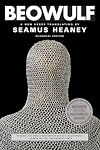
Beowulf pales somewhat in comparison to the Iliad or the Aeneid. These earlier epics achieve greater psychological complexity and narrative effects. What Beowulf boasts is an incredible linguistic vitality. The poet’s Old English verse throbs with a melody and meaning you don’t have to understand to feel. Seamus Heaney’s rugged rendering imparts the original’s linguistic intensity, the word-life that still vibrates in this Anglo-Saxon epic, a thousand years after its writing.

I was first exposed to Beowulf: A New Translation via someone quoting a part that contained the phrase, "hashtag: blessed." It's hard to imagine a worse first impression.
But I love Beowulf, and there's a somewhat common phrase about not judging books by your surface level knowledge of them. So I grabbed a copy from the library, and I'm really glad I did.
This is a superb translation. Headley's poetry is wonderfully playful, weaving together the epic with delightful verse, sublime show more alliteration, clever compound expressions, and sudden hard turns into modernity. Swearing, contemporary phrasing and dialogue, and even memes are peppered throughout the book.
Thankfully, it avoids overcommitting to the bit - if that's the right word - of being a story for and by 20XX dudebros. It is far too beautiful and inventive for anyone to make that mistake. The anachronisms are rarer than you'd expect (or fear); they punctuate the poem with precision timing for moments of humor or metaphor. When it's ridiculous, it's clearly with a purpose.
It's a very quotable book, which is not something that can be said of most Beowulf translations.
It has a few clunkers here and there, moments where the swerve to modern temperament ends up crashing into a brick wall. Hashtag: Blessed did not land any better in context. Some repeated words throughout the book - bro, daddy, bling - never felt right no matter how many times I read them. At times the more modern phrases ("Meanwhile, Beowulf gave zero shits.") felt too cute, too distracting.
But these blemishes were rare, leaving a book that felt fresh and clever and brilliant. show less
But I love Beowulf, and there's a somewhat common phrase about not judging books by your surface level knowledge of them. So I grabbed a copy from the library, and I'm really glad I did.
This is a superb translation. Headley's poetry is wonderfully playful, weaving together the epic with delightful verse, sublime show more alliteration, clever compound expressions, and sudden hard turns into modernity. Swearing, contemporary phrasing and dialogue, and even memes are peppered throughout the book.
Thankfully, it avoids overcommitting to the bit - if that's the right word - of being a story for and by 20XX dudebros. It is far too beautiful and inventive for anyone to make that mistake. The anachronisms are rarer than you'd expect (or fear); they punctuate the poem with precision timing for moments of humor or metaphor. When it's ridiculous, it's clearly with a purpose.
It's a very quotable book, which is not something that can be said of most Beowulf translations.
It has a few clunkers here and there, moments where the swerve to modern temperament ends up crashing into a brick wall. Hashtag: Blessed did not land any better in context. Some repeated words throughout the book - bro, daddy, bling - never felt right no matter how many times I read them. At times the more modern phrases ("Meanwhile, Beowulf gave zero shits.") felt too cute, too distracting.
But these blemishes were rare, leaving a book that felt fresh and clever and brilliant. show less

Wow. This is one delightful bit of writing! The language is playful and welcoming. Cleaver and compassionate, the emphasis is on human qualities, good and bad, in all the actors. Grendel and his mother are in some ways less monstrous than Beowulf, whose outrageous strength proves a match and more to theirs, but he is kept from monstrosity because he makes support of his lord and land his limits, his strongest desire being the lasting fame of a good name.
Lists
Art of Reading (1)
BitLife (1)
Read in 2016 (1)
United Kingdom (1)
Poetry Corner (1)
A Reading List (1)
Ambleside Year 7 (1)
Unread books (1)
bound (1)
Western Canon (1)
Sonlight Books (1)
Ambleside Books (1)
el (1)
Gen X Library (1)
Read in 2020 (1)
Out of Copyright (1)
Five star books (1)
Western Canon (1)
Overdue Podcast (1)
Awards


You May Also Like


Associated Authors
Statistics
- Works
- 16
- Also by
- 3
- Members
- 32,527
- Popularity
- #595
- Rating
- 3.8
- Reviews
- 397
- ISBNs
- 410
- Languages
- 17
- Favorited
- 3