
Reni Eddo-Lodge
Author of Why I’m No Longer Talking to White People About Race
About the Author
Image credit: Divulgação
Works by Reni Eddo-Lodge
Associated Works
The Good Immigrant: 21 Writers Explore What It Means to be Black, Asian, and Minority Ethnic in Britain Today (2016) — Contributor — 467 copies, 13 reviews
New Daughters of Africa: An International Anthology of Writing by Women of African Descent (2019) — Contributor — 116 copies, 1 review
Tagged
Common Knowledge
- Birthdate
- 1989-09-25
- Gender
- female
- Education
- University of Central Lancashire
- Occupations
- journalist
- Nationality
- UK
- Birthplace
- London, England, UK
- Map Location
- England, UK
Members
Reviews
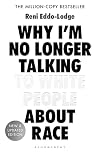
This is one of those books that everyone recommends you read, and then you read it and want to do the same. Everyone should read this. There are certain people I wish I could just throw it at. It's intelligent and interesting and if you don't think there is a racism problem in Britain then this is essential reading. If you react badly to the title, then you need to read the book. If you think 'reverse racism' is a thing, you need to read the book, you need to learn, you need to understand.
I show more don't usually read non-fiction books, so I wasn't able to read this in one go, I had to cut it up with fiction books or my brain would time-out on how much information it could absorb. I guess basically each chapter is its own separate essay on a particular aspect of racism in Britain. I have read quite a lot on this kind of subject in the last year, but usually these are short essays or articles online, with links to sources that lead my down a rabbit hole of further resources. Reading an actual book is quite a different experience, because you are only getting one voice the entire time and although there are lots of sources and references at the back of the book, you can't really look them up as you go along. I found the sections on history, real life experiences and interviews much easier to digest than the sections that were more hypothetical or just narration, based on statistics etc. I don't think I really want to read many more non-fiction books, but I would like to continue learning about this subject matter. show less
I show more don't usually read non-fiction books, so I wasn't able to read this in one go, I had to cut it up with fiction books or my brain would time-out on how much information it could absorb. I guess basically each chapter is its own separate essay on a particular aspect of racism in Britain. I have read quite a lot on this kind of subject in the last year, but usually these are short essays or articles online, with links to sources that lead my down a rabbit hole of further resources. Reading an actual book is quite a different experience, because you are only getting one voice the entire time and although there are lots of sources and references at the back of the book, you can't really look them up as you go along. I found the sections on history, real life experiences and interviews much easier to digest than the sections that were more hypothetical or just narration, based on statistics etc. I don't think I really want to read many more non-fiction books, but I would like to continue learning about this subject matter. show less
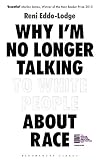
In response to a one-star review on a different book-review website:
A book full of analysis of the underlying hate and racist prejudice against black people in majority white society. Why such an insightful text took so long to be published is beyond me. It starts with its title, which is eye-catching and thought provoking, and the author carefully explains her meaning in a well-considered and personal way. If you want to see what real structural racism is, read this book.
It's easy to show more understand why some white people take offense at the title of this book. Eddo-Lodge seems to have designed it to slap the reader in the face, to take notice of their position in relation to her declaration. It's like a Zen koan, designed to snap the reader into an immediate awareness of their underlying feeling, rather than their thought. If it makes you feel uncomfortable, then, if you can be open to hearing the author's experience as a black person in a majority white society, there's undoubtedly much to learn.
I, as a white person, you're prepared to squarely look at how you have a head start in life simply by being born with a characteristic that society considers the baseline for normal (doubled and re-doubled if you happen to be male, tripled and re-tripled if you happen to be born into wealth), then you can begin to understand the exasperation of the author at constantly having to fight the same battles over and over again; constantly having the discussion about racism subverted into accusations of racism against whites.
As is obvious from the existence of the book, Eddo-Lodge has not stopped talking about race, and much of the book is directed towards white people. Yes, in a challenging way, but not in a vituperative way. Eddo-Lodge explicitely states that she does not want to evoke "white-guilt" in her readers, but rather makes a call to action, to take an anti-racist stand where it matters most, in our own lives and with the people we live and work with.
White people need not fear Eddo-Lodge's message, however uncomfortable it might feel at the outset. Awareness is a precursor of change, and she advocates for a harmonious society in which everybody is prized and is able to live a fulfilling life free from oppression. show less
A book full of analysis of the underlying hate and racist prejudice against black people in majority white society. Why such an insightful text took so long to be published is beyond me. It starts with its title, which is eye-catching and thought provoking, and the author carefully explains her meaning in a well-considered and personal way. If you want to see what real structural racism is, read this book.
It's easy to show more understand why some white people take offense at the title of this book. Eddo-Lodge seems to have designed it to slap the reader in the face, to take notice of their position in relation to her declaration. It's like a Zen koan, designed to snap the reader into an immediate awareness of their underlying feeling, rather than their thought. If it makes you feel uncomfortable, then, if you can be open to hearing the author's experience as a black person in a majority white society, there's undoubtedly much to learn.
I, as a white person, you're prepared to squarely look at how you have a head start in life simply by being born with a characteristic that society considers the baseline for normal (doubled and re-doubled if you happen to be male, tripled and re-tripled if you happen to be born into wealth), then you can begin to understand the exasperation of the author at constantly having to fight the same battles over and over again; constantly having the discussion about racism subverted into accusations of racism against whites.
As is obvious from the existence of the book, Eddo-Lodge has not stopped talking about race, and much of the book is directed towards white people. Yes, in a challenging way, but not in a vituperative way. Eddo-Lodge explicitely states that she does not want to evoke "white-guilt" in her readers, but rather makes a call to action, to take an anti-racist stand where it matters most, in our own lives and with the people we live and work with.
White people need not fear Eddo-Lodge's message, however uncomfortable it might feel at the outset. Awareness is a precursor of change, and she advocates for a harmonious society in which everybody is prized and is able to live a fulfilling life free from oppression. show less
This was certainly an uncomfortable read, which was, I suppose, the point. As a middle-aged, middle class, white man who likes to think of himself as holding fairly liberal views, I probably fall right into the group at whom Reni Eddo-Lodge’s book is aimed.
Having heard a few people discussing this book, I think that part of me was hoping I could dismiss it as a collection of exaggerated grievances that struggled to make an overly emotive point. Nothing could be further from the truth. Ms show more Eddo-Lodge has written a clear, coherent and essentially incontrovertible account of the institutional and structural racism that abounds, in the most self-perpetuating way throughout society.
It also serves to reinforce the fact that one of the greatest disappointments in life is not how nasty or unfeeling the bad people can be – that is, after all, what one would expect. Sadly, it is the inadvertent and occasional, even casual, but no less damaging, unpleasantness from the decent people that often comes across as most painful. The sad irony is that it is the self-satisfied liberals who constantly tell themselves that they aren’t racist so don’t have anything to worry about on that score who represent one of the biggest factors hindering the eradication of racism.
Eddo-Lodge’s book arose from a blog post that she wrote which drew thousands of comments, provoking an extensive, and often heated, online debate. As a consequence of the response to her blog, she has expanded the book, covering a lot of the history of the black and non-white community in Britain, and its frequent invisibility. For instance, hundred thousands of servicemen from the Caribbean and the rest of the Empire participated in Britain’s armed forces in the two world wars, but their huge contribution has scarcely ever been acknowledged.
The book is well-written, comprehensively researched and definitely worth reading, regardless of how uncomfortable its impact might be. show less
Having heard a few people discussing this book, I think that part of me was hoping I could dismiss it as a collection of exaggerated grievances that struggled to make an overly emotive point. Nothing could be further from the truth. Ms show more Eddo-Lodge has written a clear, coherent and essentially incontrovertible account of the institutional and structural racism that abounds, in the most self-perpetuating way throughout society.
It also serves to reinforce the fact that one of the greatest disappointments in life is not how nasty or unfeeling the bad people can be – that is, after all, what one would expect. Sadly, it is the inadvertent and occasional, even casual, but no less damaging, unpleasantness from the decent people that often comes across as most painful. The sad irony is that it is the self-satisfied liberals who constantly tell themselves that they aren’t racist so don’t have anything to worry about on that score who represent one of the biggest factors hindering the eradication of racism.
Eddo-Lodge’s book arose from a blog post that she wrote which drew thousands of comments, provoking an extensive, and often heated, online debate. As a consequence of the response to her blog, she has expanded the book, covering a lot of the history of the black and non-white community in Britain, and its frequent invisibility. For instance, hundred thousands of servicemen from the Caribbean and the rest of the Empire participated in Britain’s armed forces in the two world wars, but their huge contribution has scarcely ever been acknowledged.
The book is well-written, comprehensively researched and definitely worth reading, regardless of how uncomfortable its impact might be. show less
I'm about four years late to this urgent, searing and ferociously intelligent work. In Australia, we are past due to be properly having honest conversations about race. This book reinforced to me the critical importance to ensuring any conversation about inequality, about injustice, about barriers, has race very much in the centre of the frame. Of course, where I live, blak people have been here for 60,000 years. Oh, and happy NAIDOC week btw. I'm particularly grateful to Reni Eddo-Lodge for show more writing this book, because it came from a place of profound exhaustion, the mental and emotional labour costs of managing white fragility having taken their inevitable toll. So, as a white woman, I'll put my hand up and say that I work at not expecting people of colour to always do the hard work of educating me about what it's like to live in their skin. I acknowledge that I have benefited, invisibly as well as tangibly, from white privilege. I will continue to amplify diverse voices to the best of my ability. I will provide bystander support when required. I will do anti-racist work in when I am in white spaces. I will make myself uncomfortable if it means I can be a better ally. "There is no justice. There's just us." show less
Lists
Racial identity (1)
Review 3 (1)
Awards


You May Also Like


Associated Authors
Statistics
- Works
- 2
- Also by
- 3
- Members
- 2,226
- Popularity
- #11,511
- Rating
- 4.2
- Reviews
- 62
- ISBNs
- 30
- Languages
- 10
- Favorited
- 1
