
Black Elk (1863–1950)
Author of Black Elk Speaks: Being the Life Story of a Holy Man of the Oglala Sioux
About the Author
Works by Black Elk
Black Elk Speaks: Being the Life Story of a Holy Man of the Oglala Sioux (1932) 4,278 copies, 56 reviews
The Sacred Pipe: Black Elk's Account of the Seven Rites of the Oglala Sioux (1953) 704 copies, 3 reviews
The Sixth Grandfather: Black Elk's Teachings Given to John G. Neihardt (1984) — Interviewee — 149 copies
Associated Works
The Graphic Canon, Vol. 3: From Heart of Darkness to Hemingway to Infinite Jest (2013) — Contributor — 162 copies, 1 review
Voice of the Turtle: American Indian Literature, 1900-1970 (1994) — Contributor — 139 copies, 1 review
Tagged
Common Knowledge
- Legal name
- Heȟáka Sápa
- Other names
- Schwarzer Hirsch
Alce Nero
Black Elk, Nicholas
Hehaka Sapa - Birthdate
- 1863-12
- Date of death
- 1950-08
- Gender
- male
- Occupations
- Oglala holy man
catechist - Organizations
- Oglala Lakota People
- Awards and honors
- US Board on Geographic Names (renamed Harney Peak, the highest point in South Dakota, Black Elk Peak in honor of Nicholas Black Elk, 2016)
Roman Catholic Diocese of Rapid City (opened an official cause for beautification, 2016)
Native American representative to the United Nations - Relationships
- Fools Crow, Frank (nephew)
- Nationality
- Lakota Nation
- Birthplace
- Little Powder River, Wyoming, USA
- Place of death
- Pine Ridge, South Dakota, USA
- Burial location
- Saint Agnes Catholic Cemetery, Manderson, South Dakota, USA
- Map Location
- USA
Members
Reviews
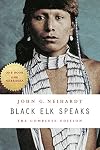
I did not know then how much was ending. When I look back now from this high hill of my old age I can still see the butchered women and children heaped and scattered all along the crooked mulch as plain as when I saw them with eyes still young. And I can see that something else died there in the bloody mud and was buried in the blizzard.
I enjoyed this book. I found it kind of difficult when I was reading it to figure out what was actually Black Elk, and what was Neihardt, although the editor had thankfully given little footnotes on the side. While I think this was a powerful book, and very interesting to read, the lack of any true authenticity bothered me quite a lot. I didn't really understand why Neihardt couldn't just tell us what Black Elk said. It was obvious to me that good parts of the book were Black Elk's words show more filtered through a European-American consciousness in such a way that they would be understandable to European-Americans. And this bugged me, some places more than others.
Still, looking at the time when it was written, I think the interesting thing of the book is not what it tells you of Black Elk (of which most words were to me suspect because of Neihardt's 'filter'), but of what it tells you of Neihardt and the mainstream society of the time.
This is not a book to read if you want an accurate, authentic autobiography of Native Americans, but it is an interesting book of Native American/European-American fusion for the time period. show less
Still, looking at the time when it was written, I think the interesting thing of the book is not what it tells you of Black Elk (of which most words were to me suspect because of Neihardt's 'filter'), but of what it tells you of Neihardt and the mainstream society of the time.
This is not a book to read if you want an accurate, authentic autobiography of Native Americans, but it is an interesting book of Native American/European-American fusion for the time period. show less
A powerful book, and a sad book. Black Elk tells of his life and in that story we learn so much!
His peoples names for the months, the significance of circles to the native people, their customs and traditions. Even legends are told in here, like the chapter titled "High Horse's Courting" which I really enjoyed! Black Elk's visions are extremely interesting as are his interactions with the spirit and animal worlds. And yet his story is that of the Native American, so it is a sad one. The show more demise of his people, the deaths of Crazy Horse and Sitting Bull and the massacre at Wounded Knee. And of course, the theft of their land by the Wasichus (white people). The ending, like that of his people, is so sad. show less
His peoples names for the months, the significance of circles to the native people, their customs and traditions. Even legends are told in here, like the chapter titled "High Horse's Courting" which I really enjoyed! Black Elk's visions are extremely interesting as are his interactions with the spirit and animal worlds. And yet his story is that of the Native American, so it is a sad one. The show more demise of his people, the deaths of Crazy Horse and Sitting Bull and the massacre at Wounded Knee. And of course, the theft of their land by the Wasichus (white people). The ending, like that of his people, is so sad. show less
[b:Black Elk Speaks: Being the Life Story of a Holy Man of the Oglala Sioux|35476|Black Elk Speaks Being the Life Story of a Holy Man of the Oglala Sioux|John G. Neihardt|https://i.gr-assets.com/images/S/compressed.photo.goodreads.com/books/1328819916l/35476._SX50_.jpg|3813941] is a fascinating piece of history. It is the life story of a Native American holy man named Black Elk, as told in 1931 to a Nebraskan poet. Black Elk recounts his youth during the mid-19th century, when battles and show more massacres drove the Sioux and other tribes into smaller and smaller areas of land. Treaties made with the American government were repeatedly broken by settlers so that land could be exploited for gold or other resources. It is thus a sad story of how the Native American way of life was brutally repressed, while also providing insight into religious and social activities before and during this repression. Black Elk explains in detail the visions he had of his people's recovery. It is this aspect that the edition I read focuses on in the blurb and introduction. It did not surprise me to learn that the book was popular in the 1960s, when indigenous spirituality was of particular interest. As a rather prosaic reader, I was most interested in it as history, in particular of how Black Elk and his people interacted with their environment. I hadn't read an account of the mid-19th century told from a Native American perspective before, and it makes a striking contrast to the narrative of economic growth and technological change that dominates histories of this period. A striking and readable autobiographical narrative. show less
Lists
Awards


You May Also Like


Associated Authors
Statistics
- Works
- 5
- Also by
- 7
- Members
- 5,133
- Popularity
- #4,856
- Rating
- 4.0
- Reviews
- 59
- ISBNs
- 82
- Languages
- 10
- Favorited
- 1