
Leo Bersani (1931–2022)
Author of Homos
About the Author
Leo Bersani is professor emeritus of French at University of California, Berkeley, and the author of numerous books, most recently Thoughts and Things, also published by the University of Chicago Press.
Image credit: Silas Crews for The Chronicle Review
Works by Leo Bersani
Conférences Litter : Catégorie ou concept : Balzac et la sexualité ; Amour folle ; La pureté à corps perdu (2006) 5 copies
Forming Couples: Godard's Contempt (Legenda, Special Lecture Series, 6) (Legenda, Special Lecture Series, 6) (2003) 2 copies
The Gay Absence 1 copy
Is the rectum a grave? 1 copy
"The Other Freud" 1 copy
El recto es una tumba? 1 copy
Baudelaire e Freud 1 copy
PROUST 1 copy
Associated Works
Tagged
Common Knowledge
- Canonical name
- Bersani, Leo
- Birthdate
- 1931-04-16
- Date of death
- 2022-02-20
- Gender
- male
- Education
- Harvard University (BA|1952|PhD|1958)
- Occupations
- literary theorist
cultural critic
professor - Organizations
- University of California, Berkeley
Wellesley College
Rutgers University - Awards and honors
- Fellow, American Academy of Arts and Sciences (1992)
- Relationships
- Geraci, Sam (partner)
- Nationality
- USA
- Birthplace
- Bronx, New York, USA
- Places of residence
- Berkeley, California, USA
- Place of death
- Peoria, Arizona, USA
- Associated Place (for map)
- USA
Members
Reviews
Homos by Leo Bersani

I largely picked up Leo Bersani's Homos because it is well known in queer theory for the formulation of the anti-social thesis, which posits that there is something inherently anti-social about homo-ness. Some extensive notes:
Bersani's prologue begins by discussing a danger he sees in much queer theory: the critique of the supposed naturalness of straight, gay, and lesbian identities is much needed, but "they are not necessarily liberating" (4) because they often erase sex ("desexualizing show more discourses") and because "the dominant heterosexual society doesn't need our belief in its own naturalness in order to continue exercising and enjoying the privileges of dominance" (5). Bersani's approach, then, is in part a continued critique of the naturalness of sexuality, but also an attempt to find something liberating about non-heterosexuality, as well as continuing to privilege the sexuality of homosexuality.
He posits his anti-social thesis of queer theory: "Perhaps inherent in gay desire is a revolutionary inaptitude for heteroized sociality. THis of course means sociality as we know it, and the most politically disruptive aspect of the homo-ness I will be exploring in gay desire is a redefinition of sociality so radical that it may appear to require a provisional withdrawal from relationality itself" (7).
Chapter 1 explores homophobia, noting that "homophobic America itself appears to have an insatiable appetite for our presence" (11). While acceptance of queers has grown, so has anti-queer activism and homophobia. Bersani believes that part of acceptance is also related to the expectation that queers will all die of AIDS (this was published in 1995): "In fact, no one can stop looking. But we might wonder if AIDS, in addition to transforming gay men into infinitely fascinating taboos, has also made it less dangerous to look. For, our projects and our energies notwithstanding, others may think of themselves as watching us disappear" (21). Homophobia is also a unique type of hatred: racism depends upon the existence of non-whites, but homophobia does not depend on the existence of homosexuals. It is, instead, "entirely a response to an internal possibility" of being homosexual oneself (27). Of course, homosexuality cannot be eradicated, and thus, homophobia, "itself the sign of the ineradicability of homosexuality, [. . .:] must remain" (29).
Chapter 2 involves detailed engagements with Wittig, Butler, Halperin, and Warner, whom Bersani charges, among other things, for desexualizing discourse about queers. Bersani then argues that "unless we define how the sexual specificity of being queer (a specificity perhaps common to the myriad ways of being queer and the myriad conditions in which one is queer) gives queers a special aptitude for making that challenge [to institutions:], we are likely to come up with a remarkably familiar, and merely liberal, version of it [that challenge:]" (72-73). Bersani pushes these theorists for not being radical enough. For Bersani, "There is a more radical possibility: homo-ness itself necessitates a massive redefining of relationality. More fundamental than a resistance to the normalizing methodologies is a potentially revolutionary inaptitude—perhaps inherent in gay desire—for sociality as it is known" (76).
Chapter 3 is a strong critique of discourses about sadomasochism, many of which argue that there is something liberating about S/M because of the ways in which partners switch roles and play with power. But Bersani is more skeptical: "Sometimes it seems that if anything in society is being challenged, it is not the networks of power and authority, but the exclusion of gays from those networks" (85). Bersani argues that S/M doesn't challenge privilege—it leaves privilege in tact and extends privilege (temporarily), making S/M "profoundly conservative in that its imagination of pleasure is almost entirely defined by the dominant culture to which it thinks of itself as giving 'a stinging slap in the face'" (87). Sure, S/M plays with power, but it doesn't critique privilege and authority.
Chapter 4 is where Bersani really outlines his anti-social theory, asking "Should a homosexual be a good citizen?" (113). Through his readings of Gide, Proust, and Genet, Bersani shows how homo-ness can constitute "a political threat [. . .:] because of the energies it releases, energies made available for the unprecedented projects of human organization" (123). Homo-ness, which involves a "self-shattering" (101), and thus a loss of the self and thus a loss of citizenship (125). Bersani proposes that Gide helps to reimagine relationality in ways that do not involve property, but in order to do this, we need to "imagine a new erotics" (128). Proust, according to Bersani, "point[s:] us in the direction of a community in which relations would no longer be held hostage to demands of intimate knowledge of the other" (151). Even more so, Genet helps us to disentangle erotics from intimacy (165). Ultimately, Bersani's reading becomes an exhort for revolt that rejects relationally: "without such a rejection, social revolt is doomed to repeat the oppressive conditions the provoked the revolt" (172) because "Revolt allows for new agents to fill the slots of master and slave, but it does not necessarily involve a new imagining of how to structure human relations. Structures of oppression outlive agents of oppression" (174). As Bersani understands oppression, "In a society where oppression is structural, constitutive of sociality itself, only what society throws off—its mistakes or its pariahs—can serve the future" (180). show less
Bersani's prologue begins by discussing a danger he sees in much queer theory: the critique of the supposed naturalness of straight, gay, and lesbian identities is much needed, but "they are not necessarily liberating" (4) because they often erase sex ("desexualizing show more discourses") and because "the dominant heterosexual society doesn't need our belief in its own naturalness in order to continue exercising and enjoying the privileges of dominance" (5). Bersani's approach, then, is in part a continued critique of the naturalness of sexuality, but also an attempt to find something liberating about non-heterosexuality, as well as continuing to privilege the sexuality of homosexuality.
He posits his anti-social thesis of queer theory: "Perhaps inherent in gay desire is a revolutionary inaptitude for heteroized sociality. THis of course means sociality as we know it, and the most politically disruptive aspect of the homo-ness I will be exploring in gay desire is a redefinition of sociality so radical that it may appear to require a provisional withdrawal from relationality itself" (7).
Chapter 1 explores homophobia, noting that "homophobic America itself appears to have an insatiable appetite for our presence" (11). While acceptance of queers has grown, so has anti-queer activism and homophobia. Bersani believes that part of acceptance is also related to the expectation that queers will all die of AIDS (this was published in 1995): "In fact, no one can stop looking. But we might wonder if AIDS, in addition to transforming gay men into infinitely fascinating taboos, has also made it less dangerous to look. For, our projects and our energies notwithstanding, others may think of themselves as watching us disappear" (21). Homophobia is also a unique type of hatred: racism depends upon the existence of non-whites, but homophobia does not depend on the existence of homosexuals. It is, instead, "entirely a response to an internal possibility" of being homosexual oneself (27). Of course, homosexuality cannot be eradicated, and thus, homophobia, "itself the sign of the ineradicability of homosexuality, [. . .:] must remain" (29).
Chapter 2 involves detailed engagements with Wittig, Butler, Halperin, and Warner, whom Bersani charges, among other things, for desexualizing discourse about queers. Bersani then argues that "unless we define how the sexual specificity of being queer (a specificity perhaps common to the myriad ways of being queer and the myriad conditions in which one is queer) gives queers a special aptitude for making that challenge [to institutions:], we are likely to come up with a remarkably familiar, and merely liberal, version of it [that challenge:]" (72-73). Bersani pushes these theorists for not being radical enough. For Bersani, "There is a more radical possibility: homo-ness itself necessitates a massive redefining of relationality. More fundamental than a resistance to the normalizing methodologies is a potentially revolutionary inaptitude—perhaps inherent in gay desire—for sociality as it is known" (76).
Chapter 3 is a strong critique of discourses about sadomasochism, many of which argue that there is something liberating about S/M because of the ways in which partners switch roles and play with power. But Bersani is more skeptical: "Sometimes it seems that if anything in society is being challenged, it is not the networks of power and authority, but the exclusion of gays from those networks" (85). Bersani argues that S/M doesn't challenge privilege—it leaves privilege in tact and extends privilege (temporarily), making S/M "profoundly conservative in that its imagination of pleasure is almost entirely defined by the dominant culture to which it thinks of itself as giving 'a stinging slap in the face'" (87). Sure, S/M plays with power, but it doesn't critique privilege and authority.
Chapter 4 is where Bersani really outlines his anti-social theory, asking "Should a homosexual be a good citizen?" (113). Through his readings of Gide, Proust, and Genet, Bersani shows how homo-ness can constitute "a political threat [. . .:] because of the energies it releases, energies made available for the unprecedented projects of human organization" (123). Homo-ness, which involves a "self-shattering" (101), and thus a loss of the self and thus a loss of citizenship (125). Bersani proposes that Gide helps to reimagine relationality in ways that do not involve property, but in order to do this, we need to "imagine a new erotics" (128). Proust, according to Bersani, "point[s:] us in the direction of a community in which relations would no longer be held hostage to demands of intimate knowledge of the other" (151). Even more so, Genet helps us to disentangle erotics from intimacy (165). Ultimately, Bersani's reading becomes an exhort for revolt that rejects relationally: "without such a rejection, social revolt is doomed to repeat the oppressive conditions the provoked the revolt" (172) because "Revolt allows for new agents to fill the slots of master and slave, but it does not necessarily involve a new imagining of how to structure human relations. Structures of oppression outlive agents of oppression" (174). As Bersani understands oppression, "In a society where oppression is structural, constitutive of sociality itself, only what society throws off—its mistakes or its pariahs—can serve the future" (180). show less
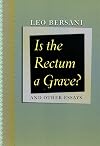
Bersani's Is the Rectum a Grave? is largely a project to put Focault's injunction to look for new ways of relating to each other, psychoanalytical thought, and aesthetics in conversation with each other. Because it is a collection of essays, lectures, and interviews, it gets a tad repetitive at times, but this repetition is also helpful in that it approaches the same questions from a variety of ways. Ultimately, Bersani's writing addresses "our most urgent project now: redefining modes of show more relationally and community, the very notion of sociality" (172).
"Is the Rectum a Grave?" is foundation for queer theory, and is largely a response to representation of HIV/AIDS in popular discourses. Bersani argues that popular media doesn't teach a lot about HIV/AIDS, but can teach us a lot about heterosexual anxieties about HIV/AIDS, homosexuals, and families. This media is geared toward heterosexuals, and helps to make "the family mean in a certain way" (9). Bersani also outlines how discourses about AIDS equate promiscuity with infection (18) and portrays gays as killers (17). He logically argues that the claims of MacKinnon and Dworkin are right in a way: pornography can be realism and denigrating toward women. The ultimate logic of their argument, however, is "the criminalization of sex itself until it has been reinvented" (20), and he actually sees MacKinnon and Dworkin as sharing assumptions with Foucault, Weeks, and others: that sex needs to be redefined. His problem with Dworkin and MacKinnon is their pastoralization of sex: they ignore "the inestimable value of sex as—at least in certain of its ineradicable aspects—anticommunal, antiegalitarian, antinurturing, antiloving" (22). Bersani argues for the value of powerlessness in sex: the "radical disintegration and humiliation of the self" (24). We need to reinvent the body, and Bersani argues that gay men (and everyone) should not be modeling sex off of patriarchal, heterosexual pastoral sex: the value of sexuality itself is to demean the seriousness of efforts to redeem it" (29). He concludes that "The self is a practical convenience; promoted to these status of an ethical ideal, it is a section for violence" (30).
Other ideas/quotes:
"An important function of art might be redefined as anticommunitarian, against (to the extent that this is possible) institutional assimilations of particular works" (34).
Value of homes: "Our implicit and involuntary message might be that we aren't sure of how we want to be social, and that we therefore invite straights to redefine with us the notions of community and sociality" (38).
On shame: "we will never participate in the invention of what Foucault called 'new relational models' if we merely assert the dignity of a self we have been told to be ashamed of" (69).
Teaching: "it's a sustained time and space where you do nothing but see who a group of people are going to connect" (200).
"Pedagogy and friendship are modes of extensibility less glamorous than public sex (a current queer favorite) but perhaps more worthy of exploration. . . . To redefine friendship would be a political move" (201). show less
"Is the Rectum a Grave?" is foundation for queer theory, and is largely a response to representation of HIV/AIDS in popular discourses. Bersani argues that popular media doesn't teach a lot about HIV/AIDS, but can teach us a lot about heterosexual anxieties about HIV/AIDS, homosexuals, and families. This media is geared toward heterosexuals, and helps to make "the family mean in a certain way" (9). Bersani also outlines how discourses about AIDS equate promiscuity with infection (18) and portrays gays as killers (17). He logically argues that the claims of MacKinnon and Dworkin are right in a way: pornography can be realism and denigrating toward women. The ultimate logic of their argument, however, is "the criminalization of sex itself until it has been reinvented" (20), and he actually sees MacKinnon and Dworkin as sharing assumptions with Foucault, Weeks, and others: that sex needs to be redefined. His problem with Dworkin and MacKinnon is their pastoralization of sex: they ignore "the inestimable value of sex as—at least in certain of its ineradicable aspects—anticommunal, antiegalitarian, antinurturing, antiloving" (22). Bersani argues for the value of powerlessness in sex: the "radical disintegration and humiliation of the self" (24). We need to reinvent the body, and Bersani argues that gay men (and everyone) should not be modeling sex off of patriarchal, heterosexual pastoral sex: the value of sexuality itself is to demean the seriousness of efforts to redeem it" (29). He concludes that "The self is a practical convenience; promoted to these status of an ethical ideal, it is a section for violence" (30).
Other ideas/quotes:
"An important function of art might be redefined as anticommunitarian, against (to the extent that this is possible) institutional assimilations of particular works" (34).
Value of homes: "Our implicit and involuntary message might be that we aren't sure of how we want to be social, and that we therefore invite straights to redefine with us the notions of community and sociality" (38).
On shame: "we will never participate in the invention of what Foucault called 'new relational models' if we merely assert the dignity of a self we have been told to be ashamed of" (69).
Teaching: "it's a sustained time and space where you do nothing but see who a group of people are going to connect" (200).
"Pedagogy and friendship are modes of extensibility less glamorous than public sex (a current queer favorite) but perhaps more worthy of exploration. . . . To redefine friendship would be a political move" (201). show less
I intitially got this book for the title essay, but I'm really glad I read it all, because in some ways, it expands and makes legible what I found so frustrating about the first essay. (I will say, I've been ranking queer theorists--as much as Bersani resists that label--by how they make me feel; so far, it's Edelman makes me feel both stupid and angry, but Bersani makes me feel stupid but not angry.) I really think the rest of the book fleshes out what Bersani tries to say in "Is the Rectum show more a Grave?" which is good because to me, that essay feels massively unfinished. I will also say that it might really help your understanding of the book if you have a firmer grasp than I do on psychoanalytic theory (which is to say, any grasp at all.) I will probably be revisiting this again (I've already read the title essay three times, trying to understand it,) and am looking for people to talk with about it! show less
Homos by Leo Bersani
This is a mid-1990s work on homosexuality (mostly male homosexuality). It has no clear overarching point, presumably because it is critical theory. Even so, I found the discussion of the tension between the visibility of an identity and the mainstreaming of that identity (in the Prologue and first two chapters "The Gay Presence" and "The Gay Absence") very interesting. It was full of known theory nuggets put together in interesting ways, with especial resonance added in the last 15 years show more because we've gone so far down first essentializing and then normalizing gay identities in search of legitimacy. (The naturalness of gayness as an identity rather than an act is an assessment about reality that is just as fraught for the Queer Left as for the Christian Right -- and, interestingly, opposition from both groups is crumbling.)
Some quotes from the parts I liked:
The second half, though, was pure literary criticism ("The Gay Daddy" and "The Gay Outlaw"). Critical theory applied to authors like Proust and Genet didn't work for me, since I have not read their works and I don't really care about the topics at hand (ahem, Genet's rhetorical use of rimming). So, I tuned out. Way out.
Overall, the first half is intriguing, and the second half isn't. To get a better introduction to the valuable concepts, I'd recommend Warner's The Trouble With Normal over Bersani's Homos, with the recognition that Warner built on Bersani. show less
Some quotes from the parts I liked:
-
The constructed binary sexual divide: "The gay liberationists of the early 1970s, as Steven Epstein notes, repudiated 'the notion of "the homosexual" as a distinct type...in favor of a left Freudian view of human sexuality as "polymorphously perverse."'"
-
Why we de-gayed ourselves: "The sodomite had no case to make for his sexual practices; the homosexual personality, by psychologizing such practices and integrating its sexuality into the structures of a demonstrably viable social self, could begin to make a persuasive case for legitimation. The invention of the homosexual may have been the precondition of sexual liberation in that the homosexual essence partially desexualizes (and thereby sanitizes or domesticates) the very acts that presumably called the essence into being."
-
Problems with de-gaying: "De-gaying gayness can only fortify homophobic oppression; it accomplishes in its own way the principal aim of homophobia: the elimination of gays." (This quote is the book's winner.)
-
Inevitability of homophobia: "Inasmuch as homophobia is itself the sign of the ineradicability of homosexuality, however, it must remain."
- Drag may be fun but is not significant: "Resignification cannot destroy; it merely presents to the dominant culture spectacles of politically impotent disrespect."
The second half, though, was pure literary criticism ("The Gay Daddy" and "The Gay Outlaw"). Critical theory applied to authors like Proust and Genet didn't work for me, since I have not read their works and I don't really care about the topics at hand (ahem, Genet's rhetorical use of rimming). So, I tuned out. Way out.
Overall, the first half is intriguing, and the second half isn't. To get a better introduction to the valuable concepts, I'd recommend Warner's The Trouble With Normal over Bersani's Homos, with the recognition that Warner built on Bersani. show less
Lists
Want to Read (1)
You May Also Like


Associated Authors
Statistics
- Works
- 32
- Also by
- 5
- Members
- 899
- Popularity
- #28,500
- Rating
- 3.7
- Reviews
- 12
- ISBNs
- 73
- Languages
- 4
- Favorited
- 2