
David A. Sinclair
Author of Lifespan: Why We Age―and Why We Don't Have To
About the Author
Works by David A. Sinclair
Tagged
Common Knowledge
- Birthdate
- 1969-06-26
- Gender
- male
- Nationality
- Australia
- Birthplace
- Sydney, New South Wales, Australia
- Places of residence
- Newton, Massachusetts, USA
- Associated Place (for map)
- Australia
Members
Reviews

I've been reading sf stories about life extension for a class I will teach, but I've also been reading books recommended by one of my co-teachers about the actuality of it. This one is by a Harvard Medical School researcher into aging. Compared to some others that I have read, it has more of a real science feel. It's somewhat written in that breathless style of popular science journalism, but not as often. There's some real science in here, or at least so it seems from the perspective of show more this nonscientist.
I also appreciated that Sinclair thinks through some of the social consequences of longer lifespan, and he has good answers where he can. Some areas, he freely admits, don't have good answers: the rich will gain access first, and longer lifespan will allow the rich to acquire even more, creating a feedback loop. (This is something I've seen in a number of the sf stories I've read.) On the other hand, I wasn't convinced by all his answers: he says we'll save money from not having to treat diseases that are symptoms of aging... but since he's not promising immortality, wouldn't those diseases catch up with us again at some point?
The book is clearly trying to be accessible but also not be fluff. I think it fails in threading the needle when it comes to explaining epigenetics, which is the key to Sinclair's theory of aging, but which I totally failed to understand the explanation of; it's a mixture of too-much technical detail and too-dumbed down analogies.
But on the whole, I found this to be one of the more convincing advocacies of anti-aging I've read. Should I start taking the supplements he recommends to extend my own lifespan...? show less
I also appreciated that Sinclair thinks through some of the social consequences of longer lifespan, and he has good answers where he can. Some areas, he freely admits, don't have good answers: the rich will gain access first, and longer lifespan will allow the rich to acquire even more, creating a feedback loop. (This is something I've seen in a number of the sf stories I've read.) On the other hand, I wasn't convinced by all his answers: he says we'll save money from not having to treat diseases that are symptoms of aging... but since he's not promising immortality, wouldn't those diseases catch up with us again at some point?
The book is clearly trying to be accessible but also not be fluff. I think it fails in threading the needle when it comes to explaining epigenetics, which is the key to Sinclair's theory of aging, but which I totally failed to understand the explanation of; it's a mixture of too-much technical detail and too-dumbed down analogies.
But on the whole, I found this to be one of the more convincing advocacies of anti-aging I've read. Should I start taking the supplements he recommends to extend my own lifespan...? show less
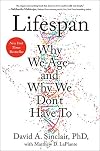
In Lifespan, the Harvard ageing scientist describes the current state of play of the science of why we age, and what can be done to slow or even reverse this process.
Ageing relates to a complex set of processes, including the shortening of the telomeres, the protective chromosome endcaps, and mitochondrial dysfunction. However, there may be an underlying cause to all these factors, which is that the cell loses information about how to function. They do this because the DNA gets damaged and show more then stops telling the cell how to work properly – the correct information for the cell to carry out its myriad tasks is increasingly degraded.
What can we do to stop this deleterious process? Sinclair recommends a set of actions: exercise, intermittent fasting, exposing ourselves to hot (saunas) and cold (t-shirts in the winter) environments, a vegan diet. It’s also possible that certain chemical supplements may help, most notably Metformin (a common type II diabetes drug), resveratrol, and NMN. All these together may activate DNA repair mechanisms in our bodies, as well as reduce inflammation, and help keep us young.
The scientific content in this book is very detailed and clear, and the ethical and societal implications of this work are put forward with an obvious agenda, but the arguments are well reasoned. This, to me, was one of the most important science books I’ve read.
However, I should add the small caveat that Sinclair has a lot of fingers in a lot of pies, and some of those pies are commercial ventures. At times, the NMN and other suggestions appeared a little like adverts. The science isn’t so clear as yet on the benefits of NMN, for instance. It could be that while NMN boosts cellular activity in ways that might “rejuvenate” cells, it might also boost the activity of cancer cells. This research is ongoing, and there are as yet no published studies to demonstrate the long-term benefit of NMN in humans. I would have preferred Sinclair to express more caution about some of his claims.
Nevertheless, this is an extremely important, very engaging and well written book and, as long as you aren’t totally taken in by the promises of impending immortality, it is a book that everyone should read. show less
Ageing relates to a complex set of processes, including the shortening of the telomeres, the protective chromosome endcaps, and mitochondrial dysfunction. However, there may be an underlying cause to all these factors, which is that the cell loses information about how to function. They do this because the DNA gets damaged and show more then stops telling the cell how to work properly – the correct information for the cell to carry out its myriad tasks is increasingly degraded.
What can we do to stop this deleterious process? Sinclair recommends a set of actions: exercise, intermittent fasting, exposing ourselves to hot (saunas) and cold (t-shirts in the winter) environments, a vegan diet. It’s also possible that certain chemical supplements may help, most notably Metformin (a common type II diabetes drug), resveratrol, and NMN. All these together may activate DNA repair mechanisms in our bodies, as well as reduce inflammation, and help keep us young.
The scientific content in this book is very detailed and clear, and the ethical and societal implications of this work are put forward with an obvious agenda, but the arguments are well reasoned. This, to me, was one of the most important science books I’ve read.
However, I should add the small caveat that Sinclair has a lot of fingers in a lot of pies, and some of those pies are commercial ventures. At times, the NMN and other suggestions appeared a little like adverts. The science isn’t so clear as yet on the benefits of NMN, for instance. It could be that while NMN boosts cellular activity in ways that might “rejuvenate” cells, it might also boost the activity of cancer cells. This research is ongoing, and there are as yet no published studies to demonstrate the long-term benefit of NMN in humans. I would have preferred Sinclair to express more caution about some of his claims.
Nevertheless, this is an extremely important, very engaging and well written book and, as long as you aren’t totally taken in by the promises of impending immortality, it is a book that everyone should read. show less
I have a feeling this will be a long review, so if you're just looking for some cliff-notes then mine are: "This book has the potential to change the way you live your life. You might not enjoy reading it (*1), but the topic it addresses will definitely affect you personally. Whether it's right after reading it (*2), or at a societal level in the years to come, that's up to you."
Now for the long version...
My previous knowledge of David Sinclair was from his visits to JRE podcast, where I show more found him to be an insightful and smart fella' (*3). This also comes across throughout the book, which was nice to see. I'm not denying that I went into this with a bias towards liking it, but like everything I read, I try to correct for it.
The way I see it, books can serve many purposes. Whether it's as simple as keeping you from having your own thoughts for a few dead minutes (*4), entertaining you with a well-written prose, engaging you in an action-twisted plot or changing your entire world-view by completely removing a deep-rooted assumption you've previously held since you were 4 years old, I'll have to say this book very much does the latter.
I'm not a slob to begin with. Ever since high-school my views were that your body should not be mistreated. That is if you plan on it being there for you in the long run. You either routinely take care of it as a force of habit, or you eventually try to patch it up in a very painful, costly and potentially mentally debilitating way at some point in the future (which personally, I see the loss of mental faculties as the highest price you can pay for neglect). This lead me to always try my best at being up to date on the latest medical discoveries and trying to fine tune my mental model of how my body works in hopes of better maintaining it.
That being said, I always started off by assuming that I have somewhere around 40-ish healthy adult years ahead of me (if I'm lucky), and that I should try and work around that when it came to setting goals and thinking what long-term choices are best for me to take. This book challenges that assumption to it's core.
What if my previous goal of having a decently healthy standard lifespan are me setting a low bar? Of course, I'll be lucky to have that in any case, but what if I could set the bar at actually increasing the limit of those 40 years instead? My previous goal of keeping a good health is already on the table and is pretty much included in the new goal, so what would it cost me to raise my health-span (*5)?
This book did a decent job at answering that question for me and I found the answer shocking. I think the reason I found it shocking is because of a life-long aversion to anything that advertises *rejuvenation* or *making you young again* gained from the bombardment of marketing buzzwords and a tradition of snake-oil salesmen humanity has had for millennia. It might be a case of boy-cry-wolf at a grand scale. We've been burned by bad/fake science & marketing for many years, so now when actual hard science tells us that "hey... you know this crazy idea we've had about stopping aging, well it seems it might actually be doable."(*6), our knee-jerk reaction is to ignore it.
David is not promising that, but what he does is show you just how close we might be to achieving it soon. That to me is mind-blowing out of the box. The book details how different discoveries clicked together in recent years to get us from seeing it as a crazy idea to a technology problem?! And as far as it goes, we're pretty good at solving technology issues when they get enough time and funding.
There's a great deal of things you can do now that are natural and proven to at least postpone some aspects of aging, but the review is long already and I want you to do the work of reading it to actually find out.
*1 - you might not enjoy the style, length, analogies, etc.
*2 - by curving your calorie intake, taking better care of yourself etc.
*3 - https://www.youtube.com/watch?v=HOTS0HS7aq4
*4 - that's not something we allow anymore as a society.
*5 - health-span = % of lifespan lived in good health
*6 - scientific shrug ¯_(ツ)_/¯ show less
Now for the long version...
My previous knowledge of David Sinclair was from his visits to JRE podcast, where I show more found him to be an insightful and smart fella' (*3). This also comes across throughout the book, which was nice to see. I'm not denying that I went into this with a bias towards liking it, but like everything I read, I try to correct for it.
The way I see it, books can serve many purposes. Whether it's as simple as keeping you from having your own thoughts for a few dead minutes (*4), entertaining you with a well-written prose, engaging you in an action-twisted plot or changing your entire world-view by completely removing a deep-rooted assumption you've previously held since you were 4 years old, I'll have to say this book very much does the latter.
I'm not a slob to begin with. Ever since high-school my views were that your body should not be mistreated. That is if you plan on it being there for you in the long run. You either routinely take care of it as a force of habit, or you eventually try to patch it up in a very painful, costly and potentially mentally debilitating way at some point in the future (which personally, I see the loss of mental faculties as the highest price you can pay for neglect). This lead me to always try my best at being up to date on the latest medical discoveries and trying to fine tune my mental model of how my body works in hopes of better maintaining it.
That being said, I always started off by assuming that I have somewhere around 40-ish healthy adult years ahead of me (if I'm lucky), and that I should try and work around that when it came to setting goals and thinking what long-term choices are best for me to take. This book challenges that assumption to it's core.
What if my previous goal of having a decently healthy standard lifespan are me setting a low bar? Of course, I'll be lucky to have that in any case, but what if I could set the bar at actually increasing the limit of those 40 years instead? My previous goal of keeping a good health is already on the table and is pretty much included in the new goal, so what would it cost me to raise my health-span (*5)?
This book did a decent job at answering that question for me and I found the answer shocking. I think the reason I found it shocking is because of a life-long aversion to anything that advertises *rejuvenation* or *making you young again* gained from the bombardment of marketing buzzwords and a tradition of snake-oil salesmen humanity has had for millennia. It might be a case of boy-cry-wolf at a grand scale. We've been burned by bad/fake science & marketing for many years, so now when actual hard science tells us that "hey... you know this crazy idea we've had about stopping aging, well it seems it might actually be doable."(*6), our knee-jerk reaction is to ignore it.
David is not promising that, but what he does is show you just how close we might be to achieving it soon. That to me is mind-blowing out of the box. The book details how different discoveries clicked together in recent years to get us from seeing it as a crazy idea to a technology problem?! And as far as it goes, we're pretty good at solving technology issues when they get enough time and funding.
There's a great deal of things you can do now that are natural and proven to at least postpone some aspects of aging, but the review is long already and I want you to do the work of reading it to actually find out.
*1 - you might not enjoy the style, length, analogies, etc.
*2 - by curving your calorie intake, taking better care of yourself etc.
*3 - https://www.youtube.com/watch?v=HOTS0HS7aq4
*4 - that's not something we allow anymore as a society.
*5 - health-span = % of lifespan lived in good health
*6 - scientific shrug ¯_(ツ)_/¯ show less
Interesting and passionate discourse on a topic that is not commonly discussed - how to prevent aging. Unfortunately, too many acronyms and technical terms littered within the narrative made it difficult to gain an in-depth understanding of and appreciation for the field. Still, it served as a good introduction and made me interested enough to look for more literature and research about aging.
You May Also Like


Associated Authors
Statistics
- Works
- 5
- Members
- 899
- Popularity
- #28,500
- Rating
- 3.9
- Reviews
- 14
- ISBNs
- 28
- Languages
- 8