
Alan E. Nourse (1928–1992)
Author of Star Surgeon
About the Author
Series
Works by Alan E. Nourse
The outdoorsman's medical guide;: Commonsense advice and essential health care for campers, hikers, and backpackers (1974) 5 copies
Short Science Fiction Collection 001 5 copies
Tiger by the Tail [short story] 3 copies
The Brain Sinner 2 copies
Family Resemblance 2 copies
Short Science Fiction Collection 008 2 copies
Heir Apparent 1 copy
Bramble Bush 1 copy
Sixty-Year Extension 1 copy
The Body 1 copy
Counterfeit [short fiction] 1 copy
A Miracle Too Many 1 copy
Short Fiction Collection 1 copy
So you want to be a chemist 1 copy
Alan E. Nourse Super Pack: With linked Table of Contents (Positronic Super Pack Series Book 16) (2016) 1 copy
Bd. 225. Die Zeitkapsel 1 copy
Fertőzöttek 1 copy
Five Stories 1 copy
Associated Works
Science Fiction Today and Tomorrow: A Discursive Symposium (1974) — Contributor — 102 copies, 2 reviews
The World That Couldn't Be and 8 Other Novelets From "Galaxy" (1959) — Contributor — 86 copies, 5 reviews
Reader's Digest Condensed Books 1978 v02: Jaws 2 / The Education of Little Tree / The Practice / Excellency (1978) — Author — 38 copies
Reader's Digest Best Sellers 1966: The Source | Intern | Hotel St. Gregory | To Sir, With Love (1966) — Author — 23 copies
Special Wonder: The Anthony Boucher Memorial Anthology of Fantasy and Science Fiction (1970) — Contributor — 12 copies
Readers Digest Condensed Books: Airs Above the Ground • Intern • The Secrets of the Day • The Yearling • May You Die in Ireland (1966) 4 copies
Fantastic science fiction stories. No. 068 (June 1960) — Contributor — 2 copies
Tagged
Common Knowledge
- Legal name
- Nourse, Alan Edward
- Other names
- Dr. X
- Birthdate
- 1928-08-11
- Date of death
- 1992-07-19
- Gender
- male
- Education
- Rutgers University
University of Pennsylvania - Occupations
- physician
columnist - Organizations
- United States Navy
Good Housekeeping - Nationality
- USA
- Birthplace
- Des Moines, Iowa, USA
- Place of death
- Thorp, Washington, USA
- Associated Place (for map)
- USA
Members
Reviews

This is a very diverse collection for a single author anthology. The range is particularly impressively given that this is not a career retrospective but covers just the few years from 1952 through 1956. "Second Sight" is a solid early entry to the Hoffman Medical Center "Psi High" stories, though not listed as such in the Internet SF Database. It makes for an interesting almost sequel to "My Friend Bobby", the best story in the book, on how telepathy can breed monsters on both sides of the show more parent-child relationship. "The Canvas Bag" is a quiet mood piece from F&SF. "An Ounce of Cure" and "Meeting of the Board" are overdone comic inferno stories. "The Counterfeit Man" is an overwrought variation on Campbell's "Who Goes There" where the main character spins an incredibly complicated -- but true -- hypothesis about shape-changing aliens based on no evidence at all. "The Expert Touch" is a forced, predictable story about psychological manipulation, salvaged slightly by just the right closing line. The other stories, including "The Link" and "Circus" that are original to the collection, are similarly contrived idea stories.
Other than "My Friend Bobby" and "Second Sight", there's not much here for the modern reader, but this is a solid and representative collection for fans of 1950s American SF. show less
Other than "My Friend Bobby" and "Second Sight", there's not much here for the modern reader, but this is a solid and representative collection for fans of 1950s American SF. show less

A book that seemed both timely and dated when I read it in 1990. It still seems that way today. Spoilers follow. And, yes, this is the novel which lent its title to the famous movie adaptation of Philip K. Dick's Do Androids Dreamof Electric Sheep. But the title is all it lent.
The computer directed helicopter transport network is something straight out of Herman Kahn's visions of the late sixties and early seventies. The old, 1960s' fear of a population explosion in America, not to mention show more the whole world, is reflected here. (Now people write books telling us that the Western industrialized nations don't have enough babies.) But other things are quite timely in a sociopolitical sense. We still debate socialized medicine and national health insurance. Computers are becoming more and more prevalent in medicine. Even the robot surgeons of the title look more probable now. And the demographic bulge of old people is growing along with their political power and drain on resources. Nourse prediction is right on there too. And the talk of rising medical costs and dangers of massive antibiotic use and immunization programs is familiar though the genetic costs of medical intervention in inherited disease is far less talked about now but, still, most of these are problems we're dealing with 38 years after the novel was written.
The background history of the novel is realistic and certainly aided by Nourse's experience as a doctor. A massive government program to curb population growth, pay for medical costs, and reduce the incidence of genetic frailty sets the stage. The program is simple: free medical care if you're sterilized. Nourse rightly points out the flaws in this idea. People resent the sterilization requirement; others reject medical care period (like some religious groups in America or health food/environmental types). Underground medicine -- the world of the three main characters: Dr. John Long, nurse Molly Barrett, and bladerunner Billy Gimp -- thrives.
And, of course, the characteristics of the Shanghai Flu, the epidemic central to the book's actions, attack the system's weaknesses and kill many. Those who are not sterilized, massive amounts of the population, try to ride the seemingly mild flu out until it suddenly turns deadly and help, even at a regular clinic, is almost too late. The epidemic threatens to kill millions and/or swamp the national health care system. It is then the Health Control officials reveal to Long that they have long been aware of his and others illegal medical activities and have tacitly allowed them as a safety valve necessary for the Health Care system to work. At first this seems improbably insightful and compassionate on the part of the administrators. But Nourse explains the laws implementing the Health Care system were enacted hurridly in the wake of the Health Riots and nobody felt really comfortable, not even the administrators, with them. The Health Control officials appeal to Dr. Long and his underground colleagues for secret help in stemming the flu epidemic. How they do so is a simple, yet well-told story and how the epidemic forces a changes in Health Control laws is plausible.
The relationship between the three main characters was nicely done and not too sentimental. Barrett and Gimp may get together at the end and Gimp is going to study to become a doctor, but Long is still alone (his wife and child killed in the Health Riots). Nourse nicely relates the details of underground medicine. (I also liked his computerized courts -- a plausible solution to a crowded judicial system.) One of the story's main points is a humane one. Like the main doctor in Nourse's The Fourth Horseman, Long feels compelled to personally help the sick even if it means violating the law. It is a pure example of the values of the Hippocratic oath. show less
The computer directed helicopter transport network is something straight out of Herman Kahn's visions of the late sixties and early seventies. The old, 1960s' fear of a population explosion in America, not to mention show more the whole world, is reflected here. (Now people write books telling us that the Western industrialized nations don't have enough babies.) But other things are quite timely in a sociopolitical sense. We still debate socialized medicine and national health insurance. Computers are becoming more and more prevalent in medicine. Even the robot surgeons of the title look more probable now. And the demographic bulge of old people is growing along with their political power and drain on resources. Nourse prediction is right on there too. And the talk of rising medical costs and dangers of massive antibiotic use and immunization programs is familiar though the genetic costs of medical intervention in inherited disease is far less talked about now but, still, most of these are problems we're dealing with 38 years after the novel was written.
The background history of the novel is realistic and certainly aided by Nourse's experience as a doctor. A massive government program to curb population growth, pay for medical costs, and reduce the incidence of genetic frailty sets the stage. The program is simple: free medical care if you're sterilized. Nourse rightly points out the flaws in this idea. People resent the sterilization requirement; others reject medical care period (like some religious groups in America or health food/environmental types). Underground medicine -- the world of the three main characters: Dr. John Long, nurse Molly Barrett, and bladerunner Billy Gimp -- thrives.
And, of course, the characteristics of the Shanghai Flu, the epidemic central to the book's actions, attack the system's weaknesses and kill many. Those who are not sterilized, massive amounts of the population, try to ride the seemingly mild flu out until it suddenly turns deadly and help, even at a regular clinic, is almost too late. The epidemic threatens to kill millions and/or swamp the national health care system. It is then the Health Control officials reveal to Long that they have long been aware of his and others illegal medical activities and have tacitly allowed them as a safety valve necessary for the Health Care system to work. At first this seems improbably insightful and compassionate on the part of the administrators. But Nourse explains the laws implementing the Health Care system were enacted hurridly in the wake of the Health Riots and nobody felt really comfortable, not even the administrators, with them. The Health Control officials appeal to Dr. Long and his underground colleagues for secret help in stemming the flu epidemic. How they do so is a simple, yet well-told story and how the epidemic forces a changes in Health Control laws is plausible.
The relationship between the three main characters was nicely done and not too sentimental. Barrett and Gimp may get together at the end and Gimp is going to study to become a doctor, but Long is still alone (his wife and child killed in the Health Riots). Nourse nicely relates the details of underground medicine. (I also liked his computerized courts -- a plausible solution to a crowded judicial system.) One of the story's main points is a humane one. Like the main doctor in Nourse's The Fourth Horseman, Long feels compelled to personally help the sick even if it means violating the law. It is a pure example of the values of the Hippocratic oath. show less
Read the free Kindle story and listen to the free audio on YouTube.
Nobody says anything, they growl or mutter or grate. Nothing's really far away, it's unthinkably far. How, as a matter of interest, does one "breathe impatiently"? I want to take the dead author's thesaurus away and clonk him with it.
It was 1953, but we already knew about physics then; grappling a ship moving at a substantial fraction of light speed as a stationary object? Oh nay nay nay. Mayhem. Carnage. Destruction.
And show more Brownie, the coded-by-50s-stereotypes-queer little wimpy engineer, versus the vicious thuggish mate? Yech. Noir stereotypes and not particularly well done...not like Peter Lorre and Humphrey Bogart in The Maltese Falcon. The anti-Government paranoia and fascist security state? Close to home, and the grim reality of 2020 seems to me to be taking us down Nourse's grim future-history path.
The ending is really really really bleak. Really. So very grim. I hate the evil world of Nourse's last-ditch shouting against the Security State's inevitable horrors. I don't like the writing. I don't like the story. But I can't forget it. show less
Nobody says anything, they growl or mutter or grate. Nothing's really far away, it's unthinkably far. How, as a matter of interest, does one "breathe impatiently"? I want to take the dead author's thesaurus away and clonk him with it.
It was 1953, but we already knew about physics then; grappling a ship moving at a substantial fraction of light speed as a stationary object? Oh nay nay nay. Mayhem. Carnage. Destruction.
And show more Brownie, the coded-by-50s-stereotypes-queer little wimpy engineer, versus the vicious thuggish mate? Yech. Noir stereotypes and not particularly well done...not like Peter Lorre and Humphrey Bogart in The Maltese Falcon. The anti-Government paranoia and fascist security state? Close to home, and the grim reality of 2020 seems to me to be taking us down Nourse's grim future-history path.
The ending is really really really bleak. Really. So very grim. I hate the evil world of Nourse's last-ditch shouting against the Security State's inevitable horrors. I don't like the writing. I don't like the story. But I can't forget it. show less
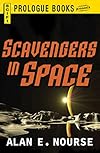
Scavengers in Space is the kind of near-future space opera I was always looking for when I rifled through the library stacks and drugstore racks in the 1960s. It had relatable characters, an engaging plot with plenty of action, and some satisfying space science and engineering. Two twin brothers who don’t always get along avoid the space patrol, pirates, and corporate baddies to find a treasure their father found just before he died in the asteroid belt. Books like this established the show more tradition that eventually led to works like the Expanse series. 4 stars, for nostalgia if nothing else. show less
Awards


You May Also Like


Associated Authors
Statistics
- Works
- 107
- Also by
- 49
- Members
- 2,256
- Popularity
- #11,366
- Rating
- 3.6
- Reviews
- 68
- ISBNs
- 233
- Languages
- 6
- Favorited
- 2