
Hilaire Belloc (1870–1953)
Author of Cautionary Tales for Children
About the Author
Hilaire Belloc, 1870 - 1953 Hilaire Belloc was born in France in 1870, educated at Oxford, and naturalized as a British subject in 1902. Although he began as a writer of humorous verse for children, his works include satire, poetry, history, biography, fiction, and many volumes of essays. With his show more close friend and fellow Catholic, G. K. Chesterton, Belloc founded the New Witness, a weekly newspaper opposing capitalism and free thought and supporting a philosophy known as distributism. The pair was so close in thought and association that George Bernard Shaw nicknamed them Chesterbelloc. During his life, Belloc published over 150 books. Today, however, he is best remembered for only a few works, most notably his light verse, such as Cautionary Tales (1907) and A Bad Child's Book of Beasts (1896). Belloc died in 1953 from burns caused when his dressing gown caught fire from the hearth. (Bowker Author Biography) show less
Image credit: George Grantham Bain collection
Works by Hilaire Belloc
Characters of the Reformation: historical portraits of 23 men and women and their place in the great religious revolution of the 16th century (1936) 430 copies, 1 review
Survivals and New Arrivals: The Old and New Enemies of the Catholic Church (1929) 170 copies, 1 review
Cautionary Verses / New Cautionary Verses (Everyman's Library Children's Classics) (1997) 34 copies, 1 review
The Bad Child's Book of Beasts, together with More Beasts for Worse Children (1999) 20 copies, 1 review
The eye-witness: being a series of descriptions and sketches in which it is attempted to reproduce (2006) 16 copies
Letters from Hilaire Belloc 7 copies
The Chanty of the Nona 7 copies
The aftermath;: Or, Gleanings from a busy life. Called upon the outer cover for purposes of sale, Calibans guide to lett (2025) 5 copies
The Collected Works of Hilaire Belloc: Historical Books, Economy Studies, Essays, Fiction & Poetry (2021) 4 copies
The book of the Bayeux tapestry, presenting the complete work in a series of colour facsimiles (1914) 3 copies
The Fame of Blessed Thomas More: Being Addresses Delivered in His Honour in Chelsea, July 1929 (1929) — Contributor — 3 copies
A History of England, Volume 2: Catholic England II. The Early Middle Ages A.D. 1066 to 1348 3 copies
A History of England, Volume 1: Pagan England. Catholic England I: The Dark Ages, B.C to A.D. 1066 3 copies
Mrs. Markham's new history of England Being an introduction for young people to the current history & institutions of our time (1926) 3 copies
The last days of the French monarchy 3 copies
Monarchy 2 copies
Caliban's Guide to Letters 2 copies
Essays of to-day and yesterday 2 copies
Land and Water Map of the War 2 copies
The Second Year of the War 2 copies
Collected Works 2 copies
The elements of the great war 2 copies
On translation 1 copy
Week-End Wodehouse 1 copy
CHESTERTON POR BELLOC: Sobre el lugar de Gilbert Keith Chesterton en la literatura universal (Spanish Edition) (2025) 1 copy
Bona Mors A Christmas Story 1 copy
The Cruise of the 'Nova' 1 copy
A Europa e a Fé 1 copy
Richeliu 1 copy
Rare Hilaire Belloc The Servile State Socialism Capitalism Distributism 1st US 1946 - Henry Holt and Company [Hardcover] Hilaire Belloc 1 copy, 1 review
Hilaire Belloc "4 Sussex Poems", Thomas Gray, "Elegy Written in a Country Church-yard" [Sound recording]. Read by Robert Speaight. — Author — 1 copy
On Essays By Hilaire Belloc 1 copy
The Alternative 1 copy
La Revolución Francesa 1 copy
Path to Rome 1 copy
Sonnets and Verse 1 copy
Ha'nacker Mill 1 copy
Songs of the South Country 1 copy
Prose and Verse 1 copy
The Revival of Latin 1 copy
The verse of Hilaire Belloc 1 copy
Klein-Kinder-Bewahr-Anstalt: Fünfzehn erbauliche Geschichten zur Warnung vor den schlimmen Folgen jugendlichen Überschwangs (1998) 1 copy
HILAIRE BELLOC 1 copy
Le migliori prose 1 copy
The Best of Hilaire Belloc 1 copy
Calendar 1 copy
Chroniques. No. 5 1 copy
Home 1 copy
At the Sign of the Lion: And Other Essays From the Books of Hilaire Belloc (Classic Reprint) (2015) 1 copy
The case of Dr. Coulton 1 copy
Historic Nuns 1 copy
This and That 1 copy
Socialism And The Servile State: A Debate Between Messrs. Hilaire Belloc And J. Ramsay Macdonald (2011) 1 copy
The Honest Man and the Devil 1 copy
Mr Belloc Still Objects 1 copy
Associated Works
Literature: An Introduction to Fiction, Poetry, and Drama (1995) — Contributor, some editions — 1,017 copies, 7 reviews
The Illustrated Treasury of Children's Literature, Volumes 1-2 (1955) — Contributor — 523 copies, 4 reviews
The Children's Treasury: Best Loved Stories and Poems from Around the World (1987) — Contributor — 164 copies, 2 reviews
The Camelot Chronicles: Heroic Adventures from the Age of Legend (1992) — Contributor — 137 copies, 1 review
Fifty Years: Being a Retrospective Collection of Novels, Novellas, Tales, Drama, Poetry, and Reportage and Essays: All Drawn from Volumes Issued during the Last Half-Century by… (1965) — Contributor — 56 copies
The English Way: Studies in English Sanctity from St. Bede to Newman (1933) — Contributor — 38 copies, 1 review
Cricket Magazine, Vol. 7, No. 12, August 1980 — Contributor — 3 copies
Then and Now. A Selection of Articles, Stories & Poems, Taken from the First Fifty Numbers of ‘Now & Then’, 1921–35. Together with Some Illustrations, etc. (1935) — Contributor — 2 copies
Inquisition: A Political and Military Study of Its Establishment (2003) — Foreword, some editions — 2 copies
The Romance of Tristan and Iseult [excerpt] — Translator — 1 copy
Tagged
Common Knowledge
- Canonical name
- Belloc, Hilaire
- Legal name
- Belloc, Joseph Hilaire Pierre René
- Other names
- Belloc, Joseph-Pierre Hilaire
- Birthdate
- 1870-07-27
- Date of death
- 1953-07-16
- Gender
- male
- Education
- Oratory School
University of Oxford (BA|1895|Balliol College) - Occupations
- political activist
biographer
editor
essayist
historian
journalist (show all 15)
lecturer
man of letters
novelist
orator
poet
politician
sailor
satirist
soldier - Organizations
- Fabian Society
UK Parliament
Land and Water - Awards and honors
- Knight Commander with Star, Order of St Gregory The Great (1934)
- Relationships
- Lowndes, Marie Belloc (sister)
Pitter, Ruth (protégé)
Parkes, Bessie Rayner (mother)
Priestley, Joseph (great-great-grandfather)
Swanton Belloc, Louise (grandmother) - Cause of death
- a fall (from burns and shock following a fall he had while placing a log into a fireplace)
- Nationality
- France (birth)
UK (naturalized|1902) - Birthplace
- La Celle-Saint-Cloud, Seine-et-Oise, France
- Places of residence
- La Celle-Saint-Cloud, France
Guildford, Surrey, England, UK - Place of death
- Guildford, Surrey, England, UK
- Burial location
- Shrine Church of Our Lady of Consolation, West Grinstead, West Sussex, England, UK
- Associated Place (for map)
- England, UK
Members
Reviews
Sometimes I feel quite impish and dream of finding oodles of books like this to distribute in all the Little Free Libraries in my town. Let's rename this from "cautionary" to "consequence genre."
Children's consequence genre answers that insatiable kid curiosity about the stuff they want to know, answering a question like, "What if I opened the cage with the lion at the zoo?" Good question, let's find out...
With open Jaws, a Lion sprang,
And hungrily began to eat
The Boy: beginning at his show more feet.
Now just imagine how it feels
When first your toes and then your heels,
And then by gradual degrees,
Your shins and ankles, calves and knees,
Are slowly eaten, bit by bit.
And then, to drive home the point, the fascinating and ghoulish picture:
I do think, though, it might be best to introduce children early to this genre rather than late. Else they grow up to make FAFO YT videos crying because they voted in a snake as king and are surprised that it bit them. They thought it would bite only those ugly people they dislike so much! Silly, silly grownups. They should have read more books like this in childhood, then they'd know it's not good to embrace a known snake or open a lion cage without actually having to idiotically try it, saving a whole country a lot of misery. show less
Children's consequence genre answers that insatiable kid curiosity about the stuff they want to know, answering a question like, "What if I opened the cage with the lion at the zoo?" Good question, let's find out...
With open Jaws, a Lion sprang,
And hungrily began to eat
The Boy: beginning at his show more feet.
Now just imagine how it feels
When first your toes and then your heels,
And then by gradual degrees,
Your shins and ankles, calves and knees,
Are slowly eaten, bit by bit.
And then, to drive home the point, the fascinating and ghoulish picture:
I do think, though, it might be best to introduce children early to this genre rather than late. Else they grow up to make FAFO YT videos crying because they voted in a snake as king and are surprised that it bit them. They thought it would bite only those ugly people they dislike so much! Silly, silly grownups. They should have read more books like this in childhood, then they'd know it's not good to embrace a known snake or open a lion cage without actually having to idiotically try it, saving a whole country a lot of misery. show less

This book’s setting in the Islamic world is a literary device, almost certainly meant to evoke memories of The Richest Man in Babylon — a then-popular how-to manual on wealth acquisition which Belloc parodies whilst satirizing Western capitalism. I’m not aware whether the Prosperity Gospel was a thing at the time, but Belloc pretty much destroys the pretensions of religious folk who pursue piety and riches with no thought for justice. Horrifyingly amusing.
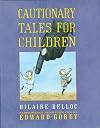
Cautionary tales for children : designed for the admonition of children between the ages of eight and fourteen years by Hilaire Belloc
Rhyme, rhythm, repetition.
Snuggled in a cuddly, loving lap.
Rhyme, rhythm, repetition.
Pictures for full multi-sensory immersion.
Rhyme, rhythm, repetition.
Two voices: sometimes taking turns, sometimes in unison.
Rhyme, rhythm, repetition.
This is the stuff of formative childhood memories.
My father regularly read these poems to me with melodramatic intonation when I was a child. He read (and sung) other things, but these were always the favourites. To this day, I know many of them by heart show more and I can only hear or read them with his delicious intonation.
Cautionary
Perhaps I have Belloc to thank for the fact I haven’t (yet) died as a result of chewing bits of string, slamming doors, telling dreadful lies, playing with a loaded gun, or running away from my nurse/nanny into the jaws of a hungry lion. Not that I was ever scared by these tales, perhaps in part because each one opens with a spoiler, and thereafter, I knew them anyway. Nor have I suffered deleterious consequences of making faces, throwing stones, or being unable to read.
For a slightly more adult slant on this idea, in prose, see Saki's brilliant short story The Open Window, which I reviewed HERE.
Variety
The cautions are a quirky mix of bizarre, gory, hyperbolic, and (just occasionally) sensible. A few good children do well (obedience leading to inheritance, for example), but they’re less fun. This volume also includes a Moral Alphabet and shorter poems about peers (aristocrats) and beasts, but for us, it was and is about the Cautionary Tales.
Inevitably there are a few duffers, but the best are sublime. Then again, it’s impossible for me to rate these objectively (but I don’t care).
Join in
These are written for performance. Even if you’re alone, read them aloud.
They’re so familiar to me, that it’s easy to give partial quotes and expect others to pick up with instant familiarity. Of course, few do. (It’s similar with Monty Python, Not the Nine O’Clock News, Flanders and Swann, and Yes Minister, amongst others.)
Age
Many of these poems do not sit easily with modern sensibilities, especially the colonial, class, and gender assumptions. The first were published in 1907 as parodies of earlier fare. Even the concept of moralistic tales is perhaps too preachy nowadays. But that’s their charm.
There’s also a dash of knowingness: a cautionary tale (Rebecca, Who Slammed Doors For Fun And Perished Miserably) that includes children being summoned to hear the story just told, and another (R, in the Moral Alphabet) about a reviewer of this very book.
Illustrations
The editions with Edward Gorey illustrations look excellent for anyone wanting a first taste, but they’re not for me. When I strive for objectivity, I grudgingly acknowledge that they’re more aesthetically appealling and skillful. But it’s Lord Ian Basil Gawaine Hamilton-Temple-Blackwood’s (yes, really) line drawings that are indelibly imprinted in my mind, accompanied by my father’s voice.
See also
You can read nearly a dozen of the cautionary tales, with BTB’s illustrations, HERE.
The other comic poems/songs that were the bedrock of my childhood and then my own child’s, are in the Flanders and Swann Songbook (my review HERE).
For a modern and darker twist on these, see Tim Burton's Melancholy Death of the Oyster Boy (my review HERE). show less
Snuggled in a cuddly, loving lap.
Rhyme, rhythm, repetition.
Pictures for full multi-sensory immersion.
Rhyme, rhythm, repetition.
Two voices: sometimes taking turns, sometimes in unison.
Rhyme, rhythm, repetition.
This is the stuff of formative childhood memories.
My father regularly read these poems to me with melodramatic intonation when I was a child. He read (and sung) other things, but these were always the favourites. To this day, I know many of them by heart show more and I can only hear or read them with his delicious intonation.
Cautionary
Perhaps I have Belloc to thank for the fact I haven’t (yet) died as a result of chewing bits of string, slamming doors, telling dreadful lies, playing with a loaded gun, or running away from my nurse/nanny into the jaws of a hungry lion. Not that I was ever scared by these tales, perhaps in part because each one opens with a spoiler, and thereafter, I knew them anyway. Nor have I suffered deleterious consequences of making faces, throwing stones, or being unable to read.
Matilda
Matilda told such Dreadful Lies,
It made one Gasp and Stretch one’s Eyes;
…
For once, towards the Close of Day,
Matilda, growing tired of play,
And finding she was left to alone,
Went tiptoe to the telephone
And summoned the Immediate Aid
Of London’s Nobel Fire-Brigade.
...
[Another evening]
That Night a Fire did break out-
You should have heard Matilda Shout!
You should have heard her Scream and Bawl,
...
For every time She shouted "Fire!"
They only answered "Little Liar!"
And therefore when her Aunt returned,
Matilda, and the House, were burned.
For a slightly more adult slant on this idea, in prose, see Saki's brilliant short story The Open Window, which I reviewed HERE.
Variety
The cautions are a quirky mix of bizarre, gory, hyperbolic, and (just occasionally) sensible. A few good children do well (obedience leading to inheritance, for example), but they’re less fun. This volume also includes a Moral Alphabet and shorter poems about peers (aristocrats) and beasts, but for us, it was and is about the Cautionary Tales.
Inevitably there are a few duffers, but the best are sublime. Then again, it’s impossible for me to rate these objectively (but I don’t care).
Join in
These are written for performance. Even if you’re alone, read them aloud.
The Frog
Be kind and tender to the Frog,
And do not call him names,
As ‘Slimy skin,’ or ‘Polly-wog,’
Or likewise ‘Ugly James,’
Or ‘Gape-a-grin,’ or ‘Toad-gone-wrong,’
Or ‘Billy Bandy-knees’:
The Frog is justly sensitive
To epithets like these.
No animal will more repay
A treatment kind and fair;
At least so lonely people say
Who keep a frog (and, by the way,
They are extremely rare).
They’re so familiar to me, that it’s easy to give partial quotes and expect others to pick up with instant familiarity. Of course, few do. (It’s similar with Monty Python, Not the Nine O’Clock News, Flanders and Swann, and Yes Minister, amongst others.)
Age
Many of these poems do not sit easily with modern sensibilities, especially the colonial, class, and gender assumptions. The first were published in 1907 as parodies of earlier fare. Even the concept of moralistic tales is perhaps too preachy nowadays. But that’s their charm.
Lord Finchley
Lord Finchley tried to mend the Electric Light
Himself.
It struck him dead: And serve him right!
It is the business of the wealthy man
To give employment to the artisan.
There’s also a dash of knowingness: a cautionary tale (Rebecca, Who Slammed Doors For Fun And Perished Miserably) that includes children being summoned to hear the story just told, and another (R, in the Moral Alphabet) about a reviewer of this very book.
Illustrations
The editions with Edward Gorey illustrations look excellent for anyone wanting a first taste, but they’re not for me. When I strive for objectivity, I grudgingly acknowledge that they’re more aesthetically appealling and skillful. But it’s Lord Ian Basil Gawaine Hamilton-Temple-Blackwood’s (yes, really) line drawings that are indelibly imprinted in my mind, accompanied by my father’s voice.
The Porcupine
What! Would you slap the Porcupine?
Unhappy child—desist!
Alas! That any friend of mine
Should turn Tupto-philist.*
* From the "tupto"=I strike; "philo"=I love; one that loves to strike; The word is not found in classical Greek, nor does it occur among the writers of the Renaissance—nor anywhere else.
See also
You can read nearly a dozen of the cautionary tales, with BTB’s illustrations, HERE.
The other comic poems/songs that were the bedrock of my childhood and then my own child’s, are in the Flanders and Swann Songbook (my review HERE).
For a modern and darker twist on these, see Tim Burton's Melancholy Death of the Oyster Boy (my review HERE). show less

Received a complimentary copy in a LibraryThing Member Giveaway.
These works live up to their reputation: I'd read of Belloc as sharing the same muse as Gorey. I expect now that Gorey at least honored Belloc's wit and wordplay, or it's an uncanny bit of coincidence they share subjects as well as tone.
This volume combines seven separate works, and the various verses play around with a few common themes, but the fun really comes in the word choice and how Belloc appears to be painting himself show more into a corner, and suddenly ends with a rhyme perfect in metre and comedic effect.
Recurrent themes for Belloc are foibles of latter day aristocrats, a bestiary ("The Bad Child's Book of Beasts" and "More Beasts for Worse Children"), and cautionary tales for obnoxious kids. The morals typically take the form either of an outsize fate, or instructions which clearly reflect an adult's own childishness: pretending good parenting is keeping children seen and not heard. (Now I think of it, the verses on aristocracy make the same point, but between adults.) There's also a good bit of nonsense verse, not brainiac like Carroll but simply wacky.
As others have said, a great deal of it seems eminently quotable, if only I had the talent of recalling lines from works I love. My best effort will be to have it on my shelf to pull out and remind myself of it, as I do Gorey, Carroll, Peake. show less
These works live up to their reputation: I'd read of Belloc as sharing the same muse as Gorey. I expect now that Gorey at least honored Belloc's wit and wordplay, or it's an uncanny bit of coincidence they share subjects as well as tone.
This volume combines seven separate works, and the various verses play around with a few common themes, but the fun really comes in the word choice and how Belloc appears to be painting himself show more into a corner, and suddenly ends with a rhyme perfect in metre and comedic effect.
Recurrent themes for Belloc are foibles of latter day aristocrats, a bestiary ("The Bad Child's Book of Beasts" and "More Beasts for Worse Children"), and cautionary tales for obnoxious kids. The morals typically take the form either of an outsize fate, or instructions which clearly reflect an adult's own childishness: pretending good parenting is keeping children seen and not heard. (Now I think of it, the verses on aristocracy make the same point, but between adults.) There's also a good bit of nonsense verse, not brainiac like Carroll but simply wacky.
As others have said, a great deal of it seems eminently quotable, if only I had the talent of recalling lines from works I love. My best effort will be to have it on my shelf to pull out and remind myself of it, as I do Gorey, Carroll, Peake. show less
This review was written for LibraryThing Member Giveaways.
Lists
Awards


You May Also Like


Associated Authors
Statistics
- Works
- 253
- Also by
- 53
- Members
- 9,041
- Popularity
- #2,662
- Rating
- 3.9
- Reviews
- 108
- ISBNs
- 749
- Languages
- 12
- Favorited
- 20


