
Audrey Niffenegger
Author of The Time Traveler's Wife
About the Author
Audrey Niffenegger (born June 13, 1963 in South Haven, Michigan) is an American writer and artist. She is also a professor in the Interdisciplinary Book Arts MFA Program at the Columbia College Chicago Center for Book and Paper Arts. Niffenegger's debut novel, The Time Traveler's Wife (2003), was a show more national bestseller. The Time Traveler's Wife is an unconventional love story that centers on a man with a strange genetic disorder that causes him to unpredictably time-travel and his wife, an artist, who has to cope with his frequent and unpredictable absences. The film version, starring Eric Bana and Rachel McAdams, is due for release in August 2009. Her latest fiction novel is entitled, Her Fearful Symmetry. (Bowker Author Biography) show less
Image credit: Audrey Niffenegger en 2009
Series
Works by Audrey Niffenegger
The Chinchilla Girl in Exile 11 copies
Jakob Wywialowski and the Angels 8 copies
The Future of Horror: The Collected Solaris Horror Anthologies, featuring House of Fear, Magic and End of the Road (2015) — Contributor — 8 copies
The Other Husband 3 copies
Love 1 copy
زوجة مسافر عبر الزمن 1 copy
Associated Works
The Lovely Bones AND The Time Traveller's Wife — Contributor — 2 copies
Morte de Smudgie — Illustrator — 1 copy
Tagged
Common Knowledge
- Legal name
- Niffenegger, Audrey Anne
- Birthdate
- 1963-06-13
- Gender
- female
- Education
- Art Institute of Chicago (AB)
Northwestern University (MFA | 1991) - Occupations
- visual artist
professor
writer - Organizations
- Columbia College Chicago (Center for the Book and Paper Arts)
North Shore Art League
Ragdale Foundation - Agent
- Joseph Regal (Regal Literary)
- Relationships
- Campbell, Eddie (spouse)
Campbell, Hayley (stepdaughter) - Nationality
- USA
- Birthplace
- South Haven, Michigan, USA
- Places of residence
- South Haven, Michigan, USA
Evanston, Illinois, USA
Chicago, Illinois, USA - Map Location
- Michigan, USA
Members
Reviews
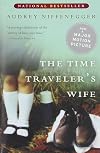
The past, present, and future exist simultaneously in Henry’s world and a rare genetic disorder transports him away from stressful moments in his present, depositing him in random locations and times from his past and future. On one of these hegiras, Henry meets Clare, his bride to be. The trouble is that Henry’s 36 year old self meets Clare, who is 6 years old, while his present self, who is 13 years old at the time, isn’t destined to meet Clare for the first time until 15 years show more later. I know it sounds confusing, and it might be if you dwell constantly on the space/time continuum while you read. But, if you relax and follow Niffenegger’s convenient signposts at the beginning of each passage, the time travel takes care of itself, fading into the background, allowing Henry and Clare’s complicated love story to take the spotlight.
Infused with Homerian tragedy, the story exhibits a rare heart, describing Clare’s constant loving and patient vigil. Henry’s frail existence, lived on the edges of destiny, present ever increasing dangers to their life together. If Henry informs his past self with future knowledge, will he change the determined path of life? Or is Henry only free to exert his will in his present life? It is a human story principally because the characters fail as often as they succeed in following the rules Henry’s unusual life requires. Whether Clare or Henry possess a foreknowledge of the events in their lives or not, their relentless future carries on, softening and re-shaping their hearts to better understand and accept the consequences of those events. And so, the book sums up the plight of human existence, constantly facing the ebb and tide of life’s events with no power but to control our own reaction to what fate has in store for us; beyond all else, we must simply live.
Niffenegger has written an effortlessly readable book. It pricks the heart almost as quickly as it tickles the reader’s fancy. There may be some obsessed with the time construct to the point of distraction but that kind of attention misses the point of the story.
5 bones!!!!!
This one makes the best of the year list. show less
Infused with Homerian tragedy, the story exhibits a rare heart, describing Clare’s constant loving and patient vigil. Henry’s frail existence, lived on the edges of destiny, present ever increasing dangers to their life together. If Henry informs his past self with future knowledge, will he change the determined path of life? Or is Henry only free to exert his will in his present life? It is a human story principally because the characters fail as often as they succeed in following the rules Henry’s unusual life requires. Whether Clare or Henry possess a foreknowledge of the events in their lives or not, their relentless future carries on, softening and re-shaping their hearts to better understand and accept the consequences of those events. And so, the book sums up the plight of human existence, constantly facing the ebb and tide of life’s events with no power but to control our own reaction to what fate has in store for us; beyond all else, we must simply live.
Niffenegger has written an effortlessly readable book. It pricks the heart almost as quickly as it tickles the reader’s fancy. There may be some obsessed with the time construct to the point of distraction but that kind of attention misses the point of the story.
5 bones!!!!!
This one makes the best of the year list. show less
I can't praise 'The Night Bookmobile' highly enough. It's painfully astute in recognising the thin line readers negotiate when losing themselves in and to books. And as a meditation on life it is utterly heartbreaking.
Read it, weep, read it again, weep some more: and try looking at your own shelves in the same way afterwards. It simply cannot be done.
Read it, weep, read it again, weep some more: and try looking at your own shelves in the same way afterwards. It simply cannot be done.
I can remember exactly when I heard about The Time Traveler's Wife, Audrey Niffenegger's 2003 mega-hit: it was summer 2004, in one of the dorms at BC. I was there for a summer course on the philosophy of Tolkien (see: nerd credentials, my), and my roommate told me it was her favorite book.
I don't think I can tell you the favorite books of any of my other roommates, sadly, but this particular roommate went on to become one of my very best friends, so her recommendation has stuck with me for show more the last nine years and five months. Of course, now she's gone and moved to Colorado, and she works nights, so I can't call her up on any old afternoon to chat about the book.
Here's the premise, for those of you who missed the big hullabaloo ten years ago: Clare and Henry are in love, but Henry suffers from a rare genetic disorder that causes him to time travel, involuntarily and without warning. He travels to the future and to the past, always landing naked (like the Terminator) and afraid, and not sure how long he'll be gone from his present time. As you might suspect, Henry and Clare face some pretty weird challenges as they navigate their relationship.
What I liked best about the novel is its mix of genres: sci-fi, romance, domestic drama. Ms. Niffenegger's writing is lively (though occasionally veering into cliche) and she has a knack for choosing quotations (Derek Walcott and A.S. Byatt both make appearances) that enhance the story. Thanks to her background in art, the scenes of Clare in her studio are some of the best in the book; I found myself wanting to learn more about contemporary paper-making and paper art.
The structure of the novel makes for a compulsive reading experience (also, it turns out that something Very Bad happens on my exact birthdate, so that was sort of weird and intriguing at the same time). It loosely follows Claire's timeline, with tangents forward and backward as necessary. At one point, time is compared to a Möbius strip, an apt analogy; the future Henry is always part of Clare's past, for example, and the present Henry and Clare cannot escape either the past or the future. Henry often feels helpless, not only because he cannot control his time traveling, but also because he cannot alter events. He might know about a terrible accident in the future, but he has no power, in his past, to change it. (On the other hand, he's pretty handy with the stock market.)
Despite the genre-bending premise, The Time Traveler's Wife is primarily a love story; the science part of the sci-fi doesn't really hold water. Sure, genetics could explain the physical symptoms associated with Henry's time displacement, but the actual time traveling as a genetic quirk? I'm not buying. (And that comes from a lady who can quote you Next Gen, chapter and verse.)
Ok, so here are the topics I want to talk to somebody (you?) about:
Henry's the lit-nerd's perfect guy, right? He's a librarian, he speaks multiple languages, he's tall dark and mysterious, he's wicked sexy, he's a bad-boy-turned-good-guy . . . I mean, really. Is he too perfect?
Wait, let me answer my first question with another question: Is Henry too damn paternalistic? All this withholding information from Clare (for her own good, of course) seems awfully condescending, and the implication that it's ok because Clare has her own secrets doesn't sit too well with me.
Is giving Clare a rich family lazy? My mother pointed out to me years ago that it's easier for writers when characters are rich; you don't have to write in what it's like to have to forgo dinner out to pay the phone bill, or write about shopping clearance sales instead of waltzing into a boutique, or explain why someone is able to buy a house or fly to Orlando. She was commenting on movies (see: Nancy Meyers's post-1990 oeuvre), but the point holds for novels, too, I think. Unless wealth and its effects are important to the plot or theme of the novel, making characters rich just seems lazy. Sure, Clare's family's property is so big that nobody notices her childhood chats with future-Henry, but why not put her on a ranch, or a farm, or a city apartment with parents who work long hours (or a single parent, for that matter)?
On a related note: What's up with many of the non-white characters being household help? I grant that Kimy is a three-dimensional character, but she still deserves more prominent placement. Could have done without Celia's characterization as a predatory lesbian, too. I think Ms. Niffenegger consciously tries to include non-white characters, but too often the attempt reads as tokenism.
And here's a question with some spoiler material, so stop reading now if you want to be kept in the dark. I'll let you know when it's safe to come back.
Why don't Clare and Henry just adopt? Six miscarriages, at least one involving a massive transfusion? Adoption seems to be the sensible solution here. I HATE with a fiery passion Clare's rationale for not adopting:
Clare says, "But that would be fake. It would be pretending." She sits up, faces me, and I do the same.
"It would be a real baby, and it would be ours. What's pretend about that?"
"I'm sick of pretending. We pretend all the time. I want to really do this."
"We don't pretend all the time. What are you talking about?"
"We pretend to be normal people, having normal lives! [. . . ]" (349-350)
It would be one thing if Clare apologized for this outburst (and for not really answering Henry's question) and explained herself. Instead, her implication that adoption is somehow "pretend" is left hanging (Henry gets angry, leaves the house, and time travels), and in a feat of magical realism, a past Henry pops up and impregnates her. Pregnancy number seven is lucky, and she delivers a healthy baby, which reads to me as if the novel endorses Clare's f'ed up analysis of the ontological status of adoption.
Safe to return, dear readers!
Despite these shortcomings, I found the novel fascinating, and, as you can tell, it gave me lots to think about. show less
I don't think I can tell you the favorite books of any of my other roommates, sadly, but this particular roommate went on to become one of my very best friends, so her recommendation has stuck with me for show more the last nine years and five months. Of course, now she's gone and moved to Colorado, and she works nights, so I can't call her up on any old afternoon to chat about the book.
Here's the premise, for those of you who missed the big hullabaloo ten years ago: Clare and Henry are in love, but Henry suffers from a rare genetic disorder that causes him to time travel, involuntarily and without warning. He travels to the future and to the past, always landing naked (like the Terminator) and afraid, and not sure how long he'll be gone from his present time. As you might suspect, Henry and Clare face some pretty weird challenges as they navigate their relationship.
What I liked best about the novel is its mix of genres: sci-fi, romance, domestic drama. Ms. Niffenegger's writing is lively (though occasionally veering into cliche) and she has a knack for choosing quotations (Derek Walcott and A.S. Byatt both make appearances) that enhance the story. Thanks to her background in art, the scenes of Clare in her studio are some of the best in the book; I found myself wanting to learn more about contemporary paper-making and paper art.
The structure of the novel makes for a compulsive reading experience (also, it turns out that something Very Bad happens on my exact birthdate, so that was sort of weird and intriguing at the same time). It loosely follows Claire's timeline, with tangents forward and backward as necessary. At one point, time is compared to a Möbius strip, an apt analogy; the future Henry is always part of Clare's past, for example, and the present Henry and Clare cannot escape either the past or the future. Henry often feels helpless, not only because he cannot control his time traveling, but also because he cannot alter events. He might know about a terrible accident in the future, but he has no power, in his past, to change it. (On the other hand, he's pretty handy with the stock market.)
Despite the genre-bending premise, The Time Traveler's Wife is primarily a love story; the science part of the sci-fi doesn't really hold water. Sure, genetics could explain the physical symptoms associated with Henry's time displacement, but the actual time traveling as a genetic quirk? I'm not buying. (And that comes from a lady who can quote you Next Gen, chapter and verse.)
Ok, so here are the topics I want to talk to somebody (you?) about:
Henry's the lit-nerd's perfect guy, right? He's a librarian, he speaks multiple languages, he's tall dark and mysterious, he's wicked sexy, he's a bad-boy-turned-good-guy . . . I mean, really. Is he too perfect?
Wait, let me answer my first question with another question: Is Henry too damn paternalistic? All this withholding information from Clare (for her own good, of course) seems awfully condescending, and the implication that it's ok because Clare has her own secrets doesn't sit too well with me.
Is giving Clare a rich family lazy? My mother pointed out to me years ago that it's easier for writers when characters are rich; you don't have to write in what it's like to have to forgo dinner out to pay the phone bill, or write about shopping clearance sales instead of waltzing into a boutique, or explain why someone is able to buy a house or fly to Orlando. She was commenting on movies (see: Nancy Meyers's post-1990 oeuvre), but the point holds for novels, too, I think. Unless wealth and its effects are important to the plot or theme of the novel, making characters rich just seems lazy. Sure, Clare's family's property is so big that nobody notices her childhood chats with future-Henry, but why not put her on a ranch, or a farm, or a city apartment with parents who work long hours (or a single parent, for that matter)?
On a related note: What's up with many of the non-white characters being household help? I grant that Kimy is a three-dimensional character, but she still deserves more prominent placement. Could have done without Celia's characterization as a predatory lesbian, too. I think Ms. Niffenegger consciously tries to include non-white characters, but too often the attempt reads as tokenism.
And here's a question with some spoiler material, so stop reading now if you want to be kept in the dark. I'll let you know when it's safe to come back.
Why don't Clare and Henry just adopt? Six miscarriages, at least one involving a massive transfusion? Adoption seems to be the sensible solution here. I HATE with a fiery passion Clare's rationale for not adopting:
Clare says, "But that would be fake. It would be pretending." She sits up, faces me, and I do the same.
"It would be a real baby, and it would be ours. What's pretend about that?"
"I'm sick of pretending. We pretend all the time. I want to really do this."
"We don't pretend all the time. What are you talking about?"
"We pretend to be normal people, having normal lives! [. . . ]" (349-350)
It would be one thing if Clare apologized for this outburst (and for not really answering Henry's question) and explained herself. Instead, her implication that adoption is somehow "pretend" is left hanging (Henry gets angry, leaves the house, and time travels), and in a feat of magical realism, a past Henry pops up and impregnates her. Pregnancy number seven is lucky, and she delivers a healthy baby, which reads to me as if the novel endorses Clare's f'ed up analysis of the ontological status of adoption.
Safe to return, dear readers!
Despite these shortcomings, I found the novel fascinating, and, as you can tell, it gave me lots to think about. show less
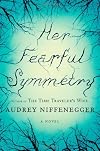
As one of the central characters in Audrey Niffenegger's Her Fearful Symmetry puts it, one of the worst things about dying is not being around "to find out what happens next." But, much to her surprise, when Elspeth Noblin dies of cancer at age 44, she is still very much aware of what comes next. She, in fact, gets to influence much of what will happen - and not just because she willed her London flat to the nieces she has not set eyes upon since they were babies.
The nieces, Julia and show more Valentina, are twenty-year-old mirror-image (literally) twins living with their parents in Chicago. Because Elspeth has been estranged from their mother (who is Elspeth’s own twin sister) for their entire loves, the girls and their parents are somewhat shocked by the letter announcing their inheritance. But there are a couple of catches: in order to claim the property, the girls must live in it for one year and their parents must not enter the apartment for that entire time. Julia and Valentina, not a particularly ambitious pair, jump at the opportunity to live in London and, with the reluctant approval of their parents, accept their deceased aunt's proposition.
When they arrive in London, Julia and Valentina are somewhat surprised that their new flat borders London's famous Highgate Cemetery, the final home to Karl Marx and George Eliot, among others. But, despite the seeming reluctance of their neighbors to make contact with them, the girls manage to navigate their way around the city quite nicely on their own, determined to make the most of their unexpected windfall. Soon enough, however, they begin to suspect that they are not the only residents of their new apartment. Their dead aunt may still have some secrets she wants to share with them.
Make no mistake: Her Fearful Symmetry is a ghost story. For that matter, despite its lack of blood and guts, it is a superb horror novel. But really it is Niffenegger's way with fictional characters that transforms the novel into such a memorable reading experience. Julia and Valentina do eventually meet the people occupying flats in their building. Robert, their aunt's lover is an independently wealthy man able to spend much of his time as a volunteer guide at Highgate Cemetery. Martin is a brilliant crossword puzzle "setter" with such a terrible obsessive compulsive disorder that his wife has finally given up on him and moved back to the Netherlands. Even the characters not as directly connected to the twins, especially Martin's wife Marijke, are vivid and well constructed. And best of all, the workings of Highgate Cemetery are presented in such sympathetic detail, that the cemetery itself is almost another key character in the novel.
Bottom Line: Her Fearful Symmetry is a compelling ghost story. It is impossible to read the novel without a growing sense of dread at the realization that, as the book begins to draw to a close, all is not likely to end well for many of Niffennegger's characters. show less
The nieces, Julia and show more Valentina, are twenty-year-old mirror-image (literally) twins living with their parents in Chicago. Because Elspeth has been estranged from their mother (who is Elspeth’s own twin sister) for their entire loves, the girls and their parents are somewhat shocked by the letter announcing their inheritance. But there are a couple of catches: in order to claim the property, the girls must live in it for one year and their parents must not enter the apartment for that entire time. Julia and Valentina, not a particularly ambitious pair, jump at the opportunity to live in London and, with the reluctant approval of their parents, accept their deceased aunt's proposition.
When they arrive in London, Julia and Valentina are somewhat surprised that their new flat borders London's famous Highgate Cemetery, the final home to Karl Marx and George Eliot, among others. But, despite the seeming reluctance of their neighbors to make contact with them, the girls manage to navigate their way around the city quite nicely on their own, determined to make the most of their unexpected windfall. Soon enough, however, they begin to suspect that they are not the only residents of their new apartment. Their dead aunt may still have some secrets she wants to share with them.
Make no mistake: Her Fearful Symmetry is a ghost story. For that matter, despite its lack of blood and guts, it is a superb horror novel. But really it is Niffenegger's way with fictional characters that transforms the novel into such a memorable reading experience. Julia and Valentina do eventually meet the people occupying flats in their building. Robert, their aunt's lover is an independently wealthy man able to spend much of his time as a volunteer guide at Highgate Cemetery. Martin is a brilliant crossword puzzle "setter" with such a terrible obsessive compulsive disorder that his wife has finally given up on him and moved back to the Netherlands. Even the characters not as directly connected to the twins, especially Martin's wife Marijke, are vivid and well constructed. And best of all, the workings of Highgate Cemetery are presented in such sympathetic detail, that the cemetery itself is almost another key character in the novel.
Bottom Line: Her Fearful Symmetry is a compelling ghost story. It is impossible to read the novel without a growing sense of dread at the realization that, as the book begins to draw to a close, all is not likely to end well for many of Niffennegger's characters. show less
Lists
Magic Realism (1)
Women Writers (1)
USA Road Trip (1)
Women's Stories (1)
A Novel Cure (1)
Five star books (1)
ScaredyKIT 2020 (1)
Page Turners (1)
2014 (1)
Books with Twins (1)
Female Author (3)
Mooie titels (1)
Unread books (1)
Simon & Schuster (1)
Favourite Books (1)
Overdue Podcast (1)
Ghosts (1)
. (1)
First Novels (1)
to get (1)
Best Satire (1)
Biblio-Mysteries (1)
2000s decade (1)
BBC Big Read (1)
100 Hemskaste (1)
Awards


You May Also Like


Associated Authors
Statistics
- Works
- 23
- Also by
- 16
- Members
- 52,615
- Popularity
- #290
- Rating
- 4.0
- Reviews
- 1,980
- ISBNs
- 241
- Languages
- 28
- Favorited
- 143
