

John Snead
Author of Magic Item Compendium
About the Author
Series
Works by John Snead
Planets of the Ufp: A Guide to Federation Worlds : Sourcebook (Star Trek, the Next Generation) (1999) — Author — 37 copies
Mindjammer: Transhuman Adventure in the Second Age of Space (Traveller) — Author — 7 copies
Enlightened Magic: Sorcery and Alchemy Rules Based on Western Occult Traditions (Basic Roleplaying) (2014) 6 copies
Victorian Lost: A Maze of Smoke and Hedge — Author — 5 copies
Marvels of Mars 2 copies
Blue 2 copies
Associated Works
Chronicles of Darkness: Dark Eras — Designer — 8 copies
Tagged
Common Knowledge
- Canonical name
- Snead, John
- Birthdate
- 1961-08-25
- Gender
- male
- Nationality
- USA
- Places of residence
- Portland, Oregon, USA
- Associated Place (for map)
- Oregon, USA
Members
Reviews

This is the second time White Wolf has attempted a roleplaying supplement centered around a time period within living memory for the New World of Darkness. Like with New Wave Requiem I was excited to check it out even though I didn't actively play the game it was based on. I own the Mage: the Awakening book but haven't read it all the way through, which may show in my review.
Mage Noir isn't just about setting your Mage game within the genre of the noir post-war film genre, it is very show more concerned with capturing the theme and mood of the time period. Before I read this book I had no idea noir film and that era of crime fiction in general was so thoroughly shaped by America's experiences with World War II, but Noir mentions the war so often you would think it was White Wolf's guide to that war. There is a lot of psychosocial dwellings on the scars left from war, it very much reminded me of watching Shutter Island a few weeks back. The other surprising aspect of Mage Noir was how little it was concerned with educating the gamer about noir movies. Usually there is a pretty good "recommended viewing/reading" in a White Wolf book but that was very brief here. Strange since the cinematic experience wrapped the book so tightly. But if you want to run a serious, dramatic Mage Noir game I guess the writer's figured you would do that research on your own, and check out criticism of the film genre to find out that The Third Man and The Naked City are really worth checking out. It was just surprising, considering the title.
What is there is a lot of great information for the storyteller and player. As with New Wave Requiem I liked the discussion of how technology and culture differ from the present day. Identity is much more mutable, for instance in the postwar period. A forged driver's license is your talisman allowing the move across the country and fulcrum to remake your identity, provided your fingerprints are not tracked to some past crime. Authors did a great job giving storytellers and players an understanding into the major social and political movements of the time and American's overall psychological philosophical relationship with the war's legacy.
Speaking of that word, the new Legacy in the book is worth the price of admission. Mage Noir succeeded as a book because it made me want to play Mage for the first time, and I don't think I would ever want to shoot for any other Legacy than The Quiescent. Nicknamed The Liars, the founders of this Legacy saw a truth about Magic that The Technocracy grasped in Mage: the Ascension did back in the Thirteenth Century, that technology had surpassed magic; antibiotics could save lives just as effectively without the risk of failure and Paradox and the atomic bomb could destroy with more vulgarity than the strongest Forces spell. They reacted in a much different manner, however. The Quiescent disdain any forms of vulgar magic, their spells are subtle and arcane but rarely can be proved to be an actual supernatural practice. They rely on their wits and mundane abilities more. One of the pre-generated characters is given a great quote that sums up the whole attitude quite well. "Who? Oh, right. He's dead. I shot him in the face while he was waving his arms around and looking like a complete idiot." These hard-boiled guys and femme fatale females have no use for cloaks, daggers and pentacles.
Lastly, I like the sample characters and how the illustrate the intent of the book and reflect the time period and genre of noir. Everything from a former USO entertainer turned nightclub singer to a Nietzsche spouting Thyrsus urban mystic, they all had a 1940s silver screen sparkle on them. Another big plus is the Bauhaus-inspired fonts that so well incorporate the 40's design of the book are the most readable for any Awakening book. show less
Mage Noir isn't just about setting your Mage game within the genre of the noir post-war film genre, it is very show more concerned with capturing the theme and mood of the time period. Before I read this book I had no idea noir film and that era of crime fiction in general was so thoroughly shaped by America's experiences with World War II, but Noir mentions the war so often you would think it was White Wolf's guide to that war. There is a lot of psychosocial dwellings on the scars left from war, it very much reminded me of watching Shutter Island a few weeks back. The other surprising aspect of Mage Noir was how little it was concerned with educating the gamer about noir movies. Usually there is a pretty good "recommended viewing/reading" in a White Wolf book but that was very brief here. Strange since the cinematic experience wrapped the book so tightly. But if you want to run a serious, dramatic Mage Noir game I guess the writer's figured you would do that research on your own, and check out criticism of the film genre to find out that The Third Man and The Naked City are really worth checking out. It was just surprising, considering the title.
What is there is a lot of great information for the storyteller and player. As with New Wave Requiem I liked the discussion of how technology and culture differ from the present day. Identity is much more mutable, for instance in the postwar period. A forged driver's license is your talisman allowing the move across the country and fulcrum to remake your identity, provided your fingerprints are not tracked to some past crime. Authors did a great job giving storytellers and players an understanding into the major social and political movements of the time and American's overall psychological philosophical relationship with the war's legacy.
Speaking of that word, the new Legacy in the book is worth the price of admission. Mage Noir succeeded as a book because it made me want to play Mage for the first time, and I don't think I would ever want to shoot for any other Legacy than The Quiescent. Nicknamed The Liars, the founders of this Legacy saw a truth about Magic that The Technocracy grasped in Mage: the Ascension did back in the Thirteenth Century, that technology had surpassed magic; antibiotics could save lives just as effectively without the risk of failure and Paradox and the atomic bomb could destroy with more vulgarity than the strongest Forces spell. They reacted in a much different manner, however. The Quiescent disdain any forms of vulgar magic, their spells are subtle and arcane but rarely can be proved to be an actual supernatural practice. They rely on their wits and mundane abilities more. One of the pre-generated characters is given a great quote that sums up the whole attitude quite well. "Who? Oh, right. He's dead. I shot him in the face while he was waving his arms around and looking like a complete idiot." These hard-boiled guys and femme fatale females have no use for cloaks, daggers and pentacles.
Lastly, I like the sample characters and how the illustrate the intent of the book and reflect the time period and genre of noir. Everything from a former USO entertainer turned nightclub singer to a Nietzsche spouting Thyrsus urban mystic, they all had a 1940s silver screen sparkle on them. Another big plus is the Bauhaus-inspired fonts that so well incorporate the 40's design of the book are the most readable for any Awakening book. show less
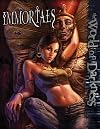
I was lucky enough to pick up the Transylvania Chronicles when it was still in print which I consider to be the finest achievement of White Wolf’s old World of Darkness. It was the only chronicle where you could hit all the plot points of the oft-maligned metaplot for Vampire: the Masquerade from the formation of the sects leading right on up to the finale of Gehenna. I never got a chance to run it, but often daydreamed about how to make this work for the other game lines. Imagine a show more Werewolf campaign involving past lives that stretched from Dark Ages right up through Wild West on to Apocalypse; an Mage game from Dark Ages though Sorcerer’s Crusade up to Ascension; a Wraith plot with a prologue surrounding Charon’s disappearance in Dark Ages cutting to The Great War and on to Ends of Empire; or even a Dark Ages: Inquisitor game run parallel with a Hunter: the Reckoning game? With a little creativity one could use the Dark Ages: Devil’s Due sourcebook as a tie-in with Demon: the Fallen.
While toying with this idea of crafting an Epic World of Darkness game with a friend we wondered if this could be accomplished with a more sandbox feel in the new World of Darkness. Surely one could run a Requiem for Rome campaign with a tie in to the modern nights, but why get yourself bogged down to Vampire right away? You could have successive packs following the same totem in Forsaken, or use life-preserving magic to keep a mage alive since Roman Empire. At high enough levels of Glamour and a crafty use of Pledges a Changeling could craft a contract with Death itself. The Soul-Eaters in Geist die multiple times, or you could run multiple characters bonded and serving the unknowable agenda of the same Geist. Then I remembered there was a sourcebook in the “blue book” line that would make this all so much easier, World of Darkness: Immortals!
This supplement provides the best option for this sort of campaign. To be honest I skipped past chapters one and two, since creating a character who achieves immortality through bathing in the blood of innocents or evicting a mortals’ soul in a Harlan Ellison’s Mephisto in Onyx-type power grab seems unseemly enough to relegate to non-player character status; but the information on The Purified and the one following in rare and unique immortals holds great promise. show less
While toying with this idea of crafting an Epic World of Darkness game with a friend we wondered if this could be accomplished with a more sandbox feel in the new World of Darkness. Surely one could run a Requiem for Rome campaign with a tie in to the modern nights, but why get yourself bogged down to Vampire right away? You could have successive packs following the same totem in Forsaken, or use life-preserving magic to keep a mage alive since Roman Empire. At high enough levels of Glamour and a crafty use of Pledges a Changeling could craft a contract with Death itself. The Soul-Eaters in Geist die multiple times, or you could run multiple characters bonded and serving the unknowable agenda of the same Geist. Then I remembered there was a sourcebook in the “blue book” line that would make this all so much easier, World of Darkness: Immortals!
This supplement provides the best option for this sort of campaign. To be honest I skipped past chapters one and two, since creating a character who achieves immortality through bathing in the blood of innocents or evicting a mortals’ soul in a Harlan Ellison’s Mephisto in Onyx-type power grab seems unseemly enough to relegate to non-player character status; but the information on The Purified and the one following in rare and unique immortals holds great promise. show less

The RPG I am currently running with my group, in which the players take the parts of British civil servants working for a secret department of the Security Services which is tasked with protecting Her Britannic Majesties Domains and Protectorates - and, incidentally the world - from all manner of unspeakable, tentacled monstrosities from beyond space and time. [a:HP Lovecraft|9494|H.P. Lovecraft|http://photo.goodreads.com/authors/1263313703p2/9494.jpg] called them The Old Gods, others have show more called them the Many-Angled Ones, but they are multitudinous and ever hungry for human souls (or quantum thought patterns, as modern terminology has it), and almost always possessed of some deranged cult that feels summoning them to our world is a good idea. Add to this the aspects of the espionage genre that [a:Charles Stross|8794|Charles Stross|http://photo.goodreads.com/authors/1218218373p2/8794.jpg] has woven into the novels on which the game is based and the authors make full use of here, and you have a fun game that can be played as any mix of Lovecraft and [a:le Carre|4400777|Le Carre|http://www.goodreads.com/images/nophoto/nophoto-U-50x66.jpg] that you wish.
The characters are not superheroes, or even necessarily heroes, just ordinary people who have been inducted (often forcefully after being involved in an Incident) into the dark secrets that hide behind our modern, wipe-clean world. Magic has always existed, of course, but the utterance of complex grammatical and mathematical summoning structures (or spells and incantations, if you prefer) was always hit and miss until Alan Turing developed both the computer and the algorithms that made the process a little safer. Hence there is a substantial emphasis on IT and CD (Information Technology and Computational Demonology), with gadgets like the specially adapted Apple product (nicknamed the NecronomiPhone) being a must have for any smart Laundry operative.
The system used is the classic BRPS (Basic Role-Playing System, usually pronounced 'burps'), a nice simple metric that leaves most of the emphasis on role playing rather than dice but offers a good solid backbone for the mechanical aspects of the game. It is also a natural fit for this setting; having been developed from the original Call of Cthulhu RPG system the players should feel right at home as their characters' sanity begins to ebb away when they encounter all manner of squamous, cyclopean terrors. show less
The characters are not superheroes, or even necessarily heroes, just ordinary people who have been inducted (often forcefully after being involved in an Incident) into the dark secrets that hide behind our modern, wipe-clean world. Magic has always existed, of course, but the utterance of complex grammatical and mathematical summoning structures (or spells and incantations, if you prefer) was always hit and miss until Alan Turing developed both the computer and the algorithms that made the process a little safer. Hence there is a substantial emphasis on IT and CD (Information Technology and Computational Demonology), with gadgets like the specially adapted Apple product (nicknamed the NecronomiPhone) being a must have for any smart Laundry operative.
The system used is the classic BRPS (Basic Role-Playing System, usually pronounced 'burps'), a nice simple metric that leaves most of the emphasis on role playing rather than dice but offers a good solid backbone for the mechanical aspects of the game. It is also a natural fit for this setting; having been developed from the original Call of Cthulhu RPG system the players should feel right at home as their characters' sanity begins to ebb away when they encounter all manner of squamous, cyclopean terrors. show less
Based on Charles Stross's series (collected in On Her Majesty's Occult Service) where C'thulhu meets Len Deighton; where nerds and geeks have to become spies in order to protect the human world. Uses Chaosium's Basic Role Playing and a bit of Call of Cthulhu, but with some (very dark) humor thrown on; the worst opposition may well be your own bureaucracy, more than the eldritch horrors.
Lists
Awards

You May Also Like


Associated Authors
Statistics
- Works
- 39
- Also by
- 3
- Members
- 1,241
- Popularity
- #20,683
- Rating
- 3.6
- Reviews
- 9
- ISBNs
- 43
- Languages
- 1