
Max Stirner (1806–1856)
Author of The Ego and Its Own
About the Author
Disambiguation Notice:
The "Roots of the Right" edition of The Ego and His Own is heavily abridged and includes other writings by Stirner as well as significant editorial content. Do not combine with The Ego and His Own.
(yid) VIAF:51780445
Image credit: Max Stirner (1806-1856) portraited by Friedrich Engels (1820–1895), made circa 1892.
Works by Max Stirner
Associated Works
Tagged
Common Knowledge
- Canonical name
- Stirner, Max
- Legal name
- Schmidt, Johann Caspar
- Birthdate
- 1806-10-25
- Date of death
- 1856-06-26
- Gender
- male
- Education
- University of Berlin
University of Erlangen - Occupations
- philosopher
- Nationality
- Germany
- Birthplace
- Bayreuth, Bavaria, Germany
- Places of residence
- Berlin, Germany
- Place of death
- Berlin, Germany
- Disambiguation notice
- The "Roots of the Right" edition of The Ego and His Own is heavily abridged and includes other writings by Stirner as well as significant editorial content. Do not combine with The Ego and His Own.
- Associated Place (for map)
- Berlin, Germany
Members
Reviews
The Ego and His Own: The Case of the Individual Against Authority (Dover Books on Western Philosophy) by Max Stirner
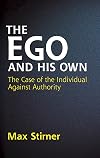
I first read The Ego and His Own as an edgelord LaVeyan Satanist who enjoyed trolling philosophy professors who were only equipped to stunt on the average freshman. At that time I considered myself a defender of (Psychological) Egoism and often attributed to Thomas Hobbes what I had actually learned from Stirner. Oops.
Reading this book years later I am proud to say that I am more annoyed with Stirner than impressed. One could read this book as a metaphysical exercise of the self versus the show more environment. How the microcosmic principles are at odds with the macrocosmic and glean quite a bit of wisdom from this exercise. I say "could" because every other page Stirner likes to remind the reader that this is absolutely not his intent.
That's not to say that this book is without merit. Stirner brings some strong arguments to the table, and like I mentioned before, even seasoned philosophers often fail to refute them easily. Often Stirner will repeat an argument from logical, wordplay, or even theological perspectives. The annotations by James J. Martin are especially helpful by pointing out the wordplay from the original German, as such nuances are often lost in translation.
Now reduced to memes that miss the point, Stirner's concept of spooks deserves to be grappled with. With the onset of Artificial Intelligence, the sale of personal data, and an ever encroaching surveillance state; going against the author's wishes and extrapolating outside of his intended scope is also illuminating, if maybe quite necessary. Social Media seems to thrive on bending us against our wills by presenting the most attractive spooks to possess us; for just one example.
Stirner targets all forms of collectivism as his favorite spooks to tear apart, often by using extreme examples that may have been laughable at the time of writing but have become all too normal now. Our media bombardment of the atrocities of the rich take Stirner's arguments from the hypothetical to the biography of Epstein. This may have always been the case but never reported so widely in the past. The veil of naivety has been torn apart for all to see.
Stiner eventually proposes his own spook, the Union of Egoists, as a utopian and voluntary organization that dissolves as soon as one member does not benefit. Like most utopias of philosophers it stands on very shaky ground and appears from several angles to be contradictory to his central thesis. Perhaps this was some sort of compromise of concession, but it is by far one of the weakest arguments in the book.
Love him or hate him, Stirner deserves to be read. His work serves as the shadow, or dark night of the modern soul, that only grows larger and repeats the more we ignore it. These are not concepts that you can ignore and make them go away, they are forever right behind you. His visceral writing may be off putting for many, but an avoidance of his arguments only speaks to an unwillingness to step outside the comfort of your own personal prejudices. A behavior that does nothing to dismiss his stance, and instead reinforces it. show less
Reading this book years later I am proud to say that I am more annoyed with Stirner than impressed. One could read this book as a metaphysical exercise of the self versus the show more environment. How the microcosmic principles are at odds with the macrocosmic and glean quite a bit of wisdom from this exercise. I say "could" because every other page Stirner likes to remind the reader that this is absolutely not his intent.
That's not to say that this book is without merit. Stirner brings some strong arguments to the table, and like I mentioned before, even seasoned philosophers often fail to refute them easily. Often Stirner will repeat an argument from logical, wordplay, or even theological perspectives. The annotations by James J. Martin are especially helpful by pointing out the wordplay from the original German, as such nuances are often lost in translation.
Now reduced to memes that miss the point, Stirner's concept of spooks deserves to be grappled with. With the onset of Artificial Intelligence, the sale of personal data, and an ever encroaching surveillance state; going against the author's wishes and extrapolating outside of his intended scope is also illuminating, if maybe quite necessary. Social Media seems to thrive on bending us against our wills by presenting the most attractive spooks to possess us; for just one example.
Stirner targets all forms of collectivism as his favorite spooks to tear apart, often by using extreme examples that may have been laughable at the time of writing but have become all too normal now. Our media bombardment of the atrocities of the rich take Stirner's arguments from the hypothetical to the biography of Epstein. This may have always been the case but never reported so widely in the past. The veil of naivety has been torn apart for all to see.
Stiner eventually proposes his own spook, the Union of Egoists, as a utopian and voluntary organization that dissolves as soon as one member does not benefit. Like most utopias of philosophers it stands on very shaky ground and appears from several angles to be contradictory to his central thesis. Perhaps this was some sort of compromise of concession, but it is by far one of the weakest arguments in the book.
Love him or hate him, Stirner deserves to be read. His work serves as the shadow, or dark night of the modern soul, that only grows larger and repeats the more we ignore it. These are not concepts that you can ignore and make them go away, they are forever right behind you. His visceral writing may be off putting for many, but an avoidance of his arguments only speaks to an unwillingness to step outside the comfort of your own personal prejudices. A behavior that does nothing to dismiss his stance, and instead reinforces it. show less
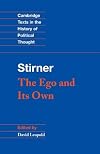
This is a work of unabashed egoism, the sort of unrestrained self-interest that makes Ayn Rand look like a 'pinko hippie'. It's fascinating, even if you want to hate Stirner's guts afterwards. He cites Ancient Greek and ecclesiastic history, and uses puns and quotations as much as logical arguments.
The Ego and Its Own starts with a polemic on all collective institutions, all dogmas, all beliefs, all religions, all political philosophies. One of his most astonishing (and perhaps correct) show more assertions is that modern ideologies take the place of what religion was in the ancient world - see Communism, Fascism setting themselves up as semi-divine cults of a fundamentalist nature. All dying for an idea, a spirit, a dogma - which he dismisses as 'spooks'. Spooks which alienate the person from themselves.
He even attacks the most basic of social customs - whether or not it is right to marry your sister, and praising the benefits of lying. It is the ethical code of either superhumans or sociopaths.
Marx and Engels devoted some 300 pages to refuting him in The German Ideology. Stirner remains relatively unknown, but influential, being the precursor to modern nihilism, existentialism
How exactly would interpersonal relationships and society exist in an entirely egoistic world? He tenderly submits a few suggestions on love based on mutual interest - a step above the quasi-rape fantasies of Atlas Shrugged. Although there is a nagging thought that anarcho-capitalism might work in the same way - a billion weasels trying to screw each other.
And so both anarchists and Marxists can consider him an influence. He's fascinating enough to grapple with, and thus worth your time. show less
The Ego and Its Own starts with a polemic on all collective institutions, all dogmas, all beliefs, all religions, all political philosophies. One of his most astonishing (and perhaps correct) show more assertions is that modern ideologies take the place of what religion was in the ancient world - see Communism, Fascism setting themselves up as semi-divine cults of a fundamentalist nature. All dying for an idea, a spirit, a dogma - which he dismisses as 'spooks'. Spooks which alienate the person from themselves.
He even attacks the most basic of social customs - whether or not it is right to marry your sister, and praising the benefits of lying. It is the ethical code of either superhumans or sociopaths.
Marx and Engels devoted some 300 pages to refuting him in The German Ideology. Stirner remains relatively unknown, but influential, being the precursor to modern nihilism, existentialism
How exactly would interpersonal relationships and society exist in an entirely egoistic world? He tenderly submits a few suggestions on love based on mutual interest - a step above the quasi-rape fantasies of Atlas Shrugged. Although there is a nagging thought that anarcho-capitalism might work in the same way - a billion weasels trying to screw each other.
And so both anarchists and Marxists can consider him an influence. He's fascinating enough to grapple with, and thus worth your time. show less
Stirner's leap from pedantic cynicism (his infamous spooks) to patronizing cynicism (mine mine mine) is not one I can get behind. He falls into the same hole that most "immanent" philosophies fall into, creating his own ideal Man to idolize right after tearing down all other ideals, just as Feuerbach did. It just happens that Stirner's Man is kind of a petty dickhead.
As an aside, his thoughts on Jews, "negroids," and "mongoloids" are pretty uncomfortable. I wish he hadn't picked up on the show more worst trends in Hegelian history there. show less
As an aside, his thoughts on Jews, "negroids," and "mongoloids" are pretty uncomfortable. I wish he hadn't picked up on the show more worst trends in Hegelian history there. show less
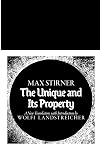
Well, hot damn this book took me a long time to read, and never have I reread so many passages. Stirner, like just about all philosophers I've read, takes the long route to get where he's going, but he gets there. I haven't been swayed towards egoism but I'd love to have more conversations about this book and read more Stirner.
Lists
You May Also Like


Associated Authors
Statistics
- Works
- 27
- Also by
- 2
- Members
- 1,135
- Popularity
- #22,615
- Rating
- 3.9
- Reviews
- 13
- ISBNs
- 103
- Languages
- 12
- Favorited
- 8