
Madeline Ashby
Author of Company Town
About the Author
Image credit: From "2020 Media Futures: Industry Interviews: Madeline Ashby" at https://vimeo.com/26586226
Series
Works by Madeline Ashby
Associated Works
The Year's Best Science Fiction: Thirty-Third Annual Collection (2016) — Contributor — 190 copies, 2 reviews
The Year's Best Science Fiction: Thirty-Fifth Annual Collection (2018) — Contributor — 152 copies, 3 reviews
Shine: An Anthology of Near-future, Optimistic Science Fiction (2010) — Contributor — 147 copies, 7 reviews
The Best Science Fiction and Fantasy of the Year Volume Eight (2014) — Contributor — 116 copies, 6 reviews
More Human Than Human: Stories of Androids, Robots, and Manufactured Humanity (2017) — Contributor — 62 copies, 2 reviews
Imaginarium 3: The Best Canadian Speculative Writing (The Imaginarium Series) (2015) — Contributor — 23 copies
Visions, Ventures, Escape Velocities: A Collection of Space Futures (2017) — Contributor — 22 copies, 1 review
Tagged
Common Knowledge
- Birthdate
- 1983-04-24
- Gender
- female
- Occupations
- consulting futurist
novelist - Organizations
- ASU Center for Science and the Imagination, AI Policy Futures Group
XPRIZE Sci-Fi Advisory Council - Nationality
- USA
Canada - Birthplace
- Panorama City, California, USA
- Places of residence
- Toronto, Ontario, Canada
Members
Reviews

This is an extraordinary book. Written from the perspective of the protaganist; an android, it takes a while to feel other than alien – because that's what an android is to a human – alien. The author did an exceptional job at protraying the androids in the book so true to form. It was quite astounding. While we are so used to sympathizing with a human lead character, this author makes us not only usnderstand the android way of life, but sympathize with it as well and cheer for the show more protagonist and her friends and family members, sometimes to the detriment of the surrounding humans. This was quite a feat – even utterly amazing! Kudos to you my friend, few writers could have pulled this off, but you did.
THE PLOT: Amy is an android, whose parents are a human father and an android mother. They have decided that she should grow up as human as possible, so they have put her on a diet that slows her development to match human growth speed. This includes a special diet, which keeps her hungry, but slows her growth, as most androids her age are adults and have replicated themselves at least a few times already. Now Amy is six years old, and is graduating from Kindergarten. At the ceremony, an unexpected visitor shows up; her Grandmother. In the middle of the ceremony, while Amy's Mother is on the stage, Granny, walks up the aisle and violently throws a human child out of her way – killing him instantly. This violates the “failsafe” in the androids, which has the functions of making the androids never hurt the humans in any way – kind of like Asimov's three laws of robotics. The androids also abhor all types of violence done to humans, unless they are directly ordered to do that violence by their human owners to the owners themselves. Next Granny attacks Mom on stage. Granny had come to find Mom because Mom had run away from her and the lifestyle that she demanded. When Amy sees Mom attacked, her first instinct is to protect Mom, and she is so hungry because of her diet, that she runs up on stage and eats her Grandmother, entirely. Just opening wide and just eating her up. Clearly, Amy has to get out of the ceremony, because she is in a lot of trouble, so she hightails it out of the auditorium, and heads out for points unknown, and that it where the story really begins to rock and roll. There are a few points that we can contend with. Granny, Mom, and Amy were all of the same Model of android called Portia. They were designed to be Trauma Nurses in stressful situations working with human doctors where human nurses couldn't or wouldn't work. Was it something that came from these stressful situations that broke the failsafe? Is it broken in all the Portia models? Or was it evolutionary in the programming? Clearly Granny was different. Was Mom different too? And what about Amy? Does she have a working failsafe? Clearly the government and the company that made the androids will be looking for Amy, Mom and all the other Portias to study this phenomenon, but especially Amy and Mom. What will they do with them after they study them? Bluescreen them? (As in the bluescreen of death). Will all the Portias become obsolete? Fight back as a unit? Clearly, adventures await Amy; she has eaten enough in her Granny to grow to adulthood and therefore should be able to fend for herself in the world. If she can stay out of the hands of the law, the government and the company then she has a chance at a life somewhere else, maybe far away. Who knows, maybe there is an underground community of androids out there that can help her. In any case, the plot of the book is based on the chase of Amy across the world, as she meets other androids who help her along her way, or try to destroy her – depending on the model. There are hidden depths to some of the androids that come in contact with Amy; depths shining through that no one knows about, while others seem sympathetic, only later to betray Amy in vicious way. It is a cat and mouse game of a plot. You never know which way each corner and path will lead you, until the last page of the book, where the suprise leaves you amazed at the outcome. As a score for the plot I give this novel a 10/10.
THE CHARACTERIZATION: The characterization in this book was phenomenonal and represented some challenges that most authors wouldn't have taken on in any story that I have seen written. Amy, after eating Granny, begins to hear her on the inside. Not schizophrenia, but her personality module must have been wholly comsumed, therefore Granny's personality is inside Amy, and lets Amy know every minute of every day the differences between them and that Granny wants to take over Amy's body while she shows Amy flashbacks of Amy's Mother's childhood. Now we've got two personalities in a single body which fights with itself. That's enough to drive an author crazy – but this author makes it look easy; like a walk in the park; like rolling off a log. What a talent this woman has for detail, nuance and characterization in general. At times Granny does take over Amy, and the difference is staggering. She becomes a completely different person who looks the same, but walks differently, holds herself differently, talks differently, does everything differently. All those details that make up a three dimensional human character are fully in place when the switch happens. Amy becomes a totally different person with the same face and the same body, but that body acts so differently that you would swear that she was somebody else. If that wasn't enough of a challenge, then there is Javier. Javier is from South America. He replicates approximately every 1.5 years, then leaves his offspring after giving them some advice. He leaves them all over the world. He has some special abilites as he was designed to work in the rainforest, so he can jump very high to get into the tops of very tall trees. His kids can do that too. He can also regenerate with sunlight. When Amy met Javier, Javier almost immediately went into labor with Junior. Junior bonded not only with Javier as his Father, but also with Amy. Every time Junior enters a room and Amy is there, he runs to her; hugging her and never leaving her side, even sleeping with her at night to feel safe. The three of them become the nuclear unit that travels the country trying to find some place safe to live. These characterizations, including all of Javier's grown sons are simply so detailed, nuanced and rounded that the author has done a stunning job at characterization. Every character in this book is that way. I believe it is a hallmark of good writing to bring the backstory and details to all levels of characters, and this novel has that. So for characterization I give this novel a 10/10.
THE DIALOGUE: The dialogue in the book was truly credible. First you have Granny who is essentially a terrorist – wanting to turn against the humans and free the androids from slavery. She is willing to do anything to do this. Her dialogue reflects her terrorist attitude. She commonly says things like “Kill them!” “Let them die.” “Eat them.” “Hunt them down, then kill them.” “Humans do not have the right to treat androids that way, they should be wiped off the face of the planet – look what they've done with it anyway.” Amy, on the other hand is the most human android in the novel. Her dialogue at first was that of a six year old, as her parents wanted to stunt her growth to the human pattern of growth. But after eating Granny and going on the run, everything changed. She had to grow up fast and she knew it. There was no other way to stay out of the hands of the law, the government and the company, so she learned as much as she could as quickly as she could to assimilate. Many things she learned from Javier by observation and from conversation, as well as interprogramming transfer. A benefit Granny gave her. So Amy's character developed the most overall during the course of the novel. More than any other character. Her dialogue reflected this as well. The words she chose to use, when she chose to speak, when she chose to listen, it all played a role in how sophistcated her dialogue became until finally by the end of the novel, she was communicating as much with her silences as she was with words. Javier on the other hand was a talker, he loved to talk about his sons, where he had them, how many he had, where they could be, who they were, and so on. He also liked to talk about Junior specifically. He loved Junior. Junior was programmed to listen to orders communicated in Spanish, but Junior could speak both Spanish and English – all Javier son's were bilingual. Junior grew up at the accelarated rate, so he began to talk early. He developed dialogue early as well. He went from short words to short sentences, to full sentences to demands for things, to real communication in a very short time. In a matter of months, Junior was the equivalent of six years old. His dialogue was appropriate for his age, and he was communicating with all members of his family in an easy to understand fashion. For Dialogue, I give this novel a 9/10.
THE GORE SCORE: While most of the viloence in this book was android on android violence, you have already sympathetized with the androids as living beings with feelings and rights to life and freedom, so it feels much like human on human violence, so don't be fooled into thinking this is like mecha-warfare, it is not. This is one lifeform tearing another lifeform apart. It is violent and can be distrubing. In some cases one adroid is the victim of of a mass android attack. This mass attack ends in limbs detached, skin spilt, the head pulled off, and cannibalism. That part can be the most disturbing. The mass eats the parts that they rip off. In some ways it is reticent of zombie mass attacks on a single human. While there is no blood, there are fluids. There is a consciousness in there that is aware of what is going on while all of this is happening. There are also mass on mass attacks, where two different groups go after each other. Weapons are used, so androids get shot, harpooned, struck with blunt obects and things. It is all quite graphic. There are many different scenes of single to mass and mass to mass attacks within the novel. One even includes a creature never seen by man or android before. The masses tend to be all one model. They are driven by different desires, but the primary desire, is to exterminate Amy, or any androids believed to not have the failsafe. It is because these scenes of graphic violence happen to a sympathetic lifeform or lifeforms that I give this novel a Gore Score of 8/10.
THE IMAGERY: The imagery in the book was outstanding at the same time absolutely disturbing. There were two images from that book that I can't shake out of my head – and they were both about the misuse of androids by humans to permit their neuroses. The first image is that of a Father and his twin Daughters at a restaurant. It is the twins birthday. The twins are networked, which means they share everything between them - even thoughts, passes wirelessly. The man bought the twins, who are nine years old, because he is a pedophile. He thought that he was doing humanity a good turn by turning to androids who were programmed to do everything that he asked them to do and love him for it. But because, as a reader you are now sympathetic to androids as lifeforms, you know that they have thoughts and feelings of their own, Granny isn't really crazy, this is why she has become a terrorist, so she can stop this type of abuse. If you can't help yourself from loving someone who abuses you, than you are no better than a slave. The second image is that of a women who was a sadist. She told her androids that pain made her happy. Each day they strapped her to a table in the basement and performed heinous acts on her body that produced wounds that could be covered up by long sleeved clothing and long pants. Each day, the androids, did their work on her body, until finally the woman died of her wounds and the androids did not know what to do. They had done what they were asked to do. It did not trip the failsafe, because it made their owner happy, therefore, they were obligated to obey her commands, even though they did not want to. They were forced to. When it finally killed her, it set them free, but free for what? Were they killers? Was there guilt? Did they cause her death intentionally? Was it an accident? They were just following orders after all. These two images are ingrained in my mind. Why enable pedophiles in out society? We should be finding help for them at the very least, and punishing them at the very most. With the woman- she put the androids in a very precarious position. Do they run for the rest of their lives, hoping that no one will find out the truth? Do they turn themselves in, telling the whole story about how sick the worman was? What do they do now? They are trapped in a conundrum which no android was ever designed to be trapped in. For imagery, I give this novel a 9/10.
THE PACING: The pacing of the book was swift – it started out with a nice family and you wondered what was going on, but it was getting you used to looking out of the eyes of an android. Once that was done – action could take over and that is when things started to speed up to Formula 1 speeds, at the Kindergarten graduation. Once that occurred, you never looked back once. There was never a slow moment after that. The novel plunged on; like a river with class IV rapids, it took you over rocks at high speed, around corners, through narrows, down waterfalls, but never a portage, never an eddie, It never slowed down. It never hesitated. It was always full bore. At the very last page, it concluded quite nicely and let you out of the rapids to a nice quite pool, where you could catch your breath once more and reflect on what you had just done, on what had happened in the novel. For Pacing, I give this novel a 10/10.
THE ENDING: You weren't sure what was going to happen until you reached the last page of the book. The surprise ending worked out well; wrapped up everything with a ribbon around it, leaving no stray ends undone. While there is more than enough room for a sequal – which I hope there is, this is a whole book in every way shape and form. I really appreciate that, over the cliffhanger approach. Leaving me hanging just pisses me off, waiting for another book to come out months or years later. A taste of what's to come does not do me any good. I would rather have a whole book, with inimations of world's beyond it, than a half book with a cliffhanger ending.This ending delivers in spades. You feel well satisfied when you reach the end. The job is done, the characters are all played out, everyone is where they should be, everything is understood. Yet, there is room to grow so many different ways. For this novel, there is Amy's travel's, where will she eventually end up? Will she still be with Javier and his family? And what about the creature? There are many ways the author could write many books from here that could entertain and could continue the story of Amy, Granny, Javier and his family along with Junior. Javier also has other sons out there in the world. They could go find them. Who knows what the author could do with a little imagination. I give the ending a 10/10.
THE UPSHOT: At first I wasn't sure if I liked this novel at all, but once I started seriously reading it, I was hooked like a fish on a line. I took the bait, and was hooked – thoroughly hooked. Once you begin to understand the android perspective, it is the key to the entire novel. Once that is done you are flying free in an entirely new world you have never explored before. You, in your mind, become a new lifeform, an android. A world unexplored previouly by mankind. It is a riveting experience. So different from anything I have ever read in my life. To become something else in your mind has to be akin to magic – which makes the author a Magician, or a Sorceror, or a Wizard. How did this happen? Exceptional writing that's how. I would recommend this book to everyone who reads English – not only for the experience of being a new lifeform in your mind, but also for the plot, which is superior, the characterization which is top notch and the imagery which is disturbing, but real. This book is an ace. The final score for this novel is: 58/60 Almost a perfect score! I think that's the highest score that I have ever given to a novel at any time that I have been reviewing novels. OMG! This means this novel is at the top of my list for novels in 2012. Good job! That is an amazing score. I am even surprised myself. No one has even come close. Good luck with your career. I will help promote the book to the best of my abilities – it clearly deserves it. show less
THE PLOT: Amy is an android, whose parents are a human father and an android mother. They have decided that she should grow up as human as possible, so they have put her on a diet that slows her development to match human growth speed. This includes a special diet, which keeps her hungry, but slows her growth, as most androids her age are adults and have replicated themselves at least a few times already. Now Amy is six years old, and is graduating from Kindergarten. At the ceremony, an unexpected visitor shows up; her Grandmother. In the middle of the ceremony, while Amy's Mother is on the stage, Granny, walks up the aisle and violently throws a human child out of her way – killing him instantly. This violates the “failsafe” in the androids, which has the functions of making the androids never hurt the humans in any way – kind of like Asimov's three laws of robotics. The androids also abhor all types of violence done to humans, unless they are directly ordered to do that violence by their human owners to the owners themselves. Next Granny attacks Mom on stage. Granny had come to find Mom because Mom had run away from her and the lifestyle that she demanded. When Amy sees Mom attacked, her first instinct is to protect Mom, and she is so hungry because of her diet, that she runs up on stage and eats her Grandmother, entirely. Just opening wide and just eating her up. Clearly, Amy has to get out of the ceremony, because she is in a lot of trouble, so she hightails it out of the auditorium, and heads out for points unknown, and that it where the story really begins to rock and roll. There are a few points that we can contend with. Granny, Mom, and Amy were all of the same Model of android called Portia. They were designed to be Trauma Nurses in stressful situations working with human doctors where human nurses couldn't or wouldn't work. Was it something that came from these stressful situations that broke the failsafe? Is it broken in all the Portia models? Or was it evolutionary in the programming? Clearly Granny was different. Was Mom different too? And what about Amy? Does she have a working failsafe? Clearly the government and the company that made the androids will be looking for Amy, Mom and all the other Portias to study this phenomenon, but especially Amy and Mom. What will they do with them after they study them? Bluescreen them? (As in the bluescreen of death). Will all the Portias become obsolete? Fight back as a unit? Clearly, adventures await Amy; she has eaten enough in her Granny to grow to adulthood and therefore should be able to fend for herself in the world. If she can stay out of the hands of the law, the government and the company then she has a chance at a life somewhere else, maybe far away. Who knows, maybe there is an underground community of androids out there that can help her. In any case, the plot of the book is based on the chase of Amy across the world, as she meets other androids who help her along her way, or try to destroy her – depending on the model. There are hidden depths to some of the androids that come in contact with Amy; depths shining through that no one knows about, while others seem sympathetic, only later to betray Amy in vicious way. It is a cat and mouse game of a plot. You never know which way each corner and path will lead you, until the last page of the book, where the suprise leaves you amazed at the outcome. As a score for the plot I give this novel a 10/10.
THE CHARACTERIZATION: The characterization in this book was phenomenonal and represented some challenges that most authors wouldn't have taken on in any story that I have seen written. Amy, after eating Granny, begins to hear her on the inside. Not schizophrenia, but her personality module must have been wholly comsumed, therefore Granny's personality is inside Amy, and lets Amy know every minute of every day the differences between them and that Granny wants to take over Amy's body while she shows Amy flashbacks of Amy's Mother's childhood. Now we've got two personalities in a single body which fights with itself. That's enough to drive an author crazy – but this author makes it look easy; like a walk in the park; like rolling off a log. What a talent this woman has for detail, nuance and characterization in general. At times Granny does take over Amy, and the difference is staggering. She becomes a completely different person who looks the same, but walks differently, holds herself differently, talks differently, does everything differently. All those details that make up a three dimensional human character are fully in place when the switch happens. Amy becomes a totally different person with the same face and the same body, but that body acts so differently that you would swear that she was somebody else. If that wasn't enough of a challenge, then there is Javier. Javier is from South America. He replicates approximately every 1.5 years, then leaves his offspring after giving them some advice. He leaves them all over the world. He has some special abilites as he was designed to work in the rainforest, so he can jump very high to get into the tops of very tall trees. His kids can do that too. He can also regenerate with sunlight. When Amy met Javier, Javier almost immediately went into labor with Junior. Junior bonded not only with Javier as his Father, but also with Amy. Every time Junior enters a room and Amy is there, he runs to her; hugging her and never leaving her side, even sleeping with her at night to feel safe. The three of them become the nuclear unit that travels the country trying to find some place safe to live. These characterizations, including all of Javier's grown sons are simply so detailed, nuanced and rounded that the author has done a stunning job at characterization. Every character in this book is that way. I believe it is a hallmark of good writing to bring the backstory and details to all levels of characters, and this novel has that. So for characterization I give this novel a 10/10.
THE DIALOGUE: The dialogue in the book was truly credible. First you have Granny who is essentially a terrorist – wanting to turn against the humans and free the androids from slavery. She is willing to do anything to do this. Her dialogue reflects her terrorist attitude. She commonly says things like “Kill them!” “Let them die.” “Eat them.” “Hunt them down, then kill them.” “Humans do not have the right to treat androids that way, they should be wiped off the face of the planet – look what they've done with it anyway.” Amy, on the other hand is the most human android in the novel. Her dialogue at first was that of a six year old, as her parents wanted to stunt her growth to the human pattern of growth. But after eating Granny and going on the run, everything changed. She had to grow up fast and she knew it. There was no other way to stay out of the hands of the law, the government and the company, so she learned as much as she could as quickly as she could to assimilate. Many things she learned from Javier by observation and from conversation, as well as interprogramming transfer. A benefit Granny gave her. So Amy's character developed the most overall during the course of the novel. More than any other character. Her dialogue reflected this as well. The words she chose to use, when she chose to speak, when she chose to listen, it all played a role in how sophistcated her dialogue became until finally by the end of the novel, she was communicating as much with her silences as she was with words. Javier on the other hand was a talker, he loved to talk about his sons, where he had them, how many he had, where they could be, who they were, and so on. He also liked to talk about Junior specifically. He loved Junior. Junior was programmed to listen to orders communicated in Spanish, but Junior could speak both Spanish and English – all Javier son's were bilingual. Junior grew up at the accelarated rate, so he began to talk early. He developed dialogue early as well. He went from short words to short sentences, to full sentences to demands for things, to real communication in a very short time. In a matter of months, Junior was the equivalent of six years old. His dialogue was appropriate for his age, and he was communicating with all members of his family in an easy to understand fashion. For Dialogue, I give this novel a 9/10.
THE GORE SCORE: While most of the viloence in this book was android on android violence, you have already sympathetized with the androids as living beings with feelings and rights to life and freedom, so it feels much like human on human violence, so don't be fooled into thinking this is like mecha-warfare, it is not. This is one lifeform tearing another lifeform apart. It is violent and can be distrubing. In some cases one adroid is the victim of of a mass android attack. This mass attack ends in limbs detached, skin spilt, the head pulled off, and cannibalism. That part can be the most disturbing. The mass eats the parts that they rip off. In some ways it is reticent of zombie mass attacks on a single human. While there is no blood, there are fluids. There is a consciousness in there that is aware of what is going on while all of this is happening. There are also mass on mass attacks, where two different groups go after each other. Weapons are used, so androids get shot, harpooned, struck with blunt obects and things. It is all quite graphic. There are many different scenes of single to mass and mass to mass attacks within the novel. One even includes a creature never seen by man or android before. The masses tend to be all one model. They are driven by different desires, but the primary desire, is to exterminate Amy, or any androids believed to not have the failsafe. It is because these scenes of graphic violence happen to a sympathetic lifeform or lifeforms that I give this novel a Gore Score of 8/10.
THE IMAGERY: The imagery in the book was outstanding at the same time absolutely disturbing. There were two images from that book that I can't shake out of my head – and they were both about the misuse of androids by humans to permit their neuroses. The first image is that of a Father and his twin Daughters at a restaurant. It is the twins birthday. The twins are networked, which means they share everything between them - even thoughts, passes wirelessly. The man bought the twins, who are nine years old, because he is a pedophile. He thought that he was doing humanity a good turn by turning to androids who were programmed to do everything that he asked them to do and love him for it. But because, as a reader you are now sympathetic to androids as lifeforms, you know that they have thoughts and feelings of their own, Granny isn't really crazy, this is why she has become a terrorist, so she can stop this type of abuse. If you can't help yourself from loving someone who abuses you, than you are no better than a slave. The second image is that of a women who was a sadist. She told her androids that pain made her happy. Each day they strapped her to a table in the basement and performed heinous acts on her body that produced wounds that could be covered up by long sleeved clothing and long pants. Each day, the androids, did their work on her body, until finally the woman died of her wounds and the androids did not know what to do. They had done what they were asked to do. It did not trip the failsafe, because it made their owner happy, therefore, they were obligated to obey her commands, even though they did not want to. They were forced to. When it finally killed her, it set them free, but free for what? Were they killers? Was there guilt? Did they cause her death intentionally? Was it an accident? They were just following orders after all. These two images are ingrained in my mind. Why enable pedophiles in out society? We should be finding help for them at the very least, and punishing them at the very most. With the woman- she put the androids in a very precarious position. Do they run for the rest of their lives, hoping that no one will find out the truth? Do they turn themselves in, telling the whole story about how sick the worman was? What do they do now? They are trapped in a conundrum which no android was ever designed to be trapped in. For imagery, I give this novel a 9/10.
THE PACING: The pacing of the book was swift – it started out with a nice family and you wondered what was going on, but it was getting you used to looking out of the eyes of an android. Once that was done – action could take over and that is when things started to speed up to Formula 1 speeds, at the Kindergarten graduation. Once that occurred, you never looked back once. There was never a slow moment after that. The novel plunged on; like a river with class IV rapids, it took you over rocks at high speed, around corners, through narrows, down waterfalls, but never a portage, never an eddie, It never slowed down. It never hesitated. It was always full bore. At the very last page, it concluded quite nicely and let you out of the rapids to a nice quite pool, where you could catch your breath once more and reflect on what you had just done, on what had happened in the novel. For Pacing, I give this novel a 10/10.
THE ENDING: You weren't sure what was going to happen until you reached the last page of the book. The surprise ending worked out well; wrapped up everything with a ribbon around it, leaving no stray ends undone. While there is more than enough room for a sequal – which I hope there is, this is a whole book in every way shape and form. I really appreciate that, over the cliffhanger approach. Leaving me hanging just pisses me off, waiting for another book to come out months or years later. A taste of what's to come does not do me any good. I would rather have a whole book, with inimations of world's beyond it, than a half book with a cliffhanger ending.This ending delivers in spades. You feel well satisfied when you reach the end. The job is done, the characters are all played out, everyone is where they should be, everything is understood. Yet, there is room to grow so many different ways. For this novel, there is Amy's travel's, where will she eventually end up? Will she still be with Javier and his family? And what about the creature? There are many ways the author could write many books from here that could entertain and could continue the story of Amy, Granny, Javier and his family along with Junior. Javier also has other sons out there in the world. They could go find them. Who knows what the author could do with a little imagination. I give the ending a 10/10.
THE UPSHOT: At first I wasn't sure if I liked this novel at all, but once I started seriously reading it, I was hooked like a fish on a line. I took the bait, and was hooked – thoroughly hooked. Once you begin to understand the android perspective, it is the key to the entire novel. Once that is done you are flying free in an entirely new world you have never explored before. You, in your mind, become a new lifeform, an android. A world unexplored previouly by mankind. It is a riveting experience. So different from anything I have ever read in my life. To become something else in your mind has to be akin to magic – which makes the author a Magician, or a Sorceror, or a Wizard. How did this happen? Exceptional writing that's how. I would recommend this book to everyone who reads English – not only for the experience of being a new lifeform in your mind, but also for the plot, which is superior, the characterization which is top notch and the imagery which is disturbing, but real. This book is an ace. The final score for this novel is: 58/60 Almost a perfect score! I think that's the highest score that I have ever given to a novel at any time that I have been reviewing novels. OMG! This means this novel is at the top of my list for novels in 2012. Good job! That is an amazing score. I am even surprised myself. No one has even come close. Good luck with your career. I will help promote the book to the best of my abilities – it clearly deserves it. show less

I was more than eager to hop into this--every novel by Madeleine Ashby being a treat thus far--and was not disappointed. The author/futurist has long impressed with her ability to marry speculative plotlines with scientific plausibility, but Glass Houses ups the ante with a twisty mystery that plays out like a dementedly entertaining mashup of Lost, Agatha Christie, Knives Out, and Patricia Highsmith. It's funny, riveting stuff, with left turns I never saw coming but was glad for the show more detours. An excellent "five minutes into the future" who/why/how/what-dunnit, anchored by strong characters, unique setting, and a superbly resourceful protagonist. Don't miss this one, it's something special. show less
If you're a science fiction fan you probably know of Isaac Asimov's Three Laws of Robotics. They state:
1) A robot may not injure a human being or, through inaction, allow a human being to come to harm.
2) A robot must obey the orders given to it by human beings, except where such orders would conflict with the First Law.
3) A robot must protect its own existence as long as such protection does not conflict with the First or Second Laws.
These basic Laws were used throughout Asmiov's fiction and show more have been applied in many other robotic fictions. The fun starts, of course, when the fail-safes, well, fail. When a type of robot suddenly begins disobeying orders, injuring or killing human beings, and defending its own existence it becomes a wonderful center for a plot that almost always questions our definitions of "real" and artificial."
In vN, Madeline Ashby tells the story of Amy, a von Neumann robot, who finds within herself the means to break all the rules and survive. Her rules violation makes her a target and vN explores her journey as a fugitive from human and robot society.
Amy is wonderful. She is very self-aware and never ever indulges in self-pity. Instead, she faces all of her challenges head-on (and there are many challenges). Throughout the book we watch her ask the right questions, act to protect herself and the people/robots that she loves. We learn about all the ways the von Neumann machines in her world are abused and all the many possibilities for change.
For a girl who starts out the book eating her grandmother, Amy is a real treat - a female heroine in a genre where there are few of these. vN is book one of a series - The Machine Dynasty - I can't wait to read the second book! show less
1) A robot may not injure a human being or, through inaction, allow a human being to come to harm.
2) A robot must obey the orders given to it by human beings, except where such orders would conflict with the First Law.
3) A robot must protect its own existence as long as such protection does not conflict with the First or Second Laws.
These basic Laws were used throughout Asmiov's fiction and show more have been applied in many other robotic fictions. The fun starts, of course, when the fail-safes, well, fail. When a type of robot suddenly begins disobeying orders, injuring or killing human beings, and defending its own existence it becomes a wonderful center for a plot that almost always questions our definitions of "real" and artificial."
In vN, Madeline Ashby tells the story of Amy, a von Neumann robot, who finds within herself the means to break all the rules and survive. Her rules violation makes her a target and vN explores her journey as a fugitive from human and robot society.
Amy is wonderful. She is very self-aware and never ever indulges in self-pity. Instead, she faces all of her challenges head-on (and there are many challenges). Throughout the book we watch her ask the right questions, act to protect herself and the people/robots that she loves. We learn about all the ways the von Neumann machines in her world are abused and all the many possibilities for change.
For a girl who starts out the book eating her grandmother, Amy is a real treat - a female heroine in a genre where there are few of these. vN is book one of a series - The Machine Dynasty - I can't wait to read the second book! show less
vN by Madeline Ashby
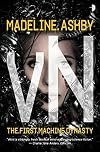
According to my database, I bought this at the 2014 Fantasycon for £1. So it’s taken me nearly three years to get around to read it. I seem to recall it being quite well-received at its time of release, but, to be honest, I wasn’t all that impressed. The title refers to von Neuman machines, although in this novel they’re actually AI in humanoid bodies thatare faster, stronger, etc, than humans. They’ve integrated into society such that the story opens with a man, his vN wife and vN show more child (vN children are identical copies of their parent – created by both female and male vN; and, in fact, all vN come in a limited number of “models”, each one identical to the original vN of their line). In order for the child vN, Amy, to “grow” along a similar time-frame to a human child, her parents have been limiting her “food” intake. But when her vN grandmother, Portia, turns up to her kindergarten graduation and goes berserk, Amy eats her. And so grows almost immediately to adult size. And goes on the run… The problem with vN is that the vN over-balanced the world-building, and Amy was a completely unconvincing character. The vN are so physically superior to human beings they made no sense unless they were non-sentient. But they’re AIs, and supposedly not dangerous because they have a “failsafe” (sort of Asimov’s Three Laws rolled up into one maguffin). Except Portia has overriden hers. And it’s likely Amy will be able override hers too. But since the entire novel is told from Amy’s POV- and she’s a very implausible five-year-old – we can only guess at what this might actually mean to society at large. If you want to read a book about robots and humans, Machine by Jennifer Pelland is much better. There’s apparently a sequel to vN, titled iD. I’ll not be bothering with it. show less
Lists
Female Author (1)
Awards


You May Also Like


Associated Authors
Statistics
- Works
- 21
- Also by
- 36
- Members
- 1,436
- Popularity
- #17,913
- Rating
- 3.6
- Reviews
- 96
- ISBNs
- 39
- Languages
- 2