
Hannu Rajaniemi
Author of The Quantum Thief
About the Author
Image credit: Photo: Zuzana Krejciova
Series
Works by Hannu Rajaniemi
Words of Birth and Death 8 copies
The Jean le Flambeur Trilogy: The Quantum Thief, The Fractal Prince, The Causal Angel (2018) 5 copies
Shibuya No Love 2 copies
Lions and Gazelles {short story} 2 copies
Gingerbread 1 copy
Kosmograd Blues 1 copy
Naarssuk's Daughter 1 copy
The Quantum Thief trilogy 1 copy
Associated Works
The Year's Best Science Fiction: Twenty-Third Annual Collection (2006) — Contributor — 568 copies, 5 reviews
The Year's Best Science Fiction: Twenty-Sixth Annual Collection (2009) — Contributor — 424 copies, 2 reviews
The Year's Best Science Fiction: Twenty-Eighth Annual Collection (2011) — Contributor — 328 copies, 3 reviews
The Year's Best Science Fiction: Thirtieth Annual Collection (2013) — Contributor — 255 copies, 3 reviews
The Best Science Fiction and Fantasy of the Year, Volume 5 (2011) — Contributor — 165 copies, 4 reviews
The Best Science Fiction and Fantasy of the Year, Volume 6 (2012) — Contributor — 162 copies, 4 reviews
The Best Science Fiction and Fantasy of the Year, Volume 3 (2009) — Contributor — 150 copies, 2 reviews
Giants at the end of the world : a showcase of Finnish weird (2017) — Contributor — 84 copies, 1 review
It Came From the North: An Anthology of Finnish Speculative Fiction (2013) — Contributor — 80 copies, 3 reviews
Anthology of European SF — Contributor — 7 copies
Tagged
Common Knowledge
- Legal name
- Rajaniemi, Hannu Jaakko
- Birthdate
- 1978-03-09
- Gender
- male
- Education
- University of Oulu (BS|Mathematics)
University of Cambridge
University of Edinburgh (PhD|mathematics) - Occupations
- entrepreneur
writer - Organizations
- ThinkTank Maths Limited
Writers' Bloc - Agent
- John Jarrold
- Short biography
- Hannu Rajaniemi was born in Ylivieska, Finland, in 1978. He read his first science fiction novel at the age of 6 – Jules Verne's ''20,000 Leagues Under the Sea''. At the age of 8 Hannu approached ESA with a fusion-powered spaceship design, which was received with a polite thank you note.
Hannu studied mathematics and theoretical physics at the University of Oulu and completed a B.Sc. thesis on transcendental numbers. He went on to complete Part III of the Mathematical Tripos at Cambridge University and a PhD in string theory at University of Edinburgh. After completing his PhD, Hannu joined three partners to co-found ThinkTank Maths (TTM). The company provides mathematics-based technologies in the defence, space and energy sectors.
Hannu is a member of an Edinburgh-based writers' group which includes Alan Campbell, Jack Deighton, Caroline Dunford and Charles Stross. His first fiction sale was the short story ''Shibuya no Love'' to Futurismic.com. Hannu's first novel, ''The Quantum Thief'', is published by Gollancz in the UK and by Tor in the US. - Nationality
- Finland
- Birthplace
- Ylivieska, Finland
- Places of residence
- Edinburgh, Scotland, UK
San Francisco, California, USA - Associated Place (for map)
- Finland
Members
Reviews
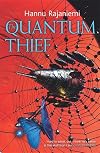
Felt like giving this a re-read. It's very very good! A little hard to follow, and my firm conclusion, on revisiting it, is that the Oubliette (a city on Mars) and its citizens are 100 times more interesting than the titular thief and the larger plot. The way the consensus-reality works is really intriguing from a social media standpoint, "the Quiet" are a great concept (the potentially-immortal citizens must periodically spend a life as mute robots who build, protect, and serve the city), show more and the little urban details and exotic intrigues are wonderful. show less
One of the reasons I read non-fiction and classics is that they tend to challenge me more than the books I enjoy reading the most. I'll pick up science-fiction or fantasy because I want to escape, relax, and take a break. But too much, and I get bored.
I did not have that problem when I read this book. Not one bit.
Hannu Rajaniemi, though, has found a way to both escape and challenge my mind at the same time. The challenge is such that, as I have seen one reviewer note, I would not recommend show more Rajaniemi's The Quantum Thief trilogy to the "uninitiated" to science fiction. Unlike the Star Wars, or even Star Trek, universes, where the laws of science are as ignored as any swords and sorcery fantasy (and, indeed, Luke Skywalker may have more in common with the questing, sword welding hero than not), Rajaniemi does not ignore physics.
He just finds a way to weld physics to do what he wants.
This is not to say that The Fractal Prince is dry and sodden down by the weight of physics. In fact, quite the contrary. Instead, the writing moves so fast, so quickly, that it is only the sprinkling of labels and jargon that reminds me that Rajaniemi is even thinking about it. What makes it feel real is this very awareness. The Fractal Prince is so far into the future that it is difficult recognizing what humanity has become. A lot of writers decide to slow down the technological progress when this happens to enable them to anchor their story in a reality that is easier to describe, if just because it looks like our own reality, but more shiny, with more space ships that look and move like gravity bound jet craft and laser guns that act more like semi-automatic firearms.
Perhaps it is because Rananiemi's is so cavalier about his ambition to create and remain honest to the setting of his story that his ambition is understated. In the universe of The Quantum Thief --who we might as well just call by name--in Jean de Flambeu's universe, we cannot help but see the characters as foreign, even alien. Gods and goddesses compete with warminds and self-loops, and a dozen other entities, all apparently descended from the race we call humanity, somehow melded by technology and preserved, copied, enhanced, and expanded.
And if that doesn't all blow your mind (at least when you read it), it's probably because you've become lost in the jargon. Rajanamiemi pulls terms from a half dozen languages that are not native to our planet, but totally uncommon to the western reader. I admit that I drew on Google more than once to get the gist for what he was intending with a word, and then even then I had to add to what I found an expanded understanding of what it meant in the context of the Quantum Thief, universe. Russian, Japanese, and Finnish all contribute to the vocabulary.
Pick up the book, though, push through the vocabulary, and you might find yourself a story that is both creative and familiar. Taking place in the space between Mars, where most of the plot in the first book in the trilogy took place, and Earth and on Earth itself, The Fractal Prince takes a page from A Thousand and One Nights . Not only is the setting of the heist a world reminiscent of the pre-Islamic Arabic world, but takes place in a shining city on the edge of a hostile desert, where decay and corruption are hiding just below the surface and where a story is as forbidden as the worship of images in modern day Islam. And yet, like our own world, the forbidden become a currency in themselves...
At its root, under all the science, the fiction, the clever jargon and imaginative settings, this is the story of a heist, and Rajanamiemi lays the pieces in place carefully, hiding strings until the end, letting the reader see them only as the plot comes together to a final denoument that is fully satisfying.
But do not going into it without your eyes wide open. This is not space opera. It's science fiction, and Rajanamiemi does it well. It will both challenge and entertain, and really, that's what good fiction should do. show less
I did not have that problem when I read this book. Not one bit.
Hannu Rajaniemi, though, has found a way to both escape and challenge my mind at the same time. The challenge is such that, as I have seen one reviewer note, I would not recommend show more Rajaniemi's The Quantum Thief trilogy to the "uninitiated" to science fiction. Unlike the Star Wars, or even Star Trek, universes, where the laws of science are as ignored as any swords and sorcery fantasy (and, indeed, Luke Skywalker may have more in common with the questing, sword welding hero than not), Rajaniemi does not ignore physics.
He just finds a way to weld physics to do what he wants.
This is not to say that The Fractal Prince is dry and sodden down by the weight of physics. In fact, quite the contrary. Instead, the writing moves so fast, so quickly, that it is only the sprinkling of labels and jargon that reminds me that Rajaniemi is even thinking about it. What makes it feel real is this very awareness. The Fractal Prince is so far into the future that it is difficult recognizing what humanity has become. A lot of writers decide to slow down the technological progress when this happens to enable them to anchor their story in a reality that is easier to describe, if just because it looks like our own reality, but more shiny, with more space ships that look and move like gravity bound jet craft and laser guns that act more like semi-automatic firearms.
Perhaps it is because Rananiemi's is so cavalier about his ambition to create and remain honest to the setting of his story that his ambition is understated. In the universe of The Quantum Thief --who we might as well just call by name--in Jean de Flambeu's universe, we cannot help but see the characters as foreign, even alien. Gods and goddesses compete with warminds and self-loops, and a dozen other entities, all apparently descended from the race we call humanity, somehow melded by technology and preserved, copied, enhanced, and expanded.
And if that doesn't all blow your mind (at least when you read it), it's probably because you've become lost in the jargon. Rajanamiemi pulls terms from a half dozen languages that are not native to our planet, but totally uncommon to the western reader. I admit that I drew on Google more than once to get the gist for what he was intending with a word, and then even then I had to add to what I found an expanded understanding of what it meant in the context of the Quantum Thief, universe. Russian, Japanese, and Finnish all contribute to the vocabulary.
Pick up the book, though, push through the vocabulary, and you might find yourself a story that is both creative and familiar. Taking place in the space between Mars, where most of the plot in the first book in the trilogy took place, and Earth and on Earth itself, The Fractal Prince takes a page from A Thousand and One Nights . Not only is the setting of the heist a world reminiscent of the pre-Islamic Arabic world, but takes place in a shining city on the edge of a hostile desert, where decay and corruption are hiding just below the surface and where a story is as forbidden as the worship of images in modern day Islam. And yet, like our own world, the forbidden become a currency in themselves...
At its root, under all the science, the fiction, the clever jargon and imaginative settings, this is the story of a heist, and Rajanamiemi lays the pieces in place carefully, hiding strings until the end, letting the reader see them only as the plot comes together to a final denoument that is fully satisfying.
But do not going into it without your eyes wide open. This is not space opera. It's science fiction, and Rajanamiemi does it well. It will both challenge and entertain, and really, that's what good fiction should do. show less
This one is just about perfect. An excellent combination of questions about objective reality and questions about what it means to be human (objective humanity, as it were).
This compares best to [a:Charles Stross|8794|Charles Stross|http://photo.goodreads.com/authors/1218218373p2/8794.jpg]'s [b:Accelerando|17863|Accelerando|Charles Stross|http://photo.goodreads.com/books/1309198110s/17863.jpg|930555], but is better written and overall a better read. (As a side note, this is one of the very show more few hard sci-fi books where I prefer the American cover to the British one.)
The inner portions of the solar system, inside the orbit of Mars, are controlled by the Founders - massively parallel transhumans based off human templates, they are the current incarnations of a small number of brilliant engineers from old Earth. There are indications that they were important, central figures in some sort of technological singularity, but memories have been heavily edited and the reader is left unsure of the objective truth (if such a thing can be said to exist). They are now churning away inside giant crystalline picotech processing palaces the size of small planets, drawing vast amounts of power from the sun.
They are not an important part of this book, but they are probably an important part of the trilogy. Something was stolen from them, and the thief who did it spends the entirety of this book reassembling himself from memory stores that were hidden on Mars.
I don't want to say anything else for fear of spoiling this book. Suffice it to say that the characters are excellent, the world building is phenomenal, the writing style is a pleasure to read, and the editing is tolerable. (I always cringe at editing mistakes in printed books, but there are only half a dozen or so in the British softcover edition.)
You should read it if you have any interest in hard sci-fi, or questions of humanity and reality. show less
This compares best to [a:Charles Stross|8794|Charles Stross|http://photo.goodreads.com/authors/1218218373p2/8794.jpg]'s [b:Accelerando|17863|Accelerando|Charles Stross|http://photo.goodreads.com/books/1309198110s/17863.jpg|930555], but is better written and overall a better read. (As a side note, this is one of the very show more few hard sci-fi books where I prefer the American cover to the British one.)
The inner portions of the solar system, inside the orbit of Mars, are controlled by the Founders - massively parallel transhumans based off human templates, they are the current incarnations of a small number of brilliant engineers from old Earth. There are indications that they were important, central figures in some sort of technological singularity, but memories have been heavily edited and the reader is left unsure of the objective truth (if such a thing can be said to exist). They are now churning away inside giant crystalline picotech processing palaces the size of small planets, drawing vast amounts of power from the sun.
They are not an important part of this book, but they are probably an important part of the trilogy. Something was stolen from them, and the thief who did it spends the entirety of this book reassembling himself from memory stores that were hidden on Mars.
I don't want to say anything else for fear of spoiling this book. Suffice it to say that the characters are excellent, the world building is phenomenal, the writing style is a pleasure to read, and the editing is tolerable. (I always cringe at editing mistakes in printed books, but there are only half a dozen or so in the British softcover edition.)
You should read it if you have any interest in hard sci-fi, or questions of humanity and reality. show less
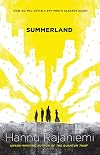
With the disaster that is Brexit looming over the UK, some popular culture has been harkening back to those rose-tinted good old days when we all pulled together like in, er, World War II… Er, WTF? How exactly does WWII map onto Brexit? Anyway, the fact Brexit is bending UK culture, as well as the economy, out of shape is a given, but it seems to have manifested a bit oddly in genre fiction, Yes, I know Rajaniemi is Finnish, but he’s been a resident of the UK for a number of years, and show more his career has been chiefly with English-language publishers. And if he’s a Finnish writer, then Geoff Ryman is a Canadian writer, Lisa Tuttle and Pat Cadigan are both American writers, Tariq Ali is a Pakistani writer, Leila Aboulela is a Sudanese writer… Um, that’s starting to fall apart. But never mind. Anyway, with Summerland and Simon Ings’s The Smoke, we have two very strange, and not so very different, approaches to science fiction, a very British form of science fiction, in fact, that owes much more to HG Wells than it does to the US tradition. Explicitly so in Summerland, as the man who looms over the entire plot, Prime Minister Herbert Blanco West, is in fact a thinly-disguised HG Wells. The novel is being sold as a science fiction spy story, and it’s true that its central plot could have come from a Le Carré novel, but, as a spy novel, I don’t think it’s entirely satisfactory. Fortunately, the rest of it is very satisfactory indeed. The world-building is especially good, and Rajaniemi has cleverly worked out not just the technological ramifications of Summerland‘s central premise but also the social ones. I think this one will do much better than The Quantum Thief; it’s much more approachable, for a start. show less
Lists
Awards


You May Also Like


Associated Authors
Statistics
- Works
- 23
- Also by
- 31
- Members
- 5,071
- Popularity
- #4,934
- Rating
- 3.7
- Reviews
- 207
- ISBNs
- 85
- Languages
- 9
- Favorited
- 8
