
Peter Watts (1) (1958–)
Author of Blindsight
For other authors named Peter Watts, see the disambiguation page.
About the Author
Peter Watts is a reformed marine biologist whom Canada's Globe and Mail has proclaimed "one of the very best hard-SF writers alive"
Image credit: Photo by Dan Brooks. (2007)
Series
Works by Peter Watts
ZeroS 7 copies
Bethlehem and Others 4 copies
Hitchhiker 3 copies
Test 4 Echo [short fiction] 2 copies
The Complete Short Fiction 2 copies
Collateral 1 copy
Bethlehem 1 copy
Maelstrom 1 copy
Fractals 1 copy
Blindsight, book 2 of 2 1 copy
Associated Works
The Year's Best Science Fiction: Twenty-Third Annual Collection (2006) — Contributor — 564 copies, 5 reviews
The Year's Best Science Fiction: Twenty-Eighth Annual Collection (2011) — Contributor — 328 copies, 3 reviews
The Year's Best Science Fiction: Twenty-Seventh Annual Collection (2010) — Contributor — 321 copies, 6 reviews
The Year's Best Science Fiction: Thirty-Second Annual Collection (2015) — Contributor — 204 copies, 8 reviews
The Very Best of the Best: 35 Years of The Year's Best Science Fiction (2019) — Contributor — 181 copies, 1 review
The Best Science Fiction and Fantasy of the Year, Volume 5 (2011) — Contributor — 165 copies, 4 reviews
The Best Science Fiction and Fantasy of the Year, Volume 6 (2012) — Contributor — 162 copies, 4 reviews
The Best Science Fiction and Fantasy of the Year, Volume 4 (2010) — Contributor — 141 copies, 2 reviews
The Year's Best Science Fiction Vol. 1: The Saga Anthology of Science Fiction 2020 (2020) — Contributor — 109 copies, 7 reviews
The Best Science Fiction and Fantasy of the Year, Volume 9 (2015) — Contributor — 73 copies, 3 reviews
The Final Frontier: Stories of Exploring Space, Colonizing the Universe, and First Contact (2018) — Contributor — 72 copies, 4 reviews
Life Beyond Us: An Original Anthology of SF Stories and Science Essays (2023) — Contributor — 36 copies, 1 review
Extreme Planets: A Science Fiction Anthology of Alien Worlds (Chaosium fiction) (2014) — Contributor — 15 copies, 1 review
Imaginarium 4: The Best Canadian Speculative Writing (The Imaginarium Series) (2016) — Contributor — 14 copies, 1 review
Strangest of All — Contributor — 13 copies
Canadian Speculative Fiction (Prairie Fire, Vol. 15., no.2 - 1994 Summer) (1994) — Contributor — 11 copies
Starshipsofa Stories Vol 3 — Contributor — 4 copies
The Year's Top Hard Science Fiction Stories 7 — Contributor — 3 copies
Tagged
Common Knowledge
- Legal name
- Watts, Peter
- Birthdate
- 1958-01-25
- Gender
- male
- Education
- University of Guelph (B.Sc.|1981|M.Sc.|1983)
University of British Columbia (Ph.D|1991) - Occupations
- marine mammal biologist
science fiction writer
biostatistical consultant - Relationships
- Sweet, Caitlin (spouse)
- Nationality
- Canada (birth)
- Birthplace
- Calgary, Alberta, Canada
- Places of residence
- Toronto, Ontario, Canada
- Associated Place (for map)
- Canada
Members
Discussions
Angel Bomb - The Things in Fine Press Forum (February 2024)
ISO: Blindsight in Centipede Press (November 2021)
Reviews
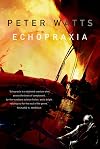
The novel is surprisingly easy to place in the taxonomy of great science fiction. Of course, to do so, one must first place Blindsight in it's proper place. It was a philosophical discussion on consciousness. Echopraxia, follows it's predecessor's conclusions, necessary story extrapolations, but it takes a sharp right turn when it brings up its primary philosophical mode. We put down consciousness for a moment, and pick up the discussion on free will. It might help to know the definition of show more the title: The involuntary repetition or imitation of another person's actions.
I loved the old topic. I rather prayed that it would continue, and it did in a lesser capacity. But instead of blowing my conscious mind again, we came along on a Hard-Sci-Fi ride that bumped me about on a God trip.
Wait! Wait, you might say. Is this a lovecraftian mashup with hard sf? Nope. Then is it an unintelligent social-dynamic exploration thing? Nope, not at all. Then what is it?
It's an exploration of how biology wires us to look for god, and how that expression manifests in all the new subspecies of human, and it happens in some of the most surprising of ways. Why do his absolutely friggin' fantastic portrayals of vampires believe in God? They're so smart that we've enslaved them to play the stock market or work out the hoariest of mathematical calculations. They glitch when they see right angles, unless they're put on a drug cycle, but more than anything, they're the most frightening thing from humanity's past, and the reasons are constantly renewed.
Seriously. I'm in awe. Vampires are so damn unpredictable, and it's worse because they can fly ahead with so many strange mental predictors to play everyone out in real life as if we're just pawns in chess. You think you've heard this tale? Try again. These aren't any kind of vampire I've ever seen. Try describing an autistic savant as an ultimate predator and you might have a slight inkling, but believe me, these vamps are better. They're hardly one or two dimensional, and they definitely don't match up with anything remotely social.
If they can see ahead so far as to play with all our destinies, then we've got just a small part of this novel revealed. Unfortunately for us, every species likes to play god, and let's not forget the alien species that still makes me shiver in delight and awe.
For a novel that devotes so much attention to free will, I rarely had a feeling that I had any during the reading of it.
I think I play a game with novels that most of us play to a more or less greater degree. I enjoy trying to parse out the plot well before the official reveals. For this novel, I really tried. Unfortunately, I was consistently left floundering because my brain had short-circuited in much the same ways that the characters did, as well. We are wired this way. We see the tiger in the bush, whether or not the tiger is really there. We draw eyes on the wall and immediately extrapolate a deity that watches over us. I get it. And I love how these quasi-post-singularity humans mess with their own programming along the spectrum, to greater or lesser successes in warding off the tiger.
Even aliens have to deal with the tiger. You know what I mean, you Kipling readers. It's all about eat or be eaten, even when you're discussing God.
The one thing I love the most about the novel is the main character. It was a severe departure from Blindsight, because he isn't one of the many strangenesses that came out of humanity's evolution. He is an honest baseline human surrounded by others who are smarter, faster, and more adaptable than him. I won't get into his story because it's quite fun in the novel, but suffice to say, it's worth it.
Is this a worthy successor to Blindsight?
That's an excellent question. I truly loved Blindsight, and most of that was due in particular to the main topic at hand. Echopraxia, by contrast, is up against a very, very long tradition of writers who have all tried to tackle the same question. I did particularly enjoy how Peter Watts gave credit to Dune, which was an excellent example of the same.
On the balance, Echopraxia is a fantastic standalone novel. As a direct sequel, there are a few solid connection points, but it doesn't need or beg for true resolution from Blindsight.
If I try to balance the two novels together, Blindsight's weight will knock Echopraxia off the scale. It only suffers in direct comparison, but by itself it rocks.
Do I recommend the novel? Hell yes. Great action, great characters, excellent suspense, and (again) fanfuckingtastic aliens. show less
I loved the old topic. I rather prayed that it would continue, and it did in a lesser capacity. But instead of blowing my conscious mind again, we came along on a Hard-Sci-Fi ride that bumped me about on a God trip.
Wait! Wait, you might say. Is this a lovecraftian mashup with hard sf? Nope. Then is it an unintelligent social-dynamic exploration thing? Nope, not at all. Then what is it?
It's an exploration of how biology wires us to look for god, and how that expression manifests in all the new subspecies of human, and it happens in some of the most surprising of ways. Why do his absolutely friggin' fantastic portrayals of vampires believe in God? They're so smart that we've enslaved them to play the stock market or work out the hoariest of mathematical calculations. They glitch when they see right angles, unless they're put on a drug cycle, but more than anything, they're the most frightening thing from humanity's past, and the reasons are constantly renewed.
Seriously. I'm in awe. Vampires are so damn unpredictable, and it's worse because they can fly ahead with so many strange mental predictors to play everyone out in real life as if we're just pawns in chess. You think you've heard this tale? Try again. These aren't any kind of vampire I've ever seen. Try describing an autistic savant as an ultimate predator and you might have a slight inkling, but believe me, these vamps are better. They're hardly one or two dimensional, and they definitely don't match up with anything remotely social.
If they can see ahead so far as to play with all our destinies, then we've got just a small part of this novel revealed. Unfortunately for us, every species likes to play god, and let's not forget the alien species that still makes me shiver in delight and awe.
For a novel that devotes so much attention to free will, I rarely had a feeling that I had any during the reading of it.
I think I play a game with novels that most of us play to a more or less greater degree. I enjoy trying to parse out the plot well before the official reveals. For this novel, I really tried. Unfortunately, I was consistently left floundering because my brain had short-circuited in much the same ways that the characters did, as well. We are wired this way. We see the tiger in the bush, whether or not the tiger is really there. We draw eyes on the wall and immediately extrapolate a deity that watches over us. I get it. And I love how these quasi-post-singularity humans mess with their own programming along the spectrum, to greater or lesser successes in warding off the tiger.
Even aliens have to deal with the tiger. You know what I mean, you Kipling readers. It's all about eat or be eaten, even when you're discussing God.
The one thing I love the most about the novel is the main character. It was a severe departure from Blindsight, because he isn't one of the many strangenesses that came out of humanity's evolution. He is an honest baseline human surrounded by others who are smarter, faster, and more adaptable than him. I won't get into his story because it's quite fun in the novel, but suffice to say, it's worth it.
Is this a worthy successor to Blindsight?
That's an excellent question. I truly loved Blindsight, and most of that was due in particular to the main topic at hand. Echopraxia, by contrast, is up against a very, very long tradition of writers who have all tried to tackle the same question. I did particularly enjoy how Peter Watts gave credit to Dune, which was an excellent example of the same.
On the balance, Echopraxia is a fantastic standalone novel. As a direct sequel, there are a few solid connection points, but it doesn't need or beg for true resolution from Blindsight.
If I try to balance the two novels together, Blindsight's weight will knock Echopraxia off the scale. It only suffers in direct comparison, but by itself it rocks.
Do I recommend the novel? Hell yes. Great action, great characters, excellent suspense, and (again) fanfuckingtastic aliens. show less
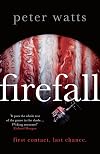
Each generation has to re-tackle the major themes of science fiction anew, because the human world that aliens contact is changing all the time. You have but to look at, say, David Brin's 'Forge of God' to see that it was a situation where aliens were contacting the Earth of the mid- to late 1980s. Even when the first contact is set in the future, our view of that future hinges on how we view that future based on the concerns and emergent technologies of our own day. Arthur C. Clarke's show more '2001' was set in a very 1960s vision of a Big Science power block future. And the same applies to the first part of this omnibus edition, the 2006 novel 'Blindsight'.
But there is so much more to 'Blindsight' than just first contact with aliens. The world Peter Watts has built (his afterword to the novel seems to hint that there are some connections with the world of an earlier trilogy of his, 'Rifters') is way in advance of ours in terms of genetic manipulation, personality restructuring, space colonisation and virtual worlds. Oh, and Watts has found a use for matter transmission that is restricted to sending single sub-atomic particles from a to b.
Having said that, Watts' Earth is only really sketched through the eyes of his characters; and we see comparatively little of it, mainly in passing. That's not really the point. And the aliens remain a puzzle, right up to the end where their belligerence is laid bare for all to see. And that is how it should be. Alien life is going to turn out to be more unknowable than we can imagine; Peter Watts gives us some pointers towards that.
But 'Blindsight' isn't even really a novel about aliens. Rather, he takes a group of characters from our world on a journey to find aliens who were responsible for manifesting an encounter with the unknown on Earth, the sudden appearance of 62,000 alien probes that burn up in Earth's atmosphere and in that short time very possibly found out much more about us than we did about them. The crew that is sent to try to find the beings responsible for that act is comprised of a number of individuals, all of whom are in some way or another damaged; the bulk of the novel is taken up with exploring those personalities and finding (for the most part) the humanity limping along inside them, even though many readers might reject those personalities as barely human. There are a couple of exceptions - the extinct evolutionary line of human vampires, which disappeared way back in our prehistory, have been genetically re-engineered back for their predator's skills in organisation and strategy. 'Human' hardly describes them (most of the time).
In the end, this is hardly a novel of first contact; rather, it's about us, about humanity at its weakest, when we are so damaged as to hardly seem human for one reason or another; and how, despite that, we are still human despite everything. Along the way, we have to get to grips with some serious science (as someone once said of another novel from another hand, "this isn't just Hard Science Fiction, it's bl**dy DIFFICULT science fiction!"). And then, just when you've resigned yourself to a long critique of the human condition, the action roars back with a vengeance - I had to read the last fifty pages or so in a couple of fairly breathless sittings because the story pulled me along. And all the science stuff fell into place, because it is important.
The sequel, 'Echopraxia', dates from 2014 and has some important differences from the first book. The action is not directly connected with the earlier novel, though obviously the setting and situation is the same. There is some crossover in characters, but no personal appearances. There is a greater emphasis on action here, and we see more of the future Earth society; however, don't be misled into thinking that the cerebration lets up for a minute. Again, we have a group of barely functional characters in a ship of exploration following the manifestation of alien intelligence over the Earth; but this time, instead of heading out towards the Oort Cloud where the action seems to be, they are heading inwards, towards the telematter station 'Icarus', suspended above the Sun and beaming energy back to Earth, as well as to the distant spaceship 'Theseus'. Some of the clues unearthed in the investigation of the alien event, the 'Firefall' of the title, pointed back to 'Icarus'. Our point of view character, Dan Brüks, is a biologist who appears to get caught up in serious interfactional fighting between orders of monks in a desert monastery. But things are not what they seem, and he finds himself on board the spaceship 'Crown of Thorns', heading for the sun. Dan is a "baseline" - an unaugmented human, something of a rarity in his world - and so represents us, the closest to Everyman you'll see in this novel.
I said that there was more action, and that's true; but just as with 'Blindsight', you need to keep your brain in gear. Ultimately, we find out much more about ourselves and our own future than we ever do about the aliens; and once again, science fiction shows us that the only truly alien planet is Earth.
Anyone who thinks science fiction is merely escapist adventure needs to read this book. show less
But there is so much more to 'Blindsight' than just first contact with aliens. The world Peter Watts has built (his afterword to the novel seems to hint that there are some connections with the world of an earlier trilogy of his, 'Rifters') is way in advance of ours in terms of genetic manipulation, personality restructuring, space colonisation and virtual worlds. Oh, and Watts has found a use for matter transmission that is restricted to sending single sub-atomic particles from a to b.
Having said that, Watts' Earth is only really sketched through the eyes of his characters; and we see comparatively little of it, mainly in passing. That's not really the point. And the aliens remain a puzzle, right up to the end where their belligerence is laid bare for all to see. And that is how it should be. Alien life is going to turn out to be more unknowable than we can imagine; Peter Watts gives us some pointers towards that.
But 'Blindsight' isn't even really a novel about aliens. Rather, he takes a group of characters from our world on a journey to find aliens who were responsible for manifesting an encounter with the unknown on Earth, the sudden appearance of 62,000 alien probes that burn up in Earth's atmosphere and in that short time very possibly found out much more about us than we did about them. The crew that is sent to try to find the beings responsible for that act is comprised of a number of individuals, all of whom are in some way or another damaged; the bulk of the novel is taken up with exploring those personalities and finding (for the most part) the humanity limping along inside them, even though many readers might reject those personalities as barely human. There are a couple of exceptions - the extinct evolutionary line of human vampires, which disappeared way back in our prehistory, have been genetically re-engineered back for their predator's skills in organisation and strategy. 'Human' hardly describes them (most of the time).
In the end, this is hardly a novel of first contact; rather, it's about us, about humanity at its weakest, when we are so damaged as to hardly seem human for one reason or another; and how, despite that, we are still human despite everything. Along the way, we have to get to grips with some serious science (as someone once said of another novel from another hand, "this isn't just Hard Science Fiction, it's bl**dy DIFFICULT science fiction!"). And then, just when you've resigned yourself to a long critique of the human condition, the action roars back with a vengeance - I had to read the last fifty pages or so in a couple of fairly breathless sittings because the story pulled me along. And all the science stuff fell into place, because it is important.
The sequel, 'Echopraxia', dates from 2014 and has some important differences from the first book. The action is not directly connected with the earlier novel, though obviously the setting and situation is the same. There is some crossover in characters, but no personal appearances. There is a greater emphasis on action here, and we see more of the future Earth society; however, don't be misled into thinking that the cerebration lets up for a minute. Again, we have a group of barely functional characters in a ship of exploration following the manifestation of alien intelligence over the Earth; but this time, instead of heading out towards the Oort Cloud where the action seems to be, they are heading inwards, towards the telematter station 'Icarus', suspended above the Sun and beaming energy back to Earth, as well as to the distant spaceship 'Theseus'. Some of the clues unearthed in the investigation of the alien event, the 'Firefall' of the title, pointed back to 'Icarus'. Our point of view character, Dan Brüks, is a biologist who appears to get caught up in serious interfactional fighting between orders of monks in a desert monastery. But things are not what they seem, and he finds himself on board the spaceship 'Crown of Thorns', heading for the sun. Dan is a "baseline" - an unaugmented human, something of a rarity in his world - and so represents us, the closest to Everyman you'll see in this novel.
I said that there was more action, and that's true; but just as with 'Blindsight', you need to keep your brain in gear. Ultimately, we find out much more about ourselves and our own future than we ever do about the aliens; and once again, science fiction shows us that the only truly alien planet is Earth.
Anyone who thinks science fiction is merely escapist adventure needs to read this book. show less

I picked Blindsight up thinking I'd be reading an immersive sci-fi story. At least I got the immersive part right. I guess it is, technically, also a sci-fi story in so much that the plot takes place in space, but labelling this book as sci-fi would be doing it a disservice.
This really is a heavy book, and keeping up with it is tough. Normally I put this down to lazy/pretentious writing and/or bad storytelling, but in this case it turns out to be more of a mutual agreement between the book show more and the reader. Yes, you have to struggle to get your head around it, but once your head is around it you realise that the struggle really was the only way to get where the book needed you to be. There is no black or white in this book, no simple characters, no easy answers. The characters are a collection of beings who are all very different, not only from each other, but also from what they once were, and what others may think they should be. The reader only ever sees these characters through the eyes of the narrator, Siri, who should in theory be the most reliable storyteller available. But is he?
So many things are explored in this book, and there are trains of thought that are ethically, emotionally and (for me at least) intellectually challenging. Several times I had to re-read segments, not because I had missed something, but because I just hadn't understood the point or the impact of what I just read. And when I did finally understand, that didn't always make me less confused or unsure of what was going on. This is a book that will keep you guessing and keep you thinking, not only about what is happening in the book, but also about things that go beyond the book itself.
In the end I have no idea whether I'd call Blindsight an inaccessible sci-fi story, or a somewhat accessible work of philosophy. I'm also not sure whether I liked it, or whether I loved it. The sci-fi in this book is solid, but is overshadowed by the great number of thought-inspiring avenues this book ventures into. I can't help but think I might have liked to go a bit further down some of these avenues, not to see them be resolved, but just to explore them a bit more. On the other hand, it's possible that the book very consciously stopped just short of where I would have liked it to go, and instead of "simply" being able to think about things, I also have to continue guessing as to what exactly the author wanted to make me think about.
It feels wrong to say that I enjoyed this book, but I'm very happy to have read it. The feeling Blindsight gave me is comparable to that of working on a very complex problem: solving it can be frustrating, but once it's solved I feel great. Having finished this book I feel like I've almost worked through most of the problem, but without the satisfaction of having resolved it.
Which, considering the book itself, seems about right. show less
This really is a heavy book, and keeping up with it is tough. Normally I put this down to lazy/pretentious writing and/or bad storytelling, but in this case it turns out to be more of a mutual agreement between the book show more and the reader. Yes, you have to struggle to get your head around it, but once your head is around it you realise that the struggle really was the only way to get where the book needed you to be. There is no black or white in this book, no simple characters, no easy answers. The characters are a collection of beings who are all very different, not only from each other, but also from what they once were, and what others may think they should be. The reader only ever sees these characters through the eyes of the narrator, Siri, who should in theory be the most reliable storyteller available. But is he?
So many things are explored in this book, and there are trains of thought that are ethically, emotionally and (for me at least) intellectually challenging. Several times I had to re-read segments, not because I had missed something, but because I just hadn't understood the point or the impact of what I just read. And when I did finally understand, that didn't always make me less confused or unsure of what was going on. This is a book that will keep you guessing and keep you thinking, not only about what is happening in the book, but also about things that go beyond the book itself.
In the end I have no idea whether I'd call Blindsight an inaccessible sci-fi story, or a somewhat accessible work of philosophy. I'm also not sure whether I liked it, or whether I loved it. The sci-fi in this book is solid, but is overshadowed by the great number of thought-inspiring avenues this book ventures into. I can't help but think I might have liked to go a bit further down some of these avenues, not to see them be resolved, but just to explore them a bit more. On the other hand, it's possible that the book very consciously stopped just short of where I would have liked it to go, and instead of "simply" being able to think about things, I also have to continue guessing as to what exactly the author wanted to make me think about.
It feels wrong to say that I enjoyed this book, but I'm very happy to have read it. The feeling Blindsight gave me is comparable to that of working on a very complex problem: solving it can be frustrating, but once it's solved I feel great. Having finished this book I feel like I've almost worked through most of the problem, but without the satisfaction of having resolved it.
Which, considering the book itself, seems about right. show less
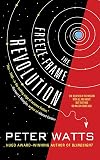
This is some classy hard-hard SF. :) Black hole/worm hole drive using new and real theories? Hell yeah.
But beyond that, I love the whole idea of short periods of wakefulness during a single trip that takes 65 million years.
Add a rebellion against IBM... I mean HAL... I mean CHIMP, without expecting anything to go quite the way that 2001 went, or even remotely like it, and we've got a really fascinating story.
Watts knows how to build really fascinating locations and situations... maybe show more better than almost any other writer. He never rests on a single awesome idea but adds to it and introduces even more interesting wrinkles such as watching an AI dance, or truly alien intelligences, or maybe just freaking out because the rest of humanity must necessarily be dead during the scope of your mission.
But add a complicated revolution among sleepers using old D&D manuals? Adding jarring notes during a musical composition?
Oh yeah, the devil is in the details. :)
I'm enjoying this novel(la according to the author) through Netgalley as an ARC, but this wonderful reviewer here: Claudia's Review has pointed out that this is not a standalone story. She's even provided a link to the author's website for the other stories (free to download) as well as the suggested reading order. Thank you!
I might be reading out of order, but I don't mind it all that much. Watts is a thinking man's hard-SF writer. I expect to be at least a little challenged and delighted. As anyone who has read Blindsight knows. :) show less
But beyond that, I love the whole idea of short periods of wakefulness during a single trip that takes 65 million years.
Add a rebellion against IBM... I mean HAL... I mean CHIMP, without expecting anything to go quite the way that 2001 went, or even remotely like it, and we've got a really fascinating story.
Watts knows how to build really fascinating locations and situations... maybe show more better than almost any other writer. He never rests on a single awesome idea but adds to it and introduces even more interesting wrinkles such as watching an AI dance, or truly alien intelligences, or maybe just freaking out because the rest of humanity must necessarily be dead during the scope of your mission.
But add a complicated revolution among sleepers using old D&D manuals? Adding jarring notes during a musical composition?
Oh yeah, the devil is in the details. :)
I'm enjoying this novel(la according to the author) through Netgalley as an ARC, but this wonderful reviewer here: Claudia's Review has pointed out that this is not a standalone story. She's even provided a link to the author's website for the other stories (free to download) as well as the suggested reading order. Thank you!
I might be reading out of order, but I don't mind it all that much. Watts is a thinking man's hard-SF writer. I expect to be at least a little challenged and delighted. As anyone who has read Blindsight knows. :) show less
Lists
Awards


You May Also Like


Associated Authors
Statistics
- Works
- 50
- Also by
- 67
- Members
- 8,816
- Popularity
- #2,715
- Rating
- 3.8
- Reviews
- 401
- ISBNs
- 168
- Languages
- 11
- Favorited
- 28