

Ted Mooney (1) (1951–2022)
Author of Easy Travel to Other Planets
For other authors named Ted Mooney, see the disambiguation page.
About the Author
Image credit: Nicholas Latimer
Works by Ted Mooney
Associated Works
Storming the Reality Studio: A Casebook of Cyberpunk and Postmodern Science Fiction (1991) — Contributor — 263 copies
Tagged
Common Knowledge
- Legal name
- Mooney, Edward Comstock
- Birthdate
- 1951-10-19
- Date of death
- 2022-03-22
- Education
- Phillips Exeter Academy
Columbia University
Bennington College (Bx) - Occupations
- editor
professor
art advisor
fiction writer - Nationality
- USA
- Birthplace
- Dallas, Texas, USA
- Associated Place (for map)
- Texas, USA
Members
Reviews

I forget how I heard about this book, but it was described to me as a Sci-Fi novel in which a marine researcher has sex with a dolphin. I gleefully checked this out from the library, anticipating a bizarre, campy, and generally terrible novel. I was surprised by how quickly the author's voice won me over. This is a complex and surreal novel about intimacy, communication, mortality, and the end of the world. The characters are fascinating and the backdrop of war and disease adds a delicious show more element of chaos.
The central character, Melissa, is trying to teach a dolphin to talk. She's having some success, more than she knows, as the dolphin calmly seduces her on the eve of her project's end. Back in New York, Melissa's mother is dying of lung cancer and her boyfriend is cheating on her. She knows these things, but she refused to face them or talk about them to those who matter most to her. Meanwhile, her best friend Nicole is pregnant and planning to get an abortion. At the last minute, Nicole reconsiders even though she believes it will put her life in danger if her boyfriend finds out.
Throughout the action of the plot, a threat of war looms as various countries try to control Antarctica. Increasing incidents of "Information Sickness" has everyone on edge and there are rumors of a new emotion that some people are experiencing for the first time.
This is a very unique book, unlike any I've read before. It's haunting, beautiful, and creepy - like a dream. show less
The central character, Melissa, is trying to teach a dolphin to talk. She's having some success, more than she knows, as the dolphin calmly seduces her on the eve of her project's end. Back in New York, Melissa's mother is dying of lung cancer and her boyfriend is cheating on her. She knows these things, but she refused to face them or talk about them to those who matter most to her. Meanwhile, her best friend Nicole is pregnant and planning to get an abortion. At the last minute, Nicole reconsiders even though she believes it will put her life in danger if her boyfriend finds out.
Throughout the action of the plot, a threat of war looms as various countries try to control Antarctica. Increasing incidents of "Information Sickness" has everyone on edge and there are rumors of a new emotion that some people are experiencing for the first time.
This is a very unique book, unlike any I've read before. It's haunting, beautiful, and creepy - like a dream. show less

Ted Mooney has crafted an intricate narrative labyrinth of intersecting realities, visible, but more often invisible, in The Same River Twice. His character's perceptions of high-stress events unraveling within and around them in Paris and, particularly, along La Seine, on a boat named Nachtvlinder, become so blurred at times, so ambiguous, that surreality is perception (and vice versa) in Mooney's character's collective eyes.
The novel, on its surface, focuses on art smuggling, and the show more violent, reverberating consequences spreading out from the original high crime in waves of interpersonal disconnectedness and conflict and, ultimately, brutal betrayals, when one of the original smugglers mysteriously disappears. The smuggler's disappearance, however, involves a powerful secret that could literally change the world, and everyone from respected art dealers to the Russian Mafia to the Paris police in riot gear, are hot on his dubious trail.
The plot's as complexly convoluted as the catacombs of Paris, which play a vital role in the novel, the catacombs - be it underground rave sponsored by French government rebels from the local Arrondissement, or Mooney's subtle commentary on the underground-ecstasy-enthusiasts-as-metaphor for what's happening up above, in a different Paris darkness of perceptions true and/or false, when the lights of the Eifell Tower are turned off - and once your eyes adjust to the multi-hued darkness' of Mooney's impressive, Parisian underworlds and shadowy above-ground worlds (who exactly are the good guys and the bad guys, if any?, or are they all both good and bad?), filled with gorgeous prose and allusions adding nuanced layers of subtext, the careful reader will be glued to the book, searching for the hidden clues and secrets, which when they appear, seem so obvious that alighting upon the answers breeds a certain familiarity (I'm not joking) inducing déjà vu.
The characters? Max, the auteur, who, like a second narrator of sorts, stands outside the novel, filming the events of The Same River Twice as they occur, without a script; Odile, Max's wife, art smuggler on- the-side, the smuggler who doesn't disappear (or does she?); Turner, art dealer extraordinaire, in bed both literally and figuratively with simply too many of the wrong people; KuKushkin, full of vodka-fueled anecdotes whose sobering prescience makes him almost a fortune teller; are a complicated and crafty lot, all of them, and more too many to mention by name. How Mooney fit them all together so seamlessly and so distinctively into his fast-paced, riveting, plot-pops-off-the-page like the artsy book cover, novel, I don't dare try and explicate. show less
The novel, on its surface, focuses on art smuggling, and the show more violent, reverberating consequences spreading out from the original high crime in waves of interpersonal disconnectedness and conflict and, ultimately, brutal betrayals, when one of the original smugglers mysteriously disappears. The smuggler's disappearance, however, involves a powerful secret that could literally change the world, and everyone from respected art dealers to the Russian Mafia to the Paris police in riot gear, are hot on his dubious trail.
The plot's as complexly convoluted as the catacombs of Paris, which play a vital role in the novel, the catacombs - be it underground rave sponsored by French government rebels from the local Arrondissement, or Mooney's subtle commentary on the underground-ecstasy-enthusiasts-as-metaphor for what's happening up above, in a different Paris darkness of perceptions true and/or false, when the lights of the Eifell Tower are turned off - and once your eyes adjust to the multi-hued darkness' of Mooney's impressive, Parisian underworlds and shadowy above-ground worlds (who exactly are the good guys and the bad guys, if any?, or are they all both good and bad?), filled with gorgeous prose and allusions adding nuanced layers of subtext, the careful reader will be glued to the book, searching for the hidden clues and secrets, which when they appear, seem so obvious that alighting upon the answers breeds a certain familiarity (I'm not joking) inducing déjà vu.
The characters? Max, the auteur, who, like a second narrator of sorts, stands outside the novel, filming the events of The Same River Twice as they occur, without a script; Odile, Max's wife, art smuggler on- the-side, the smuggler who doesn't disappear (or does she?); Turner, art dealer extraordinaire, in bed both literally and figuratively with simply too many of the wrong people; KuKushkin, full of vodka-fueled anecdotes whose sobering prescience makes him almost a fortune teller; are a complicated and crafty lot, all of them, and more too many to mention by name. How Mooney fit them all together so seamlessly and so distinctively into his fast-paced, riveting, plot-pops-off-the-page like the artsy book cover, novel, I don't dare try and explicate. show less
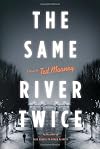
I so fully expected to love The Same River Twice, that it took about half the book before I realised that actually, I don't.
That's not to say I didn't enjoy it. I did, but only mildly. I particularly appreciated the art theme throughout the book, and the way it was woven into the narrative. When we are in the presence of a painter, the action slows right down - stops even, and we become conscious of the colour and light in the scene before us. When we follow Max, the film maker, the action show more is tight and visual. We are made to look at the action as if it's in a frame. We read it like a film. The feeling and dynamic of the narrative changes to reflect the different art forms its characters create.
An LT reviewer I respect highly has said that the symbolism in this novel is of great depth, pointing to the idea of red herrings and to alternate endings. I guess this is what Ted Mooney meant to do, and evidently, to the truly erudite, he succeeded. To me, however, the symbolisim just seemed clunky. A male key character enters the house of the key female character. The narrative pauses to point out a dressmaker's dummy behind her, swathed in cloth. Immediately, the reader knows the two characters will either have sex, or else start thinking about it. Or, Max has been tracking down the people who have made alternate endings to his DVDs, and having found what is perhaps a clue, the narrative again pauses to show us a mother catch a balloon which has escaped from her son's fingers. I don't know. Perhaps it's clever. But it seemed rather forced to me.
Recently in LT, I loftily made a statement to the effect that an author's gender makes no difference to any reader's enjoyment of their work. I would like to publicly announce that my statement was utter rubbish. I take it back entirely. This is without doubt a 'blokey' book. The female characters are all externally attractive and otherwise enigmatic. The male characters are quick-thinking, quick-acting, and at the same time, everlastingly confused. There is an appeal to testosterone throughout the book which I found increasingly difficult to ignore.
I also found it slightly worrying that the main message of the book seemed to be to never examine the past, never ask questions of oneself or of others; to disclaim all responsibility for one's actions and simply act in the present. I waited for this to resolve - for Max and Odile to examine their relationship and question this philosophy, and for Max himself to reflect on his most questionable actions. But they never do. The final sentence of the book only reinforces that a lack of reflection and responsibility is an excellent thing. This is of course central to the novel, echoed in its title and the suggestion that if we try to go back and re-do a thing, we'll only find it's impossible. That we can't step into the same river twice - the water will always be different from what it was before.
An actual river is the central force of the story - we keep returning to it again and again. It's a place of inspiration, beauty, art - also a place of danger and violence, and a place to hide crime. Mooney is strong on motifs, but I found their effectiveness patchy; however I thought the river was a strong point of the novel.
As a genre novel, a thriller, my one complaint is that the stakes weren't raised high enough. Why was there so much emphasis on Max's much-loved daughter, if she is never put in danger? I kept waiting for a terrible moment when she would be under some kind of threat, where Max would have to make some kind of terrible choice... and it never came. The only time it comes close falls flat, leading to a pseudo-bonding moment between stepmother and stepdaughter, plus a few random friends.
This book is definitely not all bad. I'm focusing on the negatives because they took me so much by surprise - as I said, I expected to love this book. I'm worried about saying such bad things about it, since people whose opinions I think highly of seem to think this is a wonderful novel, of a depth and intelligence which completely escaped me. The fault is probably mine.
I'd like to add that the 13 year old daughter's voice is wonderfully authentic, and her young vulnerability and toughness combined are beautifully portrayed. Her presence brightened the book for me.
The language in general is excellent. The dialogue is tight, the narrative smooth. As genre fiction, this is extremely readable. Certainly, Ted Mooney is not Matthew Reilley - he is much more intelligent. But The Same River Twice did not feel like 'literature' to me. show less
That's not to say I didn't enjoy it. I did, but only mildly. I particularly appreciated the art theme throughout the book, and the way it was woven into the narrative. When we are in the presence of a painter, the action slows right down - stops even, and we become conscious of the colour and light in the scene before us. When we follow Max, the film maker, the action show more is tight and visual. We are made to look at the action as if it's in a frame. We read it like a film. The feeling and dynamic of the narrative changes to reflect the different art forms its characters create.
An LT reviewer I respect highly has said that the symbolism in this novel is of great depth, pointing to the idea of red herrings and to alternate endings. I guess this is what Ted Mooney meant to do, and evidently, to the truly erudite, he succeeded. To me, however, the symbolisim just seemed clunky. A male key character enters the house of the key female character. The narrative pauses to point out a dressmaker's dummy behind her, swathed in cloth. Immediately, the reader knows the two characters will either have sex, or else start thinking about it. Or, Max has been tracking down the people who have made alternate endings to his DVDs, and having found what is perhaps a clue, the narrative again pauses to show us a mother catch a balloon which has escaped from her son's fingers. I don't know. Perhaps it's clever. But it seemed rather forced to me.
Recently in LT, I loftily made a statement to the effect that an author's gender makes no difference to any reader's enjoyment of their work. I would like to publicly announce that my statement was utter rubbish. I take it back entirely. This is without doubt a 'blokey' book. The female characters are all externally attractive and otherwise enigmatic. The male characters are quick-thinking, quick-acting, and at the same time, everlastingly confused. There is an appeal to testosterone throughout the book which I found increasingly difficult to ignore.
I also found it slightly worrying that the main message of the book seemed to be to never examine the past, never ask questions of oneself or of others; to disclaim all responsibility for one's actions and simply act in the present. I waited for this to resolve - for Max and Odile to examine their relationship and question this philosophy, and for Max himself to reflect on his most questionable actions. But they never do. The final sentence of the book only reinforces that a lack of reflection and responsibility is an excellent thing. This is of course central to the novel, echoed in its title and the suggestion that if we try to go back and re-do a thing, we'll only find it's impossible. That we can't step into the same river twice - the water will always be different from what it was before.
An actual river is the central force of the story - we keep returning to it again and again. It's a place of inspiration, beauty, art - also a place of danger and violence, and a place to hide crime. Mooney is strong on motifs, but I found their effectiveness patchy; however I thought the river was a strong point of the novel.
As a genre novel, a thriller, my one complaint is that the stakes weren't raised high enough. Why was there so much emphasis on Max's much-loved daughter, if she is never put in danger? I kept waiting for a terrible moment when she would be under some kind of threat, where Max would have to make some kind of terrible choice... and it never came. The only time it comes close falls flat, leading to a pseudo-bonding moment between stepmother and stepdaughter, plus a few random friends.
This book is definitely not all bad. I'm focusing on the negatives because they took me so much by surprise - as I said, I expected to love this book. I'm worried about saying such bad things about it, since people whose opinions I think highly of seem to think this is a wonderful novel, of a depth and intelligence which completely escaped me. The fault is probably mine.
I'd like to add that the 13 year old daughter's voice is wonderfully authentic, and her young vulnerability and toughness combined are beautifully portrayed. Her presence brightened the book for me.
The language in general is excellent. The dialogue is tight, the narrative smooth. As genre fiction, this is extremely readable. Certainly, Ted Mooney is not Matthew Reilley - he is much more intelligent. But The Same River Twice did not feel like 'literature' to me. show less
A stylish & atmospheric thriller with all the requisite elements for escapist winter reading: a glamorous setting in Paris, smart & idiosyncratic characters with cool jobs (filmmaking, fashion design), a plot involving the smuggling of art objects, the Russian mafia & mysterious women with tattoos ... even a bit of metaphysical speculation (Can one truly start over in life?) thrown in for good measure. In my opinion the ending fails to deliver on the promise of a surprising climactic scene, show more but overall I found this to be an enjoyable read, similar in some ways to William Gibson's Pattern Recognition/Spook Country/Zero History novels, but less oblique & challenging.
"You could not step twice into the same river; for other waters are ever flowing on to you."
--Heraclitus show less
"You could not step twice into the same river; for other waters are ever flowing on to you."
--Heraclitus show less
Lists
Awards


You May Also Like


Associated Authors
Statistics
- Works
- 4
- Also by
- 2
- Members
- 403
- Popularity
- #60,269
- Rating
- 3.7
- Reviews
- 15
- ISBNs
- 17
- Languages
- 3
- Favorited
- 1

