
Ulrich Plenzdorf (1934–2007)
Author of The New Sorrows of Young W
About the Author
Works by Ulrich Plenzdorf
Suhrkamp BasisBibliothek : Plenzdorf : Die neuen Leiden des jungen W. (2004) — Text — 129 copies, 2 reviews
Die Legende von Paul & Paula | Die neuen Leiden des jungen W. : Ein Kino- und ein Bühnenstück (1977) — Author — 5 copies
1974 1 copy
Legende vom Glueck ohne Ende 1 copy
Legenda o šťastí 1 copy
Nove patnje mladog Wertera 1 copy
Associated Works
The New Sufferings of Young W. and Other Stories from the German Democratic Republic (1997) — Contributor — 12 copies
Tagged
Common Knowledge
- Legal name
- Plenzdorf, Ulrich
- Birthdate
- 1934-10-26
- Date of death
- 2007-08-09
- Gender
- male
- Occupations
- playwright
screenwriter - Organizations
- Akademie der Künste Berlin (seit 1992)
Literaturinstitut Leipzig (2004) - Awards and honors
- Adolf-Grimme-Preis (1995)
Ingeborg-Bachmann-Preis (1978)
Heinrich-Mann-Preis DDR (1973) - Nationality
- Germany
- Birthplace
- Berlin, Germany
- Places of residence
- Berlin, Germany
- Place of death
- Berlin, Germany
- Burial location
- Berlin, Germany
- Associated Place (for map)
- Berlin, Germany
Members
Reviews

In the 70s cult hit Die neuen Leiden des jungen W., the East German author Ulrich Plenzdorf cleverly wove together elements of the plots of Werther and Robinson Crusoe to create East Berlin's comic answer to The catcher in the rye. The 17-year-old engineering apprentice Edgar Wibeau drops out of his training in a boring provincial small town and runs away to Berlin where he hopes to become an undiscovered genius. Unfortunately, he has no talent for painting, and what's more, he finds that he show more has forgotten to bring any books. After a long search, all he can find are the remains of a Reclam paperback hanging on a nail in the privy. The title page has already been used, but the book turns out to be an epistolary novel about some guy called Werther. Not a patch on his old friend J.D. Salinger, but it will have to do, and after a while, despite coming to the conclusion that Werther is a blithering idiot, Edgar finds himself captivated by the story. And then the plot of Werther starts inveigling its way into his own life, but not quite in the way we are expecting it to.
Again, this is probably a book you would enjoy most if you read it when you're young, but it's still a lot of fun even later in life (part of the joke is that Edgar takes it for granted that Salinger is a teenager like himself , but we know that both Salinger and Plenzdorf are writing as grown-ups...). Reading both books back to back, I particularly enjoyed the way Edgar makes liberal (mis-)use of quotations from Goethe throughout the book, but no-one ever recognises them. show less
Again, this is probably a book you would enjoy most if you read it when you're young, but it's still a lot of fun even later in life (part of the joke is that Edgar takes it for granted that Salinger is a teenager like himself , but we know that both Salinger and Plenzdorf are writing as grown-ups...). Reading both books back to back, I particularly enjoyed the way Edgar makes liberal (mis-)use of quotations from Goethe throughout the book, but no-one ever recognises them. show less
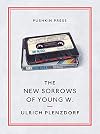
The New Sorrows of Young W. by Ulrich Plenzdorf is a recommended satirical novel that was originally published in 1972 in Germany. This re-released edition is translated from the German by Romy Fursland.
Edgar Wibeau, a 17 year old drop out, is found dead, electrocuted, inside a condemned building in Berlin with just a tape recorder and a battered copy of Goethe's The Sorrows of Young Werther. Edgar had previously sent tapes discussing his life to his friend Willi Linder. His father, hoping show more to find an explanation for his son's death, now listens to the tapes and retraces Edgar's travels, from Mittenberg to Berlin, since he left home. The voice of Edgar's spirit interjects comments and explanations along the way as his father visits Charlie, the kindergarten teacher Edgar loved, and Addi, Edgar's last employer.
The New Sorrows of Young W. is a parody of and follows The Sufferings of Young Werther. Goethe's work is often quoted along the way, creating a work of intertextuality between the two. Along with Young Wether, Plenzdorf also includes tie-ins to Salinger's Holden Caulfield, the standard for teen arrogance and angst. The result is a funny, absurd, and tragic coming of age story set in East Germany.
Having never read Goethe's original but well acquainted with Salinger, I found this novel amusing and entertaining. The whole part on blue jeans, how they should be worn and who can wear them was pretty funny, even as it served as a symbolic representation of communism in East Germany. While the novel is dated, it was interesting and insightful. It might be more entertaining if I had been a teenage boy.
Disclosure: My Kindle edition was courtesy of Pushkin Press for review purposes. show less
Edgar Wibeau, a 17 year old drop out, is found dead, electrocuted, inside a condemned building in Berlin with just a tape recorder and a battered copy of Goethe's The Sorrows of Young Werther. Edgar had previously sent tapes discussing his life to his friend Willi Linder. His father, hoping show more to find an explanation for his son's death, now listens to the tapes and retraces Edgar's travels, from Mittenberg to Berlin, since he left home. The voice of Edgar's spirit interjects comments and explanations along the way as his father visits Charlie, the kindergarten teacher Edgar loved, and Addi, Edgar's last employer.
The New Sorrows of Young W. is a parody of and follows The Sufferings of Young Werther. Goethe's work is often quoted along the way, creating a work of intertextuality between the two. Along with Young Wether, Plenzdorf also includes tie-ins to Salinger's Holden Caulfield, the standard for teen arrogance and angst. The result is a funny, absurd, and tragic coming of age story set in East Germany.
Having never read Goethe's original but well acquainted with Salinger, I found this novel amusing and entertaining. The whole part on blue jeans, how they should be worn and who can wear them was pretty funny, even as it served as a symbolic representation of communism in East Germany. While the novel is dated, it was interesting and insightful. It might be more entertaining if I had been a teenage boy.
Disclosure: My Kindle edition was courtesy of Pushkin Press for review purposes. show less
3.5*
Seventeen-year old Edgar Wibeau is a “straight A” student and an upcoming model citizen of the GDR. Until one day he does the unthinkable – he drops out of his apprenticeship, escapes from his sleepy home town, and settles down at his friend Willi’s abandoned summer house in East Berlin. Over the next few months he finds a handyman job, falls in love with a happily-engaged kindergarten teacher named Charlie and develops an unlikely fixation with Goethe’s Sorrows of Young show more Werther. After Edgar dies in a cartoonish accident, his estranged father tries to piece together the final chapter of his son’s story by interviewing his friends and acquaintances. Transcripts of the interviews are found throughout the book (possibly an indication of the novel’s early life as a screenplay). They alternate with tragicomic “American Beauty” style monologues delivered by the dead Edgar himself.
The novel’s literary forebears are Salinger’s [b:The Catcher in the Rye|5107|The Catcher in the Rye|J.D. Salinger|https://images.gr-assets.com/books/1398034300s/5107.jpg|3036731] and Goethe’s [b:The Sorrows of Young Werther|16640|The Sorrows of Young Werther|Johann Wolfgang von Goethe|https://images.gr-assets.com/books/1386920896s/16640.jpg|746264]. Both are referenced in the book, with Goethe’s novel inspiring the title and playing a part in the plot. Indeed, The New Sorrows works best as a parody of Goethe, spiced with an element of political satire. The bucolic backdrop of the original Sorrows is replaced by a grey East Berlin, the OTT Romantic language substituted by Edgar’s “trendy” colloquialisms. It must have been particularly difficult to evoke the now dated 1970s German slang. In her 2015 translation for Pushkin Press, Romy Fursland opts for an argot which veers between the quaint and the cringe-inducing, but which is surprisingly effective.
This feels like a novel of its time – but nonetheless remains an enjoyable and often funny read. show less
Seventeen-year old Edgar Wibeau is a “straight A” student and an upcoming model citizen of the GDR. Until one day he does the unthinkable – he drops out of his apprenticeship, escapes from his sleepy home town, and settles down at his friend Willi’s abandoned summer house in East Berlin. Over the next few months he finds a handyman job, falls in love with a happily-engaged kindergarten teacher named Charlie and develops an unlikely fixation with Goethe’s Sorrows of Young show more Werther. After Edgar dies in a cartoonish accident, his estranged father tries to piece together the final chapter of his son’s story by interviewing his friends and acquaintances. Transcripts of the interviews are found throughout the book (possibly an indication of the novel’s early life as a screenplay). They alternate with tragicomic “American Beauty” style monologues delivered by the dead Edgar himself.
The novel’s literary forebears are Salinger’s [b:The Catcher in the Rye|5107|The Catcher in the Rye|J.D. Salinger|https://images.gr-assets.com/books/1398034300s/5107.jpg|3036731] and Goethe’s [b:The Sorrows of Young Werther|16640|The Sorrows of Young Werther|Johann Wolfgang von Goethe|https://images.gr-assets.com/books/1386920896s/16640.jpg|746264]. Both are referenced in the book, with Goethe’s novel inspiring the title and playing a part in the plot. Indeed, The New Sorrows works best as a parody of Goethe, spiced with an element of political satire. The bucolic backdrop of the original Sorrows is replaced by a grey East Berlin, the OTT Romantic language substituted by Edgar’s “trendy” colloquialisms. It must have been particularly difficult to evoke the now dated 1970s German slang. In her 2015 translation for Pushkin Press, Romy Fursland opts for an argot which veers between the quaint and the cringe-inducing, but which is surprisingly effective.
This feels like a novel of its time – but nonetheless remains an enjoyable and often funny read. show less
3.5*
Seventeen-year old Edgar Wibeau is a “straight A” student and an upcoming model citizen of the GDR. Until one day he does the unthinkable – he drops out of his apprenticeship, escapes from his sleepy home town, and settles down at his friend Willi’s abandoned summer house in East Berlin. Over the next few months he finds a handyman job, falls in love with a happily-engaged kindergarten teacher named Charlie and develops an unlikely fixation with Goethe’s Sorrows of Young show more Werther. After Edgar dies in a cartoonish accident, his estranged father tries to piece together the final chapter of his son’s story by interviewing his friends and acquaintances. Transcripts of the interviews are found throughout the book (possibly an indication of the novel’s early life as a screenplay). They alternate with tragicomic “American Beauty” style monologues delivered by the dead Edgar himself.
The novel’s literary forebears are Salinger’s [b:The Catcher in the Rye|5107|The Catcher in the Rye|J.D. Salinger|https://images.gr-assets.com/books/1398034300s/5107.jpg|3036731] and Goethe’s [b:The Sorrows of Young Werther|16640|The Sorrows of Young Werther|Johann Wolfgang von Goethe|https://images.gr-assets.com/books/1386920896s/16640.jpg|746264]. Both are referenced in the book, with Goethe’s novel inspiring the title and playing a part in the plot. Indeed, The New Sorrows works best as a parody of Goethe, spiced with an element of political satire. The bucolic backdrop of the original Sorrows is replaced by a grey East Berlin, the OTT Romantic language substituted by Edgar’s “trendy” colloquialisms. It must have been particularly difficult to evoke the now dated 1970s German slang. In her 2015 translation for Pushkin Press, Romy Fursland opts for an argot which veers between the quaint and the cringe-inducing, but which is surprisingly effective.
This feels like a novel of its time – but nonetheless remains an enjoyable and often funny read. show less
Seventeen-year old Edgar Wibeau is a “straight A” student and an upcoming model citizen of the GDR. Until one day he does the unthinkable – he drops out of his apprenticeship, escapes from his sleepy home town, and settles down at his friend Willi’s abandoned summer house in East Berlin. Over the next few months he finds a handyman job, falls in love with a happily-engaged kindergarten teacher named Charlie and develops an unlikely fixation with Goethe’s Sorrows of Young show more Werther. After Edgar dies in a cartoonish accident, his estranged father tries to piece together the final chapter of his son’s story by interviewing his friends and acquaintances. Transcripts of the interviews are found throughout the book (possibly an indication of the novel’s early life as a screenplay). They alternate with tragicomic “American Beauty” style monologues delivered by the dead Edgar himself.
The novel’s literary forebears are Salinger’s [b:The Catcher in the Rye|5107|The Catcher in the Rye|J.D. Salinger|https://images.gr-assets.com/books/1398034300s/5107.jpg|3036731] and Goethe’s [b:The Sorrows of Young Werther|16640|The Sorrows of Young Werther|Johann Wolfgang von Goethe|https://images.gr-assets.com/books/1386920896s/16640.jpg|746264]. Both are referenced in the book, with Goethe’s novel inspiring the title and playing a part in the plot. Indeed, The New Sorrows works best as a parody of Goethe, spiced with an element of political satire. The bucolic backdrop of the original Sorrows is replaced by a grey East Berlin, the OTT Romantic language substituted by Edgar’s “trendy” colloquialisms. It must have been particularly difficult to evoke the now dated 1970s German slang. In her 2015 translation for Pushkin Press, Romy Fursland opts for an argot which veers between the quaint and the cringe-inducing, but which is surprisingly effective.
This feels like a novel of its time – but nonetheless remains an enjoyable and often funny read. show less
Lists
Awards


You May Also Like


Associated Authors
Statistics
- Works
- 33
- Also by
- 2
- Members
- 860
- Popularity
- #29,750
- Rating
- 3.4
- Reviews
- 10
- ISBNs
- 68
- Languages
- 7
