

Lorraine Daston
Author of Objectivity
About the Author
Lorraine Daston is director of the Max Planck Institute for the History of Science in Berlin and is visiting professor in the Committee on Social Thought at the University of Chicago.
Works by Lorraine Daston
The Cambridge History of Science, Volume 3: Early Modern Science (2006) — Editor; Editor — 69 copies
How Reason Almost Lost Its Mind: The Strange Career of Cold War Rationality (2013) — Author — 33 copies
Natural Law and Laws of Nature in Early Modern Europe: Jurisprudence, Theology, Moral and Natural Philosophy (2017) — Editor — 15 copies
"The Image of Objectivity" 1 copy
Associated Works
Tagged
Common Knowledge
- Canonical name
- Daston, Lorraine
- Birthdate
- 1951-06-09
- Gender
- female
- Education
- Harvard University (BA|1973|Ph.D|1979)
University of Cambridge (Dipl.|1974) - Occupations
- historian of science
- Organizations
- Max Planck Institute for the History of Science, Berlin (Executive Director)
University of Chicago - Awards and honors
- American Academy of Arts and Sciences (1993)
Order of Merit of the Federal Republic of Germany (2010)
George Sarton Medal (2012)
American Philosophical Society (2017)
Dan David Prize (2018) - Relationships
- Gigerenzer, Gerd (husband)
- Nationality
- USA
- Birthplace
- East Lansing, Michigan, USA
- Places of residence
- Chicago, Illinois, USA
Berlin, Germany - Associated Place (for map)
- USA
Members
Reviews

In their landmark monograph, Daston and Galison examine the visual practices of scientific epistemology in the nineteenth, twentieth, and twenty-first centuries, arguing that the development of these practices goes hand-in-hand with the development of the scientific self; these practices are needed because the scientific self is being conceptualized in certain ways (5-7), because “it is fear that drives epistemology” (49). If the scientist is afraid of being self-interested, then show more scientific sight must become disinterested. Daston and Galison are quick to articulate that their project is a disinterested enterprise itself, concerned with “what objectivity is – how it functions in the practices of science,” not objectivity as a praise- or blameworthy concept (51). It's an exhaustively thorough undertaking, and their concepts almost immediately illuminated for me some of the differences in the way that scientists are portrayed in the nineteenth century, with their distinctions between truth-to-nature and mechanical objectivity. Daston and Galison say that they imagined their “study as a beginning rather than an end” and hope it will lead to other histories being written (6)... one of those histories might be mine, someday! show less
I picked up this book because I’ve always liked Galison’s work on the history of science - first reading Einstein’s Clocks, Poincaré’s Maps: Empires of Time - and because of what felt like the provocative challenge of the single-word title. What is objectivity in science? Can we study the universe without the human being as interpreter between nature and reality? Is there a truth outside of human model-making?
Objectivity is a thoughtful and persuasive work of scholarship in the show more history and philosophy of science. The authors possess a masterful grasp on a huge body of scientific history. The elegance of the prose resists anything but direct quotation, and the text is illuminated with sumptuous and abundant illustrations, many in color. It’s an intellectual feast that comes laden with surprise and sufficiency. Surely scientists of different eras have attempted to represent nature in their work with accuracy. Less obvious, both to scientists themselves and to us the reader, are the ways those depictions have responded to the social and epistemological concerns of the day.
Daston and Galison are interested in what the concept of objectivity has meant in the science of roughly the last two hundred years. They take a historical approach to sorting out the complexities that follow, arguing that a modern understanding of the term dates only to that period. They are curious about what motivated the various approaches to subjectivity and objectivity in science. What competing and intersecting strategies have been used to address those concerns? What does this history tell us about the changing role of the scientist over time, something they term “the scientific self”? The authors attempt to clarify the dense philosophic challenges of this material by focusing on how they have played out in practical scientific work.
You would be right to imagine that the topic of objectivity is vast. This is an ambitious study. Despite 400 pages, the authors perforce constrain the scope of their work. They focus on the scientific atlas, which has presented the working objects of science over centuries and in fields as far apart as anatomy, meteorology and physics:
“Atlases are systematic compilations of working objects. They are like dictionaries of the sciences of the eye…Atlases are intrinsically collective. They are designed for longevity: if all goes well, they should serve generations within a scientific community…Since at least the seventeenth century, scientific atlases have served to train the eye of the novice and calibrate that of the old hand. They teach how to see the essential and overlook the incidental, which objects are typical and which are anomalous, what the range and variability of objects in nature are.”
And more essentially, “They are the guides practitioners consult time and time again to find out what is worth looking at, how it looks, and perhaps most important of all, how it should be looked at.” Science needs “working objects”, standardized in ways that allow for cooperation in generalization and comparison.
I was immediately reminded of the trees in the northeastern US regarded as type specimens. These are considered some of the most characteristic examples of their species. Many of the largest and most accessible are situated in the village greens of the small towns in NY and New England. Protected sometimes for centuries in these public spaces, they make a wonderful excuse for a day trip on a weekend afternoon. The early atlases Daston and Galison present contain type specimens.
The authors look to the advent of mechanical image-making - especially photography - in the mid-nineteenth century to ground their analysis. Before this, they term the approach to the scientific atlas as “truth-to-nature.” The model was scientist as learned sage - botanists and anatomists like Linnaeus, Albinus and even Audubon - who attempted to illustrate the fundamental form of the objects under study. These atlases displayed beautiful and carefully-rendered drawings. Often the images didn’t conform to any actual specimen, but rather to an idealized type, a characteristic exemplar of the object under examination. But the precision of photography in mid-century raised new concerns. Had the images created for atlases been influenced by their maker? Had the learned sage imposed aestheticized improvements on the images? How far from the reality of nature had this embellishment ventured? The authors call the new approach “mechanical objectivity”. This conveys the value (an “epistemic virtue”) placed not on verisimilitude but on non-intervention. The scientist was now a worker who rejected his own will in favor of unadulterated unbiased images. Self-restraint was essential. Even artifacts of the photographic process should be included in the service of automaticity and the eschewing of human bias.
By the early twentieth century, mechanical objectivity began to break down. The limitations of photography and mechanical imaging alone as tools became appreciated. Identical photographic plates might obscure or expose different aspects of an image. What of retouching photographs? The absolutism of mechanical images worked against the very purpose of the atlas: to provide useful and accurate working objects.
Daston and Galison use the term “trained judgement” to describe a subsequent approach to images. Young scientists were educated and trusted to build expertise, to develop pattern-recognition capabilities. Objective technologies remained more useful and important than ever, but interpretation and judgment could sort out the important, the salient, from the background. Interpretive vision, not the blind sight of mechanical objectivity, served the practical need of the scientist. No longer the learned sage nor the self-abnegating worker, the new scientific persona was that of trained expert. Judgment supplemented objectivity. The epistemic virtue that emerged valued explanation and efficacy over a pure but less useful objectivity.
The authors close with a mention of a new role for images, not as mere passive bearers of the working objects of science, but as tools for manipulation by the user. Nanotechnology images, for example, are sometimes intended and used interactively. Computers can be used to cut, alter, rotate and use images for purposes. The authors describe this as a shift from “image-as-representation to image-as-process.” The future of images in science may differ considerably from those of the past.
Nonetheless, the primary focus here is to channel the conversation to a narrow piece of the scientific method. To show how scientists have in fact dealt with one aspect of how we can come to know things, how we study them, and what ethical and epistemological concerns - not necessarily explicitly conscious - have influenced their approaches. These influences and choices reflect changing human values. And with different notions of what produces good, useful science comes an evolution in the status of the scientific persona. The idea of what it is to be a scientist shifts along with the process of doing science itself. The authors have made a considerable contribution to the history of scientific work. Objectivity integrates a wealth of challenging material, offering us greater insight into how we extend scientific knowledge. show less
Objectivity is a thoughtful and persuasive work of scholarship in the show more history and philosophy of science. The authors possess a masterful grasp on a huge body of scientific history. The elegance of the prose resists anything but direct quotation, and the text is illuminated with sumptuous and abundant illustrations, many in color. It’s an intellectual feast that comes laden with surprise and sufficiency. Surely scientists of different eras have attempted to represent nature in their work with accuracy. Less obvious, both to scientists themselves and to us the reader, are the ways those depictions have responded to the social and epistemological concerns of the day.
Daston and Galison are interested in what the concept of objectivity has meant in the science of roughly the last two hundred years. They take a historical approach to sorting out the complexities that follow, arguing that a modern understanding of the term dates only to that period. They are curious about what motivated the various approaches to subjectivity and objectivity in science. What competing and intersecting strategies have been used to address those concerns? What does this history tell us about the changing role of the scientist over time, something they term “the scientific self”? The authors attempt to clarify the dense philosophic challenges of this material by focusing on how they have played out in practical scientific work.
You would be right to imagine that the topic of objectivity is vast. This is an ambitious study. Despite 400 pages, the authors perforce constrain the scope of their work. They focus on the scientific atlas, which has presented the working objects of science over centuries and in fields as far apart as anatomy, meteorology and physics:
“Atlases are systematic compilations of working objects. They are like dictionaries of the sciences of the eye…Atlases are intrinsically collective. They are designed for longevity: if all goes well, they should serve generations within a scientific community…Since at least the seventeenth century, scientific atlases have served to train the eye of the novice and calibrate that of the old hand. They teach how to see the essential and overlook the incidental, which objects are typical and which are anomalous, what the range and variability of objects in nature are.”
And more essentially, “They are the guides practitioners consult time and time again to find out what is worth looking at, how it looks, and perhaps most important of all, how it should be looked at.” Science needs “working objects”, standardized in ways that allow for cooperation in generalization and comparison.
I was immediately reminded of the trees in the northeastern US regarded as type specimens. These are considered some of the most characteristic examples of their species. Many of the largest and most accessible are situated in the village greens of the small towns in NY and New England. Protected sometimes for centuries in these public spaces, they make a wonderful excuse for a day trip on a weekend afternoon. The early atlases Daston and Galison present contain type specimens.
The authors look to the advent of mechanical image-making - especially photography - in the mid-nineteenth century to ground their analysis. Before this, they term the approach to the scientific atlas as “truth-to-nature.” The model was scientist as learned sage - botanists and anatomists like Linnaeus, Albinus and even Audubon - who attempted to illustrate the fundamental form of the objects under study. These atlases displayed beautiful and carefully-rendered drawings. Often the images didn’t conform to any actual specimen, but rather to an idealized type, a characteristic exemplar of the object under examination. But the precision of photography in mid-century raised new concerns. Had the images created for atlases been influenced by their maker? Had the learned sage imposed aestheticized improvements on the images? How far from the reality of nature had this embellishment ventured? The authors call the new approach “mechanical objectivity”. This conveys the value (an “epistemic virtue”) placed not on verisimilitude but on non-intervention. The scientist was now a worker who rejected his own will in favor of unadulterated unbiased images. Self-restraint was essential. Even artifacts of the photographic process should be included in the service of automaticity and the eschewing of human bias.
By the early twentieth century, mechanical objectivity began to break down. The limitations of photography and mechanical imaging alone as tools became appreciated. Identical photographic plates might obscure or expose different aspects of an image. What of retouching photographs? The absolutism of mechanical images worked against the very purpose of the atlas: to provide useful and accurate working objects.
Daston and Galison use the term “trained judgement” to describe a subsequent approach to images. Young scientists were educated and trusted to build expertise, to develop pattern-recognition capabilities. Objective technologies remained more useful and important than ever, but interpretation and judgment could sort out the important, the salient, from the background. Interpretive vision, not the blind sight of mechanical objectivity, served the practical need of the scientist. No longer the learned sage nor the self-abnegating worker, the new scientific persona was that of trained expert. Judgment supplemented objectivity. The epistemic virtue that emerged valued explanation and efficacy over a pure but less useful objectivity.
The authors close with a mention of a new role for images, not as mere passive bearers of the working objects of science, but as tools for manipulation by the user. Nanotechnology images, for example, are sometimes intended and used interactively. Computers can be used to cut, alter, rotate and use images for purposes. The authors describe this as a shift from “image-as-representation to image-as-process.” The future of images in science may differ considerably from those of the past.
Nonetheless, the primary focus here is to channel the conversation to a narrow piece of the scientific method. To show how scientists have in fact dealt with one aspect of how we can come to know things, how we study them, and what ethical and epistemological concerns - not necessarily explicitly conscious - have influenced their approaches. These influences and choices reflect changing human values. And with different notions of what produces good, useful science comes an evolution in the status of the scientific persona. The idea of what it is to be a scientist shifts along with the process of doing science itself. The authors have made a considerable contribution to the history of scientific work. Objectivity integrates a wealth of challenging material, offering us greater insight into how we extend scientific knowledge. show less
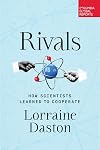
Here’s an odd angle: how did scientists come to co-operate? This question and the fact that Lorraine Daston’s Rivals is in the Columbia Global Reports series, made me want to settle in to a great philosophical/historical discussion. But, for the first time since I began reviewing this normally superlative series, my curiosity was not even addressed.
The book came out of a lecture Daston gave. She spent years researching in national and company libraries. The result is a recitation of show more history without much attempt to evaluate, until the conclusion. Worse, for me at any rate, Daston does not address the things that make science and scientists controversial if not suspicious today. It made me question the whole concept of this book.
First of all, science is really very recent. Scientists were known as natural philosophers until just 300 years ago. Second, co-operation is a function of communication, and the farther back you look, the less communication was even possible. Galileo did not have a whole lot of peers – that he even knew of – that he could communicate with, let alone work with.
With better communications and more traveling, scientists could finally make contact with others. But would they be pigheaded rivals, or co-operative and generous co-workers? The clear answer must be both; it takes all kinds.
Daston reaches back to find international co-operation in fits and starts, as you might expect. Unfortunately, all the wealth early on was in the hands of the monarch, which meant politics and favors for supporting whatever the scientists were undertaking together. This became crystal clear when the Universal Postal Union came into being (1874). Postmasters from around the world congregated in Switzerland to hammer out a system whereby mail from other countries would be accepted and delivered locally. The key to it all was the word postmaster. No “diplomats” were involved, so the work got done, by the people who understood the mechanics of it. This is the first demonstrable example of a global working group succeeding totally. And the UPU remains precisely the system we continue to employ today, despite Donald Trump nearly pulling the USA out of it.
It was really only since World War II that scientists have been conferencing and co-operating on things like global measurements and universal standards. They are getting to network, meet face to face, and to leverage each other’s strengths. They also have all their professional journals, where peers supposedly review papers that are submitted for publication. This has devolved into a constant scandal of corruption, with articles having to be retracted by the publisher, and scams whereby literally thousands of scientists get credit as co-authors of a four page paper, just so they can say they published something. Some publishers openly sell the space. Again, it takes all kinds.
The bulk of the book is a microscopic examination of two international efforts in the late 19th and early 20th centuries: The cloud atlas and the star/sky map. Atmospheric scientists wanted to catalog every kind of cloud around the world. They had a great deal of difficulty with co-operation, standards, and the overwhelming costs of putting together a book with so many fine graphics (for the time). Politics played a big role, as France for example, insisted it be printed in France and in French. The usual.
The astronomical map fared far better, as astronomers around the world accepted blocks of sky to photograph, played by the rules and regulations they were given, and ultimately produced a map that a hundred years later is proving valuable in comparing the size and position of various entities in the sky. It worked because of the enthusiasm of the practitioners, and of the indefatigable project leader, who traveled the world to enlist them to his cause. Meeting them in person made all difference.
Both case studies are filled with characters very few readers will recognize, and whose strategic moves and perseverance seems totally unimportant in today’s world of mass co-operation and the management of large groups of researchers. They are not household names, did not go on to win the Nobel Prize or publish deathless papers, it seems. Christopher Nolan will not be making Imax feature films about them. They have little importance.
Yet far from the handful of astronomers participating in the study, today’s estimate of co-operating researches numbers almost four million globally, Daston says. Co-operation is now endemic.
She tries to build intrigue by claiming “nothing was less inevitable” than co-operation among scientists who were members of their own countries’ elite national Societies. Science was about national pride, with credit to the king or chancellor. Opulent gatherings and endless dull speeches. And it was really thanks to the World Meteorological Organization after the Second World War that scientists suddenly discovered that systems worked globally, and that they needed each other’s data to make sense of anything, from oceans flows to weather fronts to the dispersal of volcanic ash, and everything in between.
Daston also tries to argue “that scientific internationalism of the late nineteenth century did not survive the first world war, much less the second,” largely because of nationalism and rivalries based on it. But that way of thinking clearly gave way to scientific answers that were required of ever deeper enquiries into how the world works, from the submicroscopic to the galactic. Today, it does not matter what country a scientist was trained in, science transcends borders thanks to air travel, telephones and the internet. University professors often seem to be foreign, no matter where you enroll. Crippling arguments like Egypt’s that Sudan should not have a vote because it was a colony have been relegated to the UN to sort out. In science, new facts win every time.
She insists that “’community’ seems a peculiarly ill-suited term to describe this fractious, competitive, dispersed and diverse collective.” Yet you have only to look at the great accomplishments recognized in awards every year, to see that collaboration across continents has become the rule, not the exception.
Another thing that bothered me was ignoring the constant attacks on science these days. How is it that people all over the world have come to the conclusion that science is fraudulent, and what role does their co-operation across borders and continents play in that? Is there jingoism behind it? Can only local scientists be trusted? Or is it the isolated locals who are the problem? Daston does not venture there, even though it is front and center globally: scientists can’t be trusted. Do they even trust each other?
I don’t think anyone would argue the world of science is humble or that it doesn’t operate its own governance, structures and recognition systems, peculiar to itself. But to maintain scientists remain rivals seems completely wrong. Of course, you want your team to be the one to discover the cure for cancer or reverse climate change. But tapping the resources of another team halfway round the world has been totally integrated and subsumed by the greater good of science itself. It seems to me that it is when scientists don’t collaborate and claim to make incredible discoveries on their own that the fraud occurs. That’s when you get the “discovery” of superconductors at room temperatures, studies that cannot be replicated by anyone else, the supposed cloning of humans, lab notes proving totally falsified data, and the launching of products and services that don’t perform any of the miracles claimed. Co-operative efforts act as a reality check and an honesty check, from what I’ve seen.
And to that extent, I don’t see the point of this book.
David Wineberg show less
The book came out of a lecture Daston gave. She spent years researching in national and company libraries. The result is a recitation of show more history without much attempt to evaluate, until the conclusion. Worse, for me at any rate, Daston does not address the things that make science and scientists controversial if not suspicious today. It made me question the whole concept of this book.
First of all, science is really very recent. Scientists were known as natural philosophers until just 300 years ago. Second, co-operation is a function of communication, and the farther back you look, the less communication was even possible. Galileo did not have a whole lot of peers – that he even knew of – that he could communicate with, let alone work with.
With better communications and more traveling, scientists could finally make contact with others. But would they be pigheaded rivals, or co-operative and generous co-workers? The clear answer must be both; it takes all kinds.
Daston reaches back to find international co-operation in fits and starts, as you might expect. Unfortunately, all the wealth early on was in the hands of the monarch, which meant politics and favors for supporting whatever the scientists were undertaking together. This became crystal clear when the Universal Postal Union came into being (1874). Postmasters from around the world congregated in Switzerland to hammer out a system whereby mail from other countries would be accepted and delivered locally. The key to it all was the word postmaster. No “diplomats” were involved, so the work got done, by the people who understood the mechanics of it. This is the first demonstrable example of a global working group succeeding totally. And the UPU remains precisely the system we continue to employ today, despite Donald Trump nearly pulling the USA out of it.
It was really only since World War II that scientists have been conferencing and co-operating on things like global measurements and universal standards. They are getting to network, meet face to face, and to leverage each other’s strengths. They also have all their professional journals, where peers supposedly review papers that are submitted for publication. This has devolved into a constant scandal of corruption, with articles having to be retracted by the publisher, and scams whereby literally thousands of scientists get credit as co-authors of a four page paper, just so they can say they published something. Some publishers openly sell the space. Again, it takes all kinds.
The bulk of the book is a microscopic examination of two international efforts in the late 19th and early 20th centuries: The cloud atlas and the star/sky map. Atmospheric scientists wanted to catalog every kind of cloud around the world. They had a great deal of difficulty with co-operation, standards, and the overwhelming costs of putting together a book with so many fine graphics (for the time). Politics played a big role, as France for example, insisted it be printed in France and in French. The usual.
The astronomical map fared far better, as astronomers around the world accepted blocks of sky to photograph, played by the rules and regulations they were given, and ultimately produced a map that a hundred years later is proving valuable in comparing the size and position of various entities in the sky. It worked because of the enthusiasm of the practitioners, and of the indefatigable project leader, who traveled the world to enlist them to his cause. Meeting them in person made all difference.
Both case studies are filled with characters very few readers will recognize, and whose strategic moves and perseverance seems totally unimportant in today’s world of mass co-operation and the management of large groups of researchers. They are not household names, did not go on to win the Nobel Prize or publish deathless papers, it seems. Christopher Nolan will not be making Imax feature films about them. They have little importance.
Yet far from the handful of astronomers participating in the study, today’s estimate of co-operating researches numbers almost four million globally, Daston says. Co-operation is now endemic.
She tries to build intrigue by claiming “nothing was less inevitable” than co-operation among scientists who were members of their own countries’ elite national Societies. Science was about national pride, with credit to the king or chancellor. Opulent gatherings and endless dull speeches. And it was really thanks to the World Meteorological Organization after the Second World War that scientists suddenly discovered that systems worked globally, and that they needed each other’s data to make sense of anything, from oceans flows to weather fronts to the dispersal of volcanic ash, and everything in between.
Daston also tries to argue “that scientific internationalism of the late nineteenth century did not survive the first world war, much less the second,” largely because of nationalism and rivalries based on it. But that way of thinking clearly gave way to scientific answers that were required of ever deeper enquiries into how the world works, from the submicroscopic to the galactic. Today, it does not matter what country a scientist was trained in, science transcends borders thanks to air travel, telephones and the internet. University professors often seem to be foreign, no matter where you enroll. Crippling arguments like Egypt’s that Sudan should not have a vote because it was a colony have been relegated to the UN to sort out. In science, new facts win every time.
She insists that “’community’ seems a peculiarly ill-suited term to describe this fractious, competitive, dispersed and diverse collective.” Yet you have only to look at the great accomplishments recognized in awards every year, to see that collaboration across continents has become the rule, not the exception.
Another thing that bothered me was ignoring the constant attacks on science these days. How is it that people all over the world have come to the conclusion that science is fraudulent, and what role does their co-operation across borders and continents play in that? Is there jingoism behind it? Can only local scientists be trusted? Or is it the isolated locals who are the problem? Daston does not venture there, even though it is front and center globally: scientists can’t be trusted. Do they even trust each other?
I don’t think anyone would argue the world of science is humble or that it doesn’t operate its own governance, structures and recognition systems, peculiar to itself. But to maintain scientists remain rivals seems completely wrong. Of course, you want your team to be the one to discover the cure for cancer or reverse climate change. But tapping the resources of another team halfway round the world has been totally integrated and subsumed by the greater good of science itself. It seems to me that it is when scientists don’t collaborate and claim to make incredible discoveries on their own that the fraud occurs. That’s when you get the “discovery” of superconductors at room temperatures, studies that cannot be replicated by anyone else, the supposed cloning of humans, lab notes proving totally falsified data, and the launching of products and services that don’t perform any of the miracles claimed. Co-operative efforts act as a reality check and an honesty check, from what I’ve seen.
And to that extent, I don’t see the point of this book.
David Wineberg show less

Really neat history of the epistemology of Western scientific knowledge through the history of how scientists created, thought about, and represented images. The authors argue that various concepts competed and responded to each other through the general concept of “objectivity,” from truth-to-nature (requiring an ideal) to mechanical objectivity (requiring a picture made without human intervention) to responses to mechanical objectivity that involved either abandoning images entirely or show more exercising human judgment to pick and evaluate pictures. Objectivity is always defined with reference to subjectivity, and thus the debate over what an appropriate scientific image is also requires debate over the definition of what a good scientist is. A specialized but satisfying read. show less
Lists
Awards


You May Also Like


Associated Authors
Statistics
- Works
- 21
- Also by
- 7
- Members
- 1,665
- Popularity
- #15,418
- Rating
- 4.0
- Reviews
- 10
- ISBNs
- 74
- Languages
- 5
- Favorited
- 4