
About the Author
Will Bunch is the senior writer for the Philadelphia Daily News and the author of a political blog called "Attytood." He was a member of the New York Newsday staff that won the 1992 Pulitzer Prize for spot news reporting. His magazine articles have appeared in numerous publications including the show more New York Times Magazine, American Prospect, and Mother Jones. He has written three books. (Bowker Author Biography) show less
Image credit: NY Times
Works by Will Bunch
Tear Down This Myth: How the Reagan Legacy Has Distorted Our Politics and Haunts Our Future (2009) 182 copies, 5 reviews
The Backlash: Right-Wing Radicals, High-Def Hucksters, and Paranoid Politics in the Age of Obama (2010) 108 copies, 3 reviews
After the Ivory Tower Falls: How College Broke the American Dream and Blew Up Our Politics―and How to Fix It (2022) 97 copies, 5 reviews
Jukebox America: Down Back Streets and Blue Highways in Search of the Country's Greatest Jukebox (1994) 23 copies
Tagged
Common Knowledge
- Birthdate
- 1958
- Gender
- male
- Organizations
- New York Newsday
Philadelphia Daily News
Media Matters for America - Awards and honors
- Pulitzer Prize. Spot Reporting (1992)
- Nationality
- USA
- Places of residence
- Pennsylvania, USA
- Associated Place (for map)
- Pennsylvania, USA
Members
Reviews
After the Ivory Tower Falls: How College Broke the American Dream and Blew Up Our Politics―and How to Fix It by Will Bunch
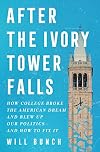
Summary: How the culture wars, costs, and inaccessibility of college have contributed to our political divides and what may be done.
I graduated from college in 1976. Because of personal savings, scholarships, and work, I finished college without debt. Our family did not have much in the way of financial resources at that time and did not contribute financially except for providing a roof over my head. Low, state-subsidized tuitions helped make that possible. Reading this book, I realized show more that this could not have happened in 2022. If I went to college, I likely would have ended with five or six figured debt. I even might not have gone to college.
Will Bunch argues that there are two Americas–one that manages to afford a college education, and one that does not and either finishes or drops out with massive debts, or doesn’t even try. He proposes that our political divides map onto those two Americas. He opens the book by using Knox County, Ohio as an object lesson of this division. Knox County is the home of the elite, liberal arts college, Kenyon College in Gambier, as well as Mount Vernon, six miles to the west, the county seat and a town struggling to get by after its largest factories were shuttered. Kenyon costs in excess of $76,000 a year and attracts a national student body, many from households that can afford these costs. In 2020, the median household income in Mount Vernon was $46,656. In terms of politics, Gambier is an island of blue surrounded by an ocean of red, and Bunch, who spent time embedded in the area as a journalist, maps how those differences played out.
He then zooms out to a time when public education got as close to being universally accessible, following World War 2 and the G.I. Bill, the building boom that accompanied the Baby Boom, and the low or no tuitions (in the case of California) for in-state institutions at public institutions. He traces the increasing disaffection toward public support for colleges to the political radicalism of the Vietnam era and the rise of the culture wars and conservative talk radio in the 1980’s and 1990’s, particularly in the Clinton era. During this time, state support for higher education began to decrease and costs rose. And so began the efforts of colleges to recruit from out of state or even internationally those who would pay premium prices. By the 2020’s, student debt had climbed to $1.7 trillion and scandals like the Varsity Blues scandal exposed the pay to play admissions policies with vast inequities, particularly at the most elite schools.
Bunch then zooms in again, describing four groups, illustrated by four individuals that he argues comprise the two Americas. First are the Left Perplexed, boomers and Gen-Xers who are baffled by the rise of both Trumpism and youth drawn to socialism. Second are the Left Broke, the children of the Left Perplexed, saddled with high debts and drawn to socialist solutions and concerns for racial justice. Third are the Left Behind, the Boomers and Xers who went to work out of high school in factory jobs, many of which went away or were off-shored, people often drawn to Donald Trump as one who affirms their value, their work ethic, and their concerns. Finally, there are the Left Out, the young growing up in the former factory towns who don’t have access to the college track, who work in warehouse and service industries while struggling with alcohol or opioid addiction and higher rates of suicide.
He then chronicles both the increased resentments of foreclosed opportunities in movements like Occupy Wall Street and the rejection of the knowledge associated with college from science to social analysis, particularly among the Left Behind, who often felt themselves belittled and marginalized by the progressive elites associated with higher education.
Bunch then turns to Truman-era solutions as the beginnings of a way out, arguing for the public good of subsidized post-secondary education, whether college or skilled trades. He also looks at the possible benefits of a National Service program for 18 year-olds, bringing people from a variety of backgrounds together for the good of the country as well as mentoring that prepares them for further educational options. In addition to advancing the common good, such a program would help close the divides and forging new bonds of commonality.
I found Bunch’s survey of the higher education and cultural landscape both persuasive in the broad strokes and flawed in the nuances. I wonder if the portrayal of an college vs. high school educated divide, while working as a broad generalization, especially among white Americans, neither explains the support of Trump politics among the educated, nor the more progressive policies supported by some communities with less access to higher education.
What is more compelling is the account of rising college costs, the burdens of college debt, and the urgency for a new policy that recognizes the public good of education beyond high school. To fail to act on this perpetuates not only economic inequities but also political divides. The best way to avoid divides is to include those who might be alienated. It is actually in the common interest of all of us to provide education beyond high school at the public expense as opposed to that education being available only to those who can pay. But that will require a shift in understanding of “us versus them” to “we” and from competing interests to the common good. The question this leaves me with is where the leadership will come from to forge that new understanding. show less
I graduated from college in 1976. Because of personal savings, scholarships, and work, I finished college without debt. Our family did not have much in the way of financial resources at that time and did not contribute financially except for providing a roof over my head. Low, state-subsidized tuitions helped make that possible. Reading this book, I realized show more that this could not have happened in 2022. If I went to college, I likely would have ended with five or six figured debt. I even might not have gone to college.
Will Bunch argues that there are two Americas–one that manages to afford a college education, and one that does not and either finishes or drops out with massive debts, or doesn’t even try. He proposes that our political divides map onto those two Americas. He opens the book by using Knox County, Ohio as an object lesson of this division. Knox County is the home of the elite, liberal arts college, Kenyon College in Gambier, as well as Mount Vernon, six miles to the west, the county seat and a town struggling to get by after its largest factories were shuttered. Kenyon costs in excess of $76,000 a year and attracts a national student body, many from households that can afford these costs. In 2020, the median household income in Mount Vernon was $46,656. In terms of politics, Gambier is an island of blue surrounded by an ocean of red, and Bunch, who spent time embedded in the area as a journalist, maps how those differences played out.
He then zooms out to a time when public education got as close to being universally accessible, following World War 2 and the G.I. Bill, the building boom that accompanied the Baby Boom, and the low or no tuitions (in the case of California) for in-state institutions at public institutions. He traces the increasing disaffection toward public support for colleges to the political radicalism of the Vietnam era and the rise of the culture wars and conservative talk radio in the 1980’s and 1990’s, particularly in the Clinton era. During this time, state support for higher education began to decrease and costs rose. And so began the efforts of colleges to recruit from out of state or even internationally those who would pay premium prices. By the 2020’s, student debt had climbed to $1.7 trillion and scandals like the Varsity Blues scandal exposed the pay to play admissions policies with vast inequities, particularly at the most elite schools.
Bunch then zooms in again, describing four groups, illustrated by four individuals that he argues comprise the two Americas. First are the Left Perplexed, boomers and Gen-Xers who are baffled by the rise of both Trumpism and youth drawn to socialism. Second are the Left Broke, the children of the Left Perplexed, saddled with high debts and drawn to socialist solutions and concerns for racial justice. Third are the Left Behind, the Boomers and Xers who went to work out of high school in factory jobs, many of which went away or were off-shored, people often drawn to Donald Trump as one who affirms their value, their work ethic, and their concerns. Finally, there are the Left Out, the young growing up in the former factory towns who don’t have access to the college track, who work in warehouse and service industries while struggling with alcohol or opioid addiction and higher rates of suicide.
He then chronicles both the increased resentments of foreclosed opportunities in movements like Occupy Wall Street and the rejection of the knowledge associated with college from science to social analysis, particularly among the Left Behind, who often felt themselves belittled and marginalized by the progressive elites associated with higher education.
Bunch then turns to Truman-era solutions as the beginnings of a way out, arguing for the public good of subsidized post-secondary education, whether college or skilled trades. He also looks at the possible benefits of a National Service program for 18 year-olds, bringing people from a variety of backgrounds together for the good of the country as well as mentoring that prepares them for further educational options. In addition to advancing the common good, such a program would help close the divides and forging new bonds of commonality.
I found Bunch’s survey of the higher education and cultural landscape both persuasive in the broad strokes and flawed in the nuances. I wonder if the portrayal of an college vs. high school educated divide, while working as a broad generalization, especially among white Americans, neither explains the support of Trump politics among the educated, nor the more progressive policies supported by some communities with less access to higher education.
What is more compelling is the account of rising college costs, the burdens of college debt, and the urgency for a new policy that recognizes the public good of education beyond high school. To fail to act on this perpetuates not only economic inequities but also political divides. The best way to avoid divides is to include those who might be alienated. It is actually in the common interest of all of us to provide education beyond high school at the public expense as opposed to that education being available only to those who can pay. But that will require a shift in understanding of “us versus them” to “we” and from competing interests to the common good. The question this leaves me with is where the leadership will come from to forge that new understanding. show less
After the Ivory Tower Falls: How College Broke the American Dream and Blew Up Our Politics―and How to Fix It by Will Bunch
After the Ivory Tower Falls by Will Bunch is a detailed and nuanced look at how college has gone from a symbol of the American dream to a divisive battleground in the current partisan environment.
In tracing how a college education went from being only for a select few to being an avenue for (theoretically) all to improve their lot in life and then on to becoming a political pawn and punching bag Bunch offers insight into what we could have done and what we still could do.
It seems to me that show more one of the biggest obstacles to actual debate on making higher education accessible, affordable, and effective is how we define higher education. So many of us think only of 4-year universities and maybe a nod toward community colleges. First of all, community colleges deserve a lot more than a nod. In addition, the inclusion of skills training, apprenticeships, and many other forms of education and training need to be included in a wide-ranging plan to include as many people as possible and as many avenues toward a fulfilling life as possible.
We can't go back in time, whether to make the decisions about higher education that should have been made in Truman's time or to a world where manufacturing is again a dominant and well-paying field. Many of those jobs are gone, not to someplace else but simply gone. The consensus and motivation that we had early in this time frame is also gone so what we should have done is mostly moot, though we can learn (one hopes) from it. We have to look at where we are now, who we are now, and work toward something that will do the best for the most. Bunch offers suggestions and ideas toward this end and the future of our young people is the future of our country, and that should not be a partisan issue.
One quote from close to the front struck me. In discussing Clark Kerr and the type of meritocracy envisioned at the time, Bunch states "[a]wash in prosperity, no one worried about a future in which the fantasy of merit-based success became entrenched, but the equality of opportunity needed for a real system of merit would disappear." For me, that sums up a lot of what still angers and frustrates me about where we are. We went from college being for the elite, to college being a steppingstone for millions of everyday people, and now back to college being for the elite (as far as postgraduate success) while being a burden on everyone else (whether from crippling debt in a poor job market or being shut out completely from even attending and having the chance).
My comments are what struck me and are my takeaways. The book itself offers so much information that I think any reader with an interest in how we can repair society will find points that speak to them and thus have different takeaways. Ideally, all of us with our different perspectives can then start some kind of dialogue about making meaningful change.
Reviewed from a copy made available by the publisher via NetGalley. show less
In tracing how a college education went from being only for a select few to being an avenue for (theoretically) all to improve their lot in life and then on to becoming a political pawn and punching bag Bunch offers insight into what we could have done and what we still could do.
It seems to me that show more one of the biggest obstacles to actual debate on making higher education accessible, affordable, and effective is how we define higher education. So many of us think only of 4-year universities and maybe a nod toward community colleges. First of all, community colleges deserve a lot more than a nod. In addition, the inclusion of skills training, apprenticeships, and many other forms of education and training need to be included in a wide-ranging plan to include as many people as possible and as many avenues toward a fulfilling life as possible.
We can't go back in time, whether to make the decisions about higher education that should have been made in Truman's time or to a world where manufacturing is again a dominant and well-paying field. Many of those jobs are gone, not to someplace else but simply gone. The consensus and motivation that we had early in this time frame is also gone so what we should have done is mostly moot, though we can learn (one hopes) from it. We have to look at where we are now, who we are now, and work toward something that will do the best for the most. Bunch offers suggestions and ideas toward this end and the future of our young people is the future of our country, and that should not be a partisan issue.
One quote from close to the front struck me. In discussing Clark Kerr and the type of meritocracy envisioned at the time, Bunch states "[a]wash in prosperity, no one worried about a future in which the fantasy of merit-based success became entrenched, but the equality of opportunity needed for a real system of merit would disappear." For me, that sums up a lot of what still angers and frustrates me about where we are. We went from college being for the elite, to college being a steppingstone for millions of everyday people, and now back to college being for the elite (as far as postgraduate success) while being a burden on everyone else (whether from crippling debt in a poor job market or being shut out completely from even attending and having the chance).
My comments are what struck me and are my takeaways. The book itself offers so much information that I think any reader with an interest in how we can repair society will find points that speak to them and thus have different takeaways. Ideally, all of us with our different perspectives can then start some kind of dialogue about making meaningful change.
Reviewed from a copy made available by the publisher via NetGalley. show less
Tear Down This Myth: How the Reagan Legacy Has Distorted Our Politics and Haunts Our Future by Will Bunch
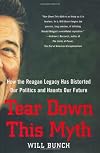
Ronald Reagan’s star has been on an upward trajectory, for these past few years, reaching such celestial heights, that the Right utter his name in hushed reverence. The Holy One! There was even a proposal, on having him added to Mt. Rushmore. Will Bunch, an award-winning political journalist, brings our sainted fortieth President, crashing back to Earth, where he belongs, leaving the cowboy hat and big stick, resting quietly by the door. This is not a heated slam-fest, it is a clear-eyed, show more factual look at a misunderstood presidency. Yes, there are undeniable qualities to this man, but there are also a fair share of flaws. Someone famously said that “facts are stubborn things”. Reagan flubbed this line, in a speech, as “facts are stupid things”. In this excellent, well-researched book, facts rule the day! show less
Tear Down This Myth: How the Reagan Legacy Has Distorted Our Politics and Haunts Our Future by Will Bunch
A new look at the Reagan myth, one that shows Reagan as he was - a flawed human being who did some things right and some things wrong, and who understood America well enough to play on some of the worst traits: our greed, our selfishness, and our short attention spans that prefer one minute sound bites to in depth exploration of policy. The author does a good job at tracing the evolution of the Reagan myth, and how that myth has influenced politics for the past two decades, but he misses the show more boat entirely on Clinton, believing somehow that Clinton veered sharply away from the Reagan persona, instead of recognizing that Clinton, in fact, fit on a seamless line with Reagan. Overall, it's good reading, and should be read by anyone too young to remember Reagan, or too starstruck to remember him correctly. Not a hatchet job, but a more nuanced look at the black and white. In fact, in many places, the author actually feels like the myth shows him in much worse light, and that he really wasn't a rabid religious right war monger, but instead resisted going to war most of the time, and gave the religious right little more than rhetoric. An important entry in the genre of Let's try to figure out how we got where we are today. show less
Awards


You May Also Like


Statistics
- Works
- 7
- Members
- 425
- Popularity
- #57,428
- Rating
- 3.8
- Reviews
- 15
- ISBNs
- 12