
J. B. S. Haldane (1892–1964)
Author of On Being the Right Size
About the Author
J.B.S. Haldane was the William Dunn Reader in Biochemistry at Cambridge University. He simultaneously served as Fellow of New College, in Oxford University's Horticultural Institute. Carl A. Price served until 1999 as professor of plant molecular biology in the Waksman Institute of Microbiology at show more Rutgers, the State University of New Jersey. He also served as the editor of Plant Molecular Biology Reporter from 1983 until 1997 show less
Image credit: Wikipedia
Works by J. B. S. Haldane
Science and the Supernatural: A Correspondence Between Arnold Lunn and J. B. S. Haldane (1935) 11 copies
NEW PATHS In GENETICS. 3 copies
Problemi della scienza 2 copies
The Last Judgement 2 copies
Adventures of a biologist 2 copies
Gold-Makers [short story] 1 copy
A.R.P. for Hampstead 1 copy
El tiempo en la biología 1 copy
The Outlook of Science 1 copy
Associated Works
Shadows of Imagination: The Fantasies of C. S. Lewis, J. R. R. Tolkien, and Charles Williams (Crosscurrents: Modern Critiques) (1969) — Contributor — 49 copies
Gender in Modernism: New Geographies, Complex Intersections (2007) — Contributor — 12 copies, 1 review
Tagged
Common Knowledge
- Legal name
- Haldane, John Burdon Sanderson
- Other names
- Haldane, Jack
- Birthdate
- 1892-11-05
- Date of death
- 1964-12-01
- Gender
- male
- Education
- Eton College
University of Oxford (New College) - Occupations
- biologist
university professor - Awards and honors
- Darwin Medal (1952)
Huxley Memorial Medal (Royal Anthropological Society)
Darwin-Wallace Medal (1958) - Relationships
- Haldane, R. B. (uncle)
Mitchison, Naomi (sister)
Haldane, Elizabeth Sanderson (aunt)
Haldane, J. A. (great-grandfather)
Haldane, John Scott (father) - Nationality
- UK (birth)
India (naturalised) - Birthplace
- Oxford, Oxfordshire, England, UK
- Places of residence
- Cambridge, Cambridgeshire, England, UK
London, England, UK - Place of death
- Bhubaneswar, India
- Map Location
- England, UK
Members
Discussions
Childrens fantasy novel about an eccentric magician in Name that Book (October 2018)
Reviews
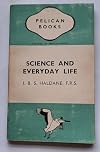
“So I drank as much hydrochloric acid as I could. But I couldn’t drink enough without burning my stomach. So I drank a solution of ammonium chloride...”
Seventy essays reprinted from the Daily Worker after it’s suppression. I actually learned quite a lot from it. That I can do so from a book eighty years old says something rather worrying about the state of my knowledge of science. It also shows good science writing. It reminded me a couple of times of the approach taken by Isaac show more Asimov in his essays. I don’t know if there’s a direct line of influence. I do know Arthur C Clarke quotes Haldane somewhere or other (which is why I read this book). Certainly he is endlessly quotable. I’ve restricted myself to one, but I could go on for pages and pages. Really the only fault with the essays is that they’re too short. I’d liked to know more about his auto-experiments (he takes heroin as well), but really the above quotation is all the detail we get.
The book is interesting also as a snapshot of politics, society and science on the eve of the 2nd World War. The essays are written from a Marxist perspective and he quite often refers to the work of Soviet scientists who were involved in something other that rocketry. Quite a shocker. And because of this perspective he often applies the science to the lives of ordinary people, giving you a little glimpse into a world only the very oldest now living remember. That said, some things never change. He discusses the impending doom of the Gros Michel banana and here we are, eighty years later, discussing the doom of the Cavendish. show less
Seventy essays reprinted from the Daily Worker after it’s suppression. I actually learned quite a lot from it. That I can do so from a book eighty years old says something rather worrying about the state of my knowledge of science. It also shows good science writing. It reminded me a couple of times of the approach taken by Isaac show more Asimov in his essays. I don’t know if there’s a direct line of influence. I do know Arthur C Clarke quotes Haldane somewhere or other (which is why I read this book). Certainly he is endlessly quotable. I’ve restricted myself to one, but I could go on for pages and pages. Really the only fault with the essays is that they’re too short. I’d liked to know more about his auto-experiments (he takes heroin as well), but really the above quotation is all the detail we get.
The book is interesting also as a snapshot of politics, society and science on the eve of the 2nd World War. The essays are written from a Marxist perspective and he quite often refers to the work of Soviet scientists who were involved in something other that rocketry. Quite a shocker. And because of this perspective he often applies the science to the lives of ordinary people, giving you a little glimpse into a world only the very oldest now living remember. That said, some things never change. He discusses the impending doom of the Gros Michel banana and here we are, eighty years later, discussing the doom of the Cavendish. show less
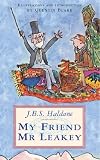
A close friend of mine sent this to me for Christmas, and I have to admit, I'd never heard of it before. That's not too much of a surprise. He is more attuned to odd little paperback childhood wonders than I - and I haven't the slightest doubt that's what this is, some little delight he found fading away in the corner of a dusty London bookshop. He's a regular Home for Forgotten Children's Books, that one, and now I wonder if he might not have a pet dragon, too.
Mr. Leakey does. Mr. Leakey show more has a pet dragon, and an at-home jinn, and a beetle to serve his salt, among other things. He acquired an octopus waiter by enchanting a man whose legs "were cut off by a railway train," forcing him to save the man by turning him into an animal with no legs. Mr. Leakey has strange adventures all over the world on his magic carpet, and he throws a party where everyone is turned into whatever they wish, including a fire engine, an elephant, William Shakespeare, and a comet. (A fellow guest is the archangel Raphael, who attests that it is "always a pleasure to come to Mr. Leakey's parties.") The Leakey stories are wonderful, flighty, tongue-in-cheek pieces of fantasy, told in that slightly irreverent British tone that only seems to have existed in literature written between the two world wars.
Unfortunately, the book sputters to a finish with three shorter stories that do not feature Mr. Leakey at all, and although they're each charming in their own way, I found myself missing the more outrageous qualities of the Leakey tales. Next time I'll know what to expect and not be disappointed. It's a lovely little book, overall, and one that could definitely afford to be better-known. What child reader wouldn't want a friend whose hat magically provides hot soup? show less
Mr. Leakey does. Mr. Leakey show more has a pet dragon, and an at-home jinn, and a beetle to serve his salt, among other things. He acquired an octopus waiter by enchanting a man whose legs "were cut off by a railway train," forcing him to save the man by turning him into an animal with no legs. Mr. Leakey has strange adventures all over the world on his magic carpet, and he throws a party where everyone is turned into whatever they wish, including a fire engine, an elephant, William Shakespeare, and a comet. (A fellow guest is the archangel Raphael, who attests that it is "always a pleasure to come to Mr. Leakey's parties.") The Leakey stories are wonderful, flighty, tongue-in-cheek pieces of fantasy, told in that slightly irreverent British tone that only seems to have existed in literature written between the two world wars.
Unfortunately, the book sputters to a finish with three shorter stories that do not feature Mr. Leakey at all, and although they're each charming in their own way, I found myself missing the more outrageous qualities of the Leakey tales. Next time I'll know what to expect and not be disappointed. It's a lovely little book, overall, and one that could definitely afford to be better-known. What child reader wouldn't want a friend whose hat magically provides hot soup? show less

This is a collection of 24 essays by the Cambridge biologist J B S Haldane. He writes about various things, including history, genetics, politics, science, philosophy, and society. He comes across as very perceptive, and I enjoyed reading these essays far more than a similar collection that I read recently by another Cambridge biologist C H Waddington. The essays and lectures were written 1920s and early 1930s, and published in 1932, but are still largely relevant today from a scientific show more viewpoint.
What impressed me about some of the essays is how he talks about things that have become un-politically correct these days, for no rational reason, and he deals with the issues sensibly and comes to valid conclusions. There are issues that exist today, that scientist are virtually forbidden to talk about, and if they could be tackled then some of the problems of society could be reduced, and well-being improved. The main one of these is more than hinted at in the title, though one could be forgiven for thinking it didn't exist, given what the non-scientific public and the media might sometimes suggest, against common sense. The inequality of man is natural, genetic, and this was apparent to Haldane and most other biologists even before the genetic code had been solved. Most of the essays are about other things though, and the piece that I most enjoyed reading was a story about certain events that the author experienced. It involves guns, conspiracy, murders, chases across Europe, and a secret formula. When I started reading it, I thought it must be based on real events, but by the end I more or less realised that it was just a story, but I wasn't completely sure. show less
What impressed me about some of the essays is how he talks about things that have become un-politically correct these days, for no rational reason, and he deals with the issues sensibly and comes to valid conclusions. There are issues that exist today, that scientist are virtually forbidden to talk about, and if they could be tackled then some of the problems of society could be reduced, and well-being improved. The main one of these is more than hinted at in the title, though one could be forgiven for thinking it didn't exist, given what the non-scientific public and the media might sometimes suggest, against common sense. The inequality of man is natural, genetic, and this was apparent to Haldane and most other biologists even before the genetic code had been solved. Most of the essays are about other things though, and the piece that I most enjoyed reading was a story about certain events that the author experienced. It involves guns, conspiracy, murders, chases across Europe, and a secret formula. When I started reading it, I thought it must be based on real events, but by the end I more or less realised that it was just a story, but I wasn't completely sure. show less

A wonderful set of fantasy short stories, by J,B.S. Haldane, an important British biologist and a seriously committed Marxist, who wrote a critique of Out of the Silent Planet (Auld Hornie FRS) to which C.S. Lewis wrote a reply. These tales prove Haldane was quite a gifted fantasy writer himself. Three are about his encounters with Mr. Leakey, a wizard living in modern London with a jinn for a valet, a small dragon useful for cooking, and an octopus who used to be a man. The first story show more tells how the narrator met Leakey and had dinner in his flat, the second tells of a trip with Mr. Leakey around the world by magic carpet, and the third tells of a masquerade party Mr. Leakey gives at which the guests are actually transformed into whatever they wish, from Shakespeare to a fire engine and even a cesium atom. In addition, there is a a very clever adaptation of the traditional three sons fairy tale; in this modern version, the rats of the London docks have become a tremendous nuisance under the leadership of a very shrewd king, and a huge reward is offered for anyone who can deal with them; the three brothers all try for it -- one was good at practical jokes, and tried making traps that look like tin cans, one was a chemist who made subtly poisoned cheeses. and the last was an electrician who put very fine iron filings in biscuits, and once the rats had eaten enough of them, he turned on very strong magnets which drew the rats into pits so they were drowned. This worked, --he even drowned the rat king-- and he won the reward. There is also the story of an unpleasant rich man in Brazil who had his pet boa constrictor fitted with golden teeth -- but the real teeth grew back and when the man tried to punish his keeper (thinking the keeper ha stolen the gold ones) the rich man got eaten by his pet caiman, and serve him right. This is one of the few Marxist touches. (Another is when Mr. Leakey makes the writing on a loan shark's loan records disappear.) There is also a rather anecdotal story about how the narrator loses his fine old temper (inherited from Melusine) and his collar stud, and buys a new unlosable one from a fairy who used to live in the river Wandle. show less
Lists
Awards


You May Also Like


Associated Authors
Statistics
- Works
- 42
- Also by
- 7
- Members
- 712
- Popularity
- #35,610
- Rating
- 4.0
- Reviews
- 13
- ISBNs
- 56
- Languages
- 3
- Favorited
- 4