
Annette Carson
Author of Richard III: The Maligned King
Works by Annette Carson
Flight Fantastic: The Illustrated History of Aerobatics (A Foulis aviation book) (1986) 19 copies, 1 review
RICHARD III UNSPUN: The Mysterious Affair at Stony Stratford and The Trouble with Hastings (2026) 4 copies
The Beaufort Legitimation 1 copy
Tagged
Common Knowledge
- Gender
- female
Members
Reviews
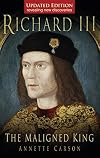
If I had to summarize this book in one word, it would be provocative. From the opening chapter where Annette Carson analyzes Richard Collins's theory that Edward IV may have died of poisoning, to the closing chapter depicting Richard's personal tragedies--son dies suddenly and wife dies after a long illness--and how they affected his security, to his miscalculations of how to manage the powerful lords upon whose support he depended, we not only learn how history has maligned this medieval show more monarch, but also how certain key events have several valid interpretations.
The chapters are arranged chronologically, starting just before Edward IV's death to Richard's defeat and death on Bosworth Field--a period extending just under two and a half years--and of the Tudor aftermath where Richard's good name was maligned. While Carson clearly sides with the "good king Richard" view, she does not ignore detracting theories for each point she examines. Throughout all the tumultuous events of this short historical span, Carson analyzes the primary (where available) and secondary sources--sometimes supporting and sometimes contradicting the conclusions that are drawn. Notably she doesn't shirk from citing and examining controversial references such as that of Thomas More's 'History of King Richard III'.
Carson's work is well balanced, logical, and witty. I believe this text is readily understandable by someone just embarking on learning about this era as well as an important addition to the more knowledgeable reader. The selected bibliography lists over a hundred references that she cites throughout the text. Despite the weight of the research, the book is highly readable and accessible to the non-historian.
The one negative for me was the small type face. I found it a strain to read. Admittedly, I'm of an age where I need reading glasses, but haven't graduated to large print yet.
In the spirit of full disclosure, the author and I traded books when we met for the first and only time last August. Neither of us had any expectations of receiving or giving a review. I am writing this review because I think this book is a valuable addition for anyone interested in Richard III and that period of history. show less
The chapters are arranged chronologically, starting just before Edward IV's death to Richard's defeat and death on Bosworth Field--a period extending just under two and a half years--and of the Tudor aftermath where Richard's good name was maligned. While Carson clearly sides with the "good king Richard" view, she does not ignore detracting theories for each point she examines. Throughout all the tumultuous events of this short historical span, Carson analyzes the primary (where available) and secondary sources--sometimes supporting and sometimes contradicting the conclusions that are drawn. Notably she doesn't shirk from citing and examining controversial references such as that of Thomas More's 'History of King Richard III'.
Carson's work is well balanced, logical, and witty. I believe this text is readily understandable by someone just embarking on learning about this era as well as an important addition to the more knowledgeable reader. The selected bibliography lists over a hundred references that she cites throughout the text. Despite the weight of the research, the book is highly readable and accessible to the non-historian.
The one negative for me was the small type face. I found it a strain to read. Admittedly, I'm of an age where I need reading glasses, but haven't graduated to large print yet.
In the spirit of full disclosure, the author and I traded books when we met for the first and only time last August. Neither of us had any expectations of receiving or giving a review. I am writing this review because I think this book is a valuable addition for anyone interested in Richard III and that period of history. show less
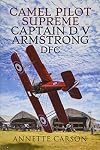
Annette Carson's CAMEL PILOT SUPREME CAPTAIN DV ARMSTRONG DFC is an important addition to the history of early aviation and its role in the First World War. However, it did seem to be more of a history book than a biography, as it seems Armstrong himself left very little in the way of notes or letters, forcing Carson to rely primarily on an album of old photographs with a few brief, sketchy captions, that Armstrong's family had kept. So in fact Carson drew heavily from other early aviators' show more accounts of flying, including many of Armstrong's friends and colleagues.
Aviation was still in its infancy during the great war, and Carson presents an apt description in this passage from Arthur Gould Lee's book, NO PARACHUTE -
"the aeroplanes of the day not only lacked brakes, but had an open cockpit, no heater, no oxygen, no parachute, no radio link with air or ground, and no compass worth the name. These deficiencies were in keeping with the construction, wooden frames braced by wires and covered with highly inflammable doped fabric."
So yes, flying was a pretty iffy and dangerous business in those days, and demanded a daredevil spirit, which the young pilot from South Africa, DV Armstrong, apparently had in spades. And although he wrote almost nothing himself about his stunt-flying and aerobatic escapades, his fellow flyers did remember him as the most daring and accomplished of them all, both while he was serving at the front and while he worked as a trainer of other new pilots on the home front. Carson drew heavily from those accounts, as well as battle histories of the war and how these aviators were utilized.
One of her sources was Cecil Lewis's memoir, SAGITTARIUS RISING, a book I read myself not long ago, primarily because a later edition of the book boasted an introduction by Samuel Hynes, an author I have admired for many years. Hynes penned his own memoir of his WWII years, when he was a Marine Corps pilot in the Pacific (FLIGHTS OF PASSAGE), and, years later, he wrote his own history of early aviation and its use during the Great War, THE UNSUBSTANTIAL AIR, a book which I absolutely loved, personalized as it was by the voice of "an old pilot."
While CAMEL PILOT SUPREME does boast many photos and drawings of planes and pilots, some of the photographs from Armstrong's own album, it remains, to my mind, a rather impersonal and sketchy portrait of Armstrong the man. The primary and first-hand sources were apparently just too meager. Students and scholars of the Great War and early aviation will find much to admire here, however, as Carson obviously dug deep and widely for secondary sources to tell Armstrong's story. It is a pity there wasn't more written by the subject himself, and perhaps he might have written his own story, like Lee and Lewis did years later. Sadly though, Armstrong's life was cut short when he died in a crash at a French airfield just two days after the Armistice was signed.
I found Carson's book to very good as a history book, if a bit dry. As a biography it is not quite as successful. The primary sources were simply too thin. But the Air World imprint of Pen & Sword Books has done a wonderful job in presenting Armstrong's story in a most attractive edition, and I will recommend it highly to war and aviation buffs.
- Tim Bazzett, author of the Cold War memoir, SOLDIER BOY: AT PLAY IN THE ASA show less
Aviation was still in its infancy during the great war, and Carson presents an apt description in this passage from Arthur Gould Lee's book, NO PARACHUTE -
"the aeroplanes of the day not only lacked brakes, but had an open cockpit, no heater, no oxygen, no parachute, no radio link with air or ground, and no compass worth the name. These deficiencies were in keeping with the construction, wooden frames braced by wires and covered with highly inflammable doped fabric."
So yes, flying was a pretty iffy and dangerous business in those days, and demanded a daredevil spirit, which the young pilot from South Africa, DV Armstrong, apparently had in spades. And although he wrote almost nothing himself about his stunt-flying and aerobatic escapades, his fellow flyers did remember him as the most daring and accomplished of them all, both while he was serving at the front and while he worked as a trainer of other new pilots on the home front. Carson drew heavily from those accounts, as well as battle histories of the war and how these aviators were utilized.
One of her sources was Cecil Lewis's memoir, SAGITTARIUS RISING, a book I read myself not long ago, primarily because a later edition of the book boasted an introduction by Samuel Hynes, an author I have admired for many years. Hynes penned his own memoir of his WWII years, when he was a Marine Corps pilot in the Pacific (FLIGHTS OF PASSAGE), and, years later, he wrote his own history of early aviation and its use during the Great War, THE UNSUBSTANTIAL AIR, a book which I absolutely loved, personalized as it was by the voice of "an old pilot."
While CAMEL PILOT SUPREME does boast many photos and drawings of planes and pilots, some of the photographs from Armstrong's own album, it remains, to my mind, a rather impersonal and sketchy portrait of Armstrong the man. The primary and first-hand sources were apparently just too meager. Students and scholars of the Great War and early aviation will find much to admire here, however, as Carson obviously dug deep and widely for secondary sources to tell Armstrong's story. It is a pity there wasn't more written by the subject himself, and perhaps he might have written his own story, like Lee and Lewis did years later. Sadly though, Armstrong's life was cut short when he died in a crash at a French airfield just two days after the Armistice was signed.
I found Carson's book to very good as a history book, if a bit dry. As a biography it is not quite as successful. The primary sources were simply too thin. But the Air World imprint of Pen & Sword Books has done a wonderful job in presenting Armstrong's story in a most attractive edition, and I will recommend it highly to war and aviation buffs.
- Tim Bazzett, author of the Cold War memoir, SOLDIER BOY: AT PLAY IN THE ASA show less
I had hoped that this overview of the controversy surrounding Richard III would have a bit more about the recent discovery of his remains in a Leicester car park. While the author alludes a couple of times to what has been learned from Richard’s skeletal remains and to DNA evidence, the main thrust of the book is to analyze the evidence either substantiating or refuting the accusations that Richard III usurped the throne and murdered his nephews. Even though it is aimed at a popular rather show more than an academic audience, the book could have benefited from a bibliography of recommended sources for readers who want to explore the topic in greater depth. Primary sources are mentioned throughout the book, such as Thomas More’s History of King Richard III and Polydore Vergil’s English history, and it would be helpful to non-academics to provide a little more information about the availability of modern editions of these works. This book covers a lot of the same ground as Josephine Tey’s The Daughter of Time. Readers who have already read Tey’s book may not feel like they’re picking up many new details.
This review is based on an electronic advanced reading copy provided by the publisher through NetGalley. show less
This review is based on an electronic advanced reading copy provided by the publisher through NetGalley. show less

Good coverage of not just his career but also about making the albums and the problems of working with different people, and how they influenced the end result.
You May Also Like


Statistics
- Works
- 16
- Members
- 198
- Popularity
- #110,928
- Rating
- 3.9
- Reviews
- 6
- ISBNs
- 17