
John Ashdown-Hill
Author of The Last Days of Richard III and the Fate of His DNA
About the Author
John Ashdown-Hill is uniquely placed to answer these questions. By working with geneticists and scientists, and exploring the mtDNA haplogroup of the living all-female-line collateral descendant of the brothers, he questions the orthodoxy and strips away the myths.
Image credit: From the'King Richard Armitage' website -- http://kingrichardarmitage.rgcwp.com/2011/08/23/dr-john-ashdown-hill-talks-about...
Works by John Ashdown-Hill
The Secret Queen: Eleanor Talbot, the Woman Who Put Richard III on the Throne (2009) 84 copies, 2 reviews
The Dublin King: The True Story of Edward Earl of Warwick, Lambert Simnel and the 'Princes in the Tower' (2015) 31 copies, 1 review
Tagged
Common Knowledge
- Legal name
- Louis John Frederick Ashdown-Hill
- Other names
- Ashdown-Hill, Louis John Frederick
- Birthdate
- 1949
- Gender
- male
- Education
- University of East Anglia
University of Essex - Occupations
- writer
historian
speaker - Awards and honors
- Order of the British Empire (Member)
Society of Antiquaries of London (Fellow) - Nationality
- UK
- Associated Place (for map)
- UK
Members
Reviews
The Last Days of Richard III and the fate of his DNA: The Book that Inspired the Dig by John Ashdown-Hill

This book is a bit of a curate's egg for me. The tracking down of Richard's mitochondrial DNA through the female line to a lady living in Canada, in order to establish the authenticity of the Leicester car park skeleton, is a great piece of genetic detective work and a classic illustration of how science can aid in the solution of historical mysteries. The attempt in the earlier chapters to establish how Richard spent the last few months of his reign and life, without the hindsight benefit show more of knowing the Bosworth outcome, is a genuinely worthy exercise. But for me the narrative is marred by the author's absolutely uncritical support for everything Richard said and did. In other respects, he applies the historian's critical faculties well, but just loses them when he discusses Richard, who can do no wrong. His absolute right to the throne over his allegedly bastard nephew Edward V is assumed, and the allegation that he wanted to marry his niece Elizabeth to secure an heir all malicious gossip; the point of my criticism here is not necessarily the views he holds, but rather his complete confidence in their unchallenged veracity, on which other conclusions automatically follow. He also consistently puts "Tudor" in inverted commas and advances a theory that Henry Tudor's father Edmund may not have been the son of Owen Tudor, but rather that of Edmund Beaufort, Duke of Somerset, though this theory is not developed. He criticises the polarised nature of much discourse on Richard III, while seemingly unaware of his own contribution towards that polarisation. I'm still giving this book 4/5 though for its many interesting features.
(Just realised I'm finishing this on the 528th anniversary of Bosworth) show less
(Just realised I'm finishing this on the 528th anniversary of Bosworth) show less
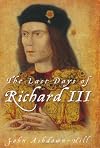
Who hasn't seen a production of Shakespeare's "The Tragedy of King Richard III" and thought, 'whoa, no one could be that bad, well, 'cept King John..." That's what I thought when I first saw Olivier's devilishly wicked and wonderful portrayal of Richard and started me on a lifetime of interest and research into the life and times of the last Yorkist/Plantagenet king. Mr. Ashdown-Hill does the continuing debate over this much-maligned king a service by setting forth a chronology of what show more Richard's last 150 days would have been like, based on extant documents and commentaries of the times, and bringing to light for me, new information. He validates facts and he dismisses the hearsay and conjecture started by gossip at Court that made its way into history books, following Richard's actual movements as they are known to us. While he tells us upon which side of the polarized debate he stands, he avoids the dramatic, empurpled prose and commentary of say, Kendall, to make his points and when he dismisses arguments. He gives us facts as set before him. I approached this work with skepticism, thinking, "Oh dear, another 'Did he or didn't he?' tome on the disappearance of Edward IV's sons from public view," and the rumors that followed. What a delight it was to discover new facts and clear thought. There are new interpretations of court papers and documents, e.g., the documents from Spain and Portugal concerning Richard's diplomatic efforts to find a husband for Elizabeth of York, Edward IV's eldest daughter, and a new wife for himself (after the death of his queen Anne Neville), the curious, out-of-character behavior of Richard on the night before the battle of Bosworth Field and on the morning - was it due to illness? There was a bout of Sweating Sickness going around.
Mr. Ashdown-Hill doesn't set out to prove anything except that the man Thomas More and Shakespeare handed down to history was quite different from the reality. In "The Last Days of Richard III" we see a man not plagued by ghosts or his evil deeds, but a monarch going about daily business and governance, expecting to be victorious once again on the battlefield and never expecting to die. show less
Mr. Ashdown-Hill doesn't set out to prove anything except that the man Thomas More and Shakespeare handed down to history was quite different from the reality. In "The Last Days of Richard III" we see a man not plagued by ghosts or his evil deeds, but a monarch going about daily business and governance, expecting to be victorious once again on the battlefield and never expecting to die. show less
The Last Days of Richard III and the Fate of His DNA: The Book That Inspired the Dig by John Ashdown-Hill
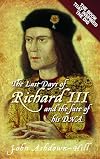
John Ashdown-Hill has been one of the driving forces behind the recent discoveries of Richard III’s bones. He pieced together the direct maternal descendants of Richard III’s closest relatives so that the mitochondrial DNA of him and his descendants could be examined for a match, which was indeed the case and laid to rest the few doubts remaining after the scoliosis-stricken body was identified. This lightly updated text includes some of the recent findings.
The focus of the text is on show more the event of Richard III’s last year (not so much the last days as the battle of Bosworth is given not many lines and one of the worst sketches in any history books). The year before Bosworth was hard for Richard as he lost both his heir and his wife. This made him politically vulnerable as his supporters had no long-term outlook. He sought to arrange a marriage alliance with Portugal instead of cementing his local support in England with an English match (as did his successor Henry VII).
Richard III’s chief mistake in his final year was to carry on as normal, fulfilling his strenuous religious duties (personally touching the festering wounds of sick people, washing the feet of the poor, …) and going on hunts. When Henry Tudor landed in Wales, Richard III did not interdict Henry’s build-up of his small army and failed to keep the unreliable Stanleys close. It is curious how poor Richard III’s decisions were given that he had putsched himself quite adroitly to power. Ashdown-Hill, an outspoken Ricardian, shows Richard as a Schmerzensmann, leading a pious life that led to a brutal end – quite the opposite of Shakespeare’s take. Overall, a good, short read that only in one or two places verges into truthiness partisanship. show less
The focus of the text is on show more the event of Richard III’s last year (not so much the last days as the battle of Bosworth is given not many lines and one of the worst sketches in any history books). The year before Bosworth was hard for Richard as he lost both his heir and his wife. This made him politically vulnerable as his supporters had no long-term outlook. He sought to arrange a marriage alliance with Portugal instead of cementing his local support in England with an English match (as did his successor Henry VII).
Richard III’s chief mistake in his final year was to carry on as normal, fulfilling his strenuous religious duties (personally touching the festering wounds of sick people, washing the feet of the poor, …) and going on hunts. When Henry Tudor landed in Wales, Richard III did not interdict Henry’s build-up of his small army and failed to keep the unreliable Stanleys close. It is curious how poor Richard III’s decisions were given that he had putsched himself quite adroitly to power. Ashdown-Hill, an outspoken Ricardian, shows Richard as a Schmerzensmann, leading a pious life that led to a brutal end – quite the opposite of Shakespeare’s take. Overall, a good, short read that only in one or two places verges into truthiness partisanship. show less
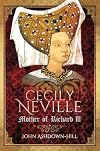
More 2.5 stars than 2 - I wanted to like this more than I did but found it quite hard work in places. The author has made a valiant job in attempting to reconstruct a medieval woman's life from the primary sources without getting swamped by her prominent male kinfolk, and he draws on a wider range of disciplines than documentary history to do so. There were, however, too many notes that jarred - for example, a weird section on being a middle aged woman that could have done with an edit by a show more middle aged woman, and a hyper-partisan approach to Cecily's familial relationships that requires some contortions to maintain (including accusing Elizabeth Woodville of committing murder without a shred of proof). This may be a more engaging read to those of a strongly pro-Yorkist, anti-Woodville bent. show less
Lists
You May Also Like


Statistics
- Works
- 18
- Members
- 571
- Popularity
- #43,840
- Rating
- 3.5
- Reviews
- 13
- ISBNs
- 49
- Languages
- 1
- Favorited
- 1