
Alex Langlands
Author of Cræft: An Inquiry Into the Origins and True Meaning of Traditional Crafts
About the Author
Alexander Langlands is a British archaeologist and medieval historian. He is a regular presenter for the BBC and teaches medieval history at Swansea University. He currently resides in Swansea, Wales.
Works by Alex Langlands
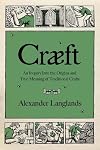
Cræft: An Inquiry Into the Origins and True Meaning of Traditional Crafts (2017) 428 copies, 8 reviews
Associated Works
Victorian Farm [2009 TV series] — Presenter — 2 copies
Wartime Farm [2012 TV series] — Presenter — 1 copy
Tagged
Common Knowledge
- Legal name
- Langlands, Alexander
- Birthdate
- 1978
- Gender
- male
- Education
- Institute of Archaeology, University College London (B.A.) (medieval archaeology)
Institute of Archaeology, University College London (M.A. ∙ world archaeology)
University of Winchester (M.Phil./Ph.D. ∙ early medieval history and archaeology ∙ 2013) - Occupations
- archeologist
broadcaster
academic
historian - Organizations
- British Broadcasting Corporation
University of Swansea - Nationality
- UK
- Associated Place (for map)
- UK
Members
Reviews
A frustrating book; the kind that makes you want to say “What a deep insight!” on one page and throw it against the wall on the next. The jacket blurb describes Author Alexander Langlands as an archaeologist, medieval historian, and “regular presenter on BBC”; so far so good. But as we learn through the book, he’s also an avocational farmer.
Langlands praises “cræft”, spelled with the Old English “ash”; the process of doing useful things with your hands in the show more “traditional” manner. Chapters cover making hay, keeping bees, thatching roofs, masking pots, weaving baskets, and so on. And every chapter is full of fascinating details about how it’s done; making hay is more complicated than just cutting down grass with a scythe; thatching roofs is more involved than just throwing plants on top of your house. These are all things a medieval archaeologist should know how to do, just as a Paleolithic archaeologist should know how to knap flint and butcher a cow with the results.
But it’s one thing to know how to do these things so you can interpret what’s found in an archaeological dig, but it’s another to suggest that it’s somehow “better” that way. This starts in the initial chapter, where Langlands moans peevishly about the difficulty getting his “strimmer” (what would be called a “string trimmer” on this side of the Atlantic) to work, what with mixing the oil and “petrol”, decarbonizing the spark plug, replacing the nylon string, and then still be unable to get it to start. Well, guess what; maintaining internal combustion engines is a “cræft” – see Zen and the Art of Motorcycle Maintenance. It gets worse; Langlands advocates farmers return to plowing with horse teams, because it’s more “cræfty”; and their dung will fertilize the fields. I think we need Vaclav Smil to do a little input-output analysis on that one. And last, I observe that my copy of this book was printed on a high speed rotogravure press with oil-based inks on mass-produced paper and machine bound, not hand lettered in a scriptorium on vellum using oak-gall ink and a goose feather quill.
No illustrations other than pseudomedieval line drawings leading off the chapters. No bibliography or notes. Perhaps I’m too harsh; there really are a lot of fascinating things in Cræft. But I just get tired of claims that “the old ways were better”; sure, 80% child mortality, serfdom, and now and then burning a witch for a little excitement. show less
Langlands praises “cræft”, spelled with the Old English “ash”; the process of doing useful things with your hands in the show more “traditional” manner. Chapters cover making hay, keeping bees, thatching roofs, masking pots, weaving baskets, and so on. And every chapter is full of fascinating details about how it’s done; making hay is more complicated than just cutting down grass with a scythe; thatching roofs is more involved than just throwing plants on top of your house. These are all things a medieval archaeologist should know how to do, just as a Paleolithic archaeologist should know how to knap flint and butcher a cow with the results.
But it’s one thing to know how to do these things so you can interpret what’s found in an archaeological dig, but it’s another to suggest that it’s somehow “better” that way. This starts in the initial chapter, where Langlands moans peevishly about the difficulty getting his “strimmer” (what would be called a “string trimmer” on this side of the Atlantic) to work, what with mixing the oil and “petrol”, decarbonizing the spark plug, replacing the nylon string, and then still be unable to get it to start. Well, guess what; maintaining internal combustion engines is a “cræft” – see Zen and the Art of Motorcycle Maintenance. It gets worse; Langlands advocates farmers return to plowing with horse teams, because it’s more “cræfty”; and their dung will fertilize the fields. I think we need Vaclav Smil to do a little input-output analysis on that one. And last, I observe that my copy of this book was printed on a high speed rotogravure press with oil-based inks on mass-produced paper and machine bound, not hand lettered in a scriptorium on vellum using oak-gall ink and a goose feather quill.
No illustrations other than pseudomedieval line drawings leading off the chapters. No bibliography or notes. Perhaps I’m too harsh; there really are a lot of fascinating things in Cræft. But I just get tired of claims that “the old ways were better”; sure, 80% child mortality, serfdom, and now and then burning a witch for a little excitement. show less
I'm so delighted that another member of the archaeological team that brought us the British "farm" series is turning to authorship, and doing a bang-up job of it, too. I was initially a little skeptical -- the use of craeft, with it's odd spelling seemed like a potentially pretentious sign. Instead, I found a thorough and fascinating intellectual argument woven through both personal storytelling and thoughtful investigations of how things have been done through history. Thoughtful is a great show more word for this book -- Langlands does a wonderful job providing a vast historical context, both past and present, and manages to avoid sinking into a quagmire of nostalgia without practical purpose. He also links the evolution of crafts in ways that that I would not have thought of, and offers a lot of food for thought for incorporating this sort of work into modern life. I learned a lot here, and I enjoyed taking my time reading it.
Advanced Reader's Copy provided by Edelweiss. show less
Advanced Reader's Copy provided by Edelweiss. show less
Alexander Langlands had my dream job: he was an experimental archaeologist, experimenting with the tools and techniques of history to better understand the way the past worked. He was clearly in this job by temperament as much as anything, because throughout this book he displays a remarkable curiosity about not just the individual components of historic life but the whole system of the thing: the way one skill led into another, one craft creating byproducts that in turn become the core show more structural elements of another. He calls this kind of systemic, interdependent thinking "craeftiness," a mode of relating to the world that abhors waste the way nature abhors a vacuum, finding a clever, economical use for every scrap, and making every expenditure of energy do at least two jobs.
This isn't your ordinary history book; in fact, I'm hard-pressed to find anything to compare it to. It's deeply personal, each chapter (focusing on a different craft, from haymaking to basket-weaving to wall and barrow building) exploring Langlands' own experience with the skill as well as his archaeological knowledge of its history. It's profoundly location-based, as suits a book about the way pre-industrial people lived. And, crucially, it's not nostalgic or romanticizing of the past: Langlands is well aware of how hard all this work is, having done much of it himself, albeit without life-or-death consequences. What he's explaining is not just these individual skills that have been lost in the wake of cheap petroleum-based energy, but a way of thinking that was lost along with them, one which might become necessary in the near future, as petroleum-based energy becomes not so cheap. show less
This isn't your ordinary history book; in fact, I'm hard-pressed to find anything to compare it to. It's deeply personal, each chapter (focusing on a different craft, from haymaking to basket-weaving to wall and barrow building) exploring Langlands' own experience with the skill as well as his archaeological knowledge of its history. It's profoundly location-based, as suits a book about the way pre-industrial people lived. And, crucially, it's not nostalgic or romanticizing of the past: Langlands is well aware of how hard all this work is, having done much of it himself, albeit without life-or-death consequences. What he's explaining is not just these individual skills that have been lost in the wake of cheap petroleum-based energy, but a way of thinking that was lost along with them, one which might become necessary in the near future, as petroleum-based energy becomes not so cheap. show less
This was a delightful excursion through a variety of crafts through the eyes of an archeologist and near-compulsive dabbler. Langlands has had the opportunity to either set his hand to the crafts described or seen, first-hand and up close, masters demonstrating their skill at them.
[Audiobook note: Matthew Lloyd Davies is an excellent reader. I intend to look for other books he has narrated.]
[Audiobook note: Matthew Lloyd Davies is an excellent reader. I intend to look for other books he has narrated.]
You May Also Like


Associated Authors
Statistics
- Works
- 7
- Also by
- 4
- Members
- 753
- Popularity
- #33,775
- Rating
- 4.0
- Reviews
- 13
- ISBNs
- 19
- Languages
- 1