
Maurice Isserman
Author of America Divided: The Civil War of the 1960s
About the Author
Maurice Isserman is the Publius Virgilius Rogers Professor of American History at Hamilton College. His prize-winning books include Fallen Giants, which won the prestigious Banff Mountain Book Festival prize for best mountaineering history. He lives in Clinton, New York.
Disambiguation Notice:
Maurice Isserman is the pseudonym of James L. Ferguson.
Image credit: By Gail Haile as "work for hire" - files of Maurice Isserman, CC BY-SA 3.0, https://commons.wikimedia.org/w/index.php?curid=4785225
Works by Maurice Isserman
The Winter Army: The World War II Odyssey of the 10th Mountain Division, America's Elite Alpine Warriors (2019) 118 copies, 3 reviews
Fallen Giants: A History of Himalayan Mountaineering from the Age of Empire to the Age of Extremes (2008) 103 copies, 1 review
IF I HAD A HAMMER: The Death of the Old Left and the Birth of the New Left (1987) 79 copies, 1 review
Which Side Were You On?: The American Communist Party During the Second World War (1982) 35 copies, 1 review
Associated Works
The Other America: Poverty in the United States (1962) — Foreword, some editions — 826 copies, 8 reviews
Cold War Triumphalism: The Misuse of History After the Fall of Communism (2004) — Contributor — 41 copies
Exploration in the World of the Middle Ages, 500-1500 (Discovery & Exploration) (2005) — Editor — 26 copies
Tagged
Common Knowledge
- Legal name
- James L. Ferguson
- Birthdate
- 1951-03-12
- Gender
- male
- Education
- University of Rochester (Ph.D.|American History)
- Occupations
- historian
- Nationality
- USA
- Disambiguation notice
- Maurice Isserman is the pseudonym of James L. Ferguson.
- Associated Place (for map)
- USA
Members
Reviews

This is an excellent survey of the 1960's. I am hesitant to use the word "survey" because this work is very detailed, but it covers so much ground it does not attempt to be comprehensive. Isserman shows the development of the 1960's and the major milestones in a chronological narrative. He breaks down the big events in the Civil Rights Movement, VIetnam, the Free Speech Movement, and the Great Society. He does not have a strong over arching theme except that the 1960s were divisive and so show more complicated that easy summaries are impossible.
For the Civil Rights movement, he discusses the major events of the sit-ins, marches in Alabama and civil rights legislation. He shows the ups and downs of the movement, particularly how it needed white support to flourish. He shows how marches in Birmingham and Selma were mainly successful because of overreaction of the white authorities, which led to sympathy from northern whites and political pressure in Washington. He also shows that neither Kennedy nor Johnson had much interest to deal with civil rights until that pressure mounted. The movement splintered after 1965 because it movement away from segregation in the south to employment and housing, sometimes in the north, which got a lot less sympathy. Young African-Americans because resentful that their only successes came because of white sympathy. which led some to become more militant in the Nation of Islam or SNCC.
For VIetnam, he shows both what happened in Washington and in public perceptions. This is perhaps the weakest part of the book, although that may be a bias on my part because it is the part I am most familiar with. He shows that Kennedy was unlikely to order the sort of buildup that Johnson did, but he never explains why Johnson decided to escalate (at least to my satisfaction). Given that he thought the Great Society would be his legacy, it seems a very odd gamble to take. He also glosses over incidents of Johnson's duplicity, only mentioning the increasing "credibility gap". He does much better with Nixon. He explains that that he didn't get out in 1969 because he wanted to be the war hero who won the unwinnable war but his strategy was not that different than Johnson. He wanted to make the war so costly for the North Vietnamese that they would have no choice but to capitulate. But it didn't work and he finally got out in 1973 with pretty much the same deal he was offered in 1969. By that point, he was so unpopular and public pressure was so much, he had little choice.
Isserman is fairly critical of the Great Society, especially the War on Poverty. He paints it as poorly thought out and with little commitment in resources. Johnson didn't want to raise taxes (although he did eventually) and didn't want to give "handouts", so he grand program wasn't that grand. Medicaid and Medicare, however, were much more successful. The Great Society floundered because of Johnson's limited approach and because he very unpopular by 1966, only a year into the war. After the Tet Offensive, his political career was over.
That brings up one of the most interesting arguments Isserman makes. He shows how quickly political fortunes can changed. His biggest argument is that while liberalism appeared ascendent in the 60s, it as actually waning. It was disorganized and was creating resentment in mainstream America. Meanwhile, after Goldwater's defeat in 1964, conservatives were forming grass roots organizations that tied free-markets and conservative Christianity together into a force that would emerge in the 1970's with Reagan. On a smaller scale, he shows that Johnson and Nixon both won overwhelming landslide victories for reelection but were incredibly unpopular only a year later. American politics are fickle and the winds change fast.
This is an excellent book for a specialist or for anyone interested in the period. It is well-written and well-researched. I highly recommend it. show less
For the Civil Rights movement, he discusses the major events of the sit-ins, marches in Alabama and civil rights legislation. He shows the ups and downs of the movement, particularly how it needed white support to flourish. He shows how marches in Birmingham and Selma were mainly successful because of overreaction of the white authorities, which led to sympathy from northern whites and political pressure in Washington. He also shows that neither Kennedy nor Johnson had much interest to deal with civil rights until that pressure mounted. The movement splintered after 1965 because it movement away from segregation in the south to employment and housing, sometimes in the north, which got a lot less sympathy. Young African-Americans because resentful that their only successes came because of white sympathy. which led some to become more militant in the Nation of Islam or SNCC.
For VIetnam, he shows both what happened in Washington and in public perceptions. This is perhaps the weakest part of the book, although that may be a bias on my part because it is the part I am most familiar with. He shows that Kennedy was unlikely to order the sort of buildup that Johnson did, but he never explains why Johnson decided to escalate (at least to my satisfaction). Given that he thought the Great Society would be his legacy, it seems a very odd gamble to take. He also glosses over incidents of Johnson's duplicity, only mentioning the increasing "credibility gap". He does much better with Nixon. He explains that that he didn't get out in 1969 because he wanted to be the war hero who won the unwinnable war but his strategy was not that different than Johnson. He wanted to make the war so costly for the North Vietnamese that they would have no choice but to capitulate. But it didn't work and he finally got out in 1973 with pretty much the same deal he was offered in 1969. By that point, he was so unpopular and public pressure was so much, he had little choice.
Isserman is fairly critical of the Great Society, especially the War on Poverty. He paints it as poorly thought out and with little commitment in resources. Johnson didn't want to raise taxes (although he did eventually) and didn't want to give "handouts", so he grand program wasn't that grand. Medicaid and Medicare, however, were much more successful. The Great Society floundered because of Johnson's limited approach and because he very unpopular by 1966, only a year into the war. After the Tet Offensive, his political career was over.
That brings up one of the most interesting arguments Isserman makes. He shows how quickly political fortunes can changed. His biggest argument is that while liberalism appeared ascendent in the 60s, it as actually waning. It was disorganized and was creating resentment in mainstream America. Meanwhile, after Goldwater's defeat in 1964, conservatives were forming grass roots organizations that tied free-markets and conservative Christianity together into a force that would emerge in the 1970's with Reagan. On a smaller scale, he shows that Johnson and Nixon both won overwhelming landslide victories for reelection but were incredibly unpopular only a year later. American politics are fickle and the winds change fast.
This is an excellent book for a specialist or for anyone interested in the period. It is well-written and well-researched. I highly recommend it. show less
The Winter Army: The World War II Odyssey of the 10th Mountain Division, America's Elite Alpine Warriors by Maurice Isserman
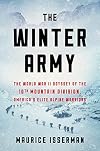
History Professor Maurice Isserman provides a fascinating chronicle of the U.S. Army's 10th Mountain Division, formed at the outset of World War II to serve as an alpine fighting force. Drawing largely from the soldiers' letters, diaries, and memoirs now housed in the 10th Mountain Division Archive at the Denver Public Library, Isserman brings the 10th to life from the inside.
Initial recruits were drawn from the ranks of championship skiers and mountain climbers, and they trained in the show more mountains of the American West. Isserman offers a treasure trove of engrossing information about how the army learned to equip and feed men for mountain warfare.
Although the skills of the 10th weren’t always used in actual combat, the men were able to draw upon their alpine training in the peaks of the North Apennines in Italy, where they moved “always forward” (their informal motto) to help drive the Germans from the Italian war theater. Isserman reports that “in terms of the percentage killed per day in combat, the 10th suffered the highest casualty rate of any US division in the campaign,” impressing both their American superiors and their German opponents with their skill and ferocity.
History buffs will delight in the way the 10th took Riva Ridge in the Apennines, using the same logic and techniques as the daring and unexpected ascent of the cliffs over the city of Quebec in 1759 by the British during the French and Indian War. There is pretty much never a dull moment in this account.
When the war was over, the surviving veterans of the 10th had no less interesting lives. Some of them went on to play leading roles in the outdoor winter sports industry. Isserman explains that “literally thousands of 10th veterans were employed one way or another, in the postwar ski industry,” whether as coaches, instructors, ski resort operators [both Aspen and Vail were developed as ski resorts by veterans], or ski equipment designers and promoters.
One veteran, told he would never walk again from his injuries in Italy, came to Aspen, resumed skiing, and in 1948 finished third in the giant slalom event at the US national ski competition. He and other veterans developed Vail, with ski runs named after men and events from the wartime experience of the 10th Division. "Riva Ridge" is one of the more challenging black diamond runs at the Vail Ski Resort today.
Evaluation: This unique and inspiring fighting force deserves to be better known. In addition to sharing their history, Isserman also includes a number of valuable insights from a wider perspective, such as about the role of momentum in war that can drive campaigns regardless of rational calculation; the importance of camaraderie in compensating for deficiencies in wartime; what “really” goes on under fire versus media accounts for the home audience; the rude awakening about the costs of war for the young men focused on adventure; and the sometimes selfish motives of the generals who determine their fate. The book excels as sports history as well. Photos and maps are included. I enjoyed it thoroughly! show less
Initial recruits were drawn from the ranks of championship skiers and mountain climbers, and they trained in the show more mountains of the American West. Isserman offers a treasure trove of engrossing information about how the army learned to equip and feed men for mountain warfare.
Although the skills of the 10th weren’t always used in actual combat, the men were able to draw upon their alpine training in the peaks of the North Apennines in Italy, where they moved “always forward” (their informal motto) to help drive the Germans from the Italian war theater. Isserman reports that “in terms of the percentage killed per day in combat, the 10th suffered the highest casualty rate of any US division in the campaign,” impressing both their American superiors and their German opponents with their skill and ferocity.
History buffs will delight in the way the 10th took Riva Ridge in the Apennines, using the same logic and techniques as the daring and unexpected ascent of the cliffs over the city of Quebec in 1759 by the British during the French and Indian War. There is pretty much never a dull moment in this account.
When the war was over, the surviving veterans of the 10th had no less interesting lives. Some of them went on to play leading roles in the outdoor winter sports industry. Isserman explains that “literally thousands of 10th veterans were employed one way or another, in the postwar ski industry,” whether as coaches, instructors, ski resort operators [both Aspen and Vail were developed as ski resorts by veterans], or ski equipment designers and promoters.
One veteran, told he would never walk again from his injuries in Italy, came to Aspen, resumed skiing, and in 1948 finished third in the giant slalom event at the US national ski competition. He and other veterans developed Vail, with ski runs named after men and events from the wartime experience of the 10th Division. "Riva Ridge" is one of the more challenging black diamond runs at the Vail Ski Resort today.
Evaluation: This unique and inspiring fighting force deserves to be better known. In addition to sharing their history, Isserman also includes a number of valuable insights from a wider perspective, such as about the role of momentum in war that can drive campaigns regardless of rational calculation; the importance of camaraderie in compensating for deficiencies in wartime; what “really” goes on under fire versus media accounts for the home audience; the rude awakening about the costs of war for the young men focused on adventure; and the sometimes selfish motives of the generals who determine their fate. The book excels as sports history as well. Photos and maps are included. I enjoyed it thoroughly! show less
Which Side Were You On?: The American Communist Party During the Second World War by Maurice Isserman
“The history of communism in America is bitterly contested terrain,” writes Maurice Isserman on the first page of his 1982 book. Nearly four decades later, it remains bitterly contested. Isserman falls into the category, I think, of historians who were open to re-examining the history of the American Communists, rejecting the overly-simplistic anti-Communist narratives that had been prevalent during the long decades of the Cold War (which was still raging in 1982).
But subsequent show more research, and in particular the opening of the Soviet archives following the collapse of the USSR, showed that the Cold Warriors had not in fact got it all wrong. The American Communists were, for many years, effectively a tool of Soviet foreign policy. The party was controlled by Moscow, was funded by it, took orders from it, and followed its lead even where it led the party into oblivion.
This should have been clear to Isserman even without access to those archives, as he devotes a considerable part of the book to the party’s darkest period – the nearly two years of the Hitler-Stalin Pact when Communists around the world were forced to focus their attacks on British imperialism, to turn down the volume when attacking Nazi Germany, and to make convoluted defences of Stalin’s decision to partner with Hitler in the division of Poland and much else.
One cannot help but read the story of the decline of the American Communists with sensing a certain sense of justice playing out. The party’s uber-leader, Earl Browder, whose portrait would hang side-by-side with those of Marx, Lenin and Stalin, was unceremoniously kicked out of the Party following yet another Moscow-ordered change on line after 1945. Browder’s rival, William Z. Foster (his enemies said the “Z” stood for “zig-zag”), then inheriting a party facing terminal decline.
A pity that Isserman has nothing to say about Marxist rivals to the Communist Party, not least of all the Trotskyists, particularly those who followed the leadership of Max Shachtman. He treats them with the same disdain as the Communists did, ignoring them completely. He doesn’t even mention what may have been Browder’s final appearance on a public stage, when in 1950 he finally agreed — now powerless and no longer with a Party to lead — to debate Shachtman in front of an audience of over 1,000 people.
At the end of Shachtman’s presentation he turned the face the former unchallenged leader of the American Stalinists and uttered these unforgettable words:
“When I saw him standing there at the podium, I said to myself: Rajk was the general secretary of the Hungarian Communist Party, and was shot, or hanged, or garrotted. Kostov was the general secretary of the Bulgarian Communist Party. And when I thought of what happened to them, I thought of the former secretary of the American Communist Party, and I said to myself: There – there but for an accident of geography, stands a corpse!" show less
But subsequent show more research, and in particular the opening of the Soviet archives following the collapse of the USSR, showed that the Cold Warriors had not in fact got it all wrong. The American Communists were, for many years, effectively a tool of Soviet foreign policy. The party was controlled by Moscow, was funded by it, took orders from it, and followed its lead even where it led the party into oblivion.
This should have been clear to Isserman even without access to those archives, as he devotes a considerable part of the book to the party’s darkest period – the nearly two years of the Hitler-Stalin Pact when Communists around the world were forced to focus their attacks on British imperialism, to turn down the volume when attacking Nazi Germany, and to make convoluted defences of Stalin’s decision to partner with Hitler in the division of Poland and much else.
One cannot help but read the story of the decline of the American Communists with sensing a certain sense of justice playing out. The party’s uber-leader, Earl Browder, whose portrait would hang side-by-side with those of Marx, Lenin and Stalin, was unceremoniously kicked out of the Party following yet another Moscow-ordered change on line after 1945. Browder’s rival, William Z. Foster (his enemies said the “Z” stood for “zig-zag”), then inheriting a party facing terminal decline.
A pity that Isserman has nothing to say about Marxist rivals to the Communist Party, not least of all the Trotskyists, particularly those who followed the leadership of Max Shachtman. He treats them with the same disdain as the Communists did, ignoring them completely. He doesn’t even mention what may have been Browder’s final appearance on a public stage, when in 1950 he finally agreed — now powerless and no longer with a Party to lead — to debate Shachtman in front of an audience of over 1,000 people.
At the end of Shachtman’s presentation he turned the face the former unchallenged leader of the American Stalinists and uttered these unforgettable words:
“When I saw him standing there at the podium, I said to myself: Rajk was the general secretary of the Hungarian Communist Party, and was shot, or hanged, or garrotted. Kostov was the general secretary of the Bulgarian Communist Party. And when I thought of what happened to them, I thought of the former secretary of the American Communist Party, and I said to myself: There – there but for an accident of geography, stands a corpse!" show less
“We called ourselves the Valley Cong. We took special pride in the fact that climbing rocks and icefalls had no economic value in society. We were rebels from the consumer culture.” [Yvon Choinard, about pursuing his métier in Yosemite Valley]
That quote is my favorite among the many interesting remarks found in Maurice Isserman’s Continental Divide: A History of American Mountaineering. The style of life to which Choinard alludes found its apotheosis in the late Fred Beckey, a show more mountaineering legend famous for his difficult personality and revered for his guidebooks and unwavering devotion to making first ascents during an ungodly number of his 93 “dirt bag” years. It doesn’t seem anyone felt much regret about committing to Choinard’s rebellious ethos and there might be a valuable lesson in that. I think so, though of course one should remember that the regretful, with their dissenting views, aren’t usually paid much attention in mountaineering books. Also, in life, ironies abound, and one is that Choinard created a company, Patagonia, whose products have whetted the ardor of many embracing consumerist culture.
This book goes back as far as 1642, with the first half devoted largely to the 19th century. Back then, Isserman tells us, “transcendentalist” philosophies and sensibilities were the rage and “sublime” was the nearly default adjective to describe nature and one’s experiences in it. It’d be nice to imitate these early nature lovers by calling Continental Divide sublime. The truth is it more often is like going through a stack of newspapers. That’s not bad. It has the merit of alerting us to much we might not know. An example is the author’s discussion of women who in the early years accomplished climbs that were notable achievements by any contemporaneous standard. So, while most readers seldom will feel themselves in the grip of great drama in this book, most everyone’s understanding of climbing’s history in America up into the early 1960s is sure to be enlarged. show less
That quote is my favorite among the many interesting remarks found in Maurice Isserman’s Continental Divide: A History of American Mountaineering. The style of life to which Choinard alludes found its apotheosis in the late Fred Beckey, a show more mountaineering legend famous for his difficult personality and revered for his guidebooks and unwavering devotion to making first ascents during an ungodly number of his 93 “dirt bag” years. It doesn’t seem anyone felt much regret about committing to Choinard’s rebellious ethos and there might be a valuable lesson in that. I think so, though of course one should remember that the regretful, with their dissenting views, aren’t usually paid much attention in mountaineering books. Also, in life, ironies abound, and one is that Choinard created a company, Patagonia, whose products have whetted the ardor of many embracing consumerist culture.
This book goes back as far as 1642, with the first half devoted largely to the 19th century. Back then, Isserman tells us, “transcendentalist” philosophies and sensibilities were the rage and “sublime” was the nearly default adjective to describe nature and one’s experiences in it. It’d be nice to imitate these early nature lovers by calling Continental Divide sublime. The truth is it more often is like going through a stack of newspapers. That’s not bad. It has the merit of alerting us to much we might not know. An example is the author’s discussion of women who in the early years accomplished climbs that were notable achievements by any contemporaneous standard. So, while most readers seldom will feel themselves in the grip of great drama in this book, most everyone’s understanding of climbing’s history in America up into the early 1960s is sure to be enlarged. show less
Lists
Awards


You May Also Like


Associated Authors
Statistics
- Works
- 18
- Also by
- 4
- Members
- 811
- Popularity
- #31,468
- Rating
- 4.1
- Reviews
- 12
- ISBNs
- 70
- Languages
- 1