
P. F. Clarke
Author of Hope and Glory: Britain 1900-2000
About the Author
Works by P. F. Clarke
The Last Thousand Days of the British Empire: Churchill, Roosevelt, and the Birth of the Pax Americana (2007) 251 copies, 3 reviews
Keynes: The Rise, Fall, and Return of the 20th Century's Most Influential Economist (2009) 120 copies, 17 reviews
Associated Works
The New History: The 1980s and Beyond (Studies in Interdisciplinary History) (1983) — Contributor — 17 copies
Tagged
Common Knowledge
- Legal name
- Clarke, Peter Frederick
- Birthdate
- 1942-07-21
- Gender
- male
- Occupations
- historian
- Organizations
- St John's College, Cambridge
- Nationality
- UK
- Birthplace
- Derbyshire, England, UK
- Associated Place (for map)
- England, UK
Members
Reviews

FWIW and from a non-economist's point of view. What attracts me to Keynes and this particular book about him is the ideas put forth of a kind of on the ground situational and pragmatic way of running an economy as opposed to the theoretical purist way of thinking of self correcting market based capitalism. As well my tendency is to look at corporations particularly multi-national ones with a great deal of suspicion. More or less this was a fact finding thing for me--though I'm fairly certain show more that the fact gathering from it is incomplete (which is not necessarily a criticism of the book but more my own unfamiliarity with technicalities of the field altogether). Keynes ideas distinct from say Friedman/Rand at least seem to argue for some kind of balance in wealth disparity which I consider necessary for a healthy society. Differences and distinctions aside individuals shouldn't become so wealthy that they become unreachable within the societies they've engendered from--and to go further that I believe firmly that any individual's right to amass wealth should not supersede the rights of the majority of people to make a living that allows them to buy a home and to raise a family. Keynes seemed to be going down the road of a broad society wide prosperity which is worth being commended for.
As for particular lessons that may be applied today in these depressed times--he believed acting pragmatically to forestall ill effects was important--that not acting at all and allowing things to run their course only made things worse. He believed taxes and spending projects on public works programs was a way of jumpstarting an economy back on the road to recovery. He believed that there was a time to set theory aside for action and that theory in any case is often blunted by situations and side effects peculiar to any give time and by nature are dependent on optimum conditions--have no way or device for calculating the chaotic ups and downs of life lived. He believed that government could have a positive impact on a people's economic lives and that programs such as public works were one way to do it. He believed the more people working the better off the society was--and I agree with all that.
As far as the book goes I had a bit of difficulty. I don't think Mr. Clarke was really all that technical as far as the subject matter goes but still for a novice on the subject such as myself it was still more than technical enough. The other thing was his British version of English at times had me reconstructing his sentences to try to get at what he was saying. In that respect I was glad that it was of fairly short length--180 pages--maybe not enough for someone else but plenty for me. I would recommend it though. The fact is I can be very opinionated about things I haven't really studied on all that much and so it was a little bit of fuel for the fire. show less
As for particular lessons that may be applied today in these depressed times--he believed acting pragmatically to forestall ill effects was important--that not acting at all and allowing things to run their course only made things worse. He believed taxes and spending projects on public works programs was a way of jumpstarting an economy back on the road to recovery. He believed that there was a time to set theory aside for action and that theory in any case is often blunted by situations and side effects peculiar to any give time and by nature are dependent on optimum conditions--have no way or device for calculating the chaotic ups and downs of life lived. He believed that government could have a positive impact on a people's economic lives and that programs such as public works were one way to do it. He believed the more people working the better off the society was--and I agree with all that.
As far as the book goes I had a bit of difficulty. I don't think Mr. Clarke was really all that technical as far as the subject matter goes but still for a novice on the subject such as myself it was still more than technical enough. The other thing was his British version of English at times had me reconstructing his sentences to try to get at what he was saying. In that respect I was glad that it was of fairly short length--180 pages--maybe not enough for someone else but plenty for me. I would recommend it though. The fact is I can be very opinionated about things I haven't really studied on all that much and so it was a little bit of fuel for the fire. show less
 This review was written for LibraryThing Early Reviewers.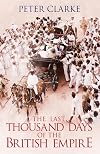
Did the Empire begin to fail with the loss of America? What about the Irish Easter Rising of 1916? Wasn’t that a strong signal that the end was nigh?… To this list so many, many other historical events that foretold the fall might be added, but this book ‘The Last Thousand Days of the British Empire’ by Peter Clarke concentrates on that last coda that saw out Britain’s great civilising force for good in the world (as the British saw it). Within that circumscription the author tries show more to select a few key nails that finally fixed the lid in place.
Peter Clarke chooses as the ‘last 1000 days’ the period from September 1944 until August 1947. That fateful September was the month that Churchill met Roosevelt in Quebec and admitted that Britain had no money to run its Empire. Other matters were discussed of course: the war was going well, military matters had to be decided and this was the conference where the partitioning of Germany, and other future political strategies, were agreed. But money matters took up a sizeable part of the proceedings. America had already forked out a lot of cash towards winning the war and the common grumble in the US was that the country was ‘being taxed of thousands of lives and billions of dollars to save the British Empire’. So it was that Churchill’s frank admission that Britain was financially broken that occupied most of the discussions. The outcome between the ‘co-equal’ allies was that the US Treasury was in effect given control over the British balance of payments by agreeing to extend the Lend-Lease arrangements, already in operation, into the post-war period. This then was the future: Britain and her Empire was in hock to the Americans, had been for some time and definitely was now, in the light of the agreements undertaken at that Quebec conference.
Moving onwards towards the very last of the ‘thousand days’, by December 1946 the writing was on the wall as regards the ‘jewel in the crown’ of the Empire, India. There ensued conferences and committees and hearings and parliamentary debates but the outcome was never in doubt and the date for British Departure from India finally was set for June 1948. In fact, power was handed over on 15 August 1947 and Peter Clarke sees this as the day the sun finally set on the British Empire. In his words:”The King had to get used to signing himself George R. and not George R. I., like his father. He did so a few days later in a letter to his mother, Queen Mary, who noted on the back of the envelope: ‘The first time Bertie wrote me a letter with the I for Emperor of India left out, very sad.’ “
Very sad indeed, And If the British had any shred of Churchillian self-delusion left as to being a ‘world power’ it was dispelled when they were lumped in with the rest of ’Europe’ by the Americans in the subsequent negotiations for aid from the Marshall Plan. There was to be no more trading as ‘The British Empire’, and no reference whatsoever was made to the ‘Special Relationship’ which Churchill believed had been built up between the Allies over the years prior to, and over the course of, the war. As far as President Truman was concerned his General, Marshall, was to deal with Britain as just another of those European countries which, now that America had won the war for them (again), had to be helped out of the financial hole they had dug for themselves.
A great read, even though the author strays a bit here and there and gives us rather more details of the various theatres of war than we really need to have. He is really, really good on conveying the personalities of the huge number and range of the politicians and apparatchiks involved in this great ‘winding down’ of Empire or, as some would say, reluctant withdrawal from other people’s countries. show less
Peter Clarke chooses as the ‘last 1000 days’ the period from September 1944 until August 1947. That fateful September was the month that Churchill met Roosevelt in Quebec and admitted that Britain had no money to run its Empire. Other matters were discussed of course: the war was going well, military matters had to be decided and this was the conference where the partitioning of Germany, and other future political strategies, were agreed. But money matters took up a sizeable part of the proceedings. America had already forked out a lot of cash towards winning the war and the common grumble in the US was that the country was ‘being taxed of thousands of lives and billions of dollars to save the British Empire’. So it was that Churchill’s frank admission that Britain was financially broken that occupied most of the discussions. The outcome between the ‘co-equal’ allies was that the US Treasury was in effect given control over the British balance of payments by agreeing to extend the Lend-Lease arrangements, already in operation, into the post-war period. This then was the future: Britain and her Empire was in hock to the Americans, had been for some time and definitely was now, in the light of the agreements undertaken at that Quebec conference.
Moving onwards towards the very last of the ‘thousand days’, by December 1946 the writing was on the wall as regards the ‘jewel in the crown’ of the Empire, India. There ensued conferences and committees and hearings and parliamentary debates but the outcome was never in doubt and the date for British Departure from India finally was set for June 1948. In fact, power was handed over on 15 August 1947 and Peter Clarke sees this as the day the sun finally set on the British Empire. In his words:”The King had to get used to signing himself George R. and not George R. I., like his father. He did so a few days later in a letter to his mother, Queen Mary, who noted on the back of the envelope: ‘The first time Bertie wrote me a letter with the I for Emperor of India left out, very sad.’ “
Very sad indeed, And If the British had any shred of Churchillian self-delusion left as to being a ‘world power’ it was dispelled when they were lumped in with the rest of ’Europe’ by the Americans in the subsequent negotiations for aid from the Marshall Plan. There was to be no more trading as ‘The British Empire’, and no reference whatsoever was made to the ‘Special Relationship’ which Churchill believed had been built up between the Allies over the years prior to, and over the course of, the war. As far as President Truman was concerned his General, Marshall, was to deal with Britain as just another of those European countries which, now that America had won the war for them (again), had to be helped out of the financial hole they had dug for themselves.
A great read, even though the author strays a bit here and there and gives us rather more details of the various theatres of war than we really need to have. He is really, really good on conveying the personalities of the huge number and range of the politicians and apparatchiks involved in this great ‘winding down’ of Empire or, as some would say, reluctant withdrawal from other people’s countries. show less
Keynes : The Rise, Fall, and Return of the 20th Century's Most Influential Economist by Peter Clarke
For readers with little or no prior knowledge of macroeconomics or John Maynard Keynes, this is not a bad place to start. British historian Peter Clarke has written an extended essay (at 180 pages, closer in style and content to a New Yorker profile than to a full-scale biography) that assesses the historical and contemporary significance of Keynes, his life, and his economic ideas. The writing is accessible and non-technical. Clarke's audience is educated readers who have heard of Keynes, show more particularly in the context of the current economic crisis, and wonder why this long-dead economist continues to be talked about.
I think Clarke succeeds in explaining Keynes's significance, but it's necessary to read the entire book to get the full picture. Clarke's introduction and first two chapters focus largely on the man, rather than his ideas. There's nothing wrong with that; Keynes was a fascinating individual. A cultural and intellectual giant in British society in the first half of the 20th century, he was a core member of the Bloomsbury crowd that included Virginia Woolf, Vanessa Bell, Lytton Stratchey and others; a philanthropist who used his earnings as a writer and financial speculator to support the arts; and a popular intellectual whose comments on public policy could not easily be ignored by governments in Britain (or even the United States) between the wars.
It's in the second half of the book (chapters three and four and an epilogue) that Clarke addresses the economic ideas and theories that made Keynes famous and influential. The going gets tougher here, but Clarke is dedicated to making Keynes's ideas as clear and understandable as Keynes did himself. The economic problem of the day, and the focus of Keynes's economic policy recommendations, was the high and persistent unemployment that plagued Britain throughout the interwar period. Clarke ranges across the body of Keynes's published work, rather than just “The General Theory of Employment, Interest, and Money” (1936), his most influential book, to trace the evolution of Keynes's thought.
Breaking with the laissez-faire economic orthodoxy of his day, which offered no solutions for unemployment, Keynes and his students developed a new, comprehensive model of the economy (creating the field that came to be known as macroeconomics) and demonstrated that the markets are not, in every case, self-correcting. Responding to severe shocks, markets eventually will find an equilibrium between supply and demand, but that equilibrium may be at a high level of unemployment. Increasing aggregate spending (investment and consumption) can reduce unemployment, but businesses and individuals, lacking confidence in the future growth of the economy, may choose instead to hold on to their money. Even reducing nominal interest rates to zero may not be enough to re-energize spending. Keynes, therefore, postulated a role for government, to stimulate spending through fiscal policy. His preference was investment in public works, though he did not rule out the usefulness of tax cuts and other measures to increase consumption.
Keynes's view that government can play a role in correcting market failures was heavily criticized in his day but ultimately became the new economic orthodoxy. In the first instance, his ideas received their warmest welcome in the United States, where a number of New Deal programs used federal spending to create jobs and stimulate investment. Roosevelt was not a Keynesian; his economic ideas, such as they were, were more in line with classical laissez-faire theories. But as Keynes recognized after meeting Roosevelt in 1934, the president's finely-honed political instincts told him that something must be done to address the country's severe economic problems, and he was willing to experiment and to adopt whatever policies worked to put people back to work. This appealed to Keynes, who also was not adverse to changing his mind and striking off in a new theoretical direction if a better solution to real problems was to be found there. Clarke suggests that this was perhaps one of Keynes's great strengths, though it opened him up to charges of inconsistency by his critics.
Since the severe inflation of the 1970s and the rise of Milton Friedman and various forms of laissez-faire economics, Keynesian ideas have lost considerable credibility with the (American) public. But there was little debate among economists and policy-makers in 2008-2009 about what to do when economies around the world were on the verge of catastrophe. Remembering what happened in the Great Depression, governments stepped in promptly to prevent the collapse of the financial system and keep credit moving. Subsequently, stimulus measures were enacted, as Keynes proposed, to raise aggregate spending, create jobs, and restore macroeconomic stability at a “normal” level of unemployment. As a result, unemployment reached the serious level of 10 percent, but got nowhere near the 25 percent rate the United States suffered at the height of the Great Depression. And the financial system did not collapse, as it did in 1933, raising hopes that the economy will not fall as far and as hard this time. The legacy of Keynes's economic analysis and policy prescriptions had more than a little to do with that.
Clarke only briefly touches on the implications of Keynes for modern economic policy. For more on that, and for a more in-depth examination of Keynes's economic theories in a brief form, see the new book by Keynes's major biographer, Robert Skidelsky, “Keynes: The Return of the Master” (2009). Of course, for a REALLY in-depth look at Keynes's life and work, see Skidelsky's monumental three-volume biography: “John Maynard Keynes: Hopes Betrayed, 1883-1920”; “John Maynard Keynes: The Economist as Saviour, 1920-1937”; and “John Maynard Keynes: Fighting for Freedom, 1937-1946” (1,658 pages in all). show less
I think Clarke succeeds in explaining Keynes's significance, but it's necessary to read the entire book to get the full picture. Clarke's introduction and first two chapters focus largely on the man, rather than his ideas. There's nothing wrong with that; Keynes was a fascinating individual. A cultural and intellectual giant in British society in the first half of the 20th century, he was a core member of the Bloomsbury crowd that included Virginia Woolf, Vanessa Bell, Lytton Stratchey and others; a philanthropist who used his earnings as a writer and financial speculator to support the arts; and a popular intellectual whose comments on public policy could not easily be ignored by governments in Britain (or even the United States) between the wars.
It's in the second half of the book (chapters three and four and an epilogue) that Clarke addresses the economic ideas and theories that made Keynes famous and influential. The going gets tougher here, but Clarke is dedicated to making Keynes's ideas as clear and understandable as Keynes did himself. The economic problem of the day, and the focus of Keynes's economic policy recommendations, was the high and persistent unemployment that plagued Britain throughout the interwar period. Clarke ranges across the body of Keynes's published work, rather than just “The General Theory of Employment, Interest, and Money” (1936), his most influential book, to trace the evolution of Keynes's thought.
Breaking with the laissez-faire economic orthodoxy of his day, which offered no solutions for unemployment, Keynes and his students developed a new, comprehensive model of the economy (creating the field that came to be known as macroeconomics) and demonstrated that the markets are not, in every case, self-correcting. Responding to severe shocks, markets eventually will find an equilibrium between supply and demand, but that equilibrium may be at a high level of unemployment. Increasing aggregate spending (investment and consumption) can reduce unemployment, but businesses and individuals, lacking confidence in the future growth of the economy, may choose instead to hold on to their money. Even reducing nominal interest rates to zero may not be enough to re-energize spending. Keynes, therefore, postulated a role for government, to stimulate spending through fiscal policy. His preference was investment in public works, though he did not rule out the usefulness of tax cuts and other measures to increase consumption.
Keynes's view that government can play a role in correcting market failures was heavily criticized in his day but ultimately became the new economic orthodoxy. In the first instance, his ideas received their warmest welcome in the United States, where a number of New Deal programs used federal spending to create jobs and stimulate investment. Roosevelt was not a Keynesian; his economic ideas, such as they were, were more in line with classical laissez-faire theories. But as Keynes recognized after meeting Roosevelt in 1934, the president's finely-honed political instincts told him that something must be done to address the country's severe economic problems, and he was willing to experiment and to adopt whatever policies worked to put people back to work. This appealed to Keynes, who also was not adverse to changing his mind and striking off in a new theoretical direction if a better solution to real problems was to be found there. Clarke suggests that this was perhaps one of Keynes's great strengths, though it opened him up to charges of inconsistency by his critics.
Since the severe inflation of the 1970s and the rise of Milton Friedman and various forms of laissez-faire economics, Keynesian ideas have lost considerable credibility with the (American) public. But there was little debate among economists and policy-makers in 2008-2009 about what to do when economies around the world were on the verge of catastrophe. Remembering what happened in the Great Depression, governments stepped in promptly to prevent the collapse of the financial system and keep credit moving. Subsequently, stimulus measures were enacted, as Keynes proposed, to raise aggregate spending, create jobs, and restore macroeconomic stability at a “normal” level of unemployment. As a result, unemployment reached the serious level of 10 percent, but got nowhere near the 25 percent rate the United States suffered at the height of the Great Depression. And the financial system did not collapse, as it did in 1933, raising hopes that the economy will not fall as far and as hard this time. The legacy of Keynes's economic analysis and policy prescriptions had more than a little to do with that.
Clarke only briefly touches on the implications of Keynes for modern economic policy. For more on that, and for a more in-depth examination of Keynes's economic theories in a brief form, see the new book by Keynes's major biographer, Robert Skidelsky, “Keynes: The Return of the Master” (2009). Of course, for a REALLY in-depth look at Keynes's life and work, see Skidelsky's monumental three-volume biography: “John Maynard Keynes: Hopes Betrayed, 1883-1920”; “John Maynard Keynes: The Economist as Saviour, 1920-1937”; and “John Maynard Keynes: Fighting for Freedom, 1937-1946” (1,658 pages in all). show less
This review was written for LibraryThing Early Reviewers.This biograhpy of John Maynard Keynes is a timely look at one of the most influential economists. Arguably, with the Chicago school in decline following the current recession and the abandonment or reconsideration of much of the Chicago school's thought, Keynes is the most respected economist of the modern age. Certainly, he is the source of much of the current thought on the need for government spending to restart economic growth.
The biographical portions of the book are the most show more interesting. Keynes led an interesting life both in academia and government. Clarke also gives us a sense of the remarkable circle of friends that Keynes enjoyed.
The explanation of Keynes's thought was less helpful. Clarke demonstrates aptly that Keynes said and wrote enough contradictory statements on economic theory to provide ammunition for arguments about who is the true Keynesian for decades. Thus, there is little in the way of a coherent course of action.
Clarke's book does an admirable job of detailing this giant of economic thought but ultimately fails to provide the reader with an understanding of what lessons we should have learned from him. show less
The biographical portions of the book are the most show more interesting. Keynes led an interesting life both in academia and government. Clarke also gives us a sense of the remarkable circle of friends that Keynes enjoyed.
The explanation of Keynes's thought was less helpful. Clarke demonstrates aptly that Keynes said and wrote enough contradictory statements on economic theory to provide ammunition for arguments about who is the true Keynesian for decades. Thus, there is little in the way of a coherent course of action.
Clarke's book does an admirable job of detailing this giant of economic thought but ultimately fails to provide the reader with an understanding of what lessons we should have learned from him. show less
This review was written for LibraryThing Early Reviewers.You May Also Like


Associated Authors
Statistics
- Works
- 12
- Also by
- 4
- Members
- 914
- Popularity
- #28,064
- Rating
- 3.7
- Reviews
- 21
- ISBNs
- 46
- Languages
- 2
