
Hal Hellman
Author of Great Feuds in Science: Ten of the Liveliest Disputes Ever
About the Author
Hal Hellman is the internationally acclaimed author of 26 popular science books, including the six-book series The World of the Future. He has also written science articles for such publications as the New York Times, Omni, Reader's Digest, Psychology Today, and Geo.
Works by Hal Hellman
The art and science of color 5 copies
The right size;: Why some creatures survive and others are extinct, (A Science survey book) (1968) 2 copies
Atomic particle detection 1 copy
Büyük Çekişmeler 1 copy
Energy and inertia 1 copy
Tagged
Common Knowledge
Members
Reviews

Thoroughly entertaining. The author has a style reminiscent of James Burke narrating the television series "Connections". I actually found myself laughing out loud at times, and it's a serious book. Despite that, the text is well researched and referenced with thirty-five pages of notes and bibliography. I was surprised to learn how much of scientific debate is really petty quarrelling and personality chafing. Looking back on it, I wonder why I was surprised. Regardless, there is a fair show more amount of actual science bandied back and forth, but it's not at a level that would jam an averagely intelligent person.
One bone to pick, though -- the last page of text. If the end of the chapter weren't on the recto of the leaf, I'd advise you to rip the page out entirely. The author advocates resolution by committee and not necessarily by a group of experts in the questioned field. It closes what otherwise was a very interesting read with drivel. I would have given the book a 4 star rating, but that Epilogue killed it. show less
One bone to pick, though -- the last page of text. If the end of the chapter weren't on the recto of the leaf, I'd advise you to rip the page out entirely. The author advocates resolution by committee and not necessarily by a group of experts in the questioned field. It closes what otherwise was a very interesting read with drivel. I would have given the book a 4 star rating, but that Epilogue killed it. show less
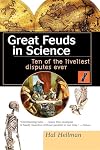
In explaining scientific arguments, Hellman has to provide enough scientific and historical background to make the dispute clear while simultaneously keeping his explanation understandable to laymen. He does a pretty good job. I can't be objective about this book: I know some science too well and others I find horribly intimidating. For example, I found the chapter on calculus and philosophy (Newton vs. Leibniz) to be a bit obtuse, but the chapter on Darwin very simplified. My bias is clear! show more I think my favorite chapters were on continental drift, heliocentrism, and paleoanthropology. show less
Science is a messy place, and what we know to be true today might not be true tomorrow. There are arguments raging in science even today (and I don't mean faux arguments like climate change deniers). This book attempts to give an overview of some of the most famous shifts in science thinking.
Some of these aren't feuds in the way that we would understand the word, since feuds usually require all of the involved parties to still be alive. Several of these are scientists working to show that show more the previous understanding wasn't accurate. There are some honest-to-goodness feuds to be found here, and those are the most interesting reading, to see where scientists let emotion overrule their data.
The book suffers from the flaw of 20/20 hindsight. Now, many years removed from most of the feuds presented herein, the feuds lose their sense that there was ever actually anything to argue about. The author makes the old arguments seem ignorant and flawed, instead of helping us understand how they were the best scientific knowledge available at the time. Later, with better instruments and a better ability to create experiments.
It's a good enough overview, but none of the feuds really held my attention. show less
Some of these aren't feuds in the way that we would understand the word, since feuds usually require all of the involved parties to still be alive. Several of these are scientists working to show that show more the previous understanding wasn't accurate. There are some honest-to-goodness feuds to be found here, and those are the most interesting reading, to see where scientists let emotion overrule their data.
The book suffers from the flaw of 20/20 hindsight. Now, many years removed from most of the feuds presented herein, the feuds lose their sense that there was ever actually anything to argue about. The author makes the old arguments seem ignorant and flawed, instead of helping us understand how they were the best scientific knowledge available at the time. Later, with better instruments and a better ability to create experiments.
It's a good enough overview, but none of the feuds really held my attention. show less
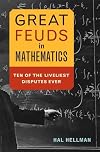
Newton vs Leibniz, Kronecker vs Cantor, Brouwer vs Hilbert, etc, provide an enjoyable way of covering some math concepts and history. Not many equations. The errors I noticed were in the chapter on the Axiom of Choice.
Awards


You May Also Like


Associated Authors
Statistics
- Works
- 29
- Members
- 561
- Popularity
- #44,551
- Rating
- 3.6
- Reviews
- 6
- ISBNs
- 40
- Languages
- 6