
James Burnham (1905–1987)
Author of The Machiavellians: Defenders of Freedom
About the Author
James Burnham (1905-1987) began his career as a professor of philosophy at New York University. He co-founded, with William F. Buckley. Jr., The National Review Michael Henry received his advanced degree in political theory. He has been teaching philosophy at St. John's University in New York since show more 1977 show less
Image credit: Marxists.org
Works by James Burnham
Associated Works
On the Firing Line: The Public Life of Our Public Figures (1989) — Contributor — 126 copies, 1 review
Did You Ever See a Dream Walking? American Conservative Thought in the Twentieth Century (1970) — Contributor — 86 copies
Tagged
Common Knowledge
- Other names
- West, John
- Birthdate
- 1905-11-22
- Date of death
- 1987-07-28
- Gender
- male
- Education
- Canterbury School, New Milford, Connecticut, USA
Princeton University (English)
University of Oxford (Balliol College) - Occupations
- professor
philosopher
editor
essayist - Organizations
- National Review
Socialist Workers Party
Partisan Review
American Workers Party
New York University
Office of Strategic Services (show all 8)
The Freeman
Symposium - Awards and honors
- Presidential Medal of Freedom (1983)
Richard M. Weaver Award (1983) - Nationality
- USA
- Birthplace
- Chicago, Illinois, USA
- Place of death
- Kent, Connecticut, USA
- Associated Place (for map)
- USA
Members
Reviews
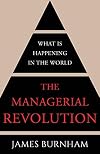
I am blown away by this book. The logic is solid and well laid out. (Orwell mimics this book in 1984 as the Goldstein text.) The Managerial Revolution was written in 1941; Orwell’s 1984 was written in 1948. Orwell, an opponent of hierarchies in general, reviewed it negatively when it came out but was obviously deeply affected by it.
Burnham makes the argument that society has evolved, inevitably, and naturally, from feudalism to capitalism, and is now heading forward into show more “managerialism” (not his phrasing) a process that began with WWI. This all happened despite the adamant (and “logical”) predictions for socialism. Russia’s government, for example, proved that socialism is not the inevitable step forward for societies evolving away from capitalism - Russia quickly became a heavily managed economy, and stayed there. American society also became much more “managerial” with the New Deal, and could not function without its “institutions”. The American government is clearly the largest employer that has ever existed. Bureaucracies have become the de facto rulers.
As feudal lords and monarchs ceded control to the capitalists, capitalists will cede control to the managers, corporate or government.
Mind-blowing. Revolutionary. show less
Burnham makes the argument that society has evolved, inevitably, and naturally, from feudalism to capitalism, and is now heading forward into show more “managerialism” (not his phrasing) a process that began with WWI. This all happened despite the adamant (and “logical”) predictions for socialism. Russia’s government, for example, proved that socialism is not the inevitable step forward for societies evolving away from capitalism - Russia quickly became a heavily managed economy, and stayed there. American society also became much more “managerial” with the New Deal, and could not function without its “institutions”. The American government is clearly the largest employer that has ever existed. Bureaucracies have become the de facto rulers.
As feudal lords and monarchs ceded control to the capitalists, capitalists will cede control to the managers, corporate or government.
Mind-blowing. Revolutionary. show less

The amazing thing about this work is how icily cold-blooded it is. There is no sentiment here. For example, consider the cliche that more education is the answer to most (or all) problems. I always swallowed that one uncritically. It seems so reasonable on a superficial examination. Thinking, instead of emoting, Burnham points out that the most aggressive and destructive nations have been some of the best-educated, Germany and Russia being obvious 20th century examples. And let's not get show more started on France. If you're a liberal and you like your cliches unexamined in light of the facts, do not read this book; it will give you nightmares.
For me, it was refreshing because he plows through hallowed cliches, warm, pink, fuzzy, feel-good, everybody-hug cliches, with a bulldozer. No one will agree with everything here (some of it is just silly), but it's a bracing breath of fresh air. show less
For me, it was refreshing because he plows through hallowed cliches, warm, pink, fuzzy, feel-good, everybody-hug cliches, with a bulldozer. No one will agree with everything here (some of it is just silly), but it's a bracing breath of fresh air. show less
This is an excellent book, overall. If you are a political scientist, then this must be on your shelf, and you must read it. He followed a path of strict realism when writing this book and, some may even say, he imbued the text with a small degree of cynicism. There is no woolly-headed philosophy in the book: just political science as he sees it.
I was not always clear about his definition of a manager. Does he refer to corporate managers or bureaucrats, or does he refer to the core team show more around political leaders? This is not always clear. show less
I was not always clear about his definition of a manager. Does he refer to corporate managers or bureaucrats, or does he refer to the core team show more around political leaders? This is not always clear. show less

Ένα εξαιρετικά επικίνδυνο βιβλίο. Η προσέγγιση των ιδεών που πραγματεύεται απαιτεί από τον αναγνώστη μεγάλη προσοχή και κριτική σκέψη. Κατά τη γνώμη μου δεν θα πρέπει να είναι ένα από τα πρώτα βιβλία πολιτικής φιλοσοφίας που αποφασίζει να διαβάσει κάποιος.
Lists
Awards


You May Also Like


Associated Authors
Statistics
- Works
- 23
- Also by
- 6
- Members
- 914
- Popularity
- #28,064
- Rating
- 3.8
- Reviews
- 10
- ISBNs
- 45
- Languages
- 4
- Favorited
- 5