
Margaret Bloy Graham (1920–2015)
Author of Be Nice to Spiders
About the Author
Margaret Bloy Graham was born on November 2, 1920 in Toronto, Canada. After receiving a B.A. in art history from the University of Toronto in 1942, she moved to New York City to start her career. She worked at Conde Nast and did freelance projects as a designer and illustrator. In 1948, she married show more George Zion and they began collaborating on children's book projects. Their first title, All Falling Down, was published in 1951. They produced 13 books as a team before they divorced in 1966, including the Harry the Dirty Dog adventures. Their title, All Falling Down, won a Caldecott Honor in 1952. Graham's illustrations for Charlotte Zolotow's The Storm Book received a Caldecott Honor in 1953. She wrote and illustrated Be Nice to Spiders and three titles starring Benjy the dog. She also illustrated What If? and It's Spring, both written by Else Minarik. She died on January 22, 2015 at the age of 94. (Bowker Author Biography) show less
Image credit: via slj.com
Series
Works by Margaret Bloy Graham
Be Nice to Spiders 1 copy
Associated Works
Harry and the lady next door [and] Harry comes home — Illustrator — 1 copy
Tagged
Common Knowledge
- Birthdate
- 1920-11-02
- Date of death
- 2015-01-22
- Gender
- female
- Education
- University of Toronto
- Occupations
- illustrator
children's book author - Organizations
- Condé Nast
- Relationships
- Zion, Gene (husband)
Holmes, Oliver Wendell (second husband) - Nationality
- Canada
- Birthplace
- Toronto, Ontario, Canada
- Places of residence
- Toronto, Ontario, Canada
- Place of death
- Belmont, Massachusetts, USA
- Associated Place (for map)
- Ontario, Canada
Members
Reviews
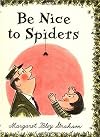
Be Nice to Spiders by Margaret Bloy Graham is an older title, but it still serves as a valuable lesson, with the theme that even the smallest creature can have a big impact on the world around them. The book reminds young readers to respect nature and its processes, as well as reassures them that though they themselves are small, they have the potential to do important things.
Helen the spider is our protagonist and I would argue that if we treat Helen as the "person" she's stuck in a show more person-against-society conflict. She's not just up against one person, nor is she battling with herself. She's up against society's attitude about—and actions toward—spiders. They see her as a pest, rather than seeing her contribution to the zoo. The resolution comes with the zookeeper's (and the zoo community's) character development, challenging and changing the way they view Helen and coming to realize her value.
The illustrations are drawn in a cartoon art style and are very detailed; the expressions of the animals add depth to the story. The contrast between the animals’ agitation and distress when the flies are buzzing around them and their peaceful expressions after Helen clears out all of the flies, makes the problem (and Helen’s value) easy to see and understand for young readers.
What stood out most to me was the message that every part of our ecosystem, even creatures that we might consider icky or scary, have important roles. It’s a reminder that we all belong, and we each have something to contribute to the world around us.
I think this book is probably most well-suited for children between the ages of 4 and 6. It might be a bit too slow for a child much older than that, and too complex for a child much younger. I appreciated that the author didn’t shy away from using bigger words such as “ventilator,” “contented,” and “irritable,” since their inclusion can help a young reader develop a richer vocabulary.
Overall, I loved this book. It’s well thought out, fun, and informative. show less
Helen the spider is our protagonist and I would argue that if we treat Helen as the "person" she's stuck in a show more person-against-society conflict. She's not just up against one person, nor is she battling with herself. She's up against society's attitude about—and actions toward—spiders. They see her as a pest, rather than seeing her contribution to the zoo. The resolution comes with the zookeeper's (and the zoo community's) character development, challenging and changing the way they view Helen and coming to realize her value.
The illustrations are drawn in a cartoon art style and are very detailed; the expressions of the animals add depth to the story. The contrast between the animals’ agitation and distress when the flies are buzzing around them and their peaceful expressions after Helen clears out all of the flies, makes the problem (and Helen’s value) easy to see and understand for young readers.
What stood out most to me was the message that every part of our ecosystem, even creatures that we might consider icky or scary, have important roles. It’s a reminder that we all belong, and we each have something to contribute to the world around us.
I think this book is probably most well-suited for children between the ages of 4 and 6. It might be a bit too slow for a child much older than that, and too complex for a child much younger. I appreciated that the author didn’t shy away from using bigger words such as “ventilator,” “contented,” and “irritable,” since their inclusion can help a young reader develop a richer vocabulary.
Overall, I loved this book. It’s well thought out, fun, and informative. show less
I can't help but admire how nonchalantly this one wears its hypocrisy and self-interest on its shoulder--be nice to the spiders because they eat the flies; and as for the flies, fuck them, they taste good.
I almost gave 4 stars instead of 5 because Helen is a cartoony spider instead of more naturalistic however I know some people (me) get The Ick looking at spiders so this is a nice way to learn without manyeyesmanylegsfangs
I’m Team No Spiders but this is a good book for learning and discussing.
However
I’m Team No Spiders but this is a good book for learning and discussing.
However
summary: In this book, a boy drops a spider (in a box) off at the steps of the zoo. The spider ends up escaping the box and going into the buildings with the zoo animals. There are a bunch of flies all around and the spider makes a web to catch them all! The book is great to explain how spiders are useful to us.
reflection: I am not a fan of spiders, personally. After reading this book, I realized how useful spiders are in the world. Although I don't really like sharing my personal space with show more spiders, maybe keeping them around sometimes isn't such a bad idea. I liked the idea in the book that there's one spider that is keeping the whole zoo free from flies. That was funny and sounds like a hard job for just one little creature! show less
reflection: I am not a fan of spiders, personally. After reading this book, I realized how useful spiders are in the world. Although I don't really like sharing my personal space with show more spiders, maybe keeping them around sometimes isn't such a bad idea. I liked the idea in the book that there's one spider that is keeping the whole zoo free from flies. That was funny and sounds like a hard job for just one little creature! show less
Lists
You May Also Like


Associated Authors
Statistics
- Works
- 8
- Also by
- 21
- Members
- 1,995
- Popularity
- #12,901
- Rating
- 4.0
- Reviews
- 18
- ISBNs
- 26
- Languages
- 1