
Pat Frank (1908–1964)
Author of Alas, Babylon
About the Author
Disambiguation Notice:
Born Harry Hart.
Image credit: Courtesy of the NYPL Digital Gallery (image use requires permission from the New York Public Library)
Works by Pat Frank
The long way round 2 copies
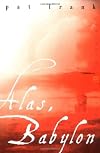
alas, baylon 1 copy
Associated Works
Tagged
Common Knowledge
- Legal name
- Frank, Harry Hart
- Birthdate
- 1907-05-05
- Date of death
- 1964-10-12
- Gender
- male
- Occupations
- journalist
government consultant - Organizations
- Jacksonville Journal
New York World
New York Evening Journal
Washington Times-Herald
United States Office of War Information - Short biography
- "Pat Frank" was the lifelong nickname adopted by the American writer, newspaperman, and government consultant, who was born Harry Hart Frank (1908-1964), and who is remembered today almost exclusively for his post-apocalyptic novel Alas, Babylon. Before the publication of his first novel Mr. Adam launched his second career as novelist and independent writer, Frank spent many years as a journalist and information handler for several newspapers, agencies, and government bureaus. His fiction and nonfiction books, stories, and articles made good use of his years of experience observing government and military bureaucracy and its malfunctions, and the threat of nuclear proliferation and annihilation. After the success of Alas, Babylon, Frank concentrated on writing for magazines and journals, putting his beliefs and concerns to political use, and advising various government bodies. In 1960 he served as a member of the Democratic National Committee. In 1961, the year in which he received an American Heritage Foundation Award, he was consultant to the National Aeronautics and Space Council. From 1963 through 1964 the Department of Defense made use of Frank's expertise and advice, and this consultancy turned out to be his last response to his country's call. His other books include Mr. Adam and Forbidden Area.
- Cause of death
- alcoholism
- Nationality
- USA
- Birthplace
- Chicago, Illinois, USA
- Places of residence
- Tangerine, Florida, USA
- Place of death
- Jacksonville, Florida, USA
- Disambiguation notice
- Born Harry Hart.
- Associated Place (for map)
- Florida, USA
Members
Discussions
Group Read - Alas Babylon in The 11 in 11 Category Challenge (June 2011)
Reviews

After nuclear war devastates the United States, the survivors in a small Florida town must work together to rebuild civilization in the first post-apocalyptic tale of the nuclear age.
In rereading Alas, Babylon, I find that it holds up very well as a post-apocalyptic survival story. It is very much a product of its time, in that I don't think this kind of story could have occurred at any other point than the height of the Cold War. It may seem problematic in its portrayal of women and African show more Americans, but I think for the time it was quite progressive. It was published when separate but equal was the rule in the South, and points out that separation of the races makes no sense when everyone's contributions are needed to keep civilization going. It's true that the African-American characters aren't as nuanced as modern readers would expect, but that didn't distract me from the gist of the story. As for the women, this is not a feminist book, but the women are free agents who can act without the permission of the men. The librarian character was particularly pro-active, finding solutions that the doctor hadn't even thought of and ensuring that the free exchange of ideas and knowledge would continue post-apocalypse.
At one point as I was reading this, when the narrator was worrying about the problem of salt, it occurred to me that it wasn't that long ago when all men and women lived this way. That is, without the benefits of electricity or automobiles or antibiotics. Every day was a gamble, but still, people kept on, despite not enjoying the level of security and control over our lives that we have. The real point of Alas, Babylon is how fragile our modern civilization is, yet we depend on it so much; it could all be wiped out in an instant. We almost forget how resilient and resourceful humans can be. Rereading Alas, Babylon is a good reminder of what we take for granted. show less
In rereading Alas, Babylon, I find that it holds up very well as a post-apocalyptic survival story. It is very much a product of its time, in that I don't think this kind of story could have occurred at any other point than the height of the Cold War. It may seem problematic in its portrayal of women and African show more Americans, but I think for the time it was quite progressive. It was published when separate but equal was the rule in the South, and points out that separation of the races makes no sense when everyone's contributions are needed to keep civilization going. It's true that the African-American characters aren't as nuanced as modern readers would expect, but that didn't distract me from the gist of the story. As for the women, this is not a feminist book, but the women are free agents who can act without the permission of the men. The librarian character was particularly pro-active, finding solutions that the doctor hadn't even thought of and ensuring that the free exchange of ideas and knowledge would continue post-apocalypse.
At one point as I was reading this, when the narrator was worrying about the problem of salt, it occurred to me that it wasn't that long ago when all men and women lived this way. That is, without the benefits of electricity or automobiles or antibiotics. Every day was a gamble, but still, people kept on, despite not enjoying the level of security and control over our lives that we have. The real point of Alas, Babylon is how fragile our modern civilization is, yet we depend on it so much; it could all be wiped out in an instant. We almost forget how resilient and resourceful humans can be. Rereading Alas, Babylon is a good reminder of what we take for granted. show less
This was more fascinating as a time capsule than as a book. What did people who actually lived through the height of the Cold War imagine a nuclear exchange and aftermath would look like? Most depictions we're familiar with come from the latter part of the war, the 70s and 80s, bleak portrayals inspired by nuclear accidents and better models for what mass nuclear fallout looks like, bigger stockpiles of higher yield weapons at that.
Alas, Babylon doesn't describe that bleak radioactive show more hellscape; instead, while a lot of people close to military sites die, life keeps rolling along afterwards. Society's reliance on technology is on the order of radios and telephones, not integral to every part of existence. Electric washing machines are still a luxury item, primitive hand cranked tools are still all around. There are looters and thieves, but no roaming bands of raiders or people reduced to cannibalism because nature is dying or toxic.
Perhaps the most dated part of the book is the characters who appear like thin stereotypes to a modern reader. The cultural biases of the 50s abound in the depiction of women and some race relations. For a nuclear apocalypse where good hearted people can shrug their shoulders and put their back into rebuilding, this is it. show less
Alas, Babylon doesn't describe that bleak radioactive show more hellscape; instead, while a lot of people close to military sites die, life keeps rolling along afterwards. Society's reliance on technology is on the order of radios and telephones, not integral to every part of existence. Electric washing machines are still a luxury item, primitive hand cranked tools are still all around. There are looters and thieves, but no roaming bands of raiders or people reduced to cannibalism because nature is dying or toxic.
Perhaps the most dated part of the book is the characters who appear like thin stereotypes to a modern reader. The cultural biases of the 50s abound in the depiction of women and some race relations. For a nuclear apocalypse where good hearted people can shrug their shoulders and put their back into rebuilding, this is it. show less
Now, this is why I like being in a book group. This novel has never, ever been on my radar. Never showed up on "recommended" lists, or been in any of my acquaintances' top-tens. So, good ole book group: Alas, Babylon!
Not a book to jump and down and shout about, but I thoroughly enjoyed this read. It holds up remarkably well - published in 1959, there is a lot of opportunity for this book to feel dated. That doesn't happen much, here, though.
Yes, gender roles in this novel are old-fashioned. show more That said, the women easily contribute as much as the men, perhaps more... women are just not to be called upon for anything that's physically dangerous. And yes, the women defer much too quickly for my 21st century sensibilities. While this novel does not go out of its way to denigrate women, it does reflect the less-than-equal era it was born in.
Similarly, race issues are old-fashioned. Pat Frank does not go along with the idea that races are fundamentally unbalanced or should be segregated; in fact, in several instances the text acknowledges that once survival is the main focus people (good people, at least) must start considering each other for what they contribute, not the color of their skin. I think this is significant, since segregated water fountains were legal until 1964.
The fact that the black characters still defer to Randy after it's clear that they're easily pulling more than their own weight (a fact which the main character notes, appreciates, and attempts to balance), they still use deferential language. Again, my 21st century mind struggled a bit on that - I ended up deciding to view it as a habit; communication styles wouldn't change as quickly as the reality of life - so habitual patterns of deference would hardly change in a day.
This not an overly complex novel; it's a survival story with a moral code. The good guys win. The bad guys don't. There are losses, of course, but in the end the town of Fort Repose creates its own little oasis in the middle of world war, chaos, and nuclear fallout.
Highly recommended read. show less
Not a book to jump and down and shout about, but I thoroughly enjoyed this read. It holds up remarkably well - published in 1959, there is a lot of opportunity for this book to feel dated. That doesn't happen much, here, though.
Yes, gender roles in this novel are old-fashioned. show more That said, the women easily contribute as much as the men, perhaps more... women are just not to be called upon for anything that's physically dangerous. And yes, the women defer much too quickly for my 21st century sensibilities. While this novel does not go out of its way to denigrate women, it does reflect the less-than-equal era it was born in.
Similarly, race issues are old-fashioned. Pat Frank does not go along with the idea that races are fundamentally unbalanced or should be segregated; in fact, in several instances the text acknowledges that once survival is the main focus people (good people, at least) must start considering each other for what they contribute, not the color of their skin. I think this is significant, since segregated water fountains were legal until 1964.
The fact that the black characters still defer to Randy after it's clear that they're easily pulling more than their own weight (a fact which the main character notes, appreciates, and attempts to balance), they still use deferential language. Again, my 21st century mind struggled a bit on that - I ended up deciding to view it as a habit; communication styles wouldn't change as quickly as the reality of life - so habitual patterns of deference would hardly change in a day.
This not an overly complex novel; it's a survival story with a moral code. The good guys win. The bad guys don't. There are losses, of course, but in the end the town of Fort Repose creates its own little oasis in the middle of world war, chaos, and nuclear fallout.
Highly recommended read. show less

Perhaps the most well-balanced of the 1950s post-apocalyptic fiction boom, Pat Frank's Alas, Babylon is certainly a fine counterpart to the meticulous apocalyptic saga Earth Abides by George R. Stewart and the more mundane and literary On the Beach by Nevil Shute (I've not yet read A Canticle for Leibowitz, the other oft-mentioned title in this company). Whereas those other books have their odd elements that the reader has to push through in order to appreciate them, Alas, Babylon is the show more closest to being a crowd-pleaser. That is, if 'crowd-pleaser' is something you can say about the depiction of a nuclear holocaust and its aftermath, something that was terrifyingly plausible to Frank's first generation of readers.
On such a, well, apocalyptic scale, Frank's book works because it invests in its characters. Though sometimes a bit obvious in its drivers and its flashpoints (leadership pressures, food, security, companionship), these character conflicts work. We invest in Randy Bragg's rise to become leader of his isolated community; we share Mark's fatalism as the impending nuclear war enters its first stages; we even care about Dan's medical tools and Alice's travails at the library. Each of the characters, even the minor ones and the minors (i.e. the children), get their moments to shine, and we get PoV chapters from them to help with this. The big moments are well-staged and well-written, and the small details (such as the message from Jacksonville stopping instantaneously (pg. 112)) can be disturbing. Horror and hope and everything in between are delivered ably by the author.
If Alas, Babylon sometimes feels routine in its reading, it's because the post-apocalyptic genre has been done to death since Frank's book was published in 1959. This can hardly be said to be a mark against the book, for Alas, Babylon is one of the originators of all those tropes: the sober gut-punch of the nuclear flash as the world ends; the survivalist tropes of getting clean water and sustainable food; the problems of defending against bandits; the sense of purpose as unlikely candidates rise to the challenge of rebuilding their community.
The author's background as a journalist and political commentator sometimes comes through. Frank intended the book to be a public service, a warning against atomic brinkmanship and M.A.D., as well as a basic guidebook on how to prepare for the aftermath, how to find a good water source and be aware of radiation and so on. To this end, certain passages can feel didactic, with Frank directing the story towards scenes where his characters can become his mouthpiece, delivering a pointed opinion or educatory example. That said, this never grates, for Frank has invested in his characters and his writing ability is enough to smooth the edges of these inserts and asides.
When you take a step back, the book can look quite unremarkable, but when you are turning its pages you appreciate every moment of it. It is an easy, character-driven story that also gets across the strange horror of atomic destruction and the regenerative hope that can be found in the people who survive it. Whereas most post-apocalyptic stories focus on the misery, the destruction and the degeneration of law and order, Alas, Babylon argues that "the world changes… [but] people don't" (pg. 197). For all that the book can seem routine in retrospect, it is this optimistic tack which places it on a different footing to all the post-apocalyptic imitators that came after it. show less
On such a, well, apocalyptic scale, Frank's book works because it invests in its characters. Though sometimes a bit obvious in its drivers and its flashpoints (leadership pressures, food, security, companionship), these character conflicts work. We invest in Randy Bragg's rise to become leader of his isolated community; we share Mark's fatalism as the impending nuclear war enters its first stages; we even care about Dan's medical tools and Alice's travails at the library. Each of the characters, even the minor ones and the minors (i.e. the children), get their moments to shine, and we get PoV chapters from them to help with this. The big moments are well-staged and well-written, and the small details (such as the message from Jacksonville stopping instantaneously (pg. 112)) can be disturbing. Horror and hope and everything in between are delivered ably by the author.
If Alas, Babylon sometimes feels routine in its reading, it's because the post-apocalyptic genre has been done to death since Frank's book was published in 1959. This can hardly be said to be a mark against the book, for Alas, Babylon is one of the originators of all those tropes: the sober gut-punch of the nuclear flash as the world ends; the survivalist tropes of getting clean water and sustainable food; the problems of defending against bandits; the sense of purpose as unlikely candidates rise to the challenge of rebuilding their community.
The author's background as a journalist and political commentator sometimes comes through. Frank intended the book to be a public service, a warning against atomic brinkmanship and M.A.D., as well as a basic guidebook on how to prepare for the aftermath, how to find a good water source and be aware of radiation and so on. To this end, certain passages can feel didactic, with Frank directing the story towards scenes where his characters can become his mouthpiece, delivering a pointed opinion or educatory example. That said, this never grates, for Frank has invested in his characters and his writing ability is enough to smooth the edges of these inserts and asides.
When you take a step back, the book can look quite unremarkable, but when you are turning its pages you appreciate every moment of it. It is an easy, character-driven story that also gets across the strange horror of atomic destruction and the regenerative hope that can be found in the people who survive it. Whereas most post-apocalyptic stories focus on the misery, the destruction and the degeneration of law and order, Alas, Babylon argues that "the world changes… [but] people don't" (pg. 197). For all that the book can seem routine in retrospect, it is this optimistic tack which places it on a different footing to all the post-apocalyptic imitators that came after it. show less
Lists
Page Turners (1)
Sonlight Books (1)
Best Dystopias (1)
Unread books (1)
Southern Fiction (1)
Awards


You May Also Like


Associated Authors
Statistics
- Works
- 14
- Also by
- 5
- Members
- 5,944
- Popularity
- #4,153
- Rating
- 4.0
- Reviews
- 166
- ISBNs
- 53
- Languages
- 1
- Favorited
- 9